
A real movie night room at home comes down to 5 things working together: a screen sized to where you sit, sound that surrounds the couch, lights and shades that set the mood on their own, one remote anyone can use, and a team that makes sure it all just works. Get those right and your family room feels like the best seat in a theater, every night of the week.
Want Ryan to look at your room? Call (973) 945-5275 or text Ryan. You can also see the full 98-inch Sony movie night room we are building for families this season.
In this guide
- Screen size and seating distance
- Why 98 inches: the Sony BRAVIA 5
- Sound with Triad and McIntosh power
- Lights and shades for movie night
- One remote anyone in the house can use
- The holiday timeline
- Football Sundays and the Big Game
- Movie night room questions
- Meet Ryan
What screen size fits your room, and how far away should you sit?
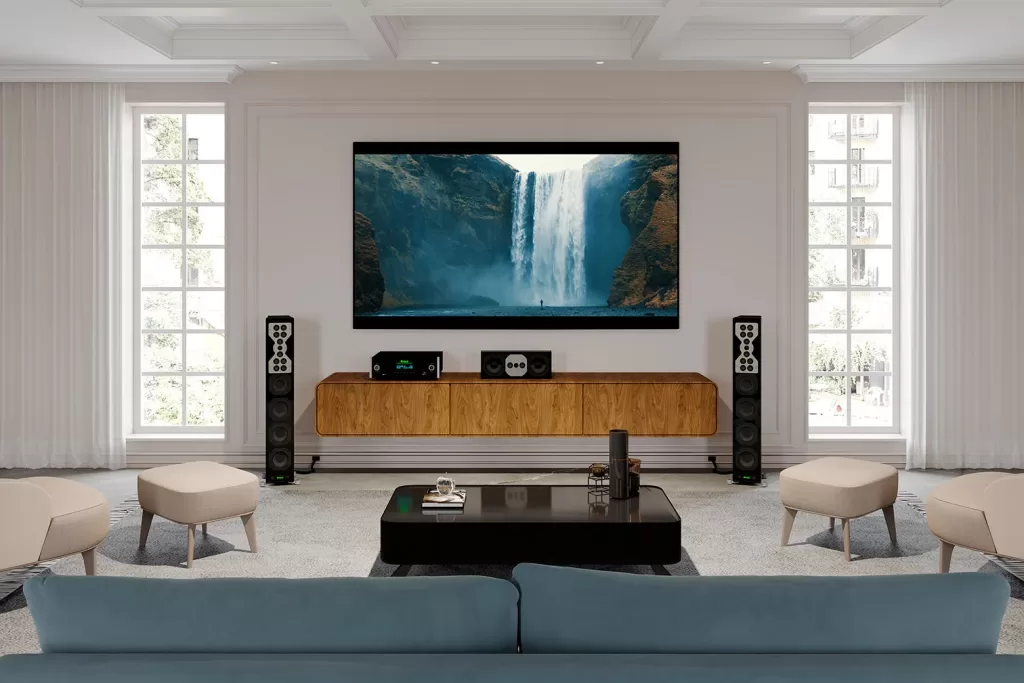
The right screen size depends on how far your main seat is from the wall. For a 98-inch screen, that sweet spot is roughly 10 to 13 feet. Closer than that and you start turning your head. Farther back and the screen shrinks into an ordinary TV.
The reason is the viewing angle, meaning how much of your field of view the picture takes up. Film industry guidelines from SMPTE call for the screen to fill at least about 30 degrees of your view from the seat. THX, the group that certifies cinemas, recommends about 40 degrees for a more immersive feel. Those 2 numbers are the bookends we design between.
Here is how the math works on the Sony BRAVIA 5 98-inch. Its picture measures 97.5 inches corner to corner, which makes the image itself about 85 inches wide. To fill 40 degrees of your view, the seat lands about 9 feet 9 inches from the screen. To fill 30 degrees, it lands about 13 feet 3 inches away. Most family rooms we see in Morris and Bergen County homes put the sofa right inside that window.
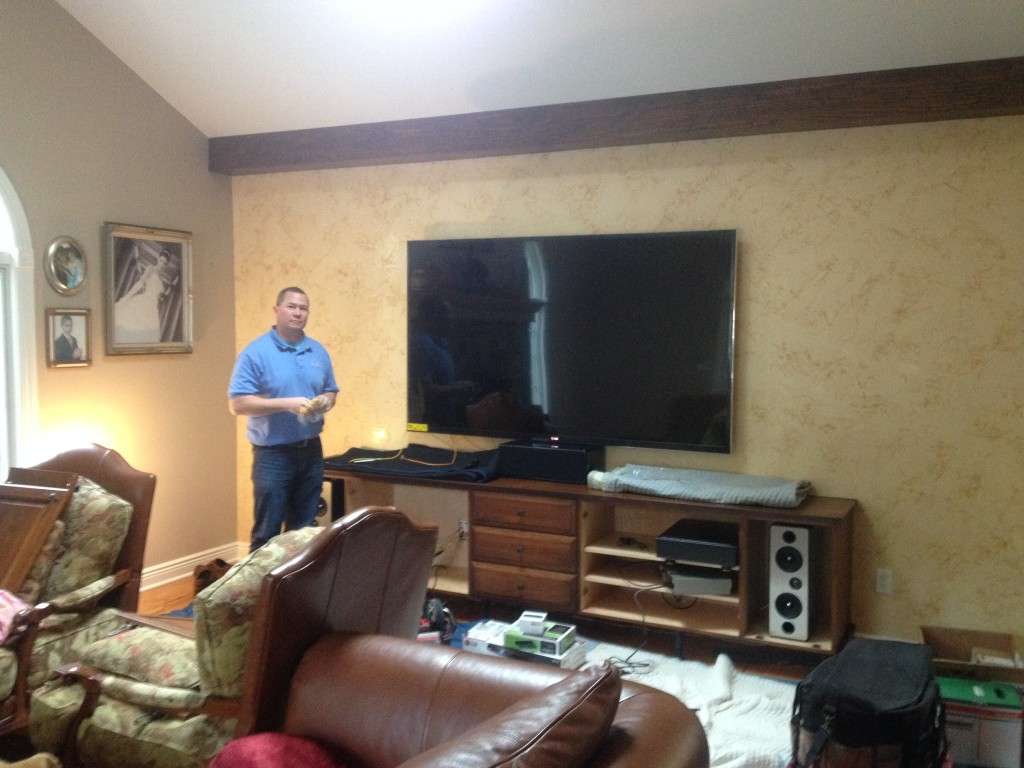
Height matters as much as distance. The center of the picture should sit close to your eye level when you are seated, not standing. That sounds obvious, yet most TVs end up high because the wall space above a console or fireplace looks empty. A screen mounted too high feels fine for 10 minutes and tiring by the end of a 2-hour movie. Ryan measures from the cushion of your actual sofa, because a deep lounge sofa and an upright chair put your eyes in very different places.
Second rows change the plan. If you want kids on the floor cushions up front and adults on a sofa behind them, the screen height has to work for both. Sometimes that means a slightly higher mount and a small tilt. Sometimes it means a low platform behind the first row. The goal is that nobody watches the movie through the back of someone else’s head.
Why 98 inches, and why the Sony BRAVIA 5?
Because 98 inches is where a family room starts to feel like a theater without needing a projector, a dark room or a separate space. The Sony BRAVIA 5 98-inch, model K-98XR50, pairs that size with a Mini LED picture that stays bright in a lived-in room and deep in a dark one.
A projector can go bigger, but it needs a dark room to look its best. A 98-inch TV like this one holds its picture with the lamps on and the shades half open, which is how most families actually watch. That is the trade we usually recommend for a family room, and the reason this size has become our favorite for movie night.
Here are the specs that matter, taken straight from Sony’s published specifications for the K-98XR50:
| Spec | Sony BRAVIA 5 98-inch (K-98XR50) | Why it matters on movie night |
|---|---|---|
| Screen size | 98-inch class, 97.5 inches measured diagonally | Big enough to fill your view from 10 to 13 feet |
| Resolution | 3840 x 2160 (4K) | 4 times the detail of a 1080p HD picture, so the image stays sharp up close |
| Backlight | Mini LED with local dimming (XR Backlight Master Drive) | Bright highlights and deep blacks in the same scene |
| Refresh rate | 120 Hz panel | Smoother motion for sports and fast action |
| HDR formats | HDR10, HLG and Dolby Vision | Plays the best version of most streaming movies and live broadcasts |
| Picture modes | Includes IMAX Enhanced and Dolby Vision modes; studio calibrated modes for Netflix, Sony Pictures Core and Amazon Prime | The picture the filmmaker approved, at the touch of a button |
| Connections | 4 HDMI inputs; HDMI 2.1 features 4K120, eARC, VRR and ALLM | Full-quality sound out to the speakers and full-speed gaming in |
| Network | Wi-Fi 6 plus a wired Ethernet port | We wire it, so 4K streaming does not depend on Wi-Fi |
| Size without stand | 86.63 x 49.5 x 3.38 inches | Slim enough to sit close to the wall on a mount |
| Weight without stand | 152.1 pounds | Needs a mount secured to the wall framing |
| Mounting pattern | VESA 600 x 400 mm | Fits professional fixed, tilt and articulating mounts |
A few of those lines are worth a closer look. The studio calibrated modes mean the TV can show a movie the way it was graded in the studio, instead of with the extra-bright, extra-blue look many TVs ship with for store shelves. When we set up the room, we pick those modes for film nights and save a brighter mode for afternoon games.
The eARC connection is the quiet hero. It lets the TV pass full-quality surround sound from its built-in apps out to the amplifier and speakers. Without it, streaming movies often get squeezed down to a simpler sound format before they ever reach your speakers.
The wired Ethernet port matters more than most people expect. Wi-Fi 6 is good, yet a 4K movie streamed on a busy Friday night, with phones, tablets and a game console all online, can still stall. We run a network cable to the TV whenever the wall allows it, so the picture never drops to a blurry low-resolution version in the middle of the best scene.
How do Triad speakers and McIntosh power make the sound feel real?
Great movie sound comes from the right number of speakers in the right places, driven by an amplifier with plenty of power in reserve. One Sound Choice is an authorized Triad dealer, and we pair Triad speakers with McIntosh amplification because the combination delivers clear voices, wide sound and bass you feel without the room turning into a box.
Start with the layout. A 5.1 system has 3 speakers across the front, 2 surrounds beside or slightly behind the seats, and a subwoofer for bass. A 7.1 system adds 2 more speakers behind the seats. Many rooms we design also add speakers in the ceiling, which lets formats like Dolby Atmos place a helicopter or a rainstorm above you. The right layout depends on the room, the seating and how much ceiling space is free of beams and lights.
The center speaker deserves special care. In most movies, the center channel carries the dialogue. If it is weak or aimed at the wrong height, you end up turning the volume up to hear the actors and then lunging for the remote when the music hits. A good center speaker placed right at the screen fixes the most common complaint people have about home sound.
Bass is the hardest part of any room. Low notes bounce off walls and pile up in some seats while disappearing in others. Using 2 subwoofers, placed with care, usually evens that out so every seat on the sofa gets the same thump. It also lets each subwoofer work less hard, which keeps the bass clean at movie volume.
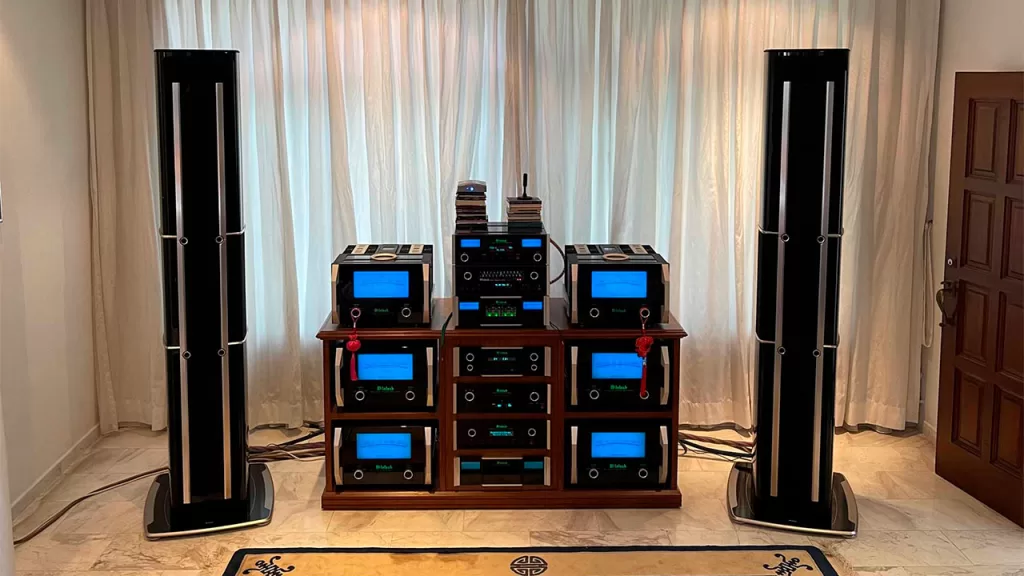
Why a separate amplifier at all? Movie soundtracks swing from a whisper to an explosion in a split second. An amplifier with real power in reserve handles those jumps without straining, so the loud moments hit hard and the quiet ones stay clear. That reserve is called headroom, and it is the difference between sound that feels big and sound that feels loud.
Triad builds speakers for in-wall, in-ceiling and on-wall installation, so the system can be close to invisible in a finished family room. Speakers set into the wall and painted to match let the room look like a living room by day and sound like a theater at night.
Then comes tuning. Every room changes the sound, so after the speakers are in, the system is measured and adjusted from the main seats: speaker levels, distances and bass balance. This is where the system starts to sound like one seamless space instead of a collection of boxes.
I hired 1 Sound Choice to do a surround sound system in my living room and multi-room audio in 5 other rooms in my house,I asked Ryan to make it simple for my wife and I to use and we didnt want to see any wires or equiptment.Ryan ( the owner of 1 Sound Choice) presented me with a awesome solution for what I asked for at a price point that was right in range of my budget.The project was done faster then estimated and the workmanship of Ryan and his crew was above and beyond what I expected, They worked clean and were very personable, I would HIGHLY reccomend everyone to use 1 Sound Choice for all A/V installations. I will definately be using them again!
– kgrecco75 (Houzz review)
Thinking about this for your family room? See how we put the picture, sound and remote together on our movie night room page, or call (973) 945-5275 to talk it through with Ryan.
How should lights and shades work on movie night?
Lights and shades should set the mood by themselves the moment you press play. The front of the room goes dark so the screen pops, a soft glow stays on near the floor so nobody trips on the way to the kitchen, and the shades close so a streetlight or a late sunset never washes out the picture.
Think of light in layers. Overhead lights near the screen are the first to go off, because they reflect on the glass. Side lights and lamps can stay at a low level so the room feels warm, not like a cave. Low path lights along steps or a walkway keep everyone safe during the snack run. Each layer gets its own level, and the system remembers all of them as one scene.
Then link the scene to what you are doing. When the movie starts, the lights fade down over a few seconds instead of snapping off. When someone pauses, the lights come up just enough to find the popcorn. When the credits roll, they rise back to normal. Nobody touches a switch.
Shades come in 2 main types for this room. Blackout fabric blocks nearly all light, which is ideal for a basement or a room used mostly at night. Light-filtering fabric cuts glare and keeps the view, which suits a family room that hosts Sunday afternoon football. Many rooms get both on a double roller: light-filtering for the day and blackout for movie night.
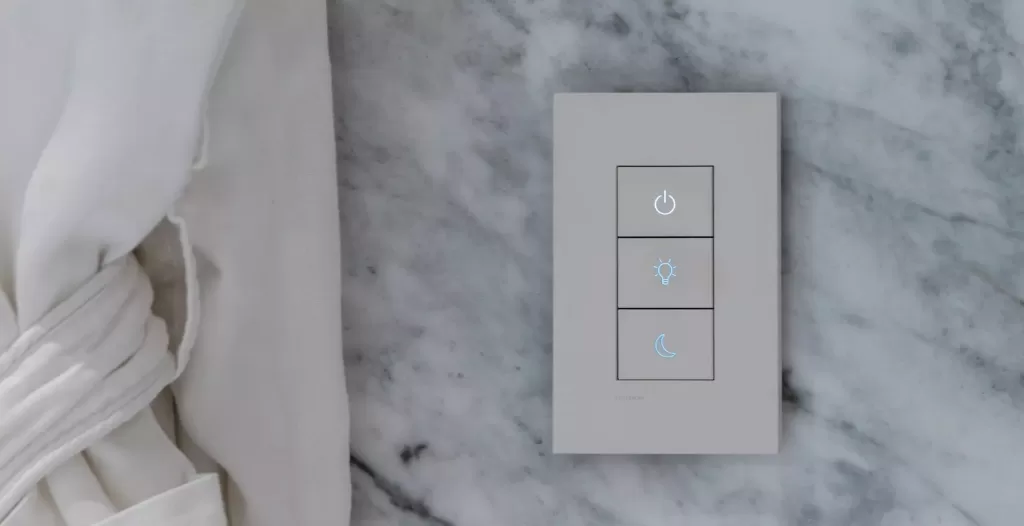
Can one remote really run the whole room?
Yes. With a Control4 system, one remote and one wall keypad run the TV, the speakers, the streaming box, the lights and the shades together. You press one button for what you want to do, and the system handles every step in the right order.
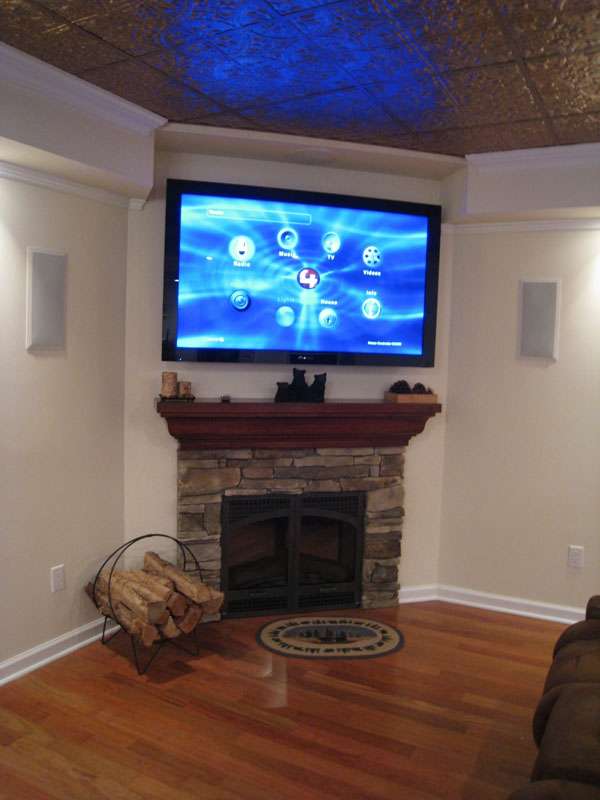
The buttons are labeled by activity, not by device. Watch a Movie turns on the TV and the amplifier, switches to the right input, closes the shades and sets the lights. Watch the Game does almost the same thing with brighter lights and the sports picture mode. Off shuts everything down at once, so nothing is left humming overnight.
This is what makes the room feel easy for the whole house. A grandparent visiting for the holidays does not need a lesson. The kids can start their movie without calling for help. Guests at a Sunday game can turn up the volume without finding a second remote. The same controls are on your phone, so a parent upstairs can pause the movie when it is time for bed.
Peace of mind is the other half of ease. A room with this many parts has to behave the same way every time, and it has to be supported when something needs attention. Streaming apps update, TVs get new software, and Wi-Fi changes over the years. When the room is built and programmed as one system by one team, there is one call to make, and the person who answers knows how your room was put together.
1 Sound Choice installed a flat screen TV for us along with surround sound. We could not be happier with the professionalism we received. They were within budget and time — no surprises. We would highly recommend 1 Sound Choice.
– The Baron Family (1 Sound Choice client testimonials)
When should you decide to have it ready for Thanksgiving and Christmas?
Now. Thanksgiving falls on Thursday, November 26, 2026, and Christmas is Friday, December 25. If you want the room finished for the parade, the afternoon game and the first holiday movie with the whole family, the decision belongs in October so the work can be planned around your calendar.
We will not guess at lead times on a web page, because every house is different. What we can tell you is what goes into the timeline, so you know why deciding early helps.
- A walk-through with Ryan. He sits where your family sits, measures the wall, checks the windows and talks through how the room is used on a normal week and on a holiday.
- A design built around the room. Screen size and height, speaker layout, where the equipment lives, the lighting scenes and the shades.
- Ordering. The screen, speakers, amplifier and shades are ordered once the design is set. Some items, especially custom shades and built-to-order speakers, take time to arrive.
- Wall and ceiling work. Cables run inside the walls, the mount is secured to the framing and in-wall speakers are cut in. In a finished room, this is planned to keep dust and disruption to a minimum.
- Installation, tuning and programming. The system goes in, the sound is tuned from the seats and the one-button scenes are programmed.
- A walk-through for the family. Everyone who will use the room learns it in a few minutes.
The timing of each step depends on your house: whether walls are open or finished, whether shades are part of the plan, and how your family’s schedule lines up with the work. Deciding now simply gives the most room to plan before the holidays fill everyone’s calendar.
If you would like the room ready for the holidays, the first step is a conversation. Call (973) 945-5275, text Ryan, or see the 98-inch Sony movie night room to picture it in your home.
Football Sundays and the Big Game
A great movie night room is also the best football room in the house. The same 98-inch screen, surround sound and lighting scenes that make a movie feel big make every Sunday feel like a seat at the 50-yard line.
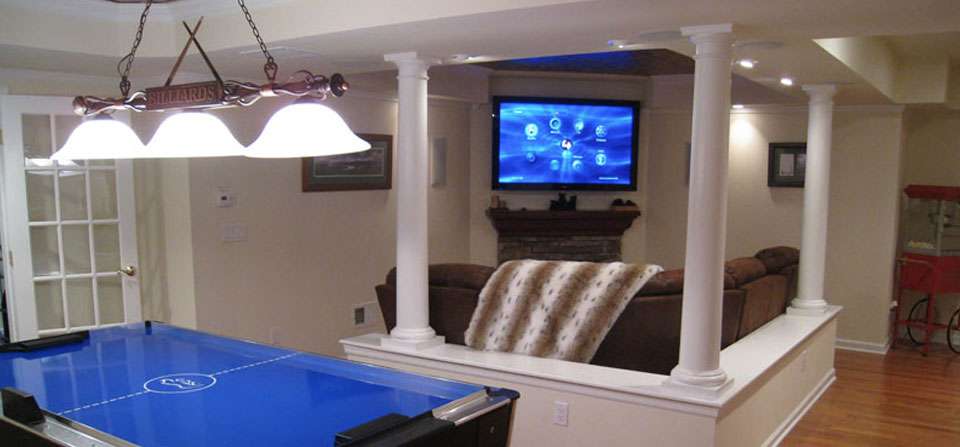
Sports ask different things of the room than movies do. The picture needs more brightness for an afternoon game with the shades partly open, so we set a separate sports mode for daytime. The 120 Hz panel keeps a long pass or a fast break smooth instead of smeared. And the sound shifts from the center of the room to the whole room, so the crowd noise fills the space while the announcers stay clear.
Game day seating is different, too. People stand, wander to the kitchen and talk through the commercials. So we look at sight lines from the island and the bar as well as the sofa, and we make sure the sound reaches the edges of the room without blasting the people closest to the screen.
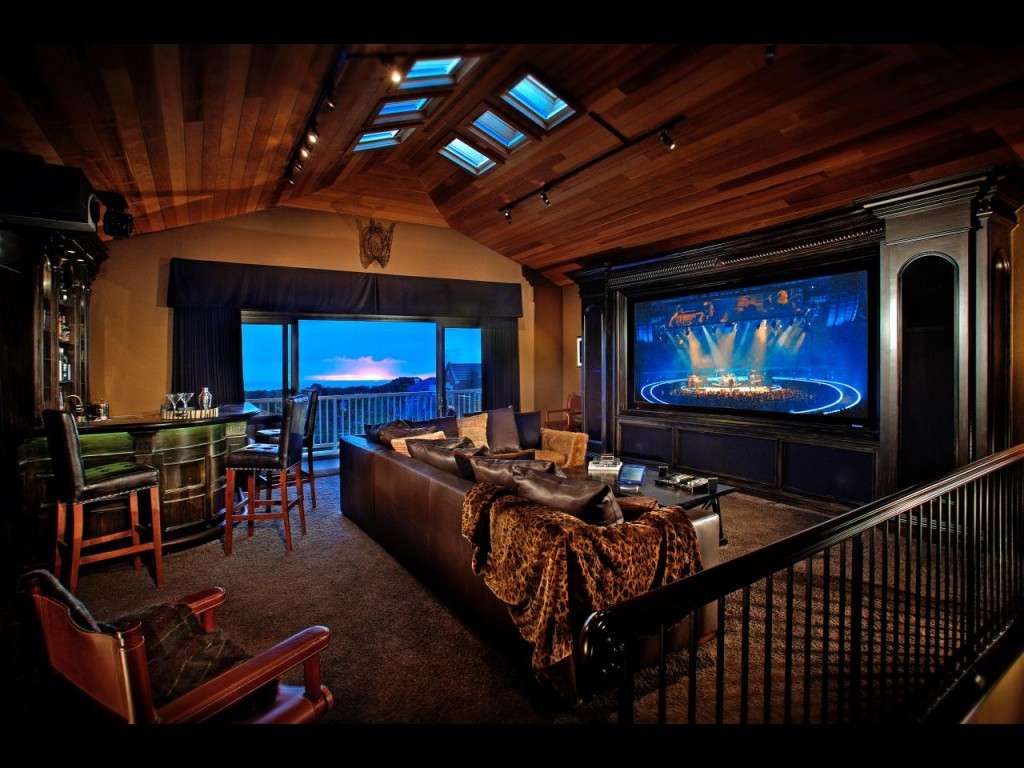
The season builds toward February, when the Super Bowl lands on Sunday, February 14, 2027. Imagine that night on a 98-inch screen, with the whole crowd in your family room.
(We received) friendly, highly competent, quick and clean installation by 1 Sound Choice. The team followed up a few weeks after completion to ask if we were satisfied with our Media Room and Home Audio System. 1 Sound Choice is truly “top shelf” – they surpassed our expectations every step of the way.
– Mr. & Mrs. Blake (1 Sound Choice client testimonials)
What One Sound Choice clients say
The quotes in this guide are copied word for word from families who invited One Sound Choice into their homes.
Movie night room questions
Is 98 inches too big for a family room?
Usually not. If your main seat is about 10 to 13 feet from the wall, a 98-inch screen fills the view the way a movie is meant to, without making you turn your head. Rooms where the couch sits closer than about 9 feet are better served by a smaller screen, and Ryan will tell you that plainly.
Do we need a dedicated theater room to get this feeling?
No. Most of the movie night rooms we build are family rooms, great rooms and finished basements that still work as everyday living space. A dedicated theater is a wonderful project, but a well-planned family room gets you most of the way there and gets used every day.
Can the movie night room also play music and video games?
Yes. The same speakers and amplifier that carry a movie can play music for a party, and the BRAVIA 5 supports 4K at 120 Hz with variable refresh rate on 2 of its HDMI inputs, which is what current game consoles use. It all runs from the same remote.
Will this work in an open floor plan?
Yes, with some planning. Open rooms leak light and sound, so we pay extra attention to shade coverage, speaker aim and bass placement so the movie stays big in the seating area without overwhelming the kitchen.
Can the rest of the house run on the same system later?
Yes. The control system that runs the movie night room can grow to music in other rooms, lighting, shades, cameras and Wi-Fi across the house, so you never end up with a second set of apps and remotes.
How do we get started?
Call or text Ryan at (973) 945-5275. He will come see the room, sit where your family sits, and walk you through what he would build and why.
Meet Ryan
Ryan Herd is the founder of One Sound Choice. He is a former Mayor of Pequannock Township, a TEDx speaker, a patent holder and the author of Join the Smart Home Revolution, with more than 30 years in home technology. For a movie night room, Ryan starts from the seat your family will use most and designs outward from there.
Where we build movie night rooms
One Sound Choice builds movie night rooms in family rooms, great rooms and finished basements across Morris, Bergen, Essex, Passaic, Somerset and Hunterdon counties in Northern New Jersey, and for clients in Manhattan.
One Sound Choice, 8 Tilley Ave, Pompton Plains, NJ 07444. Call (973) 945-5275 or text Ryan. Written by Ryan Herd, founder of One Sound Choice.