
Smart homes are transforming family life by offering tailored solutions for daily routines, security, and convenience. For families in Northern NJ, these systems must address specific challenges like large homes with Wi-Fi dead zones, historic architecture requiring custom wiring, and the need for secure remote monitoring. Modern smart homes now include AI-powered automation, privacy-focused edge processing, and health-focused features like air quality sensors and circadian lighting. While AI systems predict and adjust to routines, unified platforms give users direct control. Choosing the right approach depends on your household’s preferences and schedule.
Key takeaways:
- AI Automation: Learns daily patterns to adjust settings automatically.
- Unified Platforms: Centralized control for hands-on customization.
- Health Features: Sensors for air quality, lighting, and safety.
- Security: Strong networks and advanced systems like facial recognition.
Working with local professionals ensures your system meets your household’s unique needs while remaining secure and easy to manage.
Smart Home Automations We Use To Take Care Of Our Kids!
sbb-itb-c5b321b
Current Trends in Family Smart Home Personalization
A growing number of families are turning to smart home systems that adapt to their routines and predict their needs. These advanced systems utilize edge-based processing, which keeps data on local home hubs rather than external servers. This approach not only achieves lightning-fast response times – under 100 milliseconds – but also prioritizes family privacy by limiting data exposure [1]. Let’s explore how these trends are reshaping family life.
AI-Based Automation for Family Schedules
AI-powered automation is becoming indispensable for managing family schedules. By analyzing factors like time of day, weekdays, and historical usage patterns, these systems can anticipate household needs. For instance, when the system detects that the family is preparing to leave, it powers down unused appliances and adjusts climate settings to conserve energy.
On the technical side, models like LightGBM and XGBoost are favored for their efficiency and transparency, making them ideal for edge devices. Meanwhile, the TinyHAR model, designed for edge deployment, achieves an impressive 89.0% accuracy in recognizing daily family activities [1].
"Modern systems do not just aim at automating routine activities but also to learn and predict the user’s behavior proactively." – Mark M. Gad, Researcher, German University in Cairo [1]
Single-Platform Control for Multiple Systems
Families increasingly prefer a single platform to manage diverse smart home devices, from lighting and security to entertainment and climate control. Research shows that while 52% of smart home users take steps to protect their privacy, many still resort to manual methods like unplugging devices due to a lack of unified tools [5].
Single-platform systems address this gap by introducing features like "Privacy Diagnostics", which scan connected devices – such as smart bulbs and cameras – for security vulnerabilities. These tools provide step-by-step guidance to fix issues and even support cross-device triggers. For example, geo-fencing can pause indoor cameras automatically when a family member’s smartphone enters a designated area [5].
"Privacy Diagnostics… was far preferred over the rest… Participants praised it for ‘being simple,’ ‘offering privacy control,’ and ‘requiring little management efforts.’" – Haojian Jin et al., Carnegie Mellon University [5]
Health and Safety Features for Family Protection
Modern smart homes go beyond convenience, incorporating features that promote health and safety. Sensors now monitor air quality, humidity, and lighting to maintain a comfortable indoor environment. If pollutants are detected, air purifiers activate automatically. Circadian lighting, which adjusts color temperature throughout the day, supports better sleep patterns – especially beneficial for children and teenagers.
For physical safety, families with young kids often opt for cordless, motorized window treatments to eliminate strangulation risks [8]. Security systems have also advanced, using AI to detect unusual behavior patterns and alert homeowners in real time. Biometric access, like facial recognition and fingerprint scanning, further enhances security by reducing the risks associated with lost or stolen keys [7]. These innovations ensure that every family member feels safe and cared for at home.
Smart Home Preferences of Northern NJ Families
Families in Northern New Jersey have distinct needs when it comes to smart home technology. The region’s diverse property types – from sprawling estates in Alpine and Franklin Lakes to historic homes and compact townhouses in Hoboken – require tailored solutions. Factors like the local climate, expansive floor plans, and active household routines also play a role in shaping their preferences. These considerations highlight the importance of secure, dependable systems designed with family life in mind.
Network Infrastructure and Security Systems
A strong, professional-grade network is the backbone of any reliable smart home in Northern NJ. Larger homes often demand precise Wi-Fi coverage planning to ensure uninterrupted connectivity across multiple levels, garages, and outdoor spaces [3]. As Daisy North Jersey aptly puts it:
"A smart home is only as good as its connection. That’s why Wi-Fi networking is one of the most important aspects of a home automation system." [3]
Security is another top priority for families in the area. Advanced systems featuring high-resolution cameras, smart sensors, and keyless entry provide peace of mind by allowing parents to monitor their homes remotely. These systems also make it easy to grant secure access to family members or trusted service providers [3]. Cutting-edge features like facial recognition can even streamline entry protocols while enhancing overall safety [10].
Entertainment Systems for Family and Guests
Entertainment plays a central role in many Northern NJ households, especially those that frequently host family and friends. Multi-room audio systems allow music to flow effortlessly throughout the home, creating the perfect atmosphere for gatherings. Meanwhile, dedicated home theaters equipped with projectors and surround sound deliver a cinema-like experience without leaving the house [3][9].
In urban hubs like Jersey City and Hoboken, where residents often juggle busy schedules, these systems simplify home entertaining [9]. Families can set up custom scenes – like "Movie Night" or "Dinner Party" – with a single command, making it easy to switch between activities. Gaming enthusiasts also benefit from optimized networks and hardware, ensuring smooth, lag-free performance that satisfies both casual and competitive players alike.
How to Personalize Smart Homes for Families
Creating a smart home that works for everyone in the family requires thoughtful planning and user-friendly systems. Research indicates that 52% of smart home users actively take steps to protect their privacy, showing the importance of balancing convenience with security [5]. The ultimate goal is to design a setup that simplifies life for all family members.
Design Systems Everyone Can Use
For a smart home to be effective, it needs to be easy to use. Simple, intuitive interfaces reduce confusion and ensure that everyone, from tech-savvy teenagers to less tech-inclined adults, can operate the system. This is especially important since the person who installs the system often ends up as the go-to tech support for the household [6]. Features like visual indicators and physical controls help users quickly understand a device’s status. For example, 49% of users rely on passwords or PINs for their devices as a straightforward way to enhance security [2].
Location-based automation, such as geofencing, can further simplify daily routines. For instance, geofencing can automatically pause indoor cameras when family members arrive home, reducing the need for constant manual adjustments [5]. These features make the system not only functional but also convenient for everyone.
While ease of use is critical, a secure system is just as important to protect the household.
Add Parental Controls and Network Security
A centralized approach to security helps parents manage the entire smart home system without having to configure each device individually. This is particularly reassuring given that only 35% of users feel confident in the security of voice assistants, whereas 80% trust dedicated security devices like cameras and smart locks [2]. Implementing security measures at the network level – such as content filtering, two-factor authentication, and unique PINs for device apps – provides a strong foundation for protecting the home [2].
Parents can also enhance privacy by using smart plugs to disable cameras or speakers during specific hours. This approach maintains overall security while giving family members additional privacy when needed [5]. Such measures ensure that the home remains both safe and adaptable to the family’s lifestyle.
Build Systems That Last and Adapt
To create a smart home that keeps up with changing family needs, it’s important to invest in high-quality equipment and professional installation. Systems that use edge-based processing – where data is handled locally – offer better privacy and allow for upgrades without the need for a complete system overhaul [1]. This flexibility becomes increasingly valuable as children grow or family routines evolve.
Designing a modular system that supports multiple communication protocols, like Zigbee, Thread, and Matter, ensures that new devices can be added seamlessly as technology advances [1]. For families in Northern New Jersey, working with experienced professionals such as One Sound Choice (https://onesoundchoice.com) can help ensure that your smart home remains secure, adaptable, and user-friendly for years to come.
Comparing Smart Home Personalization Methods
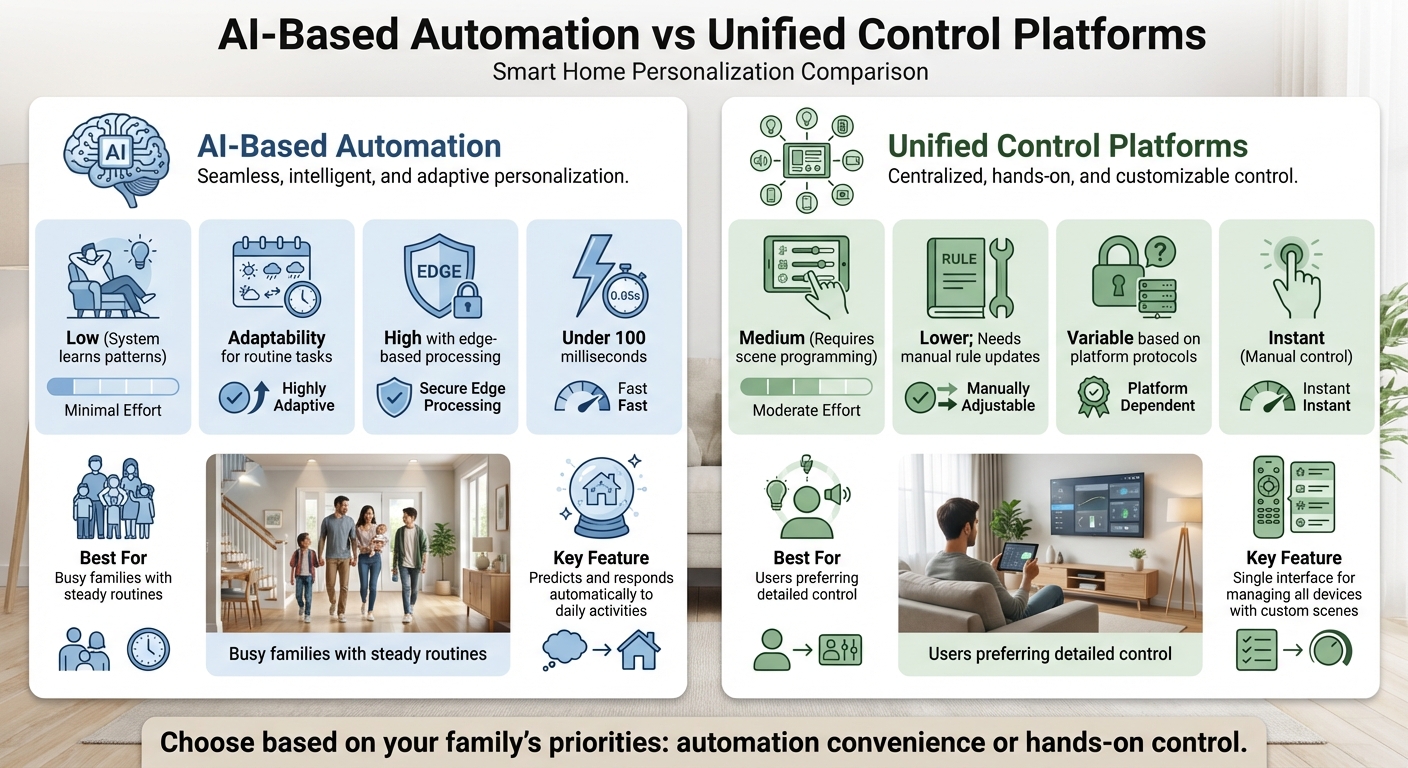
AI Automation vs Unified Control Platforms for Smart Homes
When it comes to personalizing smart homes, families often weigh the benefits of systems that learn and predict routine needs against those that prioritize manual control. The right choice depends largely on household habits and what they value most in day-to-day living.
AI Automation vs Unified Control Platforms
AI-based automation leverages machine learning to predict and respond to a family’s daily activities without direct input. These systems analyze habits – like when the family typically watches TV or prepares meals – and adjust settings such as lighting and temperature automatically. For instance, frameworks like EL-HARP process data locally on devices, ensuring privacy while maintaining lightning-fast response times under 100 milliseconds [1]. While these systems excel at managing predictable routines, they might fall short when schedules change unexpectedly, requiring manual adjustments.
On the other hand, unified control platforms offer a more hands-on approach. Through a single interface, users can manage their smart home environment by creating custom scenes and schedules. While this method gives families precise control, it also demands more effort, especially when routines shift and rules need updating. Additionally, some families may be hesitant to rely on voice-assisted platforms, making dedicated systems an appealing alternative for those seeking reliability.
| Feature | AI-Based Automation | Unified Control Platforms |
|---|---|---|
| User Effort | Low (system learns patterns) | Medium (requires scene programming) |
| Adaptability | High for routine tasks | Lower; needs manual rule updates |
| Privacy | High with edge-based processing | Variable based on platform protocols |
| Best For | Busy families with steady routines | Users preferring detailed control |
Choosing between these methods often comes down to what families prioritize – whether it’s the convenience of automation or the reassurance of direct control. This comparison also lays the groundwork for exploring how smart home systems can go beyond convenience to promote health and wellbeing.
Health-Focused Systems vs Standard Configurations
For families in Northern NJ who value wellbeing, health-focused smart home systems provide a compelling alternative to standard setups. While standard configurations are designed for convenience – offering features like voice-controlled music, automated lighting, and remote locks – health-focused systems take things a step further. They use specialized sensors to transform a home into a wellness-oriented space. For example, indoor air quality sensors can activate purifiers when pollutants are detected, circadian lighting systems can help regulate sleep by mimicking natural light patterns, and fall detection sensors can provide critical support for elderly family members [12][14].
The benefits of these systems are backed by data. Home healthcare, for example, costs about 32% less than emergency care, and nearly 80% of urgent calls for help go unanswered when older adults are alone – problems that automated health sensors can address [13]. In 2023, Kyle Steele, President of Global Wave Integration, launched FutureCare Solutions Group after a client with 600 standard smart devices specifically requested tools to track health and wellness data [14]. The growing interest in such systems is reflected in the wellness real estate market, which is projected to expand from $398 billion to $887.5 billion by 2027 [14].
While the upfront costs of health-focused systems can be higher due to specialized sensors and professional installation, they offer significant long-term savings by reducing healthcare expenses and supporting preventative care. For families looking to combine convenience with health and safety, these systems represent a forward-thinking approach to smart home living.
Conclusion
What Northern NJ Families Should Remember
Creating a smart home tailored to family life begins with a strong foundation. Ensuring your network is reliable and free of dead zones or lag is a crucial first step before expanding your setup [3][4].
When designing your smart home, it’s important to think about everyone in the household. Systems should be easy for all users, from children to guests, to navigate without frustration. At the same time, robust security measures and parental controls should remain a priority [11]. The goal is to create a home environment that works for everyone, not just the tech-savvy.
Studies suggest that a well-optimized home can boost comfort and productivity by up to 20% [4]. Whether you lean toward AI-driven automation to streamline your busy schedule or prefer hands-on control through unified platforms, the priority should always be choosing systems that align with your family’s routines and needs – rather than forcing your lifestyle to adapt to the technology.
Working With Experienced Smart Home Professionals
For a seamless smart home experience, working with experienced professionals makes all the difference. Skilled integrators address challenges that DIY solutions often can’t, such as eliminating the need for one person to manage every technical issue or request [15]. They simplify the experience by consolidating multiple apps into a single, user-friendly interface and setting up customized access levels to ensure security while meeting the needs of various users, including children and guests [15].
One Sound Choice has been a trusted name for over 30 years, completing more than 2,500 installations for families across Northern NJ. Offering services like enterprise-grade networking, whole-home audio, modern home theaters, gaming setups, lighting and shade automation, and advanced security systems, they bring a wealth of expertise to every project. Led by Ryan "The Smart Guy" Herd, the team focuses on delivering systems that are easy to use, durable, and designed to enhance daily life.
For families in Morris, Bergen, and Essex counties, partnering with local professionals like One Sound Choice ensures your smart home investment is secure, reliable, and tailored to your household’s unique needs – creating a space that works for everyone, every day.
What One Sound Choice clients say
(We received) friendly, highly competent, quick and clean installation by 1 Sound Choice. The team followed up a few weeks after completion to ask if we were satisfied with our Media Room and Home Audio System. 1 Sound Choice is truly “top shelf” – they surpassed our expectations every step of the way.
– Mr. & Mrs. Blake (1 Sound Choice client testimonials)
I’d (tell others) that Ryan’s very professional and very easy to work with, in terms of budgeting and listening to what you want to have done. He never pushed us toward anything we couldn’t afford or didn’t want and he got the job done on time.
– Mr. & Mrs. DeSantis (1 Sound Choice client testimonials)
One Sound Choice was our second try at finding a contractor to repair our flood-damaged home after Irene blew through in August of 2011. Our Cape Cod house has a slab foundation and the entire first floor – living room, kitchen, dining room, two bedrooms, and a bathroom – got 5 feet of water. Ryan, the owner, was highly professional from start to finish. He worked closely with us to produce a contract that was within our insurance budget, and he came in on time and on budget. In some cases, he went over and above the call of duty; for example, surprising me with some crown molding in the bathroom and dining room that I had really wanted but just didn’t have the money for. We actually had enough left to hire him to do our home theater and bedroom media center! We were so pleased to have discovered the truly good people at One Sound Choice, and hope to work with them again when we are ready to remodel our upstairs rooms.
– bethbarnhill (Houzz review)
FAQs
How do I fix Wi‑Fi dead zones in a large home?
To get rid of Wi-Fi dead zones in a large home, you might want to look into a mesh Wi-Fi system or install additional access points. These options help distribute the signal evenly throughout the space. Placing routers and extenders in central locations and keeping them clear of obstructions can also improve coverage. For a more reliable and tailored solution, consider having a professional, such as a smart home expert from One Sound Choice, set up a custom network designed specifically for your home.
Should my family choose AI automation or manual control?
Choosing between AI automation and manual control often comes down to what your family values more: convenience or direct involvement. AI automation can simplify daily life by creating personalized routines, enhancing security with adaptive features, and using voice recognition to tailor experiences to individual preferences. On the other hand, manual control puts you in charge, offering straightforward operation and a more hands-on approach. Combining the two can provide the best of both worlds – smart assistance when you need it, along with the flexibility to make adjustments yourself. This balance ensures a smooth and customizable smart home experience.
How can we keep smart home data private and secure?
To keep smart home data secure, it’s essential to blend automated security measures with intuitive user controls. Automated policy management helps cut down on potential risks by reducing human error, while straightforward data transparency allows users to track and manage how their data is shared. Systems that offer adjustable privacy settings enable families to address the challenges of connected devices without sacrificing convenience. These combined efforts provide a solid approach to protecting sensitive information.
Related Blog Posts
- How to Choose Smart Lighting for Every Room in Your Home
- Smart Home Questions Answered: 15 Common Concerns for Families
- Best Smart Home Upgrades for Families: Top 10 Systems in 2025
- Whole-Home Automation: Family Benefits Explained
Want a setup built around your family? See our smart home page.
More questions
Can each person in the family have their own settings?
Yes. A good system can set lights, music, and heat for each person or room. Everyone uses the same simple control.
One Sound Choice, 8 Tilley Ave, Pompton Plains, NJ 07444. Call or text (973) 945-5275. We work in homes across Morris, Passaic, Bergen, Essex, Somerset, and Hunterdon counties. Written by Ryan Herd, founder of One Sound Choice.