
In 2026, home theaters combine cutting-edge technology with expert design to deliver immersive entertainment. Key advancements include:
- 8K Projectors: Affordable models ($3,000–$5,000) bring ultra-high-definition visuals into more homes, with laser light engines lasting up to 20,000 hours.
- MicroLED Displays: Modular screens offer high brightness, infinite contrast, and flexibility for rooms with ambient light.
- Spatial Audio: Dolby Atmos and DTS:X systems create 3D soundscapes, with configurations like 7.1.4 (seven speakers, one subwoofer, four ceiling speakers) becoming standard.
- AI Integration: Smart systems automate lighting, climate, and sound, learning user preferences for seamless control.
- Professional Design: Acoustic treatments, tiered seating, and centralized control ensure optimal performance in any space.
These features make home theaters more immersive, accessible, and integrated into smart homes than ever before.
Best AV Receivers 2026 – Top Home Theater Picks From Budget to Flagship
sbb-itb-c5b321b
8K Projectors and MicroLED Displays
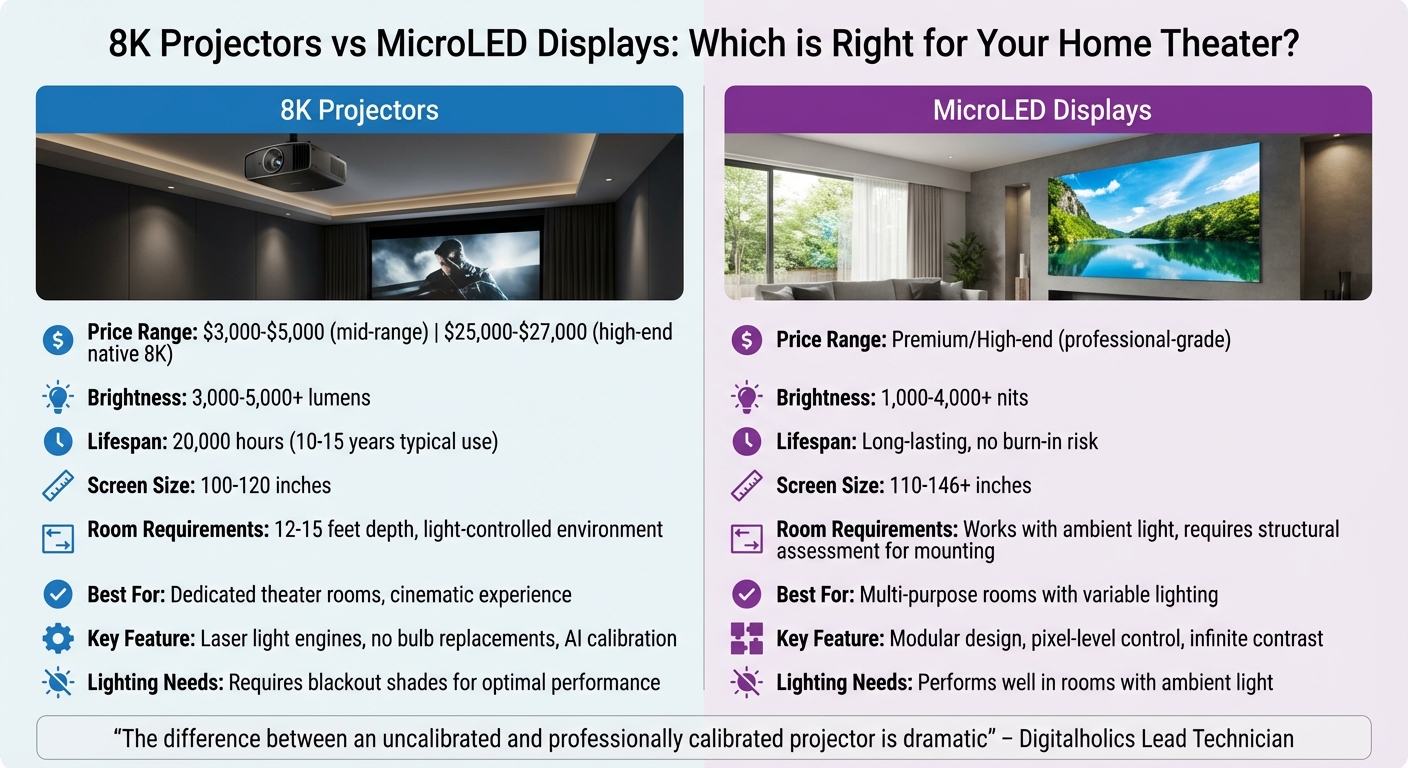
2026 Home Theater Technology Comparison: 8K Projectors vs MicroLED Displays
8K Projectors: Cinema-Quality Resolution at Home
By 2026, 8K projectors have become a standard choice for home theaters. High-end native 8K models are priced between $25,000 and $27,000, while mid-range options start at $3,000–$5,000. This price range has made ultra-high-definition entertainment more accessible for Northern New Jersey homeowners seeking top-tier visuals without spending six figures.
These projectors feature laser light engines capable of producing 3,000–5,000+ lumens and boast a lifespan of 20,000 hours. They also include advanced AI calibration, which adjusts image geometry and color accuracy to suit non-dedicated theater rooms automatically [2][6]. This technology eliminates the need for bulb replacements, providing 10 to 15 years of hassle-free use under typical conditions [2][6].
However, to get the best performance, 8K projectors require light-controlled environments. Rooms with a depth of at least 12 to 15 feet are ideal for accommodating 100 to 120-inch screens [6]. South-facing spaces may also benefit from motorized blackout shades to preserve the deep blacks and contrast that bring out the full potential of 8K resolution [6].
For those seeking a setup that balances high performance with versatility, newer display technologies present an attractive alternative.
MicroLED Displays: Modular Screens with High Brightness
While 8K projectors deliver a cinematic experience, MicroLED displays provide a high-end alternative, especially for rooms with variable lighting. Available in sizes ranging from 110 to over 146 inches, these displays offer pixel-level control, infinite contrast, and peak brightness levels of 1,000 to over 4,000 nits, making them well-suited for spaces with ambient light [6].
One of the standout features of MicroLED displays is their modular design, which offers exceptional flexibility. These panels can function as high-performance entertainment screens or transform into digital art pieces that seamlessly integrate with a home’s architecture [1]. They are also energy-efficient and built to last, avoiding the burn-in risks common with older display technologies [1]. For families in Northern New Jersey looking for professional-grade solutions, MicroLED displays combine cutting-edge performance with sleek design.
Due to their size and weight, professional installation is essential for MicroLED systems. Structural assessments are often necessary to ensure proper wall mounting [6]. As a lead technician from Digitalholics explains:
The difference between an uncalibrated and professionally calibrated projector is dramatic [6].
Dolby Atmos and Spatial Audio Systems
Dolby Atmos: Object-Based Surround Sound
Dolby Atmos has become a cornerstone for professional home theaters in 2026. Unlike traditional surround sound systems that rely on fixed channels like 5.1 or 7.1, Atmos takes a more flexible approach by treating sounds as individual objects. These sound objects can move freely in three-dimensional space, creating a listening experience where audio feels like it’s coming from all directions. Imagine hearing a helicopter hovering overhead or the subtle sound of rain falling from above – Atmos brings these elements to life in a way that feels incredibly real [1].
This effect is achieved by adding a vertical layer of sound using overhead speakers or upward-firing drivers. Modern setups can support configurations as advanced as 13.1.7 channels, but a 7.1.4 system – with four ceiling speakers – is often considered the sweet spot for medium to large spaces [7] [3]. For homes with architectural challenges, solutions like FlexConnect make installation easier by enabling wireless, auto-calibrated speaker placement [7] [4].
AI-powered processors, such as LG’s α11, further enhance the experience by analyzing room acoustics and converting older stereo formats into full surround sound [1] [7]. Technologies like Ultra-wideband (UWB) dynamically adjust the audio "sweet spot" based on where the listener is seated [7]. As Joe de Jesus, Product Manager at PSB Speakers, puts it:
The moment someone has such an experience, the words immersive and 3D suddenly make sense. [5]
Modern wireless systems have also improved significantly, offering nearly zero latency and reducing the need for messy cables. For those seeking a streamlined option, integrated 11.1.4-channel soundbars deliver professional-quality sound without the complexity of traditional setups [1] [4].
DTS:X vs. Dolby Atmos: What’s the Difference
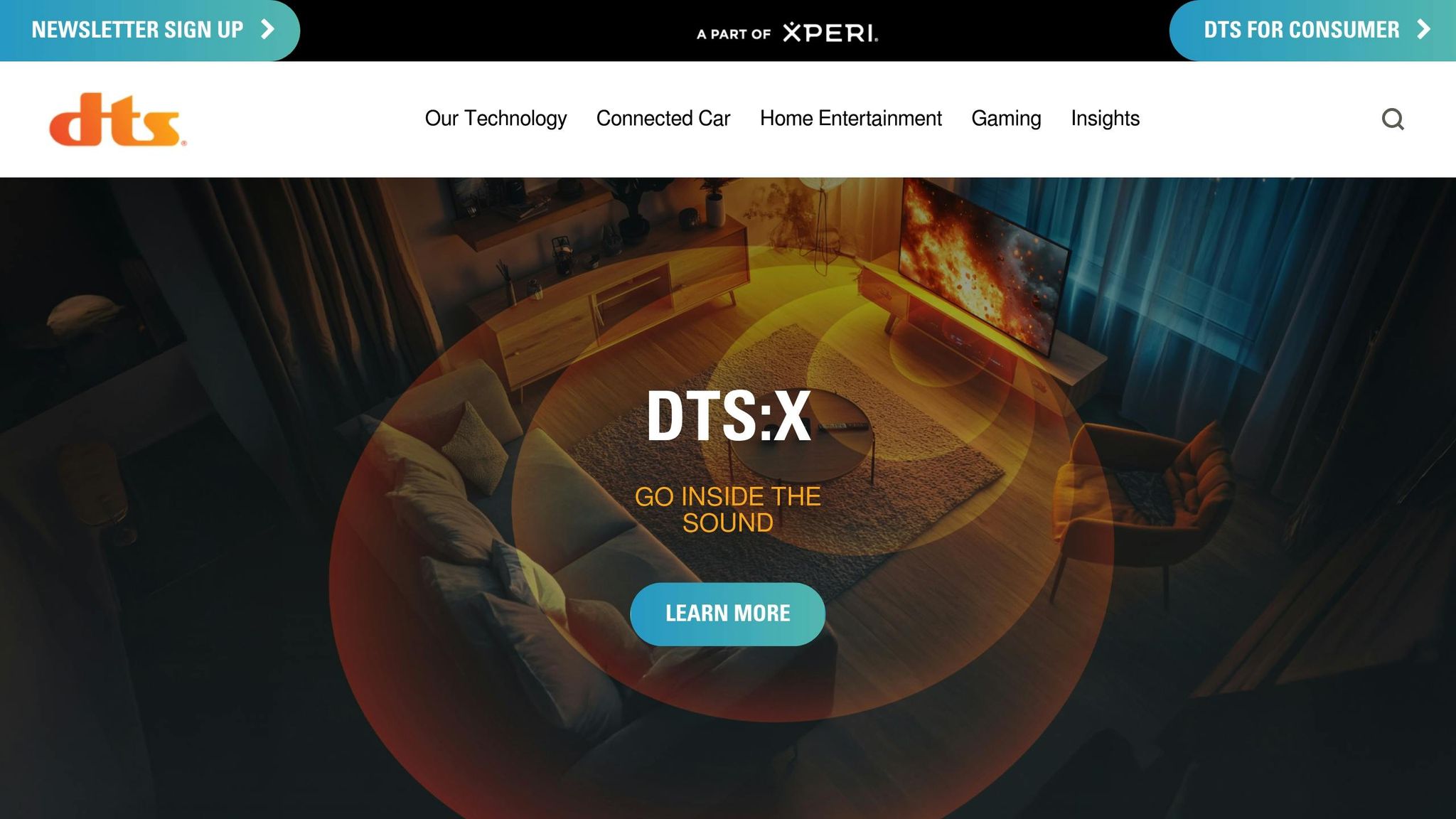
While Dolby Atmos has set the standard for 3D audio, DTS:X stands as a strong alternative with its own advantages. Both formats excel at creating immersive soundscapes, but they cater to slightly different needs in professional home theaters. Dolby Atmos is widely supported by streaming platforms like Netflix and Peacock, as well as hardware manufacturers and over 150 car models as of early 2026 [9]. On the other hand, DTS:X is a staple in IMAX Enhanced certified products, such as the Hisense PX4-PRO laser projector, making it a favorite among those who prioritize high-bitrate audio [8].
One key difference lies in their setup flexibility. Dolby Atmos traditionally requires specific overhead speaker placement to achieve its full effect, while DTS:X has historically allowed for more adaptable configurations, making it a good choice for custom installations [1]. Many high-end AV receivers, like the Denon AVC-X3800H, support both formats, offering configurations like 9.1.4 and letting users switch between formats depending on the content [10].
For families in areas like Northern New Jersey building professional-grade theaters, choosing a system that supports both formats is often the best route. Dolby Atmos provides broad compatibility with streaming services and features the Dolby AC-4 codec, which improves dialogue clarity while cutting streaming data costs by up to 60% [9]. Meanwhile, DTS:X appeals to those who prefer the IMAX Enhanced experience and physical media with high-bitrate audio [8]. As John Couling, Senior Vice President of Entertainment at Dolby Laboratories, explains:
At Dolby, we’re building technologies and partnerships that make premium experiences accessible to all, expanding how and where audiences can enjoy their favorite content. [9]
Together, these advancements in audio technology complement 8K visuals and AI-driven smart controls, creating a complete home theater experience. Opting for a dual-format system ensures flexibility for streaming services and high-quality physical media alike.
AI and Smart Home Integration
AI-Powered Control and Automation
In 2026, AI has evolved far beyond simple voice commands, reshaping how families engage with their home theaters. Modern AI systems now learn your preferences and act independently. For instance, when you settle in for a movie night, the system might automatically dim the lights, set the ideal room temperature, and lock the doors – all based on patterns it has observed over time [11].
This leap in technology is exemplified by advancements like Google Gemini, which replaces the rigid commands of older voice assistants. Instead of saying something like "turn on the TV", you can now interact conversationally with your system. With Google TV powered by Gemini, you have access to over 700,000 movies and TV episodes through a unified interface. You can even make complex requests like, "Find me a thriller from the 1990s with strong female leads", and receive tailored results [12]. Melvin Diaz, Senior Product Manager at Epson America, highlights this trend:
As smart home ecosystems evolve, people are prioritizing technology that delivers seamless connectivity and ease of use – especially when it comes to home entertainment. [12]
AI also enhances real-time performance. Modern projectors can automatically adjust screen alignment, avoid physical obstructions, and account for wall colors [12]. Audio systems, meanwhile, analyze your room’s acoustics during playback, fine-tuning sound to match the unique dimensions of your space [1][3]. These advancements make professional-grade experiences accessible, even for those who aren’t tech-savvy.
Reliability has taken a big step forward as well. While Google Assistant already supports about 50,000 devices across 10,000 brands, older systems often struggled with connectivity issues [12]. Today’s AI-driven hardware includes larger wireless antennas – up to 1.5 times bigger than previous models – ensuring a more stable connection across all devices [4].
This level of automation naturally leads to unified systems capable of managing every aspect of your home theater seamlessly.
Centralized Smart Home Control
In addition to autonomous features, centralized control systems now unify all elements of your home theater. By 2026, professional home automation systems integrate audio, video, lighting, climate control, and security into a single, cohesive interface. Your projector or TV screen doubles as a control hub, allowing you to manage everything without interrupting your movie [12].
This integration is largely powered by the Matter protocol, which has become the universal standard for smart home devices. Matter enables products from different manufacturers to work together effortlessly, eliminating the compatibility headaches of older systems [11].
Thanks to Matter and scene-based automation, a single command – like "Movie" – can trigger a series of actions. Lights dim, shades lower, the projector powers up, and the sound system adjusts, all in sync [1][13]. For families in Northern New Jersey building professional-grade theaters, this level of integration enhances the immersive experience for everyone, from kids to grandparents.
Professional systems also offer greater long-term reliability compared to DIY setups. While wireless technology has improved significantly, high-bandwidth devices like streaming boxes and gaming consoles still perform better when connected via Ethernet. This reduces WiFi congestion and ensures smooth performance [13]. Planning for a robust home network during construction or major renovations can save both time and money down the road, forming the backbone for all this advanced automation [13].
How to Design a Professional Home Theater
Room Design and Acoustic Treatment
Start by measuring your room to identify standing waves, which are spots where bass frequencies build up and distort the sound [3]. This step is crucial for deciding the placement of seating, speakers, and acoustic treatments.
To ensure everyone has an unobstructed view, consider tiered seating [3]. However, hard surfaces like drywall, hardwood floors, and windows can create echoes that reduce audio clarity. Address these issues by adding bass traps in the corners, diffusers on rear walls, and absorbers at key reflection points [14].
For a quick acoustic upgrade, homeowners in Northern New Jersey can lay down a thick area rug with a dense pad on hard floors and hang heavy curtains to block light and reduce sound reflections from windows [14]. These simple adjustments can make a noticeable difference in sound quality without requiring extensive renovations.
Additionally, professional-grade systems benefit from dedicated electrical circuits to prevent interference from other household appliances [14]. For streaming high-quality content like 8K video, hardwired Cat6 Ethernet connections are a must, as Wi-Fi often struggles to handle such high data rates [14].
These thoughtful design choices create a foundation for a home theater that stands the test of time.
Building for Long-Term Performance
Future-proofing your home theater starts with smart planning. During construction, run extra cables, such as 14-gauge in-wall speaker wire and Ultra High-Speed HDMI 2.1 cables. This avoids the hassle of tearing into drywall for future upgrades [14].
"The secret to an amazing result isn’t in the gear – it’s in the initial planning." [14]
Opt for laser-based projectors, which offer a lifespan of 20,000 hours compared to the 2,000 hours of traditional bulb models [2][6][14]. For displays, ensure all components are HDMI 2.1 compatible to support 8K at 60Hz and 4K at 120Hz, which are essential for both movie-watching and next-generation gaming [3].
For audio, a 7.1.4 setup – seven speakers, one subwoofer, and four ceiling speakers – delivers the precision needed for Dolby Atmos sound [3]. Professional calibration software like Audyssey or Dirac Live can fine-tune the system based on your room’s layout, ensuring the best possible performance [3].
Finally, consider a modular design that makes upgrading easy. Systems that integrate audio, video, lighting, and climate control into a single interface allow for seamless additions as technology advances [1].
Conclusion
Home theaters in 2026 represent a move away from focusing solely on equipment toward creating seamless, immersive experiences. Modern high-end systems – like 8K projectors with laser light engines boasting lifespans of up to 25,000 hours, advanced MicroLED displays, and spatial audio setups such as Dolby Atmos – are designed to bring the magic of the cinema into your living room [15].
The key to unlocking the full potential of these systems lies in professional integration. A strong network is essential for handling the heavy data requirements of 8K streaming, while acoustic treatments and centralized control systems ensure the best sound and picture quality. These elements work together to eliminate issues like standing waves and bring harmony to your audio, video, lighting, and even climate control.
"Even the best hardware can underperform if it isn’t correctly installed or tuned." – Transcend Home Theater [15]
Professional installation not only ensures peak performance but also provides lasting reliability. With a dedicated setup, you can count on your system to deliver consistently and accommodate future upgrades [1][13]. Scheduling professional recalibration every 12 to 18 months keeps your setup aligned with any changes in your room or how you use it [15].
What One Sound Choice clients say
1 Sound Choice installed a flat screen TV for us along with surround sound. We could not be happier with the professionalism we received. They were within budget and time — no surprises. We would highly recommend 1 Sound Choice.
– The Baron Family (1 Sound Choice client testimonials)
I’d (tell others) that Ryan’s very professional and very easy to work with, in terms of budgeting and listening to what you want to have done. He never pushed us toward anything we couldn’t afford or didn’t want and he got the job done on time.
– Mr. & Mrs. DeSantis (1 Sound Choice client testimonials)
I wanted to build a home theater in my basement and had accumulated quite a collection of high end electronics. But when I discussed my plans with Ryan, the proprietor of One Sound Choice, he quickly convinced me that the quality of the home theater experience starts with the proper room and acoustics. Not only was his audio/visual technical knowledge top-notch, I was impressed with his background in construction and his attention to room acoustics and ensuring the room didn’t just look pretty but also that the dimensions produced the right dynamics. Because I was also limited on the budget I could dedicate to creating this room, I was appreciative that he was responsive to adjusting plans as we moved forward to keep us on budget. Every detail was well thought out in advance, from the placement of outlets to avoid sound leakage, to lighting along the steps of the stadium seating, to one-touch programming of the remotes, to expansion conduits for future expansion of equipment. With hi-tech equipment, it seems upgrades are inevitable and it’s nice to know that the room can also adapt to future upgrades. Overall, I was very satisfied with my home theater. What I thought would be a room just for me to watch movies occasionally has now become the regular gathering spot for the whole family.
– jyrm (Houzz review)
FAQs
Should I choose an 8K projector or MicroLED for my room?
In 2026, your choice will hinge on what you’re looking for in a viewing experience. 8K projectors shine when it comes to providing ultra-high resolution on massive screens, making them a fantastic option for creating an immersive home theater. On the other hand, MicroLED displays stand out with their incredible brightness, vivid colors, and nearly perfect contrast, making them a top pick for a high-end TV setup. Think about factors like the size of your room, how you plan to watch content, and the kind of setup you envision to determine which option fits your needs best.
What room size do I need for a true 7.1.4 Atmos setup?
For a genuine 7.1.4 Dolby Atmos setup, a room size of around 300 to 400 square feet is generally suggested. This provides enough space for correct speaker placement and balanced acoustics, ensuring a truly immersive audio experience. That said, the ideal dimensions can differ depending on the room’s layout and how its acoustics behave.
Do I need wired internet for reliable 8K streaming?
For a dependable 8K streaming experience in a 2026 home theater setup, using a wired internet connection is highly recommended. It ensures stable bandwidth and reduces latency, both of which are essential for uninterrupted, high-quality streaming.
Related Blog Posts
- Home Theater Design Tool
- Home Theater Design Checklist: 12 Must-Have Features
- Outdoor Entertainment Setup: 8 Ideas for Your Backyard
- Whole-Home Automation: Family Benefits Explained
Want the family room ready for game day? See our family room game day page.
More questions
How long does an 8K laser projector last?
The laser light can last up to 20,000 hours. That is many years of movie nights before it needs work.
One Sound Choice, 8 Tilley Ave, Pompton Plains, NJ 07444. Call or text (973) 945-5275. We work in homes across Morris, Passaic, Bergen, Essex, Somerset, and Hunterdon counties. Written by Ryan Herd, founder of One Sound Choice.