
Outdoor technology can offer year-round benefits, even if it’s primarily used during certain seasons. In areas like Northern New Jersey, where harsh winters and humid summers are common, investing in professional-grade systems ensures durability, security, and long-term value. These systems, built with weather-resistant materials and advanced features, outperform DIY setups and provide consistent performance regardless of the season. Here’s why they’re worth considering:
- Year-Round Use: While outdoor speakers and TVs shine in summer, security cameras, lighting, and motion sensors safeguard your property during winter.
- Durability: Professional systems, with IP65–IP68 ratings, withstand freezing temperatures, rain, and heat, lasting up to 10–15 years.
- Improved Security: Features like motion-activated lights, AI-powered cameras, and remote monitoring enhance safety.
- Higher Home Value: Outdoor upgrades can increase property value by up to 10%, appealing to buyers seeking modern conveniences.
- Cost Efficiency: Permanent installations reduce maintenance costs compared to seasonal setups, and energy-efficient systems save money over time.
Seasonal Use vs. Year-Round Value
Why Homeowners Hesitate on Outdoor Technology
In Northern New Jersey, many homeowners are reluctant to invest in outdoor technology, fearing it might sit unused during the colder months. However, this overlooks the fact that these systems are designed to function throughout the year. While features like outdoor speakers or entertainment systems shine during the summer, devices such as security cameras, smart lighting, and motion sensors continue to operate during winter, safeguarding your property even when outdoor spaces see less use. The same technology that powers summer conveniences also supports winter security.
High-quality systems, rated between IP65 and IP68, are built to endure harsh conditions like freezing temperatures, ice storms, and heavy rainfall. These professional-grade devices outperform standard consumer options, proving their durability and reliability [1]. Instead of viewing outdoor technology as a seasonal indulgence, it’s more fitting to see it as a long-term investment in your home’s safety, security, and value.
This year-round functionality ensures your property remains protected and efficient, no matter the season.
Security and Safety Benefits That Work All Year
Outdoor security cameras and smart lighting provide consistent protection regardless of weather or season. For instance, motion-activated lights illuminate walkways as someone approaches, reducing the risk of slips and falls on icy surfaces during winter.
Advanced systems also offer remote monitoring, giving you peace of mind even when you’re away. Features like automated schedules and motion detection ensure lights only activate when necessary, which helps conserve energy and extends the life of your equipment. Additionally, hardwired systems equipped with thermostatically-controlled enclosures prevent issues like condensation or battery failure during extreme cold [1].
sbb-itb-c5b321b
Smart home tech heads outdoors – Rich On Tech
What Makes Professional-Grade Outdoor Technology Different
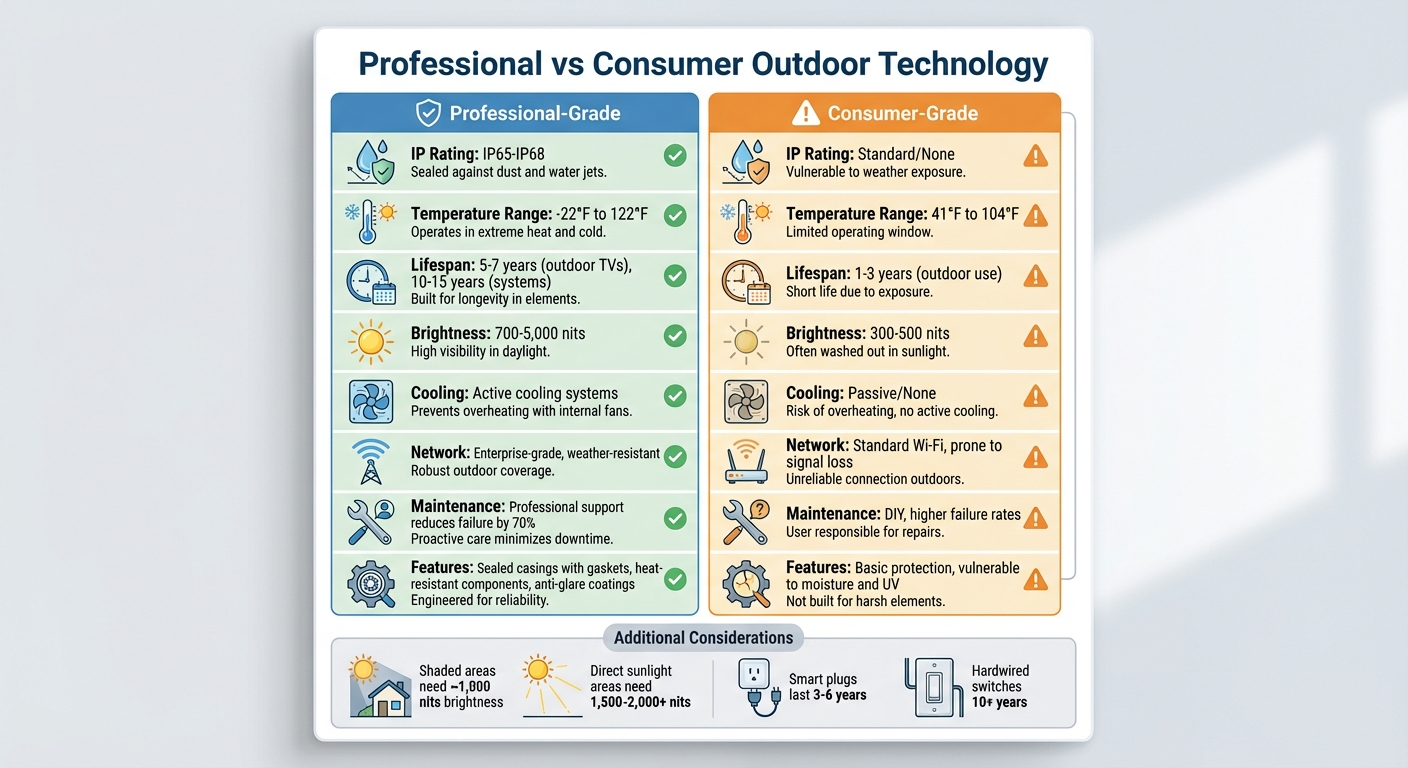
Professional vs Consumer Outdoor Technology: Durability and Performance Comparison
Built to Withstand Extreme Weather
Professional outdoor systems are designed with durability in mind, featuring sealed casings with gaskets that protect against moisture, dust, insects, and salt air – factors that can quickly ruin standard electronics [5][4]. These aren’t just basic protective covers; they include heat-resistant internal components and a sturdy chassis capable of withstanding harsh conditions like hail the size of golf balls and extended periods of heavy rain [5][4].
These systems are built to perform in extreme temperatures, operating reliably between -22°F and 122°F, compared to indoor TVs, which are typically rated for 41°F to 104°F [5]. This makes them ideal for areas with freezing winters or scorching summers. They’re also engineered to handle "cold starts", meaning the screens and hardware will respond immediately even in sub-zero temperatures, unlike standard devices that might freeze or slow down [5].
To combat overheating, especially when exposed to direct sunlight, professional outdoor TVs use active cooling systems. This feature addresses a common failure point in consumer-grade TVs and extends the lifespan of professional outdoor TVs to 5 to 7 years, compared to just 1 to 3 years for indoor TVs used outside, even with protective covers [5].
Visibility in bright outdoor conditions is another area where professional systems excel. These displays offer 700 to 5,000 nits of brightness with anti-glare coatings, far surpassing the 300 to 500 nits typical of indoor TVs [5][4]. For shaded patios, around 1,000 nits is sufficient, while setups in direct sunlight, such as poolside or open patios, may require 1,500 to 2,000+ nits for clear visibility [5]. Alongside these rugged features, reliable connectivity is essential for consistent outdoor performance.
Enterprise-Grade Networks and Smart System Integration
The durability of professional outdoor technology is matched by its seamless integration capabilities. Professional setups eliminate messy wiring by removing extension cords and exposed devices, which not only improves aesthetics but also enhances reliability in outdoor environments [5]. Enterprise-grade components ensure year-round operational stability, enabling features like remote monitoring, automated lighting schedules, and motion detection without interruptions.
A robust network infrastructure is vital when outdoor cameras, lighting, and entertainment systems need to connect with a central control system. Consumer-grade setups often face signal loss due to distance from home routers or interference from environmental factors, which can lead to frustrating connectivity issues [5]. Professional systems, on the other hand, are designed with resilient network architecture, ensuring consistent performance regardless of weather conditions – whether it’s 20°F in the winter or 95°F in the summer. These advanced systems not only enhance durability but also provide improved security and long-term value for your outdoor technology investment.
Real Benefits for Homeowners and Families
Better Family Gatherings and Outdoor Living
Upgrading your backyard with professional outdoor technology can turn it into a seamless extension of your home, perfect for seasonal enjoyment. Imagine hosting a gathering where a smart grill with Wi-Fi connectivity allows you to monitor food temperatures remotely, letting you focus on spending time with your guests. Pair that with automated lighting systems that adjust to sunset or activate "party modes", and your outdoor space becomes an inviting spot for evening get-togethers[6][1].
Weather-resistant outdoor entertainment systems make it possible to host movie nights or watch the big game under the stars. Professional-grade speakers provide rich, immersive sound throughout your yard, while smart ceiling fans, automated shades, and motion-activated pathway lighting ensure comfort and safety for everyone. These features not only elevate your outdoor living experience but also add an extra layer of security to your home all year long[6][1].
Improved Home Security and Peace of Mind
These advanced systems go beyond enhancing your social life – they also provide robust security for your home. Modern cameras equipped with AI can distinguish between people, animals, and vehicles, significantly reducing false alarms[7][8]. They offer 24/7 monitoring, even in harsh weather conditions, ensuring your property is always under watch[1].
Professional installations often include health monitoring features that notify you if a camera loses power or goes offline, so you’re never caught off guard during critical moments[8]. With backup options like cellular connectivity and wired backhaul, your security system remains operational even if your home Wi-Fi goes down[7][1]. Features such as line crossing detection, loitering alerts, and 4K color night vision ensure that potential threats are identified clearly, even in low-light settings[7][8]. These systems integrate seamlessly with existing professional-grade networks, offering a reliable and comprehensive security solution.
Higher Property Resale Value
Investing in outdoor technology can also boost your home’s market value. For instance, homes equipped with outdoor TVs tend to sell for 3.1% more, translating to an average increase of $10,749. Meanwhile, well-designed patios can enhance a home’s value by 8–10%, with a return on investment exceeding 80%[9][10]. These upgrades appeal to buyers who are increasingly drawn to homes that support a "resort-style" lifestyle, where the backyard serves as the main entertainment hub.
"This year was really all about the backyard features. It embodies this new lifestyle people want post-pandemic, where their social life is centered around their home, and specifically their yards."
Durability is key to preserving value. Professional-grade installations with proper IP ratings and routine maintenance are built to withstand extreme weather, ensuring long-term reliability[1]. These features can even help speed up the sale of your home, reducing time on the market by 5–6 days[9]. Younger, tech-savvy buyers especially appreciate features like security cameras and smart irrigation systems, making these upgrades a smart choice – even if you only use them part of the year.
Getting the Most from Your Outdoor Technology Investment
Custom Solutions for Your Property and Climate
When it comes to outdoor technology, a one-size-fits-all approach doesn’t work. Professional design ensures your setup matches your property’s layout and local climate. For example, IP65-rated devices are perfect for semi-protected areas like covered pergolas, while IP66 or IP67-rated devices are better suited for fully exposed spaces like open decks or poolside areas[1]. In regions like Northern New Jersey, where homes endure freeze-thaw cycles, coastal salt air, and intense summer heat, choosing hardware designed for these conditions helps prevent premature failures.
Professionals also use specialized materials to ensure durability. This includes outdoor-rated Cat6 cables and UV-resistant SPT-2 wiring, which hold up against prolonged sun exposure. Waterproof M8 or M12 connectors, combined with exterior-grade silicone to seal cable entry points, protect devices from water damage[1]. These precautions ensure your system can withstand harsh winters and scorching summers alike.
Starting with these tailored solutions not only protects your investment but also sets the stage for future upgrades as your needs evolve.
Planning for Future Upgrades and Expansion
A well-designed system isn’t just about meeting today’s needs – it should also adapt to tomorrow’s advancements. Opt for devices that use Matter and Thread protocols, which ensure compatibility across multiple brands and safeguard your setup from becoming obsolete if a manufacturer exits the market[1][3]. This flexibility allows for seamless upgrades, like adding more audio zones or integrating smart irrigation, without overhauling your entire infrastructure.
For permanent installations, hardwired smart switches and relays are a better long-term choice. These typically last over a decade, compared to the shorter lifespan of 3–6 years for outdoor smart plugs, which are more vulnerable to UV exposure and moisture[3]. While plug-in devices are fine for temporary setups like seasonal lighting, professional-grade hardwired solutions provide reliability and durability. Additionally, properly labeled cables make future maintenance and upgrades faster and more cost-effective[1].
Professional Maintenance and Support
Even if you only use your outdoor technology during certain seasons, regular maintenance keeps it functioning smoothly year-round. Professional upkeep can reduce device failure rates by as much as 70% compared to DIY setups that are left unchecked[1]. Technicians inspect seals for UV damage, update firmware to improve performance and security, and apply dielectric grease to metal connectors to prevent corrosion during freezing conditions[1].
Scheduling biannual maintenance – once before winter and again before summer – helps ensure your system stays reliable. In colder climates, professionals may also install small thermostatic heaters inside equipment enclosures to prevent condensation and battery drain during extreme cold[1]. These proactive steps safeguard your investment, ensuring your outdoor technology remains effective for years to come, not just a single season.
Conclusion
As discussed, professional-grade outdoor technology combines security, efficiency, and lifestyle advantages, offering value throughout the year. In Northern New Jersey, where homes endure harsh freeze-thaw cycles and coastal humidity, choosing durable equipment is a must [1][2].
Using rugged components and scheduling professional maintenance can cut equipment failure rates by 70% [1]. While hiring professionals to manage seasonal decorations costs between $250 and $650 annually [2], investing in permanent, smart-integrated solutions provides a cost-effective alternative. For example, outdoor LED lights, designed to last 50,000 hours, cost less than $1.50 per month when used for six hours nightly [2].
"If you only use them for Christmas, probably not. But if you unlock their full potential, they are one of the highest ROI (Return on Investment) upgrades you can make for your home’s exterior."
– Linkind [2]
Beyond the financial benefits, professional outdoor technology improves security, enhances curb appeal, and integrates seamlessly with smart home systems. From tailored lighting for events to automated security routines, these solutions are versatile enough to meet diverse needs [2]. For homeowners in Northern New Jersey looking for dependable and long-lasting home upgrades, professional-grade outdoor technology is more than a seasonal convenience – it’s a smart investment in safety, functionality, and property value.
What One Sound Choice clients say
I’d (tell others) that Ryan’s very professional and very easy to work with, in terms of budgeting and listening to what you want to have done. He never pushed us toward anything we couldn’t afford or didn’t want and he got the job done on time.
– Mr. & Mrs. DeSantis (1 Sound Choice client testimonials)
(We received) friendly, highly competent, quick and clean installation by 1 Sound Choice. The team followed up a few weeks after completion to ask if we were satisfied with our Media Room and Home Audio System. 1 Sound Choice is truly “top shelf” – they surpassed our expectations every step of the way.
– Mr. & Mrs. Blake (1 Sound Choice client testimonials)
Truly One Sound Choice, you won’t find better. I called a couple of AV companies for quotes but on speaking with Ryan I had confidence that One Sound Choice would do the job right. Most companises had assured me that they would not have to cut holes in my walls to achieve my project goals. Ryan was up front, honest and realistic outlining all the possible challenges my install might face whilst reassuring me that One Sound Choice had the capabilitiy and expertise to meet my goals. Consulation was painless and Ryan and Kenny captured my requirements perfectly and offered advice based on their experience regarding optional additons to the project, which were practical and delivered exceptional enhancements. Ryan provided me with a view of what could be achieved given my requirements and then worked with me complete the project with consideration to my budget, but without compromising the final solution. Even completed the project without requiring any patch work which was a bonus. Ryan and Kenny were a pleasure to work with, respectful and courteous and I had confidence having them in our home. Highly recommend for any AV work you are considering. You will not be disappointed with the results.
– Leighton (Houzz review)
FAQs
What outdoor tech is worth installing if I won’t use the patio in winter?
Investing in weather-resistant outdoor technology can be a smart decision, even if you only use it seasonally. Sturdy smart lighting and fixed installations not only boost the atmosphere and security of your space but can also increase your property’s value. To ensure these products endure the elements, prioritize those with IP-rated enclosures and waterproof connectors. These features keep your outdoor areas both practical and welcoming during the months they’re in use, delivering benefits that extend well beyond just one season.
What IP rating is needed for covered vs. fully exposed areas?
For outdoor spaces that are partially covered, a rating of IP44 typically provides sufficient protection. However, for areas that are fully exposed to the elements, a higher rating, such as IP65 or IP66, is necessary. These ratings are designed to safeguard against both water and dust, ensuring the fixture can withstand more challenging weather conditions.
How much maintenance does outdoor technology need each year?
Outdoor technology often needs yearly maintenance to remain reliable and in good working order. This can involve tasks like cleaning, checking for wear and tear, and replacing parts such as filters or fluids, depending on the specific equipment. Consistent care is crucial for maintaining performance and extending the lifespan of weather-resistant systems, particularly those built to endure shifting seasonal conditions.
Related Blog Posts
- Outdoor Entertainment Setup: 8 Ideas for Your Backyard
- “How Do You Design Outdoor Entertainment That’s Easy to Use, Not Complicated?”
- “What Should We Plan for Now If We Want Our Backyard Ready by Summer?”
- “How Do We Control Outdoor Audio and TVs Without Another App or Remote?”
Ready to plan your yard? See our backyard resort page.
More questions
Do outdoor cameras and lights still help in winter?
Yes. Speakers and TVs get used most in summer. Cameras, lights, and motion sensors keep working every month of the year.
One Sound Choice, 8 Tilley Ave, Pompton Plains, NJ 07444. Call or text (973) 945-5275. We work in homes across Morris, Passaic, Bergen, Essex, Somerset, and Hunterdon counties. Written by Ryan Herd, founder of One Sound Choice.