
Outdoor TVs are specifically designed for outdoor use, offering durability, weather resistance, and superior performance in challenging conditions. Unlike indoor TVs placed in enclosures, outdoor TVs can handle extreme temperatures, resist moisture, and deliver excellent picture quality even in direct sunlight. Enclosures, while cheaper upfront, often lead to higher long-term costs due to maintenance, repairs, and performance limitations. Here’s why outdoor TVs are the better choice:
- Weatherproof Design: Outdoor TVs are sealed against dust, water, and insects, with built-in temperature control systems for extreme climates.
- Brightness and Picture Quality: Designed for outdoor viewing, they offer 1,000+ nits of brightness and anti-glare coatings for clear visibility in sunlight.
- Long-Term Reliability: Built to last with durable materials, outdoor TVs require less frequent replacement compared to indoor TVs in enclosures.
- Smart Integration: Many outdoor TVs come with built-in streaming platforms and compatibility with smart home systems.
Quick Comparison
| Feature | Outdoor TV | Outdoor TV Enclosure |
|---|---|---|
| Weatherproofing | Fully sealed, IP55 rated | Relies on external casing |
| Temperature Range | -24°F to 122°F | Limited by indoor TV specs |
| Brightness | 1,000–4,000 nits | ~350 nits (indoor TV limit) |
| Durability | Built for outdoor use | Dependent on enclosure seals |
| Cost | $1,300–$13,000 | $399+ (enclosure only) |
| Warranty | Covered for outdoor use | Indoor TV warranty voided |
Investing in a true outdoor TV ensures better performance, fewer risks, and long-term savings. While an enclosure might seem like a budget-friendly option, it often compromises quality and durability, making outdoor TVs the smarter choice for outdoor entertainment.
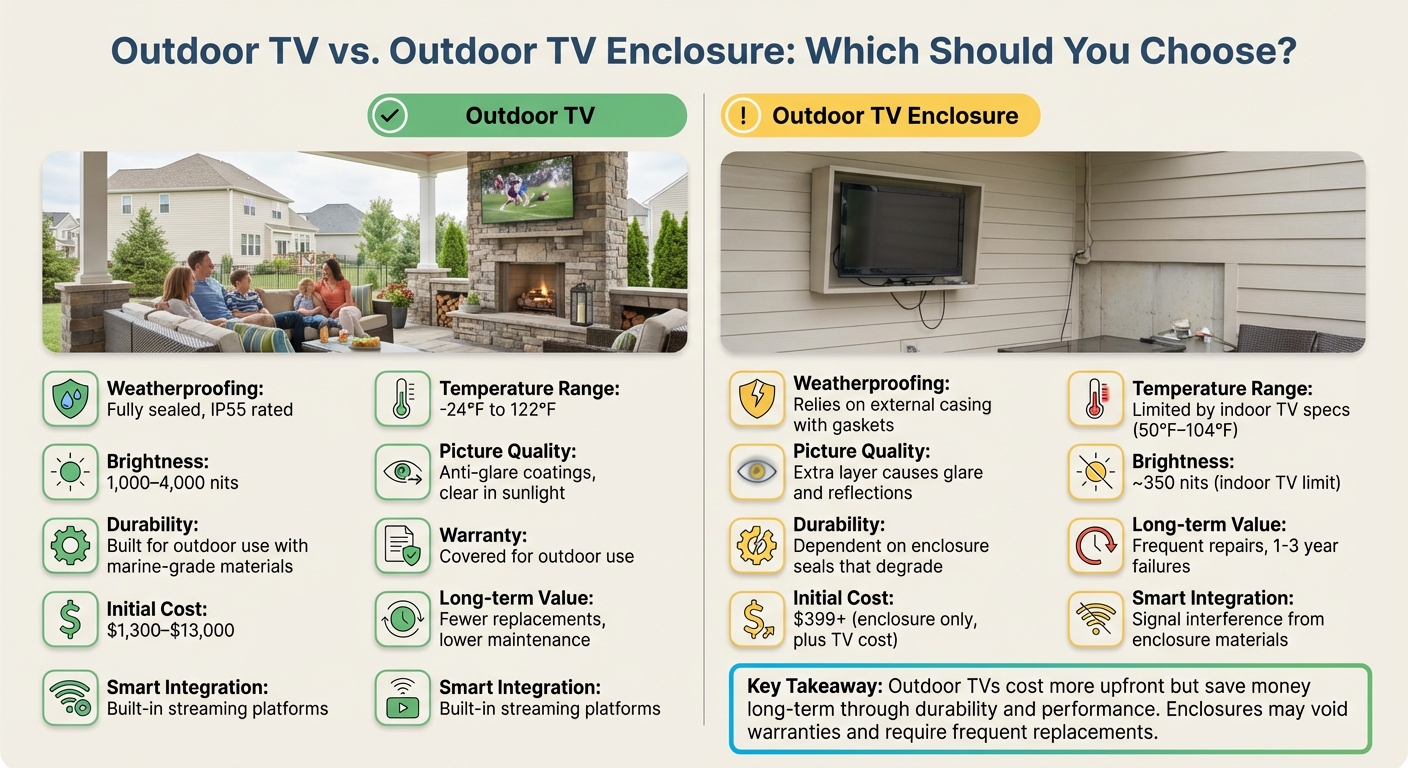
Outdoor TV vs Outdoor TV Enclosure: Complete Feature Comparison
Outdoor TVs Provide Better Weather Protection
Engineered for Outdoor Conditions
Outdoor TVs are purpose-built to endure tough outdoor environments. Their internal components and cable inputs are completely sealed to block out dust and water. With an IP55 rating, these TVs are safeguarded against dust and can handle water jets from any direction for up to five minutes [3]. Unlike setups that rely on external boxes, their waterproofing is seamlessly integrated into the design.
Temperature control is another standout feature of outdoor TVs. They function reliably in extreme conditions, from -24°F to 122°F [3], using built-in heaters and fans to regulate internal temperatures. To handle humid or salty environments, these TVs are made with anti-corrosion materials and powder-coated finishes. For homes near the coast, many models incorporate 316 marine-grade stainless steel to resist salt-fog corrosion.
Specialized vents and impenetrable grills prevent insects and spiders from damaging the electronics [4]. This level of durability sets outdoor TVs apart from indoor models that have been modified for outdoor use, which often lack such protections.
Weather Problems Enclosures Cannot Solve
Although enclosures are designed to protect indoor TVs outdoors, they fall short in several areas compared to outdoor TVs. One major issue is condensation, which can form inside enclosures and lead to short circuits [2]. Over time, the rubber seals used in enclosures crack and degrade, eventually allowing water and dust to infiltrate the system [7].
Indoor TVs also have limited temperature ranges, typically operating between 50°F and 104°F [3]. In freezing temperatures, the liquid crystals in LCD screens can expand and crack, causing permanent damage to the display [4]. On the other hand, extreme heat inside enclosures can speed up the failure of electronic components. High winds pose another challenge, as enclosures can act like sails, putting significant strain on mounting systems [7].
Even polycarbonate shields, often used in enclosures, are prone to cracking over time [7], leaving indoor TVs vulnerable to outdoor hazards. These limitations highlight why outdoor TVs are better suited for external environments.
sbb-itb-c5b321b
Outdoor TVs Deliver Better Picture Quality
High-Brightness Screens and Anti-Glare Technology
When it comes to outdoor TVs, picture quality is just as crucial as durability. Regular indoor TVs, with their typical brightness of around 250 nits, fall short in outdoor settings. In contrast, outdoor TVs offer brightness levels ranging from 1,000 to 4,000 nits, ensuring clear visibility even in direct sunlight [9][5][4]. As Bekka Oxley from Furrion points out:
In direct sunlight, that level of brightness is woefully inadequate, making your screen look washed out, faded, or invisible [5].
Outdoor TVs outperform their indoor counterparts by being four to sixteen times brighter, making them a superior choice for open-air environments. Many high-end models feature ambient light sensors that automatically adjust screen brightness based on the time of day. These are combined with matte finishes and specialized coatings that reduce glare by dispersing sunlight, ensuring a vibrant and clear image [10][9][5]. Furthermore, these screens are designed to prevent isotropic blackout, which refers to the black patches that can appear on standard LCDs when exposed to intense sunlight [4]. Technologies like IPS (In-Plane Switching) also enhance the viewing experience, offering a wide 178° viewing angle so everyone on your patio gets the same crisp picture [9][4].
How Enclosures Reduce Picture Quality
Using enclosures to house indoor TVs outdoors often leads to a noticeable drop in picture quality. The primary issue lies in the extra layer of plastic or glass between the viewer and the screen. This added layer increases reflections and glare, effectively doubling the very problem you’re trying to solve [2][8].
Enclosures also introduce other complications. Moisture and humidity can get trapped inside, leading to internal fogging and condensation, which obscures the screen [11]. Heat buildup is another serious drawback – trapped air can cause the internal electronics to overheat, potentially leading to permanent discoloration or even complete system failure [5][3]. Additionally, lower-quality materials used in some enclosures can diminish sharpness and color accuracy. The recessed position of the screen within the enclosure further limits side viewing angles, reducing the overall usability of the TV in outdoor spaces [2][11].
This contrast in performance highlights why purpose-built outdoor TVs are a better choice, setting the stage for a direct comparison.
Difference between an indoor tv and Patio outdoor TV. #outdoortv #Samsungterrace #Sunbrite
Outdoor TV vs. Outdoor TV Enclosure: Side-by-Side Comparison
Here’s a detailed comparison between purpose-built outdoor TVs and outdoor TV enclosures, highlighting their strengths and weaknesses.
Table:
| Feature | Outdoor TV | Outdoor TV Enclosure |
|---|---|---|
| Weatherproofing | Built as a sealed unit with IP54/IP55 ratings [4][6] | Relies on an external shell with gaskets for protection [2] |
| Temperature Control | Includes heaters and cooling fans, designed to operate in extreme conditions (-24°F to 122°F) [2][3] | Offers ventilation, with optional heaters for temperature management [1][2] |
| Brightness | High brightness levels (1,000–2,000+ nits) for clear visibility even in direct sunlight [3][5] | Limited to indoor TV brightness (~350 nits), which struggles outdoors [4][6] |
| Picture Quality | Equipped with anti-glare coatings and IPS technology for sharp visuals [4] | May experience glare or reflections from the enclosure’s front panel [1] |
| Security | Standard mounting options for installation | Features keyed locks and shatterproof panels for added security [2] |
| Repairability | Repairs are challenging due to the sealed design [2] | Easier to repair or replace the TV inside the enclosure [2] |
| Device Protection | Protects only the TV itself | Safeguards both the TV and connected streaming devices [2] |
| Warranty Coverage | Comes with a warranty specific to outdoor use [1][6] | Using an indoor TV outdoors voids its original warranty [4][6] |
| Upgradability | Entire unit must be replaced for upgrades [1] | Allows swapping out just the indoor TV component [1][2] |
| Initial Cost | Ranges from $1,300 to $13,000, depending on features [3] | Starts at $399 for the enclosure, plus the cost of an indoor TV [2] |
This comparison highlights how outdoor TVs are purpose-built to handle challenging environments, offering superior durability, brightness, and performance. On the other hand, enclosures provide a budget-friendly alternative but come with compromises in overall quality and protection. The choice depends on your priorities – whether you seek long-term reliability or a more economical option for occasional outdoor viewing.
Outdoor TVs Last Longer and Cost Less Over Time
Built for Longevity
Outdoor TVs are designed to stand the test of time, offering excellent long-term value through their durability. Unlike indoor models, outdoor TVs are specifically built to handle the challenges of being outside. Their frames are made from powder-coated aluminum or stainless steel, materials that resist UV damage and corrosion from rain or salty air[5]. This makes them far more resilient than the plastic frames typically found on indoor TVs.
The screens are another area where outdoor TVs shine. They use impact-resistant glass rated to IK08 or IK09, meaning they can withstand up to 5 joules of impact – enough to handle hail, debris, or other stray objects without cracking[5]. In contrast, indoor TV screens are more fragile and can suffer damage in freezing temperatures when liquid crystals expand[4]. Outdoor TVs also come equipped with systems to manage extreme temperatures, protecting against overheating or component failure – common issues for indoor TVs placed in outdoor enclosures[5][12].
"Although the initial investment is higher than with an indoor TV, in the long run it is less expensive since it does not need to be replaced as frequently." – WifiHiFi
This durability reduces the need for frequent replacements, making outdoor TVs a smart choice for long-term use.
Hidden Costs of Enclosures
While enclosures might seem like a cheaper alternative upfront, they often lead to higher costs over time due to frequent repairs and replacements. Indoor TVs housed in enclosures are particularly vulnerable to damage from humidity and extreme temperatures, often failing within a single season[4]. Additionally, using an indoor TV outdoors voids its warranty, leaving you to cover the full cost of replacements[4].
Enclosures themselves require regular upkeep. Weather seals and gaskets need constant inspection and replacement, and if a seal fails, the unprotected indoor TV inside can be damaged almost instantly[2][4][12]. Studies show that the combination of voided warranties and frequent failures within 1–3 years often cancels out any initial savings[2][4].
In the long run, the durability and reliability of outdoor TVs make them a more cost-effective option compared to the ongoing expenses of maintaining enclosures with indoor TVs.
Outdoor TVs Work Better with Smart Home Systems
Built-In Smart Features for Outdoor Use
Outdoor TVs are designed to work effortlessly with professional smart home systems, offering a unified way to control and automate your outdoor entertainment. Premium models often integrate with systems like Control4, Crestron, or Lutron, giving you the ability to manage volume, change channels, or even adjust outdoor lighting – all from a single interface[13][14]. This compatibility ensures your outdoor setup works seamlessly with the same controls you rely on indoors.
Many outdoor TVs also come equipped with built-in smart platforms, such as Samsung’s Tizen or Google TV. These platforms provide direct access to streaming apps, so you don’t need to rely on external devices[10][17]. Features like voice control, powered by Amazon Alexa or Google Assistant, add another layer of convenience. Additionally, some models include external antennas to boost WiFi and Bluetooth signals, addressing the challenges of being farther from indoor routers[5]. For the best performance, professional installers often recommend using a high-speed Ethernet connection to ensure smooth 4K streaming and reliable automation[18].
"Integrating speakers and TVs with smart home control systems will enhance usability and convenience. Using the same system you love inside, manage outdoor entertainment selections by adjusting the volume, changing the channel, or dimming the lights with a few button taps." – Bob’s Smart Home[13]
In comparison, indoor TVs placed inside enclosures struggle with similar levels of integration and convenience.
Why Enclosures Complicate Smart Home Integration
Using an indoor TV inside an enclosure introduces several challenges that make smart home integration less practical. First, mounting the TV within the enclosure can make accessing ports for professional wiring tricky[2][16]. This setup also complicates cable management and makes precise calibration more difficult[13][16].
The materials used for enclosures, such as metal or thick plastic, can interfere with WiFi and Bluetooth signals. This can create connectivity issues for streaming devices and smart remotes[17]. According to Consumer Reports, if you use a streaming stick inside an enclosure, you might need to leave the access door open to avoid signal loss. However, this exposes sensitive ports to moisture and dust, potentially damaging the equipment[17]. These limitations highlight why purpose-built outdoor TVs are a more reliable and practical choice for enhancing your outdoor living space.
Conclusion: Choose the Better Investment
What You Need to Remember
Outdoor TVs are specifically designed to handle the challenges of being outside. With sealed circuitry and proper IP ratings, like IP55, they are built to resist rain, dust, humidity, and extreme temperatures. This makes them far more reliable than indoor TVs, which often fail when exposed to outdoor conditions [5][19][20].
One of the standout features of outdoor TVs is their brightness, ranging from 400 to over 1,500 nits. This ensures a clear and vibrant picture, even in direct sunlight [5][10]. These technical advantages not only improve performance but also lead to long-term savings by reducing the need for frequent replacements or repairs.
While outdoor TVs typically cost between $1,500 and $3,000 or more, their durability, tailored warranties, and minimal maintenance requirements make them a better long-term investment. On the other hand, using an indoor TV with an enclosure often voids the warranty and risks failure due to moisture or dust within weeks [15].
The Right Choice for Your Home
When comparing the technical and economic benefits, purpose-built outdoor TVs clearly outshine retrofitted indoor models. For instance, the Samsung The Terrace, which earned a 9.4/10 rating for SDR brightness from RTINGS in November 2025, demonstrates the exceptional performance that outdoor TVs can deliver [10]. As BBQGuys aptly states:
Outdoor TVs are built specifically to handle the rigors of being outside [15].
With their advanced weather protection, superior image quality, and compatibility with smart home systems, outdoor TVs offer lasting performance and reliability. They are not just a short-term solution but a long-term investment that enhances your outdoor living space. By choosing a dedicated outdoor TV, you ensure peace of mind, fewer replacements, and a seamless entertainment experience tailored for the outdoors.
What One Sound Choice clients say
I’d (tell others) that Ryan’s very professional and very easy to work with, in terms of budgeting and listening to what you want to have done. He never pushed us toward anything we couldn’t afford or didn’t want and he got the job done on time.
– Mr. & Mrs. DeSantis (1 Sound Choice client testimonials)
The 1 Sound Choice staff was very easy to work with. Ryan, you understood our wants right from the beginning. Simplicity of installation and operation were just some of the reasons we chose 1 Sound Choice. You exceeded my expectations!
– Mr. & Mrs. Matia (1 Sound Choice client testimonials)
Very efficient and professional. Knowledgeable of equipment and products suited for your space/home. Perfectionists at their job and get the task done in promised time.
– dmhajjar (Houzz review)
FAQs
What IP rating do I actually need for my outdoor TV location?
For outdoor TV setups, an IP rating of at least IP54 is advisable to shield the device from dust and light water exposure. If you live in an area with more extreme weather, opting for a higher rating like IP65 can provide better protection against harsher conditions.
How bright should an outdoor TV be for partial sun vs full sun?
For outdoor TVs to perform well, they need a brightness level of at least 1,000 nits for areas with full sun exposure. For spots with partial sun, a brightness range of 700-800 nits is sufficient. These levels help maintain clear visuals and reduce glare, ensuring the screen remains easy to view in varying lighting conditions.
When does an enclosure make sense instead of a true outdoor TV?
Enclosures offer a practical solution when repurposing an indoor TV for outdoor use. They provide protection from dust, debris, UV rays, and harsh winter conditions. This can be a cost-effective alternative if investing in a dedicated outdoor TV isn’t an option. However, it’s worth noting that enclosures might not match the performance or durability of outdoor TVs, which are specifically engineered to withstand outdoor environments.
Related Blog Posts
- How to Choose Smart Lighting for Every Room in Your Home
- Outdoor Entertainment Setup: 8 Ideas for Your Backyard
- How to create a outdoor oasis with audio and video.
- What is the best outdoor TV?
Planning the whole patio? See our backyard resort page.
More questions
Is a TV enclosure cheaper?
It costs less at first. Over time it can cost more, because the indoor TV inside it still struggles with heat, cold, and damp air.
One Sound Choice, 8 Tilley Ave, Pompton Plains, NJ 07444. Call or text (973) 945-5275. We work in homes across Morris, Passaic, Bergen, Essex, Somerset, and Hunterdon counties. Written by Ryan Herd, founder of One Sound Choice.