
When it comes to protecting your home, choosing between smart home security systems and traditional alarms depends on your priorities. Smart systems offer convenience, remote access, and integration with other devices, while traditional alarms focus on reliability, simplicity, and professional monitoring.
Here’s a quick breakdown:
- Smart Home Security Systems: Enable remote control via smartphone, provide instant alerts, and integrate with smart devices like cameras, lights, and locks. They’re great for tech-savvy users but depend on internet connectivity and may have higher upfront costs.
- Traditional Alarm Systems: Use reliable hardware with 24/7 professional monitoring and operate independently of the internet. They’re simple to use but lack remote access and flexibility for upgrades.
Quick Comparison
| Feature | Smart Home Security | Traditional Alarms |
|---|---|---|
| Remote Access | Yes, via smartphone | No |
| Internet Dependency | Yes, with backups | No |
| Monitoring | Self or professional | Professional only |
| Integration | Works with smart devices | Limited to standalone use |
| Upfront Costs | $200–$1,500 | $600–$1,200 |
| Monthly Fees | $10–$50 | $20–$80 |
The right choice depends on your lifestyle and needs. For hands-on control and modern features, smart systems are ideal. For a straightforward, dependable setup, traditional alarms are a solid option.
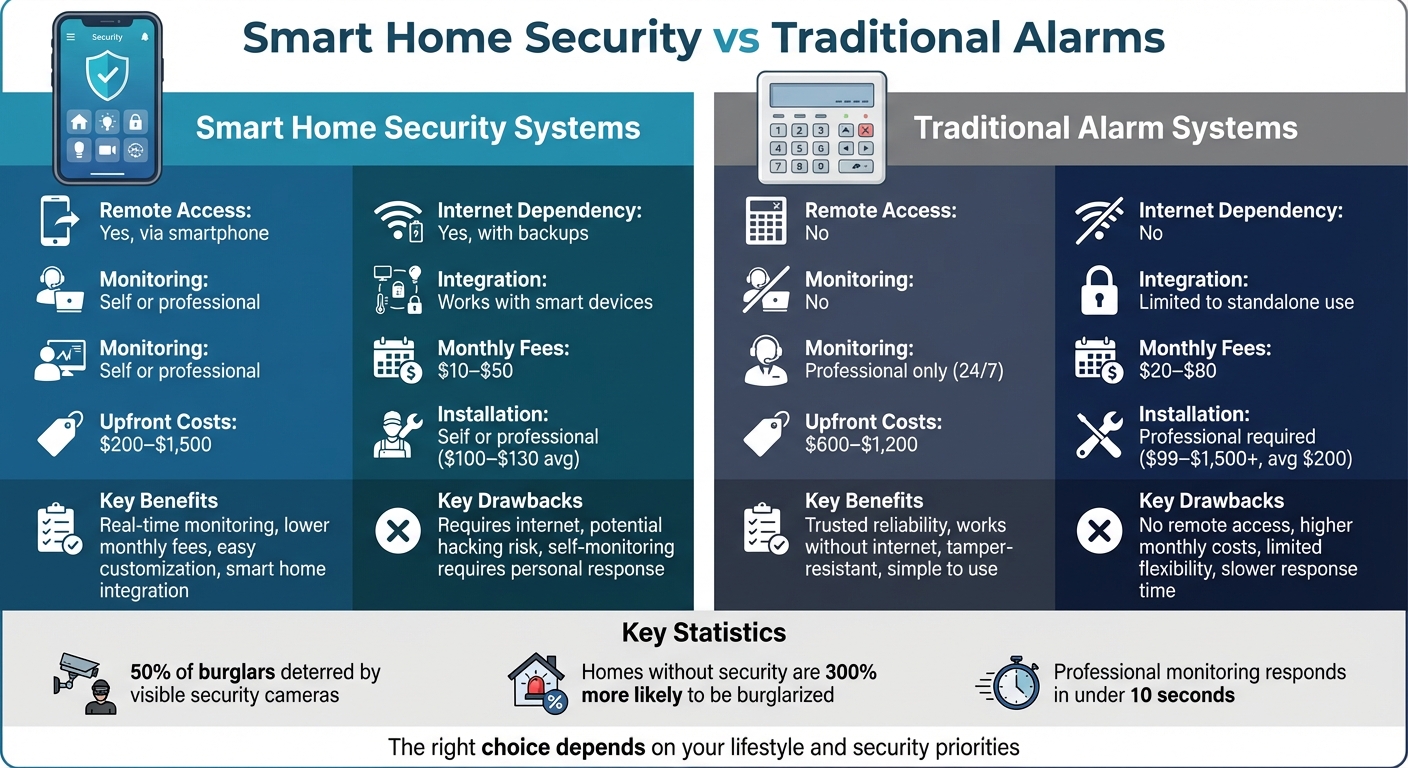
Smart Home Security vs Traditional Alarms: Feature and Cost Comparison
Wired vs Wireless Alarms Which Is Better for Your Home?
What Are Smart Home Security Systems?
Smart home security systems are internet-connected setups designed to bring home protection into the digital age. These systems let you monitor and control your home remotely. Whether you’re checking in on live video feeds, receiving instant alerts, or automating responses, you can manage it all from anywhere [1]. This connectivity forms the backbone of modern monitoring and automation, which we’ll delve into further.
The key difference with these systems is their connectivity. They link cameras, sensors, door locks, lights, and even thermostats into a single, unified network [3]. For example, if a sensor is triggered, the system can lock doors, adjust lighting, and provide live video access – all while notifying you or your chosen contacts. Everything is controlled through one app or control panel, whether you’re at home or on the go.
AI plays a big role in improving accuracy. Advanced detection features can tell the difference between a person, a package, an animal, or a vehicle [1]. This minimizes false alarms, so you only get notified about events that matter. Some systems even offer facial recognition, helping you identify visitors before you interact with them.
For families in Northern New Jersey, this level of integration offers not just security but also convenience. The system can adapt to your daily habits – arming itself when the house is empty and disarming when you return – creating a seamless and secure living environment.
Main Features of Smart Home Security
One of the standout features is remote monitoring. With just your smartphone, you can view live camera feeds and keep tabs on your home in real time [1].
Automated actions enhance convenience. You can lock doors, adjust lights, control cameras, or tweak thermostat settings remotely. Forgot to lock the front door? Want to make it look like someone’s home while you’re away? Automated scheduling makes these tasks effortless.
AI-powered detection is another game-changer. By distinguishing between different types of activity, it significantly reduces false alarms and ensures you only get alerts for important events [1].
Centralized control ties it all together. Cameras, locks, and sensors work seamlessly through a single app or control panel, making it easy to manage your home security as part of your daily routine.
Benefits of Smart Home Security
Live video access means you can check on your property anytime, anywhere. Whether you’re verifying a package delivery or making sure the kids got home safely, you’ll have secure, cloud-stored video at your fingertips.
Remote control ensures you’re always connected. Lock doors, grant access to trusted people, or tweak your security settings no matter where you are.
Customizable alerts let you prioritize what’s important. You can set up notifications for key events without being overwhelmed by every minor movement.
While these benefits are impressive, smart systems do come with some challenges.
Drawbacks of Smart Systems
One notable drawback is their reliance on the internet. If your connection goes down, features like live video monitoring and remote control may stop working. Having backup options in place is essential.
Privacy is another concern. Since these systems transmit and store data in the cloud, there’s always a risk of unauthorized access. While professional installation and strong network security can reduce this risk, it can’t be completely eliminated.
The upfront costs can also be higher compared to traditional systems. High-quality cameras, sensors, and professional-grade networking equipment, along with expert installation, often require a larger investment.
Lastly, professional setup is crucial for these systems to work properly. DIY installations often fall short when it comes to configuring networks, integrating devices, and thoroughly testing the system. In Northern New Jersey, hiring skilled professionals ensures your system is set up correctly and functions as intended from the start.
Next, we’ll take a closer look at traditional alarm systems to see how they compare in features and practicality.
What Are Traditional Alarm Systems?
Traditional alarm systems are designed to detect intrusions and sound an audible alarm when triggered. These systems can be hardwired or use wireless radio signals to communicate between components.
At the center of the system is the control panel, which connects all sensors and devices. This panel allows for keypad-based management, making it the "brain" of the setup. Traditional systems are known for their reliability, often using dedicated cellular or landline communication to ensure they remain operational even if your Wi‑Fi goes offline.
"Traditional security systems have long been trusted for their reliability and straightforward operation. Their less complex, often more rugged hardware design and straightforward monitoring services provide a sense of comfort to homeowners who prefer tried-and-true methods."
– truehomeprotection.com
One of the hallmarks of traditional alarm systems is professional monitoring. With 24/7 oversight, trained operators verify alarms and dispatch emergency responders when necessary. This consistency is especially valuable for busy families in Northern New Jersey who may not always be home to respond to alerts.
Now, let’s break down the key components that make these systems effective and secure.
Main Features of Traditional Alarms
Traditional alarm systems are built around a set of core components that work together to protect your home. Sensors are a primary feature, detecting movement, entry-point breaches, or sounds like breaking glass.
A crucial feature is the battery backup, which ensures the system remains operational during power outages. Even if the electricity is cut, the alarm continues to function and communicate with the monitoring center. The keypad interface offers a simple way to arm or disarm the system, making it user-friendly for all household members. Communication relies on dedicated cellular or landline channels, ensuring alerts reliably reach the monitoring station without depending on your internet connection. Additionally, these systems are designed to resist tampering, making it difficult for intruders to disable them.
Together, these features provide a dependable and straightforward security solution.
Benefits of Traditional Alarms
One of the biggest advantages of traditional alarm systems is their simplicity. They’re easy for everyone, from teenagers to grandparents, to operate without needing to navigate smartphone apps or worry about software updates.
Lower upfront costs also make them appealing. Without the need for expensive cameras or networking equipment, the initial investment is often more affordable. Plus, professional installation is typically included, ensuring the system is set up correctly from the start.
Another key benefit is their independence from internet connectivity. Even during storms or service outages – a common concern in Northern New Jersey – traditional alarm systems continue to protect your home.
"The biggest advantage is 24/7 professional monitoring: trained operators can quickly verify alarms and dispatch emergency responders when needed."
– Guardian Protection
Additionally, these systems tend to have fewer false alarms. Thanks to well-calibrated sensors and professional installation, alerts are more likely to be triggered by genuine threats rather than everyday activities.
Drawbacks of Traditional Alarms
Despite their strengths, traditional alarm systems do have some limitations. One major drawback is the lack of remote access. When you’re not home, you can’t check on your property or see what caused an alert, leaving you dependent on the monitoring center for updates.
Flexibility is another issue. Once installed, making changes – like adding new sensors – often requires a technician visit and additional costs. This lack of adaptability can make it challenging to adjust the system as your needs evolve or to integrate it with other home technologies.
Response times can also be slower compared to modern systems. Alerts are first sent to the monitoring center, where they must be verified before emergency services are contacted. While operators work quickly, this process can take longer than receiving an instant notification on your phone.
Finally, traditional alarms generally don’t integrate with smart home devices like smart locks, lighting, or thermostats. This means they operate independently, without offering the centralized control that many Northern New Jersey families now expect.
sbb-itb-c5b321b
Smart Systems vs Traditional Alarms: Side-by-Side Comparison
After diving into the detailed features of each system, this comparison highlights their practical differences. For families in Northern New Jersey, understanding these distinctions can help in choosing the best fit for their needs.
Feature Comparison
Smart systems focus on remote access and customization, while traditional alarms prioritize reliability and professional monitoring.
| Feature | Smart Home Security | Traditional Alarms |
|---|---|---|
| Remote Access | Full control via smartphone, including live video and instant notifications | Limited or none; managed through an on-site control panel |
| Response Speed | Instant alerts sent to your phone; monitoring response times vary by provider | Alerts are verified by a monitoring center before emergency dispatch |
| Installation | Self-installation is an option, though professional setup (averaging $100–$130) is recommended | Requires professional installation, with costs ranging from $99 to over $1,500 (average around $200) |
| Maintenance | Features automatic software updates and user-friendly troubleshooting tools | Relies on manual checks and occasional professional servicing |
| False Alarm Prevention | Advanced AI reduces false alarms by distinguishing real threats from routine activities | Uses simpler sensor technology; fewer false alarms when professionally calibrated |
| Device Integration | Works seamlessly with smart lights, locks, thermostats, and voice assistants | Operates independently, with little to no integration with other devices |
| Internet Dependency | Requires stable Wi-Fi but often includes cellular or battery backup | Functions without internet, using cellular or landline communication |
| Customization | Highly modular, allowing easy adjustments and component additions | Major changes require a technician’s visit |
This table lays the groundwork for assessing the strengths and weaknesses of each system.
Pros and Cons Summary
Weighing the advantages and drawbacks of these systems can help you find the right match for your lifestyle and security needs.
| System Type | Advantages | Disadvantages |
|---|---|---|
| Smart Home Security | • Real-time monitoring with instant alerts to your smartphone • Lower monthly fees ($10–$50 compared to $20–$80) • Easy to expand and customize • Integrates with smart home devices • Lower upfront costs with self-installation options | • Relies on a stable internet connection • Vulnerable to hacking or software issues • Self-monitoring requires personal response to alerts • May be challenging for less tech-savvy users |
| Traditional Alarms | • Trusted reliability with 24/7 professional monitoring • Operates without internet • Resistant to tampering and power outages • Simple for all household members to use • Professional verification before emergency dispatch | • No remote access when away from home • Higher monthly monitoring costs • Limited flexibility for upgrades or changes • Slower emergency response due to verification process • No integration with smart home ecosystems |
Smart systems typically cost between $200 and $1,500, while traditional systems range from $600 to $1,200. For families in Northern New Jersey looking to balance security with affordability, the lower monthly fees of smart systems can be appealing.
According to the Insurance Information Institute, smart home systems may lead to greater insurance premium discounts thanks to their advanced features [2]. Ultimately, the choice comes down to your family’s priorities and how you prefer to manage your home security.
Which System Works Best for Northern NJ Families?
The layout of your home and your daily routines play a big role in choosing the right security system. For larger homes in Northern NJ, comprehensive protection is especially important. Studies show that 50% of burglars are deterred when they spot security cameras [4]. This makes visible security measures an essential part of any system you choose.
How Each System Fits Family Life
Smart security systems are perfect for families who want control at their fingertips. With these systems, parents can check cameras, unlock doors remotely, and get instant alerts. Plus, they can integrate with features like smart lights and shades to create automated responses – like turning on outdoor lights when motion is detected.
Traditional alarm systems are ideal for families who prioritize simplicity and reliability. These systems use a straightforward keypad for arming and disarming, skipping the need for smartphone apps. They also offer 24/7 professional monitoring, where trained operators confirm alerts before contacting emergency services. Another advantage? They don’t rely on internet connectivity, so your home stays protected even during Wi-Fi outages.
For larger homes, solely relying on self-monitoring can be challenging. This is where professional oversight becomes invaluable. Homes without security systems are 300% more likely to be targeted by burglars compared to those with protection [4][9]. Choosing a system with expert installation ensures your home is not only secure but also efficiently monitored.
Why Professional Installation Matters
The quality of installation is just as important as the features of the system itself. With professional installation, all devices are seamlessly connected into a cohesive security network. Licensed technicians assess your home for vulnerabilities and strategically place sensors and cameras to provide the best possible coverage [5][6].
In Northern NJ, basic smart home setups generally cost between $3,000 and $5,000. For larger homes requiring comprehensive security, installations can range from $25,000 to over $100,000 [7]. These costs reflect the use of high-quality equipment, expert configuration, and access to ongoing support. Professional monitoring centers also respond to emergencies in under 10 seconds [8], ensuring quick action when it matters most.
Beyond the initial setup, professional installation offers long-term benefits. Technicians are available for troubleshooting, repairs, and system upgrades, ensuring your security setup evolves with your changing needs. This ongoing support makes your investment in home security both effective and adaptable over time [5][6][7].
Conclusion
Choosing between a smart security system and a traditional alarm comes down to what works best for your family’s lifestyle, home layout, and security needs. Smart systems offer modern conveniences like remote access and integration with home automation, while traditional alarms provide straightforward, reliable protection without relying on internet connectivity.
For families in Northern New Jersey looking for a customized security solution, One Sound Choice stands out with over 30 years of experience and more than 2,500 installations. Under the leadership of Ryan "The Smart Guy" Herd, their team specializes in installing professional-grade systems that blend effortlessly into your home. From the first consultation to ongoing support, they prioritize keeping your home secure with technology that’s easy to use, durable, and tailored specifically to your needs.
Whether you lean toward the advanced features of smart systems or the trusted simplicity of traditional alarms, professional installation ensures your system is set up to deliver the protection your family deserves.
What One Sound Choice clients say
We one a vacation home and were concerned with security when we are not there. 1 Sound Choice provided camera that allowed us to record all activity for a month and we could dial into the system from the internet. The system also will automatically flash lights inside the home to discourage intruders from entering.
– The Lavelle Family (1 Sound Choice client testimonials)
(We received) friendly, highly competent, quick and clean installation by 1 Sound Choice. The team followed up a few weeks after completion to ask if we were satisfied with our Media Room and Home Audio System. 1 Sound Choice is truly “top shelf” – they surpassed our expectations every step of the way.
– Mr. & Mrs. Blake (1 Sound Choice client testimonials)
I have hired 1 Sound Choice on several occasions over the past 10 years for several projects (from minor implementations to a whole house system). Ryan and the team at 1 Sound Choice are consummate professionals – extremely knowledgeable and up to date with technology, focused on delivering the best solution to fit your need, and highly customer service oriented. This combination plus the quality of finished product (every time) have made me a loyal customer… I highly recommend 1 Sound Choice.
– Terry Maytin (Houzz review)
FAQs
What advantages do smart home security systems have over traditional alarm systems?
Smart home security systems bring convenience and control to a whole new level. With real-time alerts and remote monitoring, you can keep an eye on your home no matter where you are. Plus, they work seamlessly with other smart devices like lighting and thermostats, creating a more connected and efficient home environment. Want to tweak settings to fit your family’s lifestyle? No problem – these systems are designed to be highly customizable.
What sets smart systems apart from traditional alarms is their ability to integrate with home automation. This not only simplifies security management but also enhances your home’s overall functionality. While the upfront cost might be higher than standard systems, the advanced features and flexibility they offer often make them a worthwhile investment – providing convenience and added security tailored for modern living.
What happens to smart home security systems during internet or power outages?
Smart home security systems are built to keep working, even if your internet or power goes out. Many of these systems come with cellular backup, so you’ll still get alerts if your Wi-Fi connection drops. On top of that, most devices include battery backups, ensuring essential functions stay active during power outages.
These built-in safeguards mean your home stays protected, giving you confidence that your security system won’t let you down, no matter what happens.
Should I choose a professionally installed security system or a DIY option?
When choosing between a professional installation and a DIY security system, think about your comfort with technology, how much support you’ll need, and what you want from your security setup in the long run.
DIY systems tend to be easier on the wallet upfront and give you more control over customization. However, they often don’t come with professional support, and there’s a chance of making mistakes during setup, which could impact their effectiveness.
Professionally installed systems, on the other hand, come with expert installation, regular maintenance, and 24/7 monitoring services. This option is perfect if you want a dependable, hassle-free way to protect your home and family for the long haul.
Related Blog Posts
- How to Choose Smart Lighting for Every Room in Your Home
- AI-Powered Smart Security System
- Home Theater Design Tool
- Wi-Fi Coverage Estimator
Thinking about a doorbell camera? See our doorbell camera page.
More questions
Do smart security systems need the internet?
For phone alerts and remote control, yes. A traditional alarm can work on its own without the internet.
One Sound Choice, 8 Tilley Ave, Pompton Plains, NJ 07444. Call or text (973) 945-5275. We work in homes across Morris, Passaic, Bergen, Essex, Somerset, and Hunterdon counties. Written by Ryan Herd, founder of One Sound Choice.