
When choosing a smart home system, you’ll encounter two main options: custom installations and off-the-shelf solutions. Custom systems are professionally designed and installed, offering centralized control, higher reliability, and tailored features for your home. Off-the-shelf devices, like smart bulbs or video doorbells, are more affordable and easy to install but often require managing multiple apps and may lack long-term scalability.
Key Points:
- Custom Systems: Unified interface, professional support, reliable hardwired or hybrid connections, and higher upfront costs ($2,000–$150,000). Ideal for larger homes or complex setups.
- Off-the-Shelf Devices: Affordable ($100–$3,000), DIY setup, wireless connections, but prone to compatibility and performance issues as the system grows.
For larger homes or evolving needs, custom systems provide better integration and support. Off-the-shelf options are suitable for simpler setups or renters but may face limitations over time.
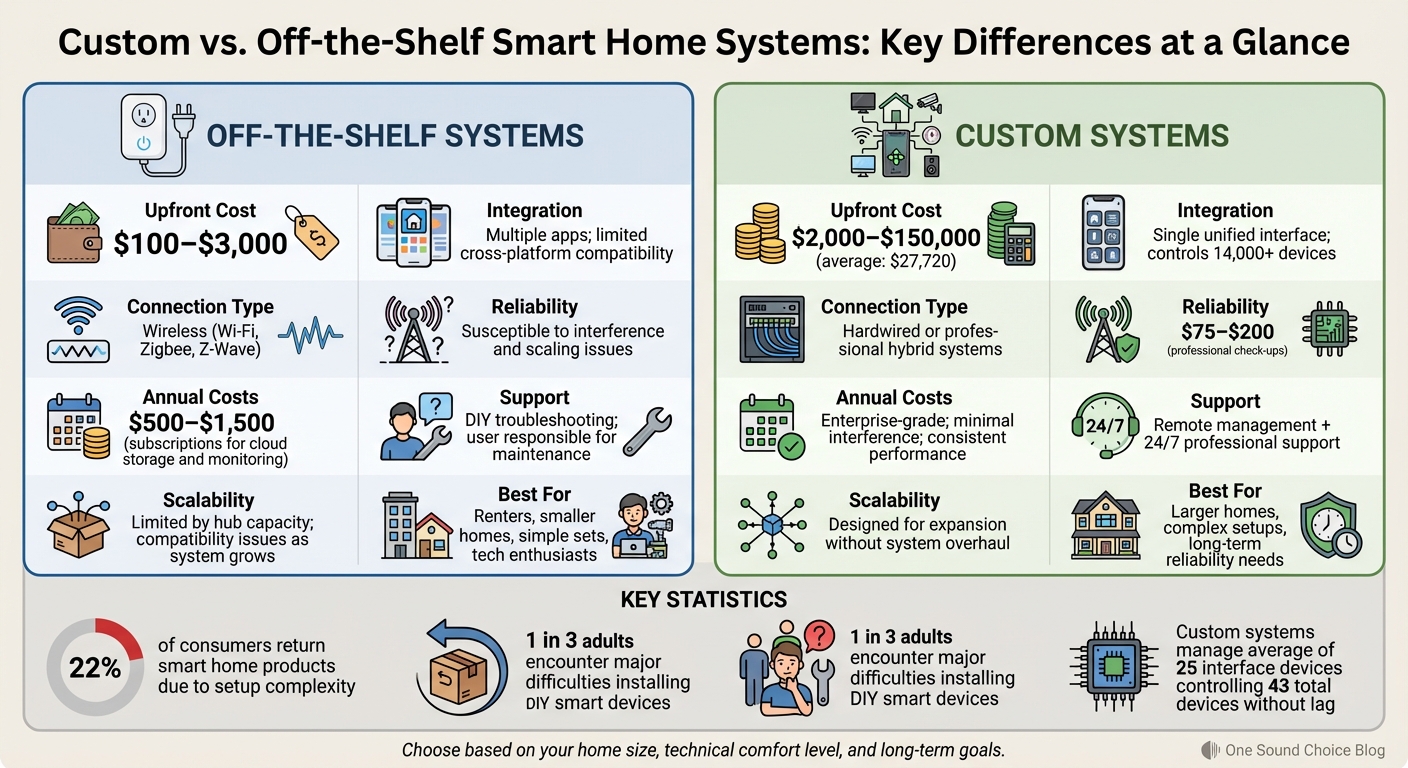
Custom vs Off-the-Shelf Smart Home Systems Comparison
What Are Custom and Off-the-Shelf Smart Home Systems?
Choosing between custom and off-the-shelf smart home systems involves understanding how they differ in design, installation, and ongoing support.
Custom Smart Home Systems
Custom smart home systems are built as complete, integrated solutions tailored specifically to your home and lifestyle. A professional integrator designs and installs these systems, ensuring they meet your unique needs. Platforms like Control4, Crestron, Savant, or Elan power these setups, enabling seamless control of nearly 14,000 devices from various manufacturers through a single interface [1].
These systems bring together multiple home functions – such as lighting, climate control, security, and audio/video – under one centralized controller. Connections are either hardwired or use professionally planned wireless protocols like Zigbee or Z-Wave, which ensure reliable performance even in larger homes or those with challenging construction materials [7][4]. Equipment is often neatly consolidated in AV racks or hidden panels, keeping your living spaces clutter-free [7].
"Off-the-shelf systems usually cover the very basic of home automation… but they often require the customer to adapt to the system. A professionally installed custom home automation system… is designed around a customer’s needs… A good analogy would be an off-the-rack suit versus a tailored one." – Joe Lautner, Director of Business Development, Core Brands [8]
Custom systems also come with professional support, offering services like remote troubleshooting and 24/7 monitoring [7]. The cost for these systems varies widely, with average installations priced around $27,720 in 2018, though luxury setups can range from $10,000 to $150,000 depending on their complexity [5][4]. This level of integration and support makes custom systems a robust choice for homeowners with evolving needs.
Off-the-Shelf Smart Home Solutions
Off-the-shelf smart home systems, on the other hand, are standalone devices you can purchase at retail and install yourself. Popular examples include smart thermostats, video doorbells, and connected light bulbs. These solutions are much more affordable upfront, typically costing between $100 and $3,000, and they allow for modular expansion [4].
However, their piecemeal nature can lead to challenges. Many users experience "app fatigue", as each device often requires its own app, and compatibility issues arise when trying to link devices from different manufacturers. While third-party hubs can help, they often have inconsistent results [2][7]. Additionally, these systems rely on your home’s Wi-Fi network, which may struggle to handle the increasing number of connected devices, leading to performance issues [7].
The DIY approach means you’re responsible for setup, troubleshooting, and maintenance. This can be a significant hurdle – more than one in three adults encounter major difficulties when installing smart home devices, and about 22% of consumers return products because they find them too complicated to set up [1]. Without professional planning, off-the-shelf systems often fail to scale effectively as your smart home expands.
Key Differences Between Custom and Off-the-Shelf Systems
System Integration and Compatibility
One of the most noticeable distinctions between custom and off-the-shelf systems lies in how they integrate devices. Custom systems rely on a centralized smart home operating system – like Control4, Crestron, or Savant – that serves as a universal translator for thousands of third-party devices. For example, Control4 can seamlessly connect and manage nearly 14,000 devices from hundreds of manufacturers, all through a single interface [1].
In contrast, off-the-shelf solutions operate within fragmented ecosystems. Many manufacturers create isolated "walled gardens", forcing users to juggle multiple apps and hope for smooth communication between devices. A homeowner in Minneapolis, for instance, managed to consolidate his 48-device, 12-app setup into one streamlined Control4 interface in less than two hours, showcasing the convenience of professional integration [1].
Professional integrators also use advanced programming tools, such as RTI‘s APEX or Crestron’s Pyng, to enable direct machine-to-machine communication. This bypasses the limitations of consumer platforms, simplifying management and improving system reliability [8].
Reliability and Performance
Custom systems are built on enterprise-level infrastructure, designed for durability and consistent performance. These setups often use hardwired protocols like X-10 and UPB or professionally designed hybrid systems such as C-Bus and Insteon, ensuring reliable operation even in challenging conditions [4][7]. Additionally, professional installations optimize equipment placement for cooling and accessibility, while remote management tools allow technicians to troubleshoot and reboot systems without needing to visit the site [7].
Off-the-shelf systems, on the other hand, rely on consumer-grade wireless protocols, which can struggle with range and interference issues as more devices are added. These setups are also vulnerable to manufacturer changes. For example, when Google discontinued its "Works with Nest" program, many DIY automations stopped working altogether [1]. Custom systems, by comparison, can handle an average of 25 interface devices controlling 43 total devices without noticeable lag, whereas DIY solutions often encounter scaling and performance challenges [5]. Beyond performance, the overall cost of ownership further highlights the advantages of custom systems over DIY alternatives.
Cost and Total Cost of Ownership
Upfront costs only tell part of the story when comparing these systems. Off-the-shelf solutions typically range from $100 to $3,000 for equipment, while custom installations start at around $2,000 and can go up to $150,000 for high-end setups. On average, a professionally installed system cost $27,720 in 2018 [5][4].
DIY systems often come with hidden expenses. About 22% of consumers end up returning smart home products due to setup frustrations [1]. Additionally, recurring subscription fees for cloud storage and professional monitoring can add $500 to $1,500 annually [4][6]. In contrast, custom systems generally require annual professional check-ups costing between $75 and $200, avoiding the ongoing subscription costs.
The long-term differences become clear in scalability and longevity. Custom systems are built to expand without requiring complete overhauls, while DIY setups often hit compatibility limits or capacity issues. Professional installations also include remote updates and continuous support, allowing the system to adapt to new devices and services without needing a complete rebuild. Trusted experts, like One Sound Choice in Northern NJ, ensure these systems remain dependable and ready for future needs.
The following table highlights the key differences between off-the-shelf and custom systems:
| Factor | Off-the-Shelf Systems | Custom Systems |
|---|---|---|
| Upfront Cost | $100–$3,000 [4] | $2,000–$150,000 [4] |
| Integration | Multiple apps; limited cross-platform [1] | Single unified interface; 14,000+ devices [1] |
| Connection Type | Wireless (Wi-Fi, Zigbee, Z-Wave) [4] | Hardwired or professional hybrid [4] |
| Reliability | Susceptible to interference [4] | Enterprise-grade; minimal interference [4] |
| Annual Costs | $500–$1,500 (subscriptions) [4][6] | $75–$200 (professional check-ups) [6] |
| Support | DIY troubleshooting | Remote management + 24/7 professional support [7] |
| Scalability | Limited by hub capacity; compatibility issues [1] | Designed for expansion without overhaul [5] |
Security and Privacy Considerations
When it comes to safeguarding your home and personal data, the choice between custom and off-the-shelf systems carries meaningful differences. Custom systems often use hardwired protocols like X-10 or UPB, which eliminate wireless signals and, in turn, reduce the risk of interception[4]. On the other hand, off-the-shelf systems heavily rely on wireless technologies such as Wi-Fi, Zigbee, or Z-Wave. While convenient, this reliance makes them more susceptible to hacking attempts[11]. These differences highlight why professional-grade systems often offer stronger security.
Custom Systems: Strength in Security
Custom systems go beyond integration and reliability – they also enhance security. Professional installers configure your network to maximize protection and ensure that all components are regularly updated to address potential vulnerabilities[7]. The most secure setups use a closed, wired system that’s completely isolated, or "air-gapped", from the internet[4].
Another key advantage is data privacy. Providers of custom systems, such as Control4, avoid selling personal data or user activity for advertising purposes[7]. Additionally, these systems often include 24/7 monitoring by experts, offering an extra layer of reassurance[3].
Off-the-Shelf Systems: Where They Fall Short
Consumer-grade systems come with notable security challenges. Justin Brookman, Director of Privacy and Technology Policy at Consumer Reports, emphasizes:
"Keep in mind that any system that relies on wireless signals, as these do, is susceptible to being hacked"[11].
These systems frequently rely on cloud servers for data storage and processing. While convenient, this dependency introduces privacy risks, as third-party servers may not always guarantee secure handling of sensitive information[9][10]. Furthermore, improper setup of these systems can leave them even more vulnerable to breaches[1][3][11].
For families in Northern NJ who prioritize enterprise-level security and prefer local data storage, One Sound Choice offers solutions that ensure your data stays on-site and out of the hands of third-party providers.
sbb-itb-c5b321b
User Experience and Support
Building on the advantages of system integration, the user experience between custom and off-the-shelf smart home systems varies significantly. Custom platforms like Control4 or Savant offer a seamless interface for managing lighting, audio, and shades through dedicated touchscreens and keypads. In contrast, off-the-shelf options often require juggling multiple apps to control different devices, creating a fragmented experience[7][1].
Ease of Use and Control
Custom systems are designed with simplicity in mind, ensuring that anyone in the household – not just tech enthusiasts – can easily operate them. These systems often feature centralized controls, such as wall-mounted touchscreens or universal remotes, making them accessible to everyone. Control4 emphasizes this point:
"Having a built-in smart home system means anyone – including visitors, nannies, or your technophobic parents – can access and control your system from centralized locations, like tabletop or wall-mounted touchscreens, keypads, or from a universal remote"[7].
Off-the-shelf systems, on the other hand, often lack such user-friendly access. Guests or less tech-savvy individuals may find it difficult to interact with these setups, as they typically require downloading and configuring multiple apps. Additionally, these systems can be prone to disruptions. For example, Google’s decision to phase out "Works with Nest" left many users scrambling to reconfigure their devices[1]. Custom systems avoid these pitfalls by offering professional management and maintenance, ensuring consistent performance and a more reliable experience.
Professional Support vs. DIY Maintenance
One of the key distinctions between custom and DIY systems lies in ongoing support. DIY setups often leave homeowners responsible for troubleshooting issues like firmware updates, battery replacements, or connectivity problems. In contrast, custom systems benefit from professional integrators who handle these tasks proactively. Using tools like OvrC, integrators can remotely monitor system health, update firmware, and even reboot devices – often resolving problems before users are even aware of them[7].
As Joe Lautner, Director of Business Development at Core Brands, explains:
"A professionally installed custom home automation system like ELAN is designed around a customer’s needs. We provide a level of personalization that is unmatched by the off-the-shelf world"[8].
For families in Northern New Jersey looking for smart home technology that operates seamlessly without the headaches of DIY maintenance, One Sound Choice offers expert guidance, over 30 years of experience, and dependable remote support to ensure everything runs smoothly.
Choosing the Right Approach
Deciding between custom and off-the-shelf smart home systems largely depends on factors like complexity, technical know-how, and long-term goals. Off-the-shelf solutions are a great fit for renters, smaller homes, or tech enthusiasts who enjoy experimenting. If your starting point is something simple, like a video doorbell or a few smart bulbs, these DIY options offer an affordable entry point, typically costing between $100 and $3,000[4]. While this can be a budget-friendly way to get started, it’s worth considering how your needs might evolve over time.
As your system grows, challenges can arise. Managing multiple apps or dealing with connectivity issues can quickly become frustrating, often negating the initial savings with wasted time and effort.
For larger homes or more complex needs, custom systems provide a more seamless experience. These setups offer unified control, hardwired reliability, and access to ongoing expert support[4]. Professional installations ensure that everything works as intended and that help is readily available if problems occur, giving you peace of mind.
Families in Northern New Jersey looking for dependable, integrated smart home solutions can rely on One Sound Choice. With over 30 years of experience, they specialize in creating technology infrastructures that safeguard your family, enhance your lifestyle, and remain dependable for years to come.
The choice boils down to simplicity and long-term reliability versus upfront cost savings. If you’re building or renovating, investing in professional-grade systems now can save you from costly retrofits later. On the other hand, if you’re comfortable juggling multiple apps and handling your own tech issues, off-the-shelf products can meet basic automation needs – just be mindful of the trade-offs in scalability and support.
What One Sound Choice clients say
We were surprised with what (Ryan) took away from the conversation – even reading between the lines to put everything we wanted and needed right into his designs for us. At first, we really didn’t know who to go with; we hadn’t had any renovations to our home before. We set up a consultation and liked (Ryan) because he was personable, a good listener and knowledgeable. He asked about our wish list and gave us some ideas…which were great.
– Mr. & Mrs. Caywood (1 Sound Choice client testimonials)
Ryan listened to us – he understood what we wanted to accomplish. (The 1 Sound Choice team’s) commitment to post-installation support and service has been unbelievable. They are professionals in every aspect and have gained our trust throughout the completion of our project.
– Mr. & Mrs. Maytin (1 Sound Choice client testimonials)
Truly One Sound Choice, you won’t find better. I called a couple of AV companies for quotes but on speaking with Ryan I had confidence that One Sound Choice would do the job right. Most companises had assured me that they would not have to cut holes in my walls to achieve my project goals. Ryan was up front, honest and realistic outlining all the possible challenges my install might face whilst reassuring me that One Sound Choice had the capabilitiy and expertise to meet my goals. Consulation was painless and Ryan and Kenny captured my requirements perfectly and offered advice based on their experience regarding optional additons to the project, which were practical and delivered exceptional enhancements. Ryan provided me with a view of what could be achieved given my requirements and then worked with me complete the project with consideration to my budget, but without compromising the final solution. Even completed the project without requiring any patch work which was a bonus. Ryan and Kenny were a pleasure to work with, respectful and courteous and I had confidence having them in our home. Highly recommend for any AV work you are considering. You will not be disappointed with the results.
– Leighton (Houzz review)
FAQs
How do I choose between a custom smart home system and an off-the-shelf solution?
Choosing between a custom smart home system and an off-the-shelf solution largely comes down to the size of your home, its complexity, and your specific needs. Custom systems are a great fit for larger or more intricate homes. They provide tailored solutions, seamless integration across devices, and reliable performance. Plus, they’re designed to adapt over time, making them a flexible choice for evolving needs. On the other hand, off-the-shelf systems work well for smaller homes or simpler setups. They’re affordable and easy to install but might not offer the same level of integration or dependability.
Another important factor is the level of support you prefer. Custom systems typically come with professional installation and ongoing assistance, which ensures everything operates as it should. In contrast, off-the-shelf options often require a DIY approach for setup and troubleshooting. While this can be appealing for tech-savvy users, it might feel overwhelming for others. Your decision should ultimately reflect your budget, how much control you want, and whether you value a personalized system with professional support.
Why are custom smart home systems more secure than off-the-shelf solutions?
Custom smart home systems put security front and center, delivering a level of integration and control that standard, off-the-shelf options just can’t provide. By connecting all your devices into a unified network, these systems help close the gaps in security that often come with juggling multiple standalone gadgets and apps.
With professional installation and high-quality hardware, custom setups offer more than just convenience – they bring enhanced reliability and are tailored to fit your unique needs. This thoughtful design not only reduces the risk of hacking but also ensures your system is built for long-term use, offering your family an added layer of safety and reassurance.
Are off-the-shelf smart home systems easy to upgrade as my needs change?
Off-the-shelf smart home systems may be quick and easy to set up, but they often come with limitations. These systems typically rely on fixed ecosystems or proprietary technologies, which can restrict their compatibility with newer devices or advanced features as time goes on. This can make it challenging to adapt your setup to changing needs or technological advancements.
In contrast, custom smart home systems are designed to grow with you. By using centralized control and open standards, they allow for smoother integration of additional devices and more advanced automation options. If you’re looking for a solution that not only meets your current needs but also adapts to future demands, a professionally installed system is often the smarter investment.
Related Blog Posts
- How to Choose Smart Lighting for Every Room in Your Home
- Smart Home Security Systems vs Traditional Alarms: What’s Best?
- Smart Home Questions Answered: 15 Common Concerns for Families
- Smart Home Investment: Quality vs. Cost
Want help with the plan? See our smart home page.
More questions
Can I start with store devices and go custom later?
Yes. Many homes start with a few store devices. A custom system can often take them in or replace them over time.
One Sound Choice, 8 Tilley Ave, Pompton Plains, NJ 07444. Call or text (973) 945-5275. We work in homes across Morris, Passaic, Bergen, Essex, Somerset, and Hunterdon counties. Written by Ryan Herd, founder of One Sound Choice.