
Low-voltage wiring is the backbone of a reliable smart home. Unlike Wi-Fi, which can struggle with congestion and interference, wired systems provide consistent performance, enhanced security, and scalability for modern devices like 4K TVs, security cameras, and smart hubs. As homes integrate more IoT devices and transition to faster internet standards like 10 Gigabit, installing advanced cabling such as Cat6A, Cat7, or fiber optics ensures long-term reliability and readiness for future advancements.
Key Benefits of Low-Voltage Wiring:
- Performance: Stable and high-speed connections (1–10 Gbps) for critical devices.
- Security: Hardwired systems are less prone to cyberattacks compared to Wi-Fi.
- Scalability: Supports growing data demands from IoT devices.
- Cost Efficiency: Installing during new construction ($1,000–$3,000) avoids expensive retrofits later.
Low-voltage wiring handles data, audio, video, and control signals with precision, powering technologies like Power over Ethernet (PoE) cameras, smart lighting, and whole-home audio systems. Proper installation, including separating low-voltage and high-voltage lines, using the right cable types, and planning for future upgrades, ensures optimal performance. For homeowners, investing in a wired infrastructure today prevents connectivity issues tomorrow.
Top 10 Smart Home Pre-Wire Secrets the Pros Use 2025!
What Low-Voltage Wiring Is and How It’s Used
Low-voltage wiring handles electrical systems that operate at 50 volts or less – commonly 12V, 24V, or 48V in residential settings – and is used to transmit data, control signals, and communications between smart home devices [2].
Unlike standard 120V/240V wiring, which powers appliances, low-voltage wiring creates a communication network for devices like security cameras, thermostats, speakers, and other networked equipment. It’s the backbone that allows these devices to "talk" to one another and respond to your commands [2].
Because these systems carry much less electrical current, they pose a lower risk of fire and electric shock compared to high-voltage circuits [2]. This safety advantage means that while low-voltage installations must adhere to the National Electrical Code (NEC) Article 725, they are often handled by skilled installers without requiring a licensed electrician or permits [2].
These characteristics shape the unique installation requirements and advantages of low-voltage systems.
Basic Characteristics of Low-Voltage Wiring
Low-voltage cables are generally between 12 and 24 AWG (American Wire Gauge) [2]. Designed to carry signals like audio, video, data, and control commands rather than heavy electrical loads, these cables are lightweight and flexible but can be more delicate during installation.
One key installation rule is keeping low-voltage wiring separate from high-voltage lines. To avoid electromagnetic interference, low-voltage cables should be placed at least 12 inches away from 120V/240V wiring. If they must cross, they should do so at a 90-degree angle to minimize interference [2].
Types of Low-Voltage Cables Used in Smart Homes
Different types of low-voltage cables are suited to specific smart home applications, ensuring reliable performance as technology continues to advance.
| Cable Type | Common Gauge | Primary Smart Home Application |
|---|---|---|
| Ethernet (Cat6/6A) | 23–24 AWG | High-speed internet, PoE devices, IP cameras, smart hubs |
| Coaxial (RG6) | 18 AWG | Cable TV, satellite signals, CCTV security cameras |
| Speaker Wire | 12–16 AWG | Whole-home audio systems, home theater speakers |
| Thermostat Wire | 18 AWG | HVAC communication, smart thermostats, video doorbells |
| Security Wire | 18–22 AWG | Alarm sensors, motion detectors, control panels |
| Fiber Optic | N/A | Ultra-high-speed data transmission, long-distance signals |
Among these, Ethernet cables have become the backbone of modern smart homes. Cat6 cables support speeds up to 10 Gbps over distances of 165 feet, while Cat6A extends this to 328 feet [6]. Power over Ethernet (PoE) is particularly useful, as it combines data and power delivery into a single cable, eliminating the need for separate power adapters [5].
Coaxial cables, like RG-6, remain a go-to for cable TV and satellite connections, though their role has lessened with the rise of streaming services [2]. Speaker wires, ranging from 12 to 16 AWG, are still essential for maintaining audio quality over long distances [2].
Choosing the right cable type ensures optimal performance today and prepares your home for future advancements. For instance, fiber optic cables are unmatched for supporting growing bandwidth demands, such as 8K video and 10 Gigabit speeds, all while avoiding interference [1].
Why Wired Connections Beat Wi-Fi for Smart Homes
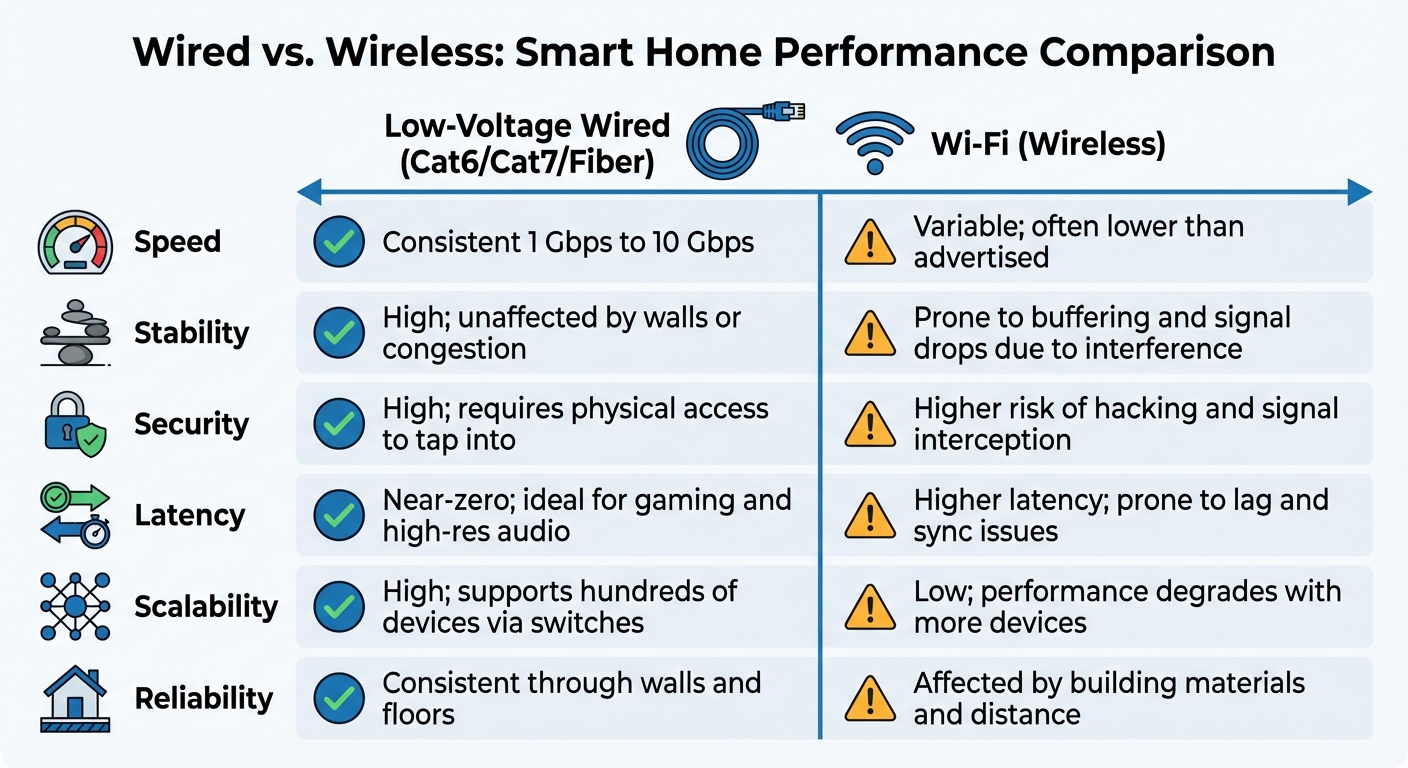
Wired vs Wi-Fi Smart Home Connections Performance Comparison
When it comes to smart homes, low-voltage wiring offers a clear advantage over Wi-Fi, especially as the number of connected devices continues to grow. Here are 9 wiring disasters that show what happens when it’s done badly.
Wi-Fi was originally designed with mobility in mind, making it less suited for managing the increasing number of stationary smart devices in homes. As more gadgets connect to your wireless network, congestion builds up, causing slower speeds, dropped connections, and overall performance issues [1].
"Wireless networking was developed as a communications platform for devices we walk around with. As he explains, using Wi-Fi to handle heavy data loads is like trying to extinguish a house fire with a garden hose."
- Eric Bodley, President of Future Ready Solutions [1]
By hardwiring devices that require high data usage – like 4K TVs, desktop computers, and security cameras – you can ensure a stable and reliable signal, even through thick walls or over long distances [4]. This also frees up your Wi-Fi network for mobile devices that truly need wireless connectivity [1].
Wired connections also excel in security. Low-voltage wiring reduces interference and is much harder to breach compared to wireless networks [1]. With billions of IoT devices now producing enormous amounts of data, the push for wired infrastructure has become more critical than ever [1].
Performance Comparison: Wired vs. Wireless
| Feature | Low-Voltage Wired (Cat6/Cat7/Fiber) | Wi-Fi (Wireless) |
|---|---|---|
| Speed | Consistent 1 Gbps to 10 Gbps [7] | Variable; often lower than advertised [7] |
| Stability | High; unaffected by walls or congestion [1][4] | Prone to buffering and signal drops due to interference [1] |
| Security | High; requires physical access to tap into [1] | Higher risk of hacking and signal interception [1] |
| Latency | Near-zero; ideal for gaming and high-res audio [1] | Higher latency; prone to lag and sync issues [1] |
| Scalability | High; supports hundreds of devices via switches [1] | Low; performance degrades with more devices [1] |
| Reliability | Consistent through walls and floors [4] | Affected by building materials and distance [7] |
These differences highlight why wired connections are a must-have for building a reliable and efficient smart home.
How to Install Low-Voltage Wiring Correctly
Installing low-voltage wiring the right way can save you from unexpected expenses down the road. The steps you take will vary depending on whether you’re working on new construction, a remodel, or an existing home. Here’s a guide to help you plan and carry out a reliable installation.
In new construction, where walls are still open, it’s a good idea to use high-performance cables like Cat6, Cat6a, Cat7, or fiber. Arrange these cables in a star layout, which centralizes connections and makes future upgrades much easier [1][6][7].
One key rule is to keep low-voltage wiring physically separated from high-voltage wiring. Maintain at least 12 inches of distance from 120V or 240V lines when running cables parallel to them. This spacing reduces electromagnetic interference, which can disrupt signals [2][6]. If the cables must cross, make sure they do so at a 90-degree angle to further minimize interference [6].
Handle low-voltage cables carefully – they’re more delicate than they might appear. Don’t pull with more than 25 pounds of force, and avoid making sharp 90-degree bends. Instead, opt for smooth loops when changing direction. Always label both ends of the cables and leave some extra length at termination points to allow for adjustments later [2][6].
Planning for Future Upgrades
To make future upgrades easier, install empty conduits from your central hub to key locations. These conduits provide a straightforward path for running new cables as technology advances [3][6].
Another smart move is to create detailed documentation. Map out every wire’s route, including line diagrams and device placements on floor plans. While this adds some upfront expense, it can prevent costly mistakes, especially on projects exceeding $50,000 [3]. Additionally, consider the heat generated by your equipment. Ensure proper ventilation or even dedicated cooling systems for your central hub [3].
Taking these steps now will not only make your system easier to upgrade but also help you budget effectively for different installation scenarios.
Installation Costs for Different Scenarios
| Scenario | Estimated Cost | Installation Difficulty | Future Flexibility |
|---|---|---|---|
| New Construction | $1,000–$3,000 [4] | Low (open walls, easy access) | High (room for conduits and extra lines) |
| Remodel | Moderate to High | Medium (partial wall access) | Moderate (depends on wall access) |
| Retrofit (Existing Home) | High (labor intensive) | High (fishing through finished walls) | Low (limited by existing structure) |
The costs can vary significantly depending on the scenario. Installing wiring during new construction or a major remodel is far less expensive compared to retrofitting an existing home. Retrofits often require specialized tools and can disrupt finished surfaces [2][6]. For remodels, you can minimize damage to finishes by running cables behind baseboards, through hollow stud walls, or via unfinished spaces like basements and attics [4][6].
sbb-itb-c5b321b
Common Mistakes to Avoid in Low-Voltage Wiring Projects
Getting low-voltage wiring right is critical, especially for the reliability required in modern smart homes. Skipping essential planning steps often leads to installation failures. In fact, nearly 25% of newly installed cables fail initial type testing due to poor installation techniques [8]. These mistakes can directly undermine system performance.
One major error is using the wrong wire gauge. If the wire is too thin, voltage drop becomes a real issue. For example, in a 12V system, losing 3V means the system operates at just 75% capacity, which can cause noticeable dimming in lighting fixtures [8]. Brian Brown, Founder and CEO of Wolverine Low Voltage, puts it succinctly:
"Voltage drop is the silent killer of low voltage systems" [8].
To avoid this, aim to keep total voltage drop within 3–5%, and for sensitive electronic systems, stay under 3% [8].
Another common misstep is using cables that aren’t properly rated for their environment. For instance, indoor-rated cables degrade quickly when used outdoors or in HVAC spaces. Always choose cables with the right environmental rating – plenum-rated for air-handling spaces or UV-resistant and waterproof for outdoor use. Failing to do so can lead to insulation breakdowns and safety risks [8][9].
Faulty connections are another frequent culprit. Damaging wire conductors during stripping or using the wrong crimping tools can lead to resistance issues, causing intermittent failures or even fire hazards [8][9]. Use color-coded wiring (such as red and black) to simplify polarity checks and verify connections with a multimeter before powering up DC systems [8]. Additionally, overloading the power supply by connecting too many devices can cause transformers to overheat and fail prematurely. Always design power budgets with a 20% overhead to account for inrush currents and potential future expansion [8].
Proper commissioning is also essential for long-term reliability. Skipping documentation and testing creates problems down the road. William Burke, Division Manager of Electrical Engineering at the National Fire Protection Association, emphasizes this point:
"An undisturbed wiring system will more or less work forever. But when it’s disturbed or altered, there’s potential for trouble" [10].
To ensure smooth operation, label every cable at both ends, test performance under full load, and maintain detailed records of wire routes and connection points [8][9]. These steps make future troubleshooting far easier and help ensure the system operates as intended.
How Low-Voltage Wiring Supports New Smart Home Technology
Low-voltage wiring plays a key role in powering modern smart home technology by delivering data, audio/video, and control signals with impressive reliability [1]. A solid wired infrastructure is essential for managing advanced home systems, enabling technologies like Power over Ethernet (PoE) cameras, distributed audio setups, enterprise-grade networking, and lighting automation to function smoothly together.
PoE technology simplifies smart home integration by combining power and data delivery into a single cable. Using the 802.3bt standard, a single Ethernet cable can supply up to 90 watts of power while transmitting data simultaneously [11]. This allows devices like IP cameras, motorized window shades, and smart lighting fixtures to operate without needing separate power outlets. For security systems, this eliminates the hassle of running both power and data lines to each camera location – one Cat6 cable does it all. This efficient setup ensures these systems are reliable and ready for daily use.
Bandwidth is another crucial factor. While Wi-Fi works well for mobile devices like smartphones and tablets, high-bandwidth devices require wired connections to perform optimally. Eric Bodley, President of Future Ready Solutions, highlights this limitation:
"Wireless networking was developed as a communications platform for devices we walk around with… as the number of wireless devices in a home continues to grow, the bandwidth of a wireless network becomes increasingly congested" [1].
By hardwiring stationary devices like 4K/8K TVs, surveillance cameras, and whole-home audio systems, homeowners can free up Wi-Fi bandwidth for mobile devices. This approach also addresses privacy concerns, as nearly two-thirds of homeowners worry about connected devices "listening" to their conversations [1].
Looking ahead, the importance of robust infrastructure will only grow. According to International Data Corporation (IDC), there will be 41.6 billion connected IoT devices generating 79.4 zettabytes of data by 2025 [1]. Industry experts also predict that 10 Gigabit internet speeds will soon become the norm [1][7]. Installing advanced cabling like Cat6A, Cat7, or fiber optics today ensures homes are ready for future data-heavy applications.
Low-Voltage Wiring for Family-Focused Smart Homes
Low-voltage wiring not only enhances system reliability but also supports features designed for family living. In Northern New Jersey homes, properly installed low-voltage systems power applications that make daily life easier. For example, whole-home audio systems use high-quality speaker wire (typically 16–12 AWG) to deliver consistent sound throughout the house, from the kitchen to outdoor entertainment spaces [11]. Unlike wireless speakers, which can suffer from interference or dropped connections, wired systems provide steady, high-quality performance.
Security and surveillance systems also benefit greatly from wired setups. PoE cameras running on 48V over Cat6 cabling deliver high-definition video feeds without the buffering or signal drops that are common with wireless options [11]. The same cabling infrastructure supports video doorbells, motion sensors, and alarm panels, creating an integrated and easily managed network.
Lighting and shade automation is another area where low-voltage wiring shines. Modern PoE lighting systems allow for advanced features like daylight harvesting, which adjusts light levels based on natural sunlight, and occupancy sensing [11]. Motorized shades can be programmed to close during the hottest parts of the day to reduce cooling costs or to open in the morning for a natural wake-up experience. These systems are also energy-efficient, using 75% less energy than traditional incandescent bulbs [12].
One Sound Choice‘s Approach to Future-Proof Wiring

One Sound Choice specializes in designing and installing low-voltage systems that evolve with advancing technology. With over 30 years of experience and more than 2,500 successful installations, the company understands that the wiring infrastructure installed today must support technologies that may not even exist yet. Their process begins with comprehensive planning during construction or renovation, making it easier to run cables through walls and ceilings without disruption.
Their approach focuses on how families actually live, rather than just what’s technically possible. This includes thoughtful placement of network drops for future devices, precise cooling calculations for equipment racks (measured in BTUs to prevent overheating), and detailed documentation of cable routes [3][11]. Led by industry expert Ryan "The Smart Guy" Herd, the team ensures every installation meets high standards, such as maintaining proper cable separation (at least 12 inches from high-voltage lines), adhering to correct bend radii for fiber optics, and thorough labeling for future maintenance [2][6].
What sets One Sound Choice apart is their commitment to ongoing support. As new technologies emerge – whether it’s the Matter universal standard for device compatibility or the next generation of 8K displays – their clients already have the wiring infrastructure needed to adopt these innovations. Their expertise ensures systems remain easy to use while being built to last, giving Northern New Jersey families confidence that their smart home investment will continue to meet their needs for years to come.
Conclusion
Low-voltage wiring serves as the backbone of a reliable, secure, and high-performing smart home. While wireless networks can struggle with congestion as more devices connect, a well-installed wired system ensures steady performance for demanding applications like 4K/8K video streaming, whole-home audio, and security cameras. As the demand for data continues to rise, having a strong wired infrastructure becomes even more important – not just for performance but also for enhanced security.
Hardwired connections offer a significant advantage by being less prone to cyber threats and interference. This means homeowners can keep sensitive data off wireless networks, providing an extra layer of privacy and peace of mind [1].
Using professional-grade cables like Cat6A, Cat7, or fiber optics ensures homes are ready for future advancements, including 10 Gigabit speeds, advanced Power over Ethernet (PoE) devices, and new smart home technologies. Eric Bodley, President of Future Ready Solutions, highlights this trend:
"It’s safe to assume that it won’t be long before 10 Gigabit speeds will become the standard of Internet service providers" [1].
For families in Northern New Jersey investing in smart home technology, working with trusted professionals like One Sound Choice ensures not only expert installation but also comprehensive documentation, keeping systems easy to maintain and upgrade for years to come. While wiring costs for new construction typically range from $1,000 to $3,000 [4], this upfront expense prevents the much higher costs of future retrofits. It’s an investment that pays off by creating a smart home that evolves with your family’s needs, offering long-term performance and value.
What One Sound Choice clients say
I’d (tell others) that Ryan’s very professional and very easy to work with, in terms of budgeting and listening to what you want to have done. He never pushed us toward anything we couldn’t afford or didn’t want and he got the job done on time.
– Mr. & Mrs. DeSantis (1 Sound Choice client testimonials)
(We received) friendly, highly competent, quick and clean installation by 1 Sound Choice. The team followed up a few weeks after completion to ask if we were satisfied with our Media Room and Home Audio System. 1 Sound Choice is truly “top shelf” – they surpassed our expectations every step of the way.
– Mr. & Mrs. Blake (1 Sound Choice client testimonials)
One Sound Choice was our second try at finding a contractor to repair our flood-damaged home after Irene blew through in August of 2011. Our Cape Cod house has a slab foundation and the entire first floor – living room, kitchen, dining room, two bedrooms, and a bathroom – got 5 feet of water. Ryan, the owner, was highly professional from start to finish. He worked closely with us to produce a contract that was within our insurance budget, and he came in on time and on budget. In some cases, he went over and above the call of duty; for example, surprising me with some crown molding in the bathroom and dining room that I had really wanted but just didn’t have the money for. We actually had enough left to hire him to do our home theater and bedroom media center! We were so pleased to have discovered the truly good people at One Sound Choice, and hope to work with them again when we are ready to remodel our upstairs rooms.
– bethbarnhill (Houzz review)
FAQs
What are the advantages of using low-voltage wiring in a smart home?
Low-voltage wiring brings some clear advantages to smart homes. It powers devices like sensors, thermostats, audio systems, security cameras, and networking equipment using voltages below 50V. This lower voltage drastically reduces the risk of electrical shock compared to the standard 120V or 240V circuits found in most homes.
Another big plus is its ability to deliver reliable, high-speed data transmission. By reducing reliance on wireless connections, it helps ease network congestion and provides a stable, wired backbone for your connected devices. Plus, its flexible nature makes installation simple and allows for easy upgrades or expansions, keeping your smart home ready for whatever new tech comes along.
Choosing low-voltage wiring means laying down a strong, future-ready foundation for your smart home. It ensures smooth integration of IoT devices, boosting efficiency and keeping your home prepared for the technologies of tomorrow.
How does low-voltage wiring enhance the security of a smart home?
Low-voltage wiring plays a key role in boosting smart home security by offering a stable and dependable connection for devices such as surveillance cameras, motion sensors, smart locks, and alarm systems. This type of wiring minimizes signal interference, ensures steady power delivery, and enhances the reliability of your security system.
With low-voltage wiring in place, smart home devices can perform more effectively, delivering quicker response times and improved consistency. It’s a crucial element for building a secure and well-prepared home setup.
How does the cost of installing low-voltage wiring compare between new construction and retrofitting an existing home?
Installing low-voltage wiring in a new build usually runs around $2–$6 per linear foot. The reason? Open walls make the job simpler and less time-consuming, keeping labor costs down.
On the other hand, retrofitting an older home tends to be pricier. The extra work involved in threading cables through finished walls drives up labor expenses. While the exact cost depends on your home’s layout and the complexity of the project, incorporating low-voltage wiring during the construction phase is often the smartest and most budget-friendly way to prepare your home for future smart tech upgrades.
Related Blog Posts
- How to Choose Smart Lighting for Every Room in Your Home
- How to Set Up Whole Home WiFi: 7 Steps for Better Coverage
- Fixing Slow WiFi at Home: 6 Solutions That Actually Work
- Smart Home Questions Answered: 15 Common Concerns for Families
Want help with the plan? See our smart home page.
More questions
Is it cheaper to wire during a build?
Yes. It costs less to run wire while the walls are open than to add it to a finished home later.
One Sound Choice, 8 Tilley Ave, Pompton Plains, NJ 07444. Call or text (973) 945-5275. We work in homes across Morris, Passaic, Bergen, Essex, Somerset, and Hunterdon counties. Written by Ryan Herd, founder of One Sound Choice.