
A real home theater is a room built for one job: making movies and big games feel like an event. I start with a high-quality Sony picture sized to the seats. Then come Triad speakers placed around the room, McIntosh power behind them, and light and sound you control. One button runs it all. My team and I design and build these rooms for homes across Northern New Jersey and in Manhattan.
I’m Ryan Herd, the founder of One Sound Choice, with over 35 years in tech. I’m a former Mayor of Pequannock, an author, a TEDx speaker and a patent holder.
Thanksgiving is Thursday, November 26, and the family’s coming over. A dedicated theater takes real time to design, build and tune, so this is a room for the games, movie nights and holidays that come after it. If you have a room in mind, call (973) 945-5275 or text (973) 945-5275. I answer my own phone.
What makes a home theater feel real
Four things working together: the picture, the sound, the room and the control. When all four are right, people stop talking when the movie starts, and they cheer together when the game turns.
Most homes I walk into get one or two of these right. There’s a great TV, or a strong set of speakers. A real theater is different, because the room itself is part of the system. The walls, the ceiling, the seats and the lights are all planned around the screen and the speakers.
That’s the big step up from a family room. In a family room, the TV has to share the space with windows, a kitchen, an open stairway and daily life. In a dedicated theater, everything in the room is there to serve the movie. If you want the family room side of this, see my earlier post on a 98-inch TV and music in every room.
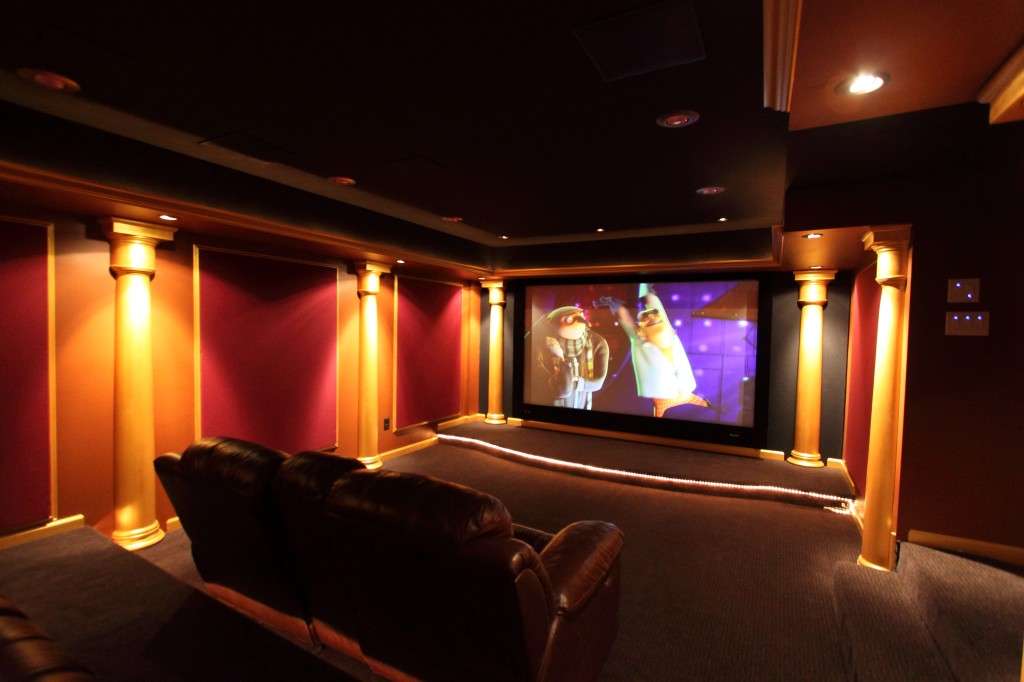
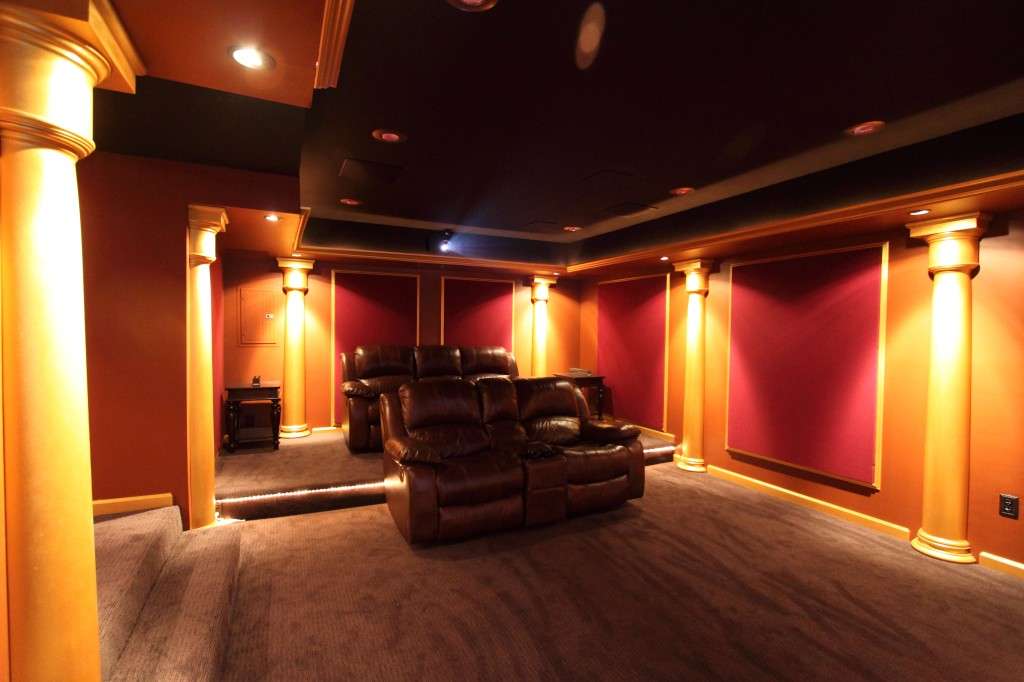
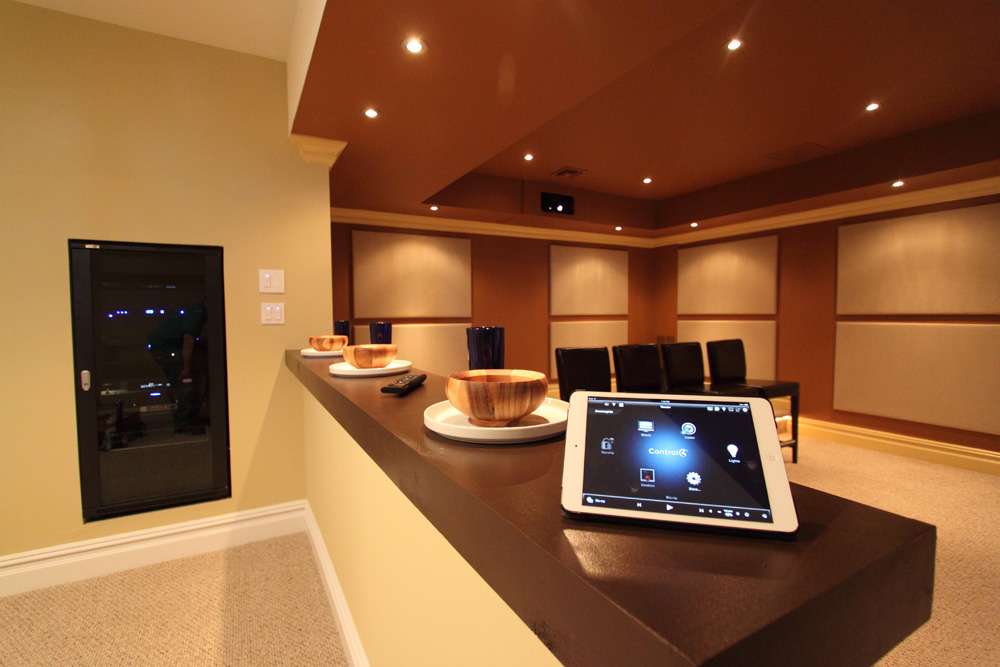
The theater in the photo above is a good example. The seats sit on a raised row, so the back row sees over the front. The columns and walls are lit softly, so nobody trips in the dark. And the screen is the brightest thing in the room. That’s exactly what you want.
After their open house and their daughter’s birthday party, Mike Deyong sent us this email about that theater:
FYI, the party went off without a hitch. I was doing demos all day. I had to wipe everyone’s chins off the floor. People were shocked and awed. If I had a nickel for each ‘unbelievable’, ‘incredible’ and ‘breathtaking’ that I heard, I could build another theater.
– Mike Deyong, One Sound Choice client
Where home theaters go wrong
Most of the time, they’re built as a pile of good parts instead of one planned room. People spend real money and still end up reaching for the remote all night.
Here’s what I see in homes again and again:
- Voices are hard to hear. The talking is too quiet, so you turn it up. Then the action scene comes, and it’s far too loud. You end up riding the volume all movie long.
- The bass booms in some seats and disappears in others. A single subwoofer in a corner can sound huge in one seat and thin in the next.
- The room fights the sound. Hard floors, bare walls and big windows bounce sound around, so dialogue turns muddy.
- Nobody else can run it. One person knows the four remotes. Everyone else calls for help or gives up.
- The sound leaks. The movie is great in the basement, and the bedroom above it hears every explosion.
- The settings never settle. Things get changed, then changed again, and the room never quite feels finished.
None of these come from buying the wrong brand. They’re planning problems. You solve them by placing the speakers for the seats, treating the room, calibrating the system and making it easy to run. That’s the work my team does.
Picking the Sony: projector or big TV
It depends on the room. A projector and screen give you the biggest picture in a room you can make dark. A very large Sony TV gives you a brighter picture and works well when some light stays in the room. Sony is my favorite brand for its natural color and smooth motion, and Sony makes both.
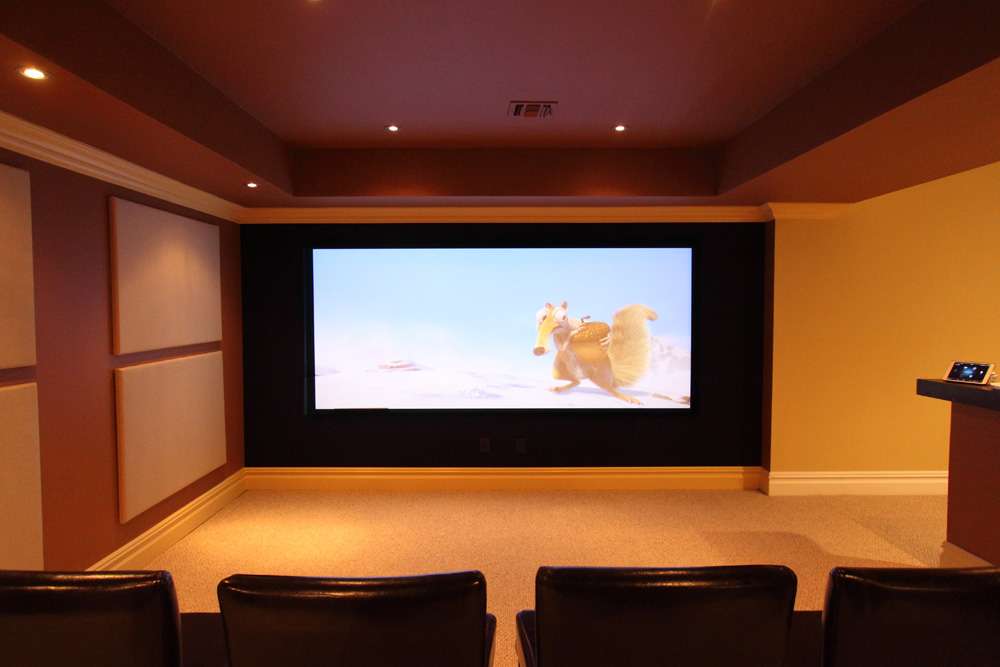
Here are the big Sony choices I look at most for a theater. The prices are what Sony’s own store listed on November 13, 2026. Prices change often, so we check them again when we put your plan together.
| Sony model | What it is | Best fit | Sony store price, Nov 13, 2026 |
|---|---|---|---|
| BRAVIA Projector 9 (VPL-XW8100ES) | Laser projector with a native 4K panel and up to 3,400 lumens | A dark, dedicated room with a large screen | $32,999.99 |
| BRAVIA Projector 8 (VPL-XW6100ES) | Laser 4K projector, one step below the Projector 9 | A dark theater with a smaller screen | $15,999.99 |
| BRAVIA 9 II 115-inch (K-115XR90M2) | Sony’s largest TV, with True RGB LED backlight | A theater that is not fully dark, or that is used in the day | $30,999.99 |
| BRAVIA 7 II 98-inch (K-98XR70M2) | 98-inch True RGB LED TV | A medium theater or media room | $8,999.99 |
| BRAVIA 5 98-inch (K-98XR50) | 98-inch Mini LED TV | A media room or bonus room | $3,199.99 |
A few facts from Sony help explain the choice. Sony says the BRAVIA Projector 9 has a native 4K panel with 3,840 x 2,160 resolution, a laser light source rated for up to 20,000 hours, and a recommended image size from 60 to 300 inches. Sony also says it can tie into control systems like Control4, Crestron and Savant. That’s how I make it start with one button.
On the TV side, Sony says the BRAVIA 9 II and BRAVIA 7 II use independently driven red, green and blue LEDs, and an X-Wide Angle design that keeps color steady from almost any seat. That matters in a theater with two rows, where some people sit off to the side.
The tradeoff: a projector needs a dark room and a good screen, and the room has to be planned around where the projector sits. A big TV is simpler and brighter, but even 115 inches is smaller than what a projector can throw in a large room. When I visit, I measure the room and the seat distance and show you what each choice would look like from your seats.
Why I use Triad speakers
In a theater, the speakers should be heard, not seen. Triad builds speakers made for custom rooms, and they can go inside the walls and ceiling. The room stays clean, and the sound comes from the right places.
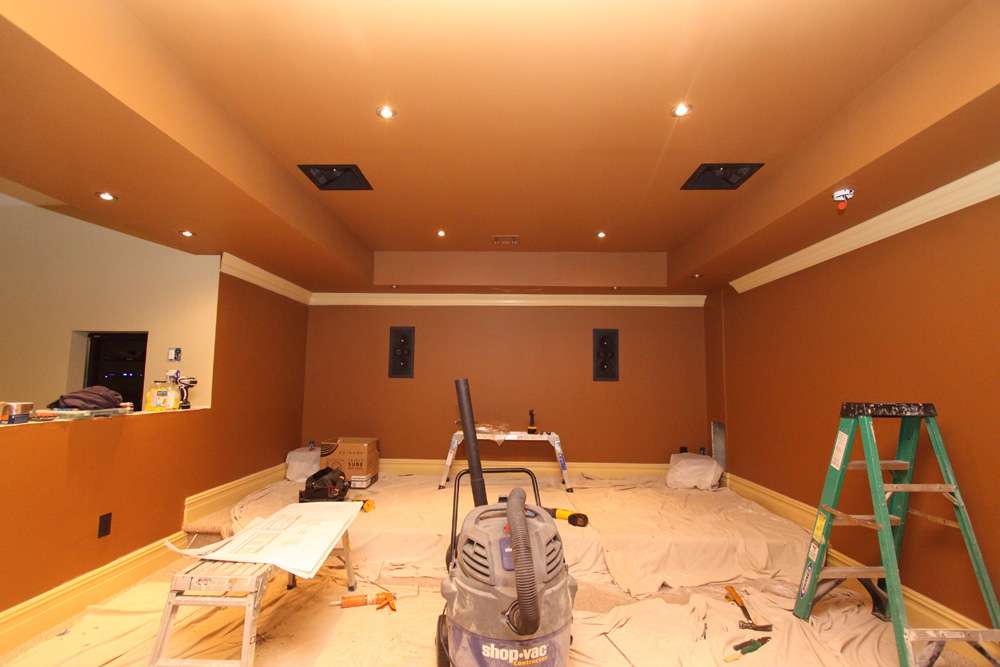
Triad has made speakers since 1981. On its own site, Triad says its speakers are built to order by hand in Portland, Oregon, and every speaker is tested in an anechoic chamber so the tone matches from speaker to speaker. That matching matters a lot in a theater. When a car drives from the front of the room to the back, it should sound like the same car the whole way.
For the front of a theater, Triad makes the Cinema Reference InWall LCR, a left, center and right speaker built for high-output home theaters. Triad lists it at 92 dB sensitivity and 250 watts of steady power handling, in a sealed design. In plain words, it plays loud and clean without strain, and the sealed box keeps the bass tight.
For the low end, Triad says its powered InRoom dual subwoofers can run at full power for over a minute. Big movie scenes and big plays can last a while, so that steady power matters.
The tradeoff: in-wall speakers need to be planned before the walls are finished, or they need careful work in an existing wall. That’s one reason a dedicated theater is a real project, not a weekend install.
What McIntosh power adds
Clean, steady power with room to spare. When a movie goes from a whisper to an explosion, the amplifier has to deliver without strain, or the sound gets harsh. McIntosh amplifiers are built for that moment. And I’ll admit it: their glowing blue meters look great in the room.
Take the McIntosh MC257, a 7-channel amplifier made for home theaters. McIntosh says it delivers 200 watts on each of 7 channels, or 250 watts on each of the 3 front channels when only those are used, into 4 or 8 ohm speakers. McIntosh also says it’s cooled by large heatsinks, so it doesn’t need noisy cooling fans. In a quiet theater, a fan you can hear during a soft scene is a real distraction.
McIntosh adds a few other things I like. Its Power Guard circuit is designed to prevent speaker damage from clipping, which happens when an amplifier is pushed past its limit. And the blue meter light can be turned off, so it doesn’t compete with the screen when the lights go down.
For larger theaters, McIntosh makes other multichannel amplifiers that can be paired for rooms with more speakers. I match the amplifiers to the speakers and the size of the room.
For the picture, I’d go with a smaller but better, higher quality screen. For speakers, bigger is always better. Same with amplifiers.
If this is the room where you’ll watch that blockbuster or your favorite movie, or listen to music if you’re really into music, it should be the best sounding and best looking room in the house. This is where I’d spend the money. For the other TVs in the house, I’d just get regular ones, even Costco TVs, and put the budget into this room. It’s the room you’ll enjoy the most, with your family.
Thinking about a dedicated theater in your home? call (973) 945-5275 or text (973) 945-5275, and tell me about the room. You can also see the idea in short on our home theater for the holidays page.
Clear voices, and sound that stays in the room
For clear voices, I start with the center speaker, then fix the room, then tune the system. Almost all the talking in a movie comes from the center speaker. So it has to be the right speaker, in the right spot, aimed at the ears of the people sitting down.
Here’s what that looks like in a real room:
- The center speaker sits at the screen. With a projection screen, it can sit behind the screen so voices seem to come from the faces. With a TV, it sits just below or above the screen, aimed at seated ear height.
- The room gets acoustic treatment. Fabric panels on the walls soak up the bounce that makes voices muddy. In the theater above, the fabric walls are part of the design.
- More than one subwoofer. Two or more subwoofers, placed well, smooth the bass so it sounds the same in the front row and the back row.
- A calibration at the end. We measure the sound at the seats and set the levels and timing for each speaker. Then we lock the settings so they don’t drift.
This matters most when the whole family is there. Grandparents should hear every word without asking for the volume to go up. Kids should be able to watch a holiday movie at a comfortable level. A well-planned room does both.
Keeping the sound in the theater is the other half. A theater should be big and exciting inside and calm everywhere else in the house, and that gets planned before the walls are closed.
The tools are simple, but the timing matters. Insulation in the walls and ceiling, a solid door instead of a hollow one, and careful sealing around the room all help. Triad also makes rear enclosures for its in-wall and in-ceiling speakers, and Triad says they help reduce sound moving through the walls into nearby rooms.
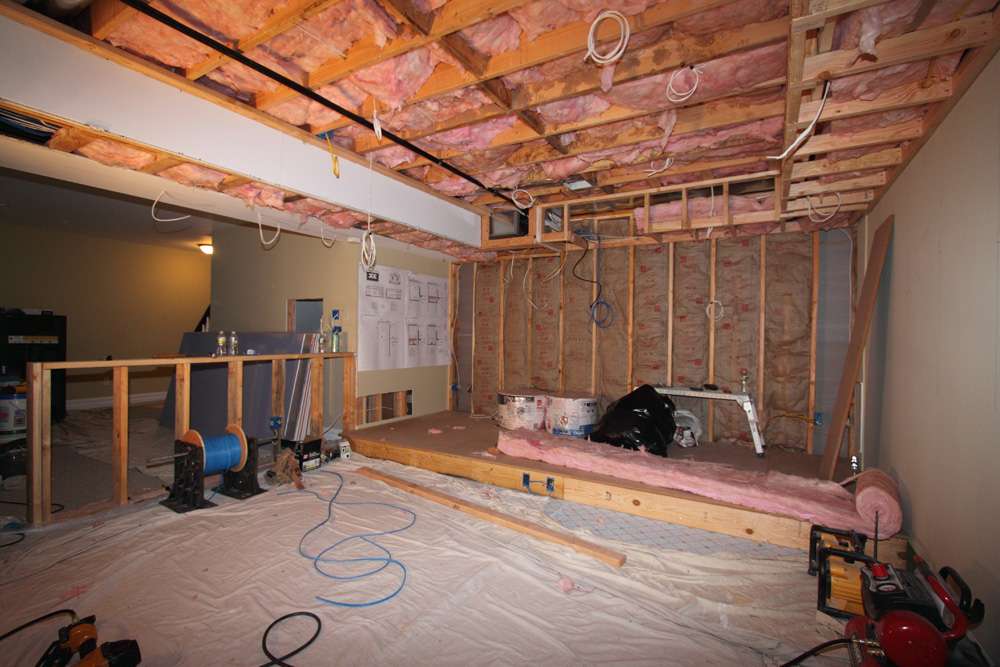
Bass is the hardest part to contain. That’s why I plan where the subwoofers go with the rooms above and beside the theater in mind. Most of this work happens during framing and drywall. It’s very hard to add after the room is finished, which is one more reason to plan the theater as a full project.
Seats for a crowd, and game day
I plan the main seats first, then the extra seats for the crowd. The main seats are centered on the screen at the right distance. The extra seats give everyone else a good view without blocking anyone.
In a dedicated theater, that usually means:
- A front row of recliners, centered on the screen, at the distance where the screen fills your view without making you turn your head.
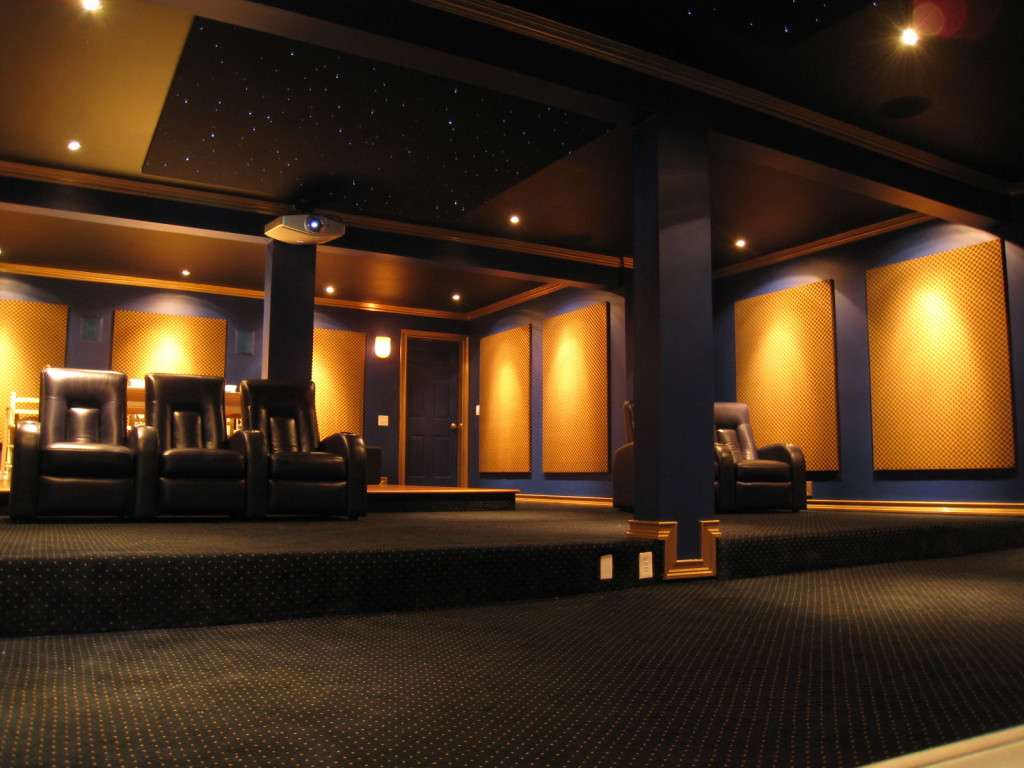
- A raised second row, on a platform, so the back row sees over the front. The theater at the top of this post has one.
- A bar-height counter behind the back row in many rooms. During the game, people like to stand, eat and drift in and out. A counter gives them a good view without crowding the recliners.
- Soft step and aisle lights, so people can move in the dark without turning on the room lights.
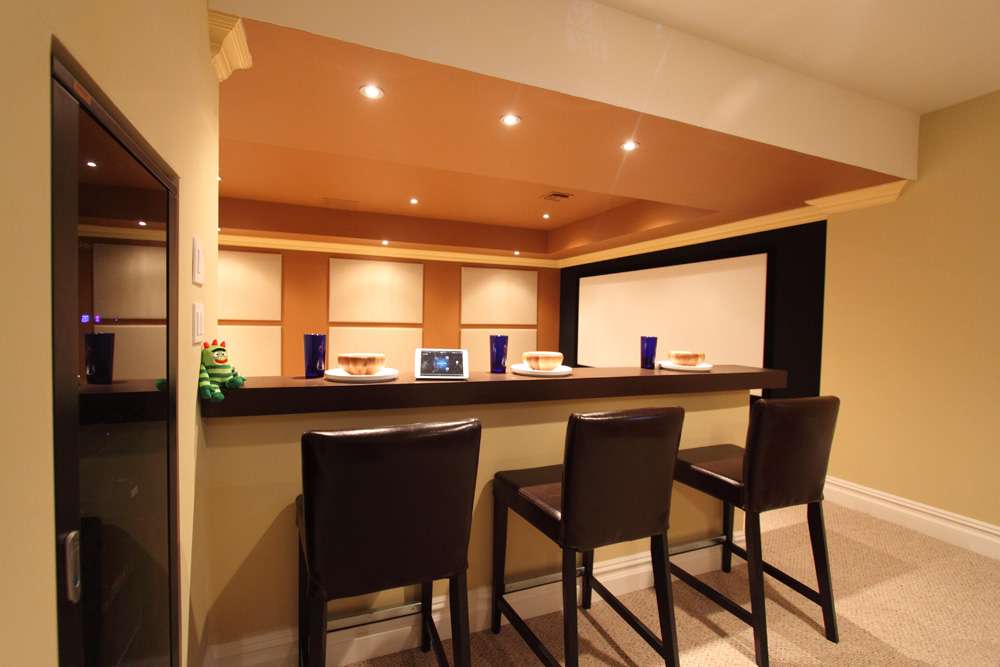
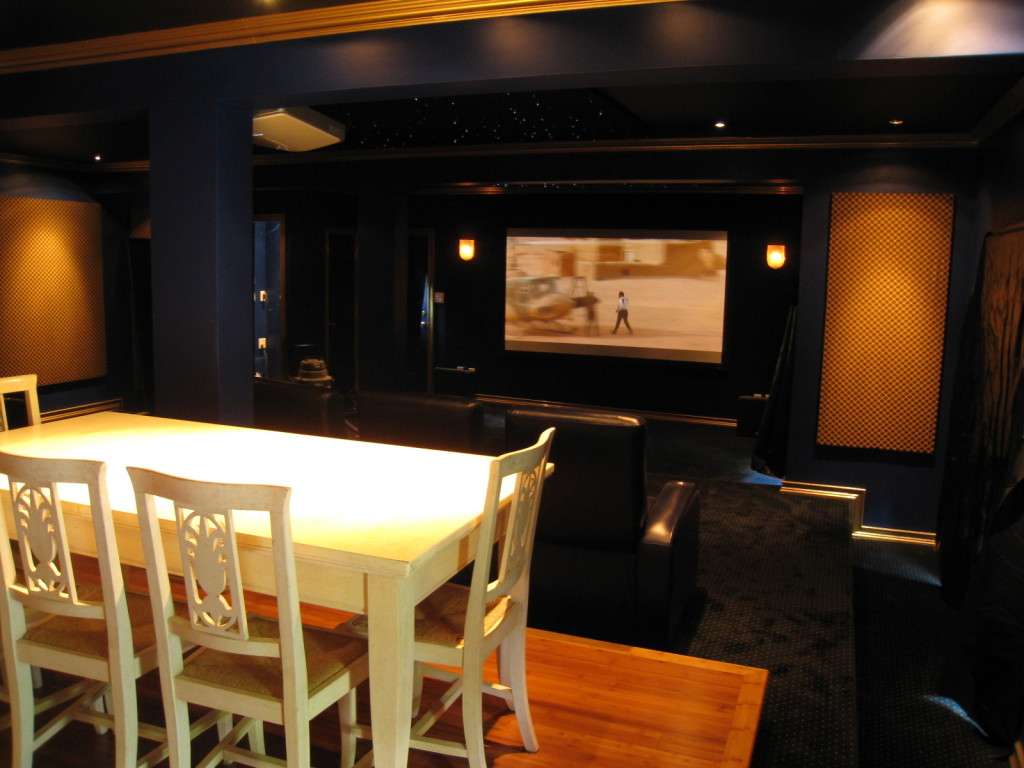
I measure the room, the screen size and the seat distance together. The goal is simple: no bad seats, even with a dozen people in the room.
The game is a different job from a movie. A movie wants a dark room. The game is often on in the afternoon, with the family going in and out. A good theater can do both, with a little planning.
On Thanksgiving Day this year, the NFL plays three games, and the first one, the Bears at the Lions, starts at 1 PM Eastern, according to the NFL. That’s a long afternoon and evening of football, with people in and out of the room.
For the game, we set up a “game” scene that keeps some soft lights on, so people can find their seats and their plates. The sound is set so you hear the crowd around you and the announcers clearly in the middle. For movie night, a “movie” scene dims everything down, and the screen takes over.
If your theater uses a projector, we’ll talk about how much light the room will have during the game. That’s part of picking the projector, the screen and the lights together.
One button for the whole room
A control system ties every part of the room together. Press “Movie,” and the screen turns on, the sound starts on the right source, the lights dim and the shades close if the room has windows. Press “Off,” and it all shuts down in the right order.
I often use Control4 for this, and the same system can tie the theater into the music, lights and shades in the rest of the house. The Sony projector above lists Control4 among the systems it works with.
The key step is testing. Before we call a theater finished, we have the people who’ll use it run it. That includes the spouse who didn’t pick the gear, the kids and a grandparent if they visit often. If anyone gets stuck, we change the buttons until nobody does. To me, that’s what peace of mind looks like in a theater.
How we build it, and what to do this fall
It follows a clear path, from the first walk-through to the night you hand the remote to your family. Here’s the order:
- The visit. I walk the room with you, measure it, look at the light, the power and the path for the wires, and ask how your family will use it.
- The design. We lay out the screen, the speakers, the seats, the lights and the equipment, and you see the plan before any work starts.
- The wiring. Speaker wire, video cable and network cable go in while the walls are open, so nothing shows later.
- The build and install. Your builder or our partners finish the room, and my team mounts the screen, speakers and equipment.
- The tuning. We calibrate the sound and picture and set up the control system.
- The family handoff. We show everyone how to use it, and we come back if anything needs a change.
The equipment needs a good home too. In a theater, the amplifiers and players live in a rack that stays cool and quiet, often in a closet next to the room. It keeps the theater clean, and it keeps the gear safe from little hands.
So what about this fall? The planning can start now, and the room comes after. Thanksgiving is Thursday, November 26. There isn’t enough time before then to design, build and tune a full dedicated theater, and I’ll never promise you that there is.
Here’s what this time of year is good for:
- I can see the room. A visit now means the design can start right away.
- You can watch how your family uses the house. Thanksgiving is a great test. Where do people gather? Where does the game end up? That helps shape the theater.
- The room gets on the schedule for the big games in January and the many movie nights after that.
For the short version of the idea, see our home theater for the holidays page. For more about a movie room in a shared family space, see my post on building a real movie night room at home.
Ready to start planning your theater? call (973) 945-5275 or text (973) 945-5275, and tell me which room you have in mind.
What clients say
Here’s what two One Sound Choice clients wrote about other theaters my team built for them. Their words are just as they wrote them, and these are different rooms from the ones in this post.
The service was timely, the process was easy and I’m very satisfied…the theatre came out phenomenal. The picture (quality) is phenomenal. The equipment (Ryan) recommended was fantastic and he was involved in the entire process (from the very beginning).
– Mr. & Mrs. Shatz
We hired Ryan from One Sound Choice to install a movie theater in home we were building. His expertise was invaluable. In addition to being an informed person about every aspect of the theater, walls, insulation, lighting, seating, installation of the walls, screen and all of the equipment in the back room, he became a trusted contractor and we have complete faith in his work. Our movie theater is amazing to look at, sit in, and enjoy movies. If any work is needed as it is periodically Ryan is very reliable. Feel free to ask Ryan for photos of the room. Dr. and Mrs. Steven Stoller Saddle River, New Jersey
– Dr. and Mrs. Steven Stoller, Saddle River, New Jersey
Questions families ask me
What’s the difference between a home theater and a family room with a big TV?
A home theater is a room built for the picture and the sound. The light’s under control, the speakers sit around the seats, and every seat has a clear view. A family room with a big TV is built for daily life first, so the picture and sound have to work around windows, open walls and furniture.
Can a dedicated home theater be built before Thanksgiving?
No, not a full dedicated theater. Thanksgiving is Thursday, November 26, and a real theater room needs time for design, wiring, building and tuning. I can see the room now, so we can set the plan and put the build on the schedule for the movie nights and big games that come after the holiday.
Should our theater have a projector or a big TV?
A projector and screen give you the biggest picture and the most cinema feel in a room you can make dark. A very large TV, like Sony’s 98-inch or 115-inch models, is brighter and works well when the room still has some light. I’ll help you choose based on the room size, the light and how you’ll use it.
Why use McIntosh amplifiers instead of a regular receiver?
A dedicated amplifier gives each speaker more steady power, so loud scenes stay clean and voices stay clear. Take the McIntosh MC257. It puts out 200 watts on each of 7 channels, and it’s cooled without noisy fans, which matters in a quiet room.
How do you keep theater sound from bothering the rest of the house?
My team plans for it before the walls are closed. That can mean insulation in the walls and ceiling, a solid door, rear enclosures behind in-wall speakers and smart placement of the bass. A theater can be loud inside and much quieter in the bedrooms above it.
Can everyone in the family run the theater?
Yes. One button starts the screen, the sound and the lights in the right order, and one button turns it all off. We test it with the people who’ll use it, kids and grandparents included, before we call the room finished.
Meet Ryan

Ryan Herd is the founder of One Sound Choice. He is a former Mayor of Pequannock Township, a TEDx speaker, a patent holder and the author of Join the Smart Home Revolution, with more than 30 years installing home technology. When Ryan plans a theater, he sits in the seats first and works out from there. Read more about Ryan.
Where we build home theaters
One Sound Choice designs and builds home theaters, media rooms and whole-home systems across Morris, Bergen, Essex, Passaic, Somerset and Hunterdon counties in Northern New Jersey, and for clients in Manhattan.
One Sound Choice, 8 Tilley Ave, Pompton Plains, NJ 07444. Phone: (973) 945-5275. You can also text me.