
Outdoor TVs are specifically designed to solve common problems you face when using regular indoor TVs outside. Indoor TVs struggle with brightness, glare, and weather exposure, making them unsuitable for outdoor use. Outdoor TVs, on the other hand, are built with higher brightness (up to 5,000 nits), anti-glare screens, and weatherproof designs to handle sunlight, rain, dust, and temperature extremes.
Key Takeaways:
- Brightness: Indoor TVs (250–500 nits) are too dim for sunlight. Outdoor TVs range from 1,000 to 5,000 nits, depending on the location (shaded, partial sun, or full sun).
- Weatherproofing: Outdoor TVs have sealed enclosures, IP ratings (IP54–IP66), and temperature management systems to operate between –22°F and 122°F safely.
- Durability: Materials like UV-resistant casings and shatterproof glass protect against environmental damage.
- Cost: Prices vary by use case: shaded areas ($1,000+), partial sun ($1,500+), and full sun ($5,000+).
Professional installation is crucial to ensure safe power connections, proper mounting, and long-term performance. Investing in an outdoor TV transforms your outdoor space into a reliable entertainment hub, even in the harshest conditions.
Outdoor TVs Good Idea or Bad Idea? Can you put a TV in FULL SUN? | HTR Talk
sbb-itb-c5b321b
Why Indoor TVs Don’t Work Outside
Indoor TVs are not built to handle the challenges of outdoor environments. Two primary reasons for this are their insufficient brightness and susceptibility to glare, as well as their inability to endure harsh weather and extreme temperatures.
Brightness and Glare Problems
Indoor TVs typically deliver around 250 nits of brightness. While this is adequate for indoor spaces, it falls short when exposed to outdoor sunlight, making the screen appear washed out, even in partially shaded areas [7].
Additionally, indoor TVs lack anti-reflective coatings, causing their screens to reflect sunlight like a mirror. Instead of displaying clear content, they end up showing reflections of nearby trees, clouds, or other surroundings [4][1].
| TV Type | Typical Brightness (Nits) | Best Use Case |
|---|---|---|
| Indoor TV | 250+ | Living rooms, bedrooms [7] |
| Shade-Rated | 500–700 | Covered patios, screened porches [7][1] |
| Partial Sun | 700–1,500 | Decks with light tree cover, morning sun [7][1] |
| Full Sun | 1,500–5,000 | Pool decks, unshaded patios [1][6] |
Weather and Temperature Damage
Indoor TVs are designed with open vents to allow airflow in climate-controlled environments. When placed outdoors, these vents become entry points for moisture, dust, insects, and even salt air, all of which can corrode the internal components [7][1]. Furthermore, the plastic casing of indoor TVs is not UV-resistant, making it prone to yellowing, warping, or cracking under prolonged exposure to sunlight [2][6].
Temperature extremes pose another serious issue. Indoor televisions are built for stable indoor conditions and cannot handle outdoor fluctuations. Cold weather can cause condensation to form on internal components, leading to short circuits. On the other hand, high temperatures can cause components to overheat and fail without proper cooling systems [1][3].
"When temperatures drop too low, condensation can occur on the TV components, drops form, and well, we know what drops do when they mix with electric components." – Willem Grobler, Founder, OuterAudio [1]
Unlike indoor TVs, outdoor models are specifically designed to handle these challenges. For example, a 55-inch outdoor TV weighs about 25 pounds more than its indoor counterpart due to its weatherproof construction. This extra weight includes sealed designs, gasketed ports, and thermal management systems that allow it to operate in temperatures ranging from -22°F to 122°F [4][3]. Such conditions would quickly render an indoor TV unusable.
These limitations of indoor TVs underscore the necessity of outdoor-specific designs, which incorporate higher brightness levels, anti-glare technology, and weather-resistant materials to thrive in outdoor environments.
What Makes Outdoor TVs Different
Outdoor TVs are built to handle environments where regular indoor TVs would struggle. They are specifically designed to address challenges like sunlight visibility and exposure to the elements, ensuring they function reliably in conditions that would overwhelm standard models. These specialized features include advanced screen technology, weather-resistant construction, and systems to manage temperature extremes.
High Brightness for Sunlight Viewing
One of the standout differences is the brightness level, measured in nits. While indoor TVs typically offer 350 to 500 nits, outdoor TVs are far brighter, ranging from 1,000 nits for shaded areas to as much as 5,000 nits for direct sunlight. For instance, the Sylvox Cinema Pro 110-inch model reaches an impressive 5,000 nits, making it ideal for sunny environments [6]. For spaces like covered patios, 1,000–1,500 nits are usually adequate, but open-air areas or poolside locations exposed to midday sun require at least 2,000–2,500 nits for clear visibility [8].
Anti-Glare Screens and Auto-Brightness
Beyond brightness, outdoor TVs combat glare and reflections with anti-glare and anti-reflective coatings. Some premium models go a step further with optical bonding, which eliminates the air gap between the LCD panel and protective glass, reducing reflections while enhancing contrast [8]. Many outdoor TVs are also equipped with adaptive brightness sensors that automatically adjust screen brightness based on surrounding light conditions. As Sam Abbott, a Verified Reviewer, shared:
"The picture is bright and clear without the interference of the sunlight or reflections from the surroundings" [4]
Weatherproof Construction
Durability is another key feature. Outdoor TVs are housed in sealed enclosures, often with IP54 to IP66 ratings, to protect against rain, snow, dust, and even insects [8]. Their frames are crafted from materials like powder-coated aluminum or mild steel for impact resistance and efficient heat dissipation. In coastal areas, high-density polyethylene (HDPE) shields units from salt and UV damage [9][10]. The screens themselves are reinforced with shatterproof materials like Lexan® polycarbonate or tempered glass, rated to withstand impacts from hail and debris (IK08 or IK09 ratings) [8][9].
To handle temperature extremes, these TVs include built-in cooling and heating systems, allowing them to operate in conditions ranging from –22°F to 122°F [8]. Certain models, such as the Furrion Aurora Partial-Sun Premier, go further with features like zinc-plated connectors and sealed cable entry points to prevent moisture from seeping in [8]. Together, these elements ensure outdoor TVs are ready for a variety of challenging environments.
| Feature | Partial Sun (Typical) | Full Sun (Typical) |
|---|---|---|
| Brightness | 1,000–1,500 nits [8] | 2,000–5,000 nits [8][6] |
| IP Rating | IP54 [8] | IP55–IP66 [8][6] |
| Screen Tech | Anti-glare coating [8] | Optically bonded / Anti-reflective [8][6] |
| Cooling | Passive or basic fans [8] | Advanced multi-fan systems [6] |
| Best Use | Covered patios, porches | Pool decks, open-air yards |
Choosing the Right TV for Your Location
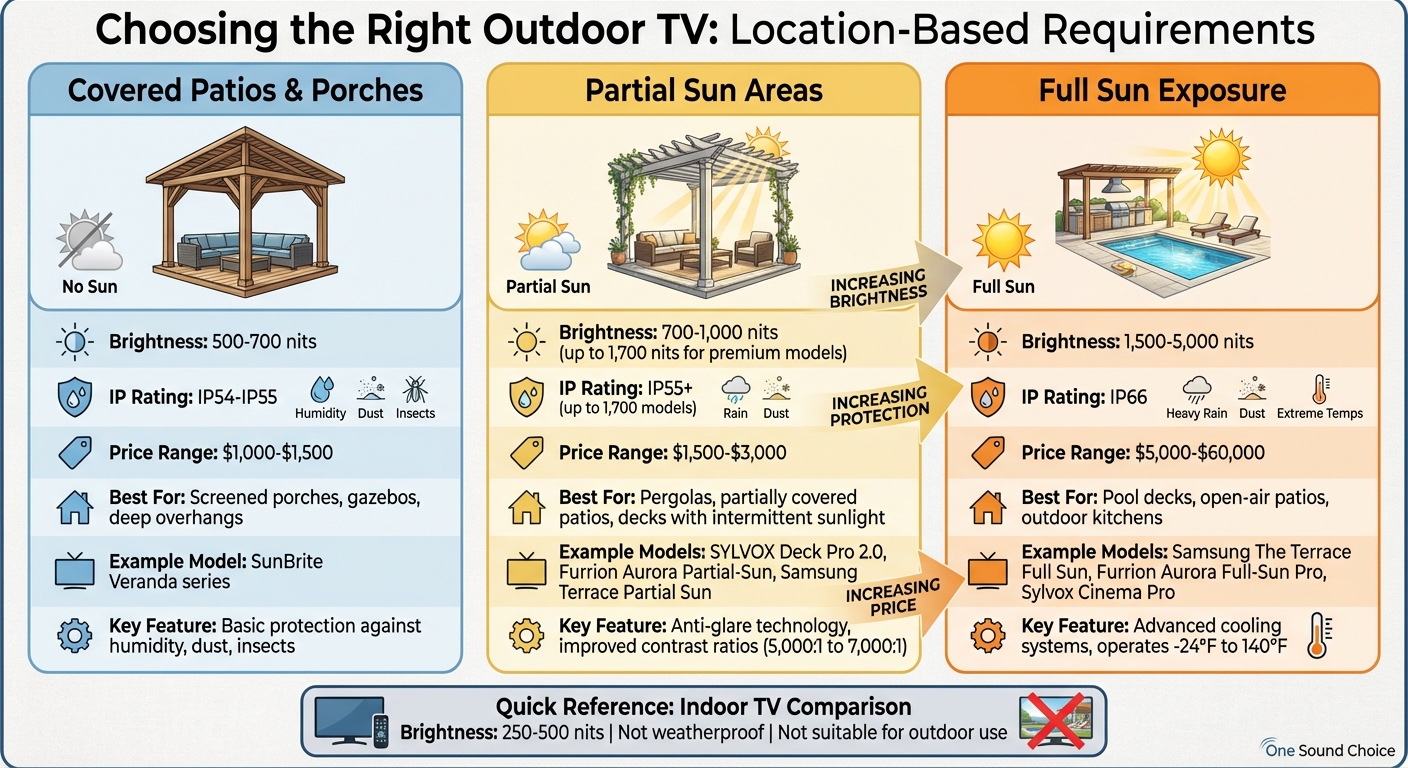
Outdoor TV Brightness and Weatherproofing Requirements by Location Type
Picking the perfect outdoor TV hinges on where you plan to place it and the amount of sunlight it will encounter. A TV that performs well under a shaded patio might struggle on a pool deck exposed to direct sunlight. By understanding your environment, you can avoid spending extra on unnecessary features or choosing a TV that doesn’t handle bright conditions. Below, we explore recommendations for TVs suited to covered patios, partial sun areas, and full sun exposure to help you make the best choice.
TVs for Covered Patios and Porches
For fully shaded spots like screened porches, gazebos, or areas with deep overhangs, you don’t need a TV with extreme brightness. Models designed for shaded environments typically offer 500–700 nits of brightness, which is sufficient when the screen is shielded from direct sunlight [1]. These TVs usually feature an IP54 or IP55 rating, protecting them against humidity, dust, insects, and occasional water splashes [3].
Affordable options, such as the SunBrite Veranda series, start at around $1,000 for a 55-inch screen, making them a practical choice for shaded areas. However, Willem Grobler, founder of OuterAudio, cautions:
"A shade TV cannot be used in partial sunlight or full sunlight" [1].
If your patio occasionally receives bright ambient light, consider upgrading to a partial-sun model. This ensures your TV maintains optimal performance even in slightly brighter conditions.
TVs for Areas with Partial Sun
For spaces like pergolas, partially covered patios, or decks with intermittent sunlight, the demands on your TV increase. These locations require TVs with 700–1,000 nits of brightness and anti-glare technology to handle changing light conditions [1]. Popular models, such as the SYLVOX Deck Pro 2.0 and Furrion Aurora Partial-Sun, are priced between $1,500 and $3,000 and come with an IP55 or higher rating [3].
The Samsung Terrace Partial Sun stands out with a peak brightness of 1,700 nits, while the Furrion Aurora Partial-Sun offers around 700 nits [3]. The PropelRC Team highlights the advantages of higher brightness:
"The 1,000 nit screen delivers remarkable visibility even when sunlight hits the display directly, something most competitors struggle with at this price point" [5].
These TVs also boast improved contrast ratios (5,000:1 to 7,000:1) compared to full-shade models, ensuring picture clarity even in varying light.
TVs for Full Sun Exposure
For open-air patios, pool decks, or outdoor kitchens exposed to constant direct sunlight, you’ll need a high-performance outdoor TV. Full-sun models require an IP66 rating to withstand heavy rain and dust, plus advanced cooling systems to function in temperatures ranging from –24°F to 140°F [11].
These features come with a higher price tag. The Samsung The Terrace Full Sun costs $7,499 for a 65-inch model with over 1,500 nits of brightness, while the Furrion Aurora Full-Sun Pro is priced at $7,999 for a 55-inch screen delivering 2,500 nits [11]. For even brighter options, the Sylvox Cinema Pro offers 3,500 nits in sizes ranging from 65 to 75 inches (priced between $5,499 and $6,999), and an impressive 110-inch model with 5,000 nits for $59,999 [6]. As Popular Mechanics notes:
"The Sylvox Cinema Pro Series pushes the brightest screen in its class, giving it the clearest picture in overly sunny situations" [6].
| Location Type | Brightness Needed | IP Rating | Typical Price Range |
|---|---|---|---|
| Covered Patios | 500–700 nits | IP54–IP55 | $1,000–$1,500 |
| Partial Sun Areas | 700–1,000 nits | IP55+ | $1,500–$3,000 |
| Full Sun Exposure | 1,500–5,000 nits | IP66 | $5,000–$60,000 |
Professional-Grade Outdoor TV Options
When it comes to outdoor TVs that can handle direct sunlight while delivering exceptional picture quality, three professional-grade models stand out. These TVs combine high brightness, durable weatherproofing, and reliable performance, making them ideal for outdoor environments.
Samsung The Terrace Full-Sun
Samsung’s top-tier outdoor TV, The Terrace Full-Sun, is built to perform under extreme conditions. With over 2,000 nits of brightness, Neo QLED technology, and an advanced anti-reflection coating, it ensures a clear and vibrant viewing experience even in direct sunlight [12]. Available in two sizes, the 75-inch model is priced at $9,999.99, while the 85-inch version costs $19,999 [12][13].
This model boasts an IP56 rating, meaning it resists high-pressure water jets and dust intrusion [12]. It operates in temperatures ranging from -22°F to 122°F and includes Direct-Sun Protection technology, which shields the screen for up to six hours in sunlight at 700 watts and 104°F [12][13]. As James Fishler, Senior Vice President at Samsung Electronics America, puts it:
"We’re seeing a greater demand for TVs that can be experienced from a variety of non-traditional places… The Terrace makes it easy to enjoy your favorite shows, movies, and games – now, on an ultra-large screen – while outside in your backyard" [13].
The TV also features built-in HDBase-T for extended cable runs and comes with an IP56-rated SolarCell Remote, ensuring both the unit and its accessories are built to withstand outdoor use [12][13].
Furrion Aurora Full-Sun Pro TV
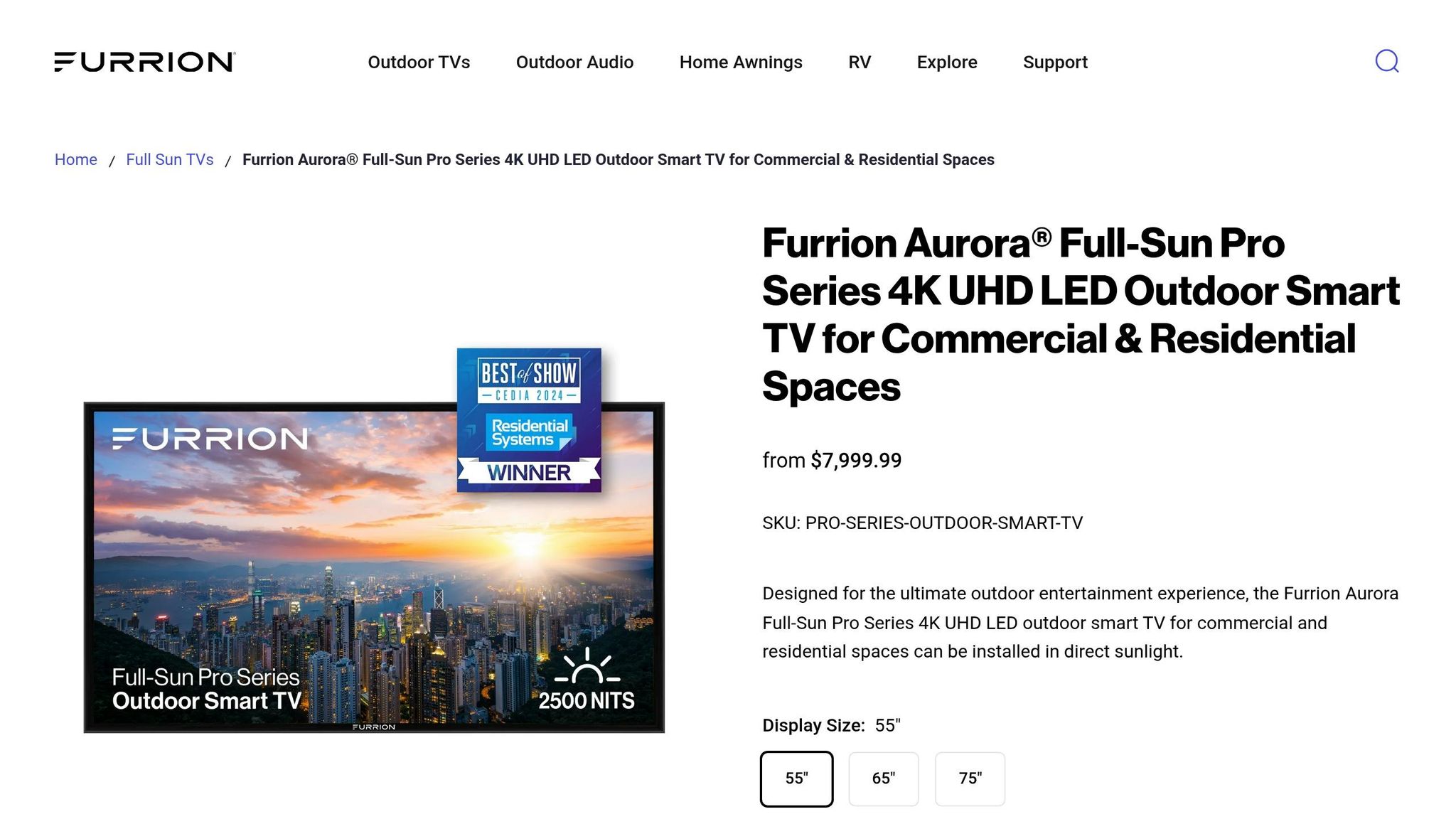
The Furrion Aurora Full-Sun Pro TV is another excellent choice for outdoor setups. Offering an impressive 2,500 nits of brightness, it automatically adjusts to changing light conditions for optimal visibility. With an IP66 weatherproof rating, it can handle harsh weather conditions and temperatures ranging from -24°F to 140°F. Its sealed design protects cable connections and internal components, ensuring long-lasting performance.
SunBrite Pro 2 Series
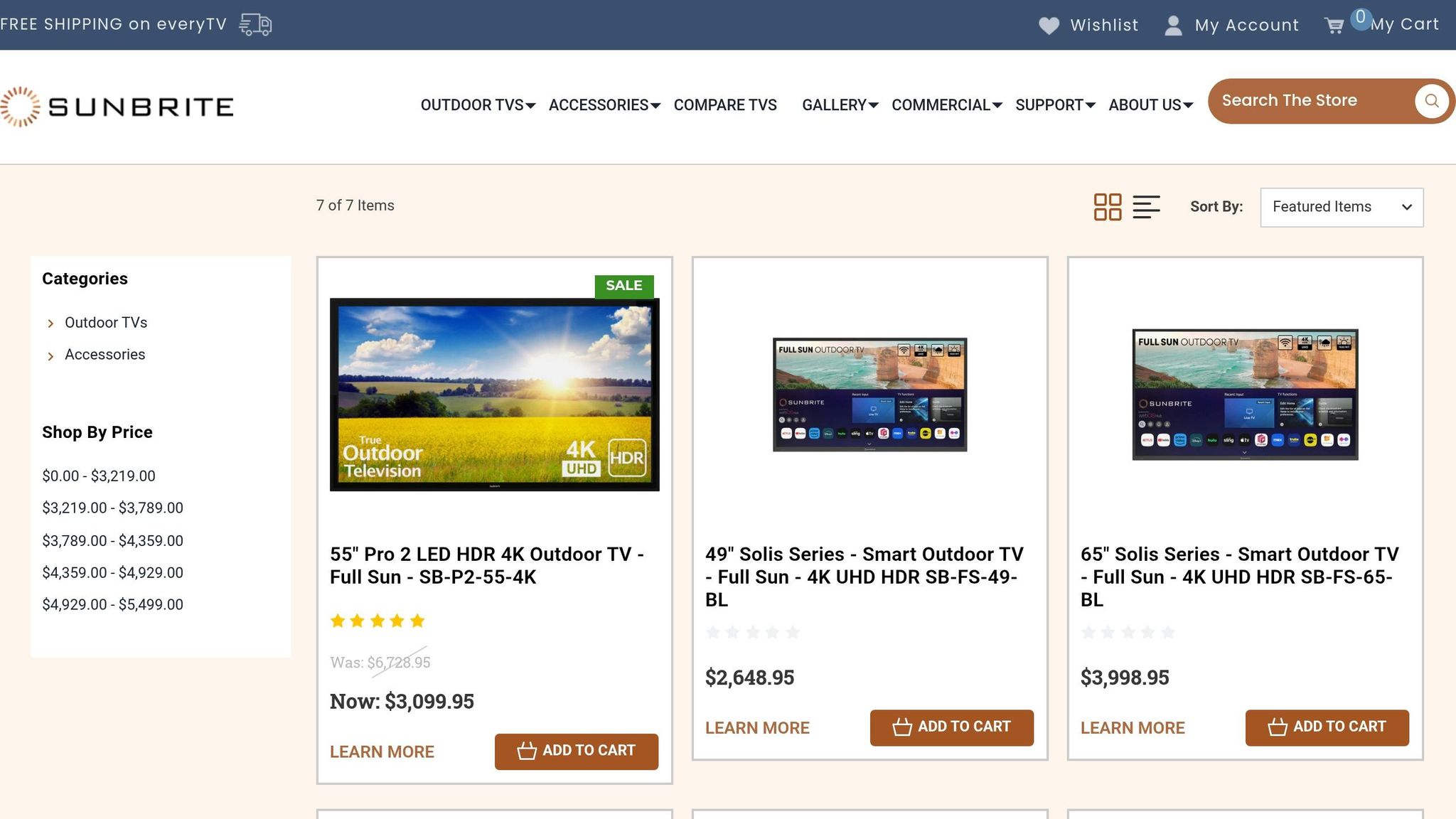
Designed for partial sun or covered areas, the SunBrite Pro 2 Series delivers 1,000 nits of brightness with anti-glare technology for a clear picture in shaded spaces. Its commercial-grade aluminum casing is highly durable, and the sealed components are built to resist moisture and temperature changes, making it a reliable option for outdoor installations.
For the best results, professional installation is recommended for these models. Proper setup ensures secure mounting, adequate power supply, and optimal cable management, allowing these TVs to perform at their best in any outdoor setting.
Professional Installation Requirements
Once you’ve chosen a high-quality outdoor TV, the next step is ensuring it’s installed correctly. A professional installation isn’t just about convenience – it’s a key part of protecting your investment. Outdoor TVs require specialized electrical work, structural planning, and technical expertise. Skipping this step can void warranties, create safety risks, or lead to early equipment failure. Here’s a closer look at why proper installation matters.
Power and Cable Management
Outdoor environments present unique challenges for electrical systems, making GFCI (Ground-Fault Circuit Interrupter) outlets a must. These outlets help prevent electrical shock in areas exposed to moisture [15][1]. Matt Lawler from MantelMount highlights the importance of proper setup:
"Always use GFCI outlets outdoors and ground the installation properly. Surge protectors and lightning arrestors are also a good idea" [15].
Professional installers ensure cables are routed through weatherproof conduits to protect against moisture, dust, and pests. They also seal wall penetrations to maintain a secure and safe setup [15][4]. Additionally, outdoor surge protectors with a joule rating of 3,000 or higher are recommended to shield your equipment from power surges and lightning strikes [15]. Since most media players aren’t designed for outdoor use, they should be housed indoors or in weatherproof enclosures. To maintain functionality, IR repeater systems can enable remote control from outside [4][14].
Mounting and Structural Support
Outdoor TVs are heavier than indoor models and must withstand wind and weather. This requires durable, load-bearing mounts [14][15]. Installers use stainless steel or galvanized hardware to prevent corrosion and ensure mounts are securely attached to load-bearing structures. Proper placement is equally important – maintaining at least 6 inches of clearance around the TV allows for adequate airflow, preventing overheating [2].
Tom Curnin, owner of Bravo AV, explains the risks of poor installation:
"We’ve replaced several TVs that failed within a year because moisture entered through unsealed inputs or the unit overheated due to trapped air" [2].
Smart Home System Integration
A professionally installed outdoor TV can do more than just display content – it can become an integral part of your smart home system. When connected to a whole-home control system, your outdoor TV can work seamlessly with other devices, enabling features like automated "Movie Night" scenes where the TV, audio, and lighting adjust together [17]. To support this level of integration, installers extend your network using outdoor-grade Wi-Fi access points or hardwired Ethernet connections. This ensures smooth 4K streaming without interruptions [17]. Professionals also calibrate the system to harmonize with your indoor technology, providing a consistent and unified experience across your property [16].
Conclusion
Outdoor TVs are designed to thrive in direct sunlight, redefining outdoor entertainment. Unlike indoor models, professional-grade outdoor TVs are built with features like high brightness and weatherproofing to handle challenging conditions effectively[4].
Selecting the right outdoor TV depends on your specific setup. A shaded patio has different requirements than a poolside area exposed to full sunlight. Brightness levels range from over 3,000 nits for full-sun installations to around 1,000 nits for partially shaded areas[2]. Indoor TVs simply aren’t equipped to handle outdoor elements, making professional-grade options a necessity for durability and performance.
Proper installation is just as crucial as the TV itself. As Tom Curnin from Bravo AV emphasizes:
"Installation matters as much as the TV itself (bad install = voided warranty)"[2]
This involves using GFCI-protected power sources, weatherproof cable management with marine-grade sealants, ventilated mounting to prevent overheating, and seamless integration with your home’s network. These steps ensure the system performs reliably and aligns with professional standards.
When expertly installed, outdoor TV systems have shown outstanding reliability, with some installations running for over five years without issues[2]. This transforms your outdoor space into an extension of your home, capable of standing up to any weather. Paired with advanced smart home technology, these setups create a complete, modern entertainment experience.
For homeowners in Northern New Jersey, One Sound Choice offers tailored outdoor entertainment solutions, seamlessly integrating with your home’s existing technology for a dependable and enjoyable setup.
What One Sound Choice clients say
(We received) friendly, highly competent, quick and clean installation by 1 Sound Choice. The team followed up a few weeks after completion to ask if we were satisfied with our Media Room and Home Audio System. 1 Sound Choice is truly “top shelf” – they surpassed our expectations every step of the way.
– Mr. & Mrs. Blake (1 Sound Choice client testimonials)
The 1 Sound Choice staff was very easy to work with. Ryan, you understood our wants right from the beginning. Simplicity of installation and operation were just some of the reasons we chose 1 Sound Choice. You exceeded my expectations!
– Mr. & Mrs. Matia (1 Sound Choice client testimonials)
Very efficient and professional. Knowledgeable of equipment and products suited for your space/home. Perfectionists at their job and get the task done in promised time.
– dmhajjar (Houzz review)
FAQs
How many nits do I actually need for my patio?
For patios that receive direct sunlight, a screen brightness of at least 1,000 nits is ideal. Premium outdoor TVs often exceed 2,000 nits, providing excellent visibility even under intense sunlight. This ensures a clear and enjoyable viewing experience for your outdoor entertainment setup.
What IP rating is “enough” for my outdoor setup?
For outdoor TVs, an IP55 rating provides a moderate level of protection against weather elements like dust and light rain. However, if your TV will be exposed to more extreme conditions, an IP65 or higher rating is a better choice. These higher ratings offer stronger safeguards against dust, heavy rain, and other outdoor challenges, ensuring your TV operates dependably in tougher environments.
Do I really need professional installation for an outdoor TV?
Professional installation is a smart choice for setting up your outdoor TV, ensuring it’s secure, weather-resistant, and functions as intended. Proper setup helps avoid problems like condensation, water exposure, or unstable mounting – issues that could void your warranty or reduce the TV’s lifespan. Outdoor TVs come with specific requirements, such as weatherproofing, anti-glare screens, and sturdy mounting solutions. A professional installer brings the expertise needed to handle these challenges, ensuring your TV is ready to endure the elements while delivering top-notch performance for years to come.
Related Blog Posts
- Outdoor Entertainment Setup: 8 Ideas for Your Backyard
- How to create a outdoor oasis with audio and video.
- What is the best outdoor TV?
- Why should I invest in a real outdoor TV and not in a outdoor TV enclosure?
Planning the whole yard, not just the TV? See our backyard resort page.
More questions
Can I just put my indoor TV outside?
No. An indoor TV is too dim for the sun and is not built for rain or cold. It will look washed out and can break fast.
One Sound Choice, 8 Tilley Ave, Pompton Plains, NJ 07444. Call or text (973) 945-5275. We work in homes across Morris, Passaic, Bergen, Essex, Somerset, and Hunterdon counties. Written by Ryan Herd, founder of One Sound Choice.