
Automating your window shades can reduce energy costs by up to 30% while improving comfort. Manual shades are often underutilized, with only 25% adjusted daily, leading to significant energy loss. Motorized shades solve this by automatically adjusting to sunlight, temperature, and room use. They minimize heating loss in winter and block heat gain in summer, easing the workload on your HVAC system, which accounts for 30–40% of home energy use.
Key steps for energy savings:
- Choose the right shade type: Cellular shades insulate well, solar shades reduce heat and UV exposure, and Roman shades offer flexibility based on fabric.
- Select a power source: Options include battery-powered (easy retrofit), plug-in (low maintenance), or hard-wired (long-term reliability).
- Program shades seasonally: Open south-facing shades in winter for warmth; close sun-facing shades in summer to block heat.
- Integrate with smart systems: Use sensors and smart home platforms to automate adjustments and sync with lighting and shades for optimal efficiency.
Automated shades typically pay for themselves in 3–5 years through reduced energy bills. Studies show they can cut overall energy use by 25%, making them a practical and cost-effective investment.
10 Reasons to Automate Your Shades for Your Long Island, NY Home
sbb-itb-c5b321b
How Windows Cause Energy Loss
Windows contribute to energy loss in a couple of key ways. In winter, they act as thermal bridges, allowing heat to escape from inside your home. In summer, they let in direct sunlight, which quickly heats up your living space and forces your HVAC system to work harder to maintain comfortable temperatures. This is often paired with smart automated lights to further reduce heat gain and improve efficiency.
The direction your windows face can make a big difference. East- and west-facing windows are often the most challenging because they receive intense sunlight at specific times of the day. South-facing windows, on the other hand, typically require more focused strategies to manage heat effectively.
Another challenge comes from the limitations of fixed window treatments. While options like glazing and tints provide some help, their static nature means they can’t adjust to changing conditions. As one industry expert notes:
Regardless of how sophisticated your window glazing, or tint may be, they’re rarely a match for mother nature’s dynamic tendencies.
This becomes especially clear when considering how the sun’s position shifts throughout the day or how weather conditions can change unexpectedly. Fixed solutions simply can’t keep up with these variables.
The size of your windows also matters. Large windows or glass walls offer more surface area for heat transfer, which can significantly increase the workload on your HVAC system [2]. Older windows with poor seals add to the problem by creating thermal bridges that let conditioned air escape and allow drafts to enter [6][9].
Even manual shades, while helpful, have their shortcomings. They only work when they’re actively adjusted, and many people don’t use them consistently. This gap highlights the importance of automating shades to achieve meaningful energy savings.
Choosing the Right Type of Motorized Shades
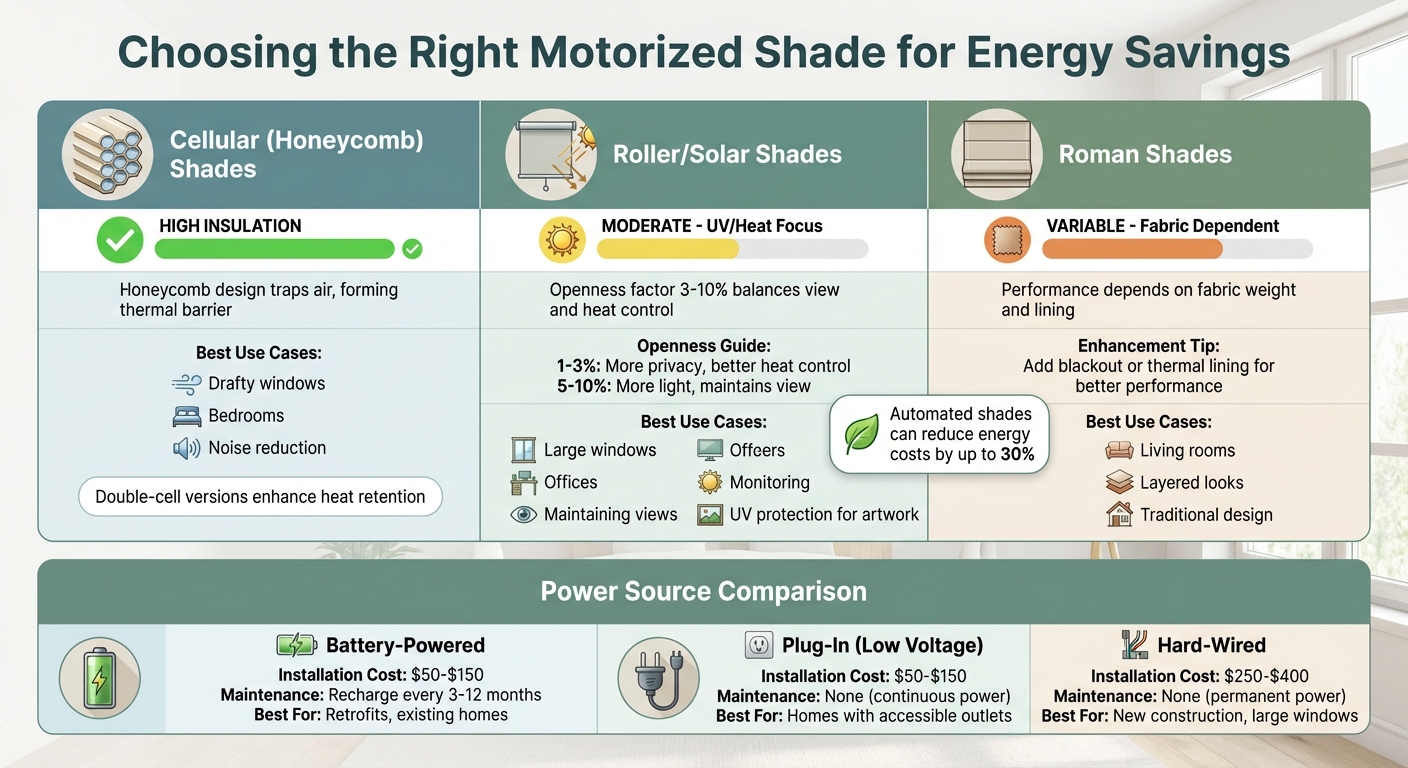
Motorized Shade Types Comparison: Energy Efficiency and Best Use Cases
Motorized shades vary in performance, influencing insulation, heat transfer, and how they complement your space.
Cellular shades stand out for their insulating properties. Their honeycomb design traps air, forming a thermal barrier between your window and the room. Double-cell versions enhance this effect, offering better heat retention and soundproofing [11]. If cutting down on HVAC energy usage is a priority, these shades are an excellent choice.
Roller shades strike a balance between energy efficiency and style. Solar roller shades are especially good at reducing heat and blocking UV rays while still allowing you to enjoy your view. The "openness factor" is key here, typically ranging from 3% to 10%. A tighter weave (1%–3%) offers more privacy and heat control, while a looser weave (5%–10%) lets in more light and maintains a stronger connection to the outdoors. Interior designer Kevin Gray highlights their value for protecting art, explaining:
The tighter it is, the less light enters. I usually pick 5%–7% to maintain a view outside. If the artwork is very expensive, and the window faces east or west, then I’ll use a bit of a tighter weave.
– Kevin Gray [8]
Roman shades bring a classic aesthetic, with their efficiency depending on the fabric selected. Heavier, layered fabrics help retain warmth in cooler seasons and create a thermal buffer, particularly when paired with drapery in draft-prone areas [6]. Adding a blackout or thermal lining further improves their performance. For those seeking both functionality and style, many homeowners layer Roman shades with roller or cellular options [8].
| Shade Type | Energy Efficiency | Best Use Case |
|---|---|---|
| Cellular (Honeycomb) | High insulation | Drafty windows, bedrooms, noise reduction |
| Roller/Solar | Moderate (UV/heat focus) | Large windows, offices, maintaining views |
| Roman | Variable (fabric-based) | Living rooms, layered looks, traditional design |
The next step is selecting the right power source to fully leverage these benefits.
Selecting the Right Power Source
The power source you choose greatly impacts installation ease, maintenance requirements, and overall reliability – whether you’re retrofitting an existing space or working on a new construction project.
Battery-powered systems rely on rechargeable lithium-ion batteries or standard D-cell batteries, making them a practical solution for homes where opening walls for wiring isn’t feasible. Rechargeable batteries typically last between 3 to 12 months on a single charge, while D-cell batteries can last 3 to 5 years before needing replacement [13]. For windows that are hard to access, adding slim solar panels can provide a trickle charge to extend battery life. As Automate Shades suggests:
If using battery motors to power your smart shades, boost the convenience and efficiency of your system by adding an Automate Solar Panel. The solar panel absorbs sunlight to power your shades, so you may never have to worry about manually charging your motors.
– Automate Shades [4]
Plug-in systems use 12V or 24V power supplied by a transformer plugged into a standard outlet. These systems are ideal for homes with accessible outlets near windows, offering a hassle-free alternative to recharging batteries. They are especially convenient for managing multiple shades via a distribution panel, and they don’t require professional installation.
Hard-wired systems provide a permanent 110V power solution, making them the most reliable option for new builds or major renovations. However, installation requires coordination with a licensed electrician, with costs ranging from $250 to $400 per window [13]. This setup ensures maintenance-free operation and is well-suited for larger or heavier window treatments. Greg Barrett, Director of Product Marketing for Lighting & Shades at Savant, elaborates:
For wired shades, integrators will need to coordinate with the rest of the build team to route appropriate wiring to each window opening.
– Greg Barrett [7]
Once installed, hard-wired systems deliver consistent performance for decades, making them a dependable choice for long-term use. Selecting the right power source ensures your shades operate smoothly, complementing your efforts to reduce HVAC energy consumption by up to 25–30% [1][3][13].
| Power Source | Installation Cost | Maintenance | Best For |
|---|---|---|---|
| Battery-Powered | $50–$150 [13] | Recharge every 3–12 months | Retrofits, existing homes |
| Plug-In (Low Voltage) | $50–$150 [13] | None (continuous power) | Homes with accessible outlets |
| Hard-Wired | $250–$400 [13] | None (permanent power) | New construction, large windows |
While the power source itself doesn’t directly affect energy efficiency, it plays a crucial role in ensuring your shades function reliably, supporting the overall goal of reducing energy use and improving comfort.
Programming Shades for Seasonal Energy Savings
Once you’ve chosen motorized shades and a compatible power source, the next step is to program them for seasonal energy efficiency. Adjusting shade schedules based on the time of year can make a noticeable difference in energy consumption.
Winter Scheduling: Harness Solar Heat
During the colder months, take advantage of the sun’s warmth by keeping south-facing shades open during the day. This lets solar heat naturally warm your home. At night, close all shades to reduce heat loss, which can be significant. For example, shutting window blinds and curtains at night can cut heat loss by up to 17% [9].
To maximize efficiency, group your shades by window orientation:
- Open east-facing shades at sunrise to capture the morning sun.
- Adjust west-facing shades later in the day as the sun moves.
- Tailor south-facing shades to let in the most sunlight during the day.
Summer Scheduling: Minimize Heat Gain
In the summer, the focus shifts to keeping heat out. Close shades on south- and west-facing windows from around 10:00 AM to 6:00 PM to block the strongest sunlight. East-facing shades should be closed in the morning when they get direct sunlight, while west-facing shades should be adjusted in the afternoon. North-facing windows, which receive less direct sunlight, may not need as much attention. As the sun sets and temperatures drop, open the shades to enjoy cooler air and the view.
Automating Adjustments with Smart Systems
Smart shade systems equipped with light and temperature sensors can take energy savings to the next level. These systems adjust shade positions automatically based on real-time conditions. For instance, if outdoor temperatures rise above a set point, the system can close the shades early – even before the scheduled time.
Many systems also allow you to create custom "scenes" for different times of the day or seasons. For example:
- A "Summer Afternoon" scene could partially close shades on sun-facing windows while keeping others open for light.
- A "Winter Morning" scene might open all shades to capture as much solar heat as possible.
These scenes can be activated manually, scheduled for specific times, or triggered automatically by sensor data. According to the US Department of Energy, only 25% of manual window coverings are adjusted daily [8]. Automation ensures your shades are always in the optimal position without requiring constant attention.
| Season | Daytime Action | Nighttime Action | Energy Goal |
|---|---|---|---|
| Winter | Open (focus on south-facing) | Close all shades | Capture solar heat; reduce heat loss |
| Summer | Close during peak sun hours | Open for ventilation/view | Block heat gain; ease HVAC load |
Some systems even integrate with your HVAC setup. For example, they can adjust shade positions when your air conditioning or heating kicks in. This coordination can cut HVAC energy use by 15–25% [14], making your home more energy-efficient without you lifting a finger. Next, we’ll look at how these automated systems fit into a broader smart home ecosystem.
Integrating Shades with Your Smart Home System
Centralized Control from One Interface
Connecting motorized shades to your smart home platform allows you to manage them alongside other systems like lighting, HVAC, and security – all from one interface. Most wireless shades require a specialized hub, such as the Lutron Smart Bridge (about $80) or the Hunter Douglas PowerView Gateway (around $195), to convert the shade motor’s radio signals into commands your Wi‑Fi network can process[12][15]. Once integrated, you can operate the shades using mobile apps, voice commands, or even physical keypads[12][15].
High-end systems like Crestron, Savant, Control4, and Elan take integration a step further by combining shades with other smart home devices into a single, unified interface. Instead of toggling between multiple apps, you can control everything seamlessly. For instance, a "Good Morning" scene could simultaneously open your shades, adjust the thermostat, and disarm your security system. These systems rely on robust communication protocols, such as Z‑Wave, RS485 for wired setups, or proprietary options like Lutron’s Clear Connect, ensuring dependable performance[4][15]. This type of integration simplifies daily routines and enhances the efficiency of your HVAC system.
Reducing HVAC Energy Use
Smart integration goes beyond convenience – it can also lead to lower energy bills. When shades are synced with your thermostat, they help regulate indoor temperatures by reacting to outdoor conditions. For example, on hot days, shades can close automatically on sun-facing windows to reduce the workload on your air conditioner. In colder months, they can open to let in natural sunlight, helping to warm your home and reduce furnace use.
Advanced systems equipped with light and temperature sensors take this a step further by responding to real-time conditions instead of sticking to a fixed schedule. If a sensor detects that the afternoon sun is heating a room faster than expected, the shades can close earlier than planned, helping to maintain a comfortable temperature without overburdening your HVAC system.
The One Sound Choice Advantage
One Sound Choice specializes in professional-grade shade automation for families in Northern New Jersey. With over 30 years of experience and more than 2,500 installations, they integrate motorized shades into comprehensive smart home systems that manage lighting, climate, security, and entertainment – all from a single, user-friendly interface. Their systems are designed for reliability, ease of use, and to enhance daily life.
Led by Ryan "The Smart Guy" Herd, One Sound Choice works closely with architects and designers during the early stages of a project to ensure proper wiring, recessed pockets, and flawless aesthetics. Kathryn Chiarelli, Residential Shades Sales Leader at Lutron, emphasizes the importance of early collaboration:
Connecting with an integrator early in the project timeline makes it possible for you to satisfy your client’s technology needs while still guaranteeing that you achieve your aesthetic vision
– Kathryn Chiarelli [7]
This proactive planning avoids common DIY mistakes, such as exposed wiring, misaligned shades, or unreliable system communication. Their approach ensures a fully integrated smart home setup that optimizes energy efficiency through centralized control, seasonal programming, and thoughtful design.
For homeowners in Morris, Bergen, and Essex counties, One Sound Choice offers expertise and a personalized, family-focused approach. Their solutions not only improve comfort and convenience but also provide meaningful energy savings, making automated shades a worthwhile investment in the long run.
Measuring Energy Savings from Automated Shades
Understanding the energy savings from automated shades helps you confirm the value of your investment. One of the simplest ways to measure this is by comparing utility bills from the same months in previous years. Focus on heating and cooling costs – if you notice a significant drop in HVAC expenses after installing the shades, it’s a clear sign they’re working. However, make sure to account for weather variations; for instance, a mild summer could naturally lower energy use, independent of the shades’ impact[5].
Using smart thermostats and home apps can provide more precise data. These tools allow you to monitor HVAC system cycles and track shade movements, helping confirm energy reductions, particularly during peak sunlight hours. Seasonal programming can further optimize these savings[16][17].
From May 2021 to March 2022, researchers studied 39 motorized insulating shades on the 37th floor of a high-rise building in Chicago. Through detailed energy monitoring, they discovered that automated control sequences reduced daily energy usage by up to 20.5%, with annual savings projected between 20% and 35% when compared to standard mini-blinds[5]. Another study conducted at Chicago’s Willis Tower by Assistant Professor Mohammad Heidarinejad and Christopher Nurre, CEO of Parata Solutions, evaluated automated shades on single-paned windows over 10 months. Their findings showed a 25% reduction in energy use during both heating and cooling seasons, with a return on investment (ROI) achieved within 3–5 years[10].
These findings highlight the financial advantages of automation, making ROI calculations straightforward. To determine ROI, divide the installation cost by the monthly energy savings. For example, if you spend $5,000 on automated shades and save $100 per month, the payback period would be 50 months, or just over four years. This aligns with industry expectations, which estimate that automated insulating shades typically pay for themselves within 3–5 years[10].
The table below compares the effectiveness of different control strategies:
| Control Strategy | Energy Savings Potential | User Compliance |
|---|---|---|
| Manual Control | Low (Highly variable) | Inconsistent |
| Predefined Schedule | Moderate (Consistent) | 100% (Automated) |
| Sensor-Based System | High (Weather-optimized) | 100% (Automated)[10] |
The main advantage of automated systems is their consistency. Unlike manual adjustments, which depend on user behavior, automated systems maintain optimal settings around the clock, delivering steady, measurable savings over time.
Conclusion
Automating your shades for energy savings boils down to three important steps: choosing the right shade type, setting up seasonal schedules, and integrating with smart home technology. Cellular shades are known for their insulating properties, thanks to their air-trapping honeycomb design, while solar shades help reduce heat gain without obstructing your view. The material and design you pick play a big role in determining how much energy you can save.
Seasonal programming is key – use winter schedules to take advantage of free solar heat and summer schedules to block intense sunlight. Automation ensures consistency, a major factor since many homeowners miss out on savings simply because they forget to adjust their shades manually.
Smart home integration adds another layer of efficiency by using sensors to adjust shades in real time, beyond just preset schedules. When shades work in tandem with your HVAC system, they help maintain a comfortable temperature without overloading your heating or cooling equipment, leading to noticeable reductions in utility bills. This combination of automation and proper installation unlocks the full potential of energy efficiency.
For those in Northern New Jersey looking for professional help, One Sound Choice specializes in designing and installing motorized shade systems that integrate seamlessly with whole-home automation platforms. Their team ensures your shades are programmed correctly, work with your existing smart home setup, and are tailored to your home’s specific layout and climate. These expertly integrated solutions, backed by research, deliver measurable energy savings.
Studies indicate that automated insulating shades can cut overall energy use by about 25%, with installation costs typically recovered within three to five years [10]. By selecting the right shade type, power source, and automation strategy, you’re making a smart investment in reducing energy bills and improving home comfort.
What One Sound Choice clients say
(We received) friendly, highly competent, quick and clean installation by 1 Sound Choice. The team followed up a few weeks after completion to ask if we were satisfied with our Media Room and Home Audio System. 1 Sound Choice is truly “top shelf” – they surpassed our expectations every step of the way.
– Mr. & Mrs. Blake (1 Sound Choice client testimonials)
We were surprised with what (Ryan) took away from the conversation – even reading between the lines to put everything we wanted and needed right into his designs for us. At first, we really didn’t know who to go with; we hadn’t had any renovations to our home before. We set up a consultation and liked (Ryan) because he was personable, a good listener and knowledgeable. He asked about our wish list and gave us some ideas…which were great.
– Mr. & Mrs. Caywood (1 Sound Choice client testimonials)
I have hired 1 Sound Choice on several occasions over the past 10 years for several projects (from minor implementations to a whole house system). Ryan and the team at 1 Sound Choice are consummate professionals – extremely knowledgeable and up to date with technology, focused on delivering the best solution to fit your need, and highly customer service oriented. This combination plus the quality of finished product (every time) have made me a loyal customer… I highly recommend 1 Sound Choice.
– Terry Maytin (Houzz review)
FAQs
Which windows should I automate first?
Start by focusing on windows that receive the most sunlight or play a major role in heat gain or loss, like those facing south or west. Prioritizing these areas can help you reduce energy costs and make your home more comfortable.
Do I need sensors, or is scheduling enough?
Scheduling your shades can help automate their operation for energy savings, but incorporating sensors takes it a step further. Sensors adjust the shades in real-time based on sunlight and temperature changes, ensuring they perform efficiently and deliver greater energy savings.
How do I estimate my payback period?
To calculate the payback period for motorized shades, compare the upfront installation cost with the annual energy savings they provide. Research indicates these shades can reduce energy use by up to 25%, often allowing you to recover your initial investment within 3 to 5 years. For a more precise estimate, take into account your home’s energy consumption patterns and the specific climate in your area.
Related Blog Posts
- How to Choose Smart Lighting for Every Room in Your Home
- Motorized Shades vs Manual Blinds: Cost and Convenience
- Cordless vs. Motorized Shades: Safety for Kids and Pets
- 5 Benefits of Remote Climate Control
Does the sun also hit your TV? See our motorized shades page.
More questions
Why not just close the shades by hand?
Most people forget. Only about 1 in 4 manual shades get moved each day. Automated shades move on time, every day.
One Sound Choice, 8 Tilley Ave, Pompton Plains, NJ 07444. Call or text (973) 945-5275. We work in homes across Morris, Passaic, Bergen, Essex, Somerset, and Hunterdon counties. Written by Ryan Herd, founder of One Sound Choice.