
If you’re deciding between motorized shades and manual blinds for your windows, here’s the main takeaway: motorized shades offer unmatched convenience and safety but cost significantly more upfront and over time. Here’s a quick breakdown:
- Manual blinds cost around $150 per window installed. They are affordable, require physical adjustment, and have minimal ongoing expenses.
- Motorized shades cost about $900 per window installed. They offer cordless safety, smartphone or voice control, energy savings of $100–$200 annually, and can boost your home’s resale value by 1–3%. However, they come with higher installation fees and recurring maintenance or power costs.
For a 14-window home, manual blinds average $2,100 total, while motorized shades range from $10,650 to $10,800. Although motorized shades are more expensive, they provide automated features, energy savings, and improved home safety – making them ideal for tech-focused or family-oriented homes.
Quick Comparison:
| Feature | Manual Blinds | Motorized Shades |
|---|---|---|
| Cost (per window) | ~$150 | ~$900 |
| Installation Fees | $35–$150 per window | $100–$350 per window |
| Energy Savings | Minimal | 10–15% annually |
| Recurring Costs | Low (cord repairs) | Batteries/electricity |
| Control | Manual adjustment | App, remote, voice |
| Child/Pet Safety | Cord hazards | Cordless, safer |
| Home Value Impact | None | 1–3% increase |
Choose manual blinds for affordability or motorized shades for convenience and long-term value.
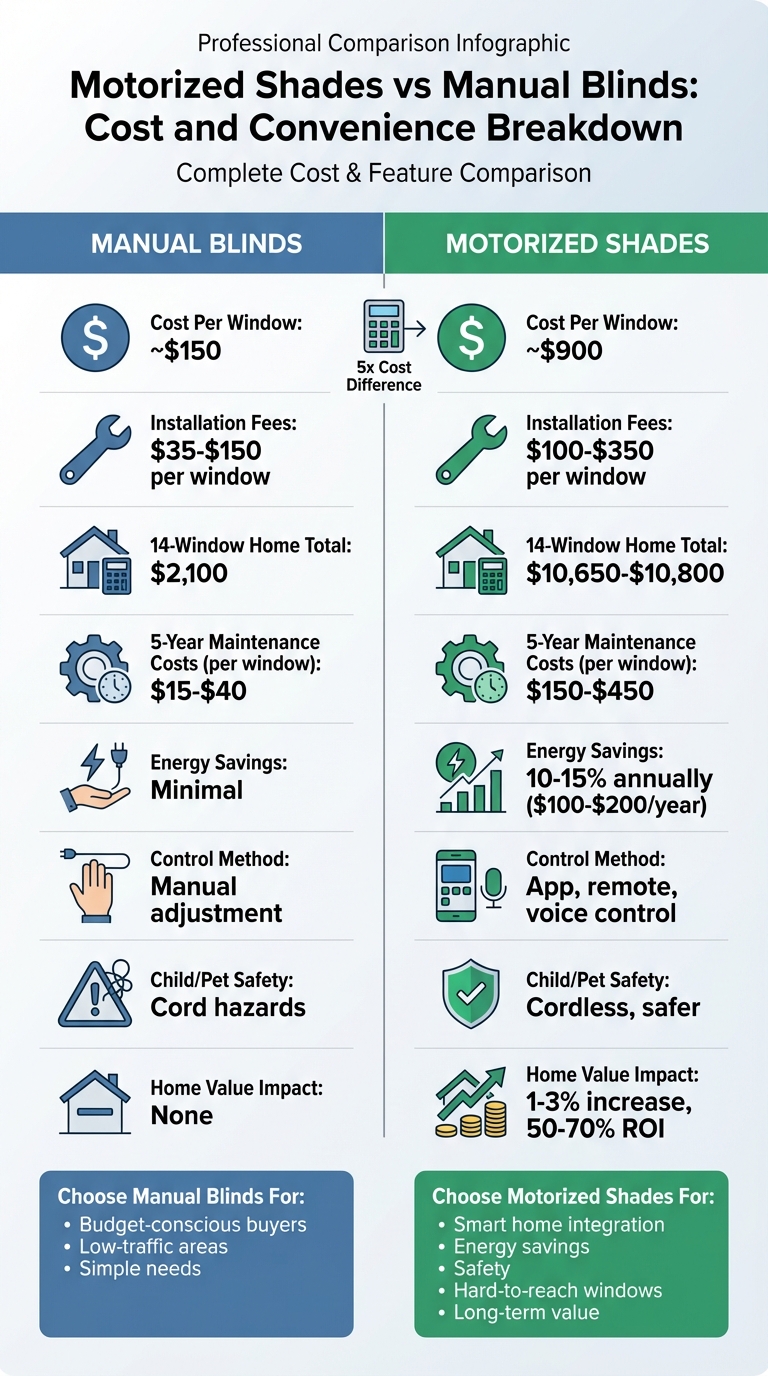
Motorized Shades vs Manual Blinds Cost Comparison Chart
Smart Blinds vs. Manual
Initial Investment: What You’ll Pay Upfront
When deciding between manual blinds and motorized shades, understanding the upfront costs is a critical part of the equation. Beyond convenience and safety, the price breakdown can help you make an informed choice.
Per-Window Pricing
The cost of window coverings starts with the type of material and design you choose. For manual blinds, pricing typically falls into these ranges:
- Vinyl or aluminum: $15–$25 per window
- Mid-range faux wood: $25–$150 per window
- Real wood or Roman shades: $200–$300 per window [1]
On the other hand, motorized shades come with a heftier price tag. Basic battery-powered models start at $150 to $300 per window. If you’re looking for professional-grade options with smart home integration, expect to pay anywhere from $300 to $1,000 per window. For premium hardwired systems with custom fabrics, costs can soar to $1,000–$2,500 per window [2][4][6].
Installation costs also vary significantly between manual and motorized options.
Installation Fees and Why Professional Help Matters
For manual blinds, professional installation ranges from $35 to $150 per window. Motorized shades, however, require more expertise, with installation fees running between $100 and $350 per window. If you opt for hardwired systems, expect an additional $100–$300 per window for setup [1][2][6].
Professional installation is especially important for motorized shades. Advanced models often require precise setup to ensure warranties remain valid and to properly configure Wi-Fi and voice-controlled integrations.
To get a clearer picture, let’s break down the total upfront costs for outfitting a 14-window home.
Total Upfront Cost for 14 Windows
Here’s a comparison of estimated costs for a 14-window home:
| Cost Category | Manual Blinds (Mid-Range) | Motorized Shades (Mid-Range) |
|---|---|---|
| Product Total (14 units) | $910 | $8,050 |
| Installation Total | $1,190 | $2,450 |
| Smart Integration Fees | $0 | $150–$300 |
| Estimated Total Investment | $2,100 | $10,650–$10,800 |
When all costs are tallied, motorized shades are approximately five times more expensive than manual blinds. However, there’s some flexibility depending on your choices. Budget-friendly motorized systems can lower the total to around $4,900, while high-end setups for 14 windows could exceed $23,000 [1].
Maintenance and Recurring Expenses
After the initial purchase, ongoing maintenance costs can vary significantly between manual and motorized blinds. Manual blinds generally require little upkeep, with occasional cord replacements costing between $15 and $40 when necessary [1].
Power Usage and Battery Costs
Battery-powered shades come with recurring battery expenses. Typically, batteries need replacing every 6–12 months, costing $10–$30 per window. Opting for premium lithium batteries can extend the replacement cycle to 1–3 years, though these come at a higher upfront cost [6]. For hardwired systems, there’s no need for battery replacements, but they do add $5–$15 annually to your electricity bill [6]. Solar-powered motors, while initially adding $50–$150 to the cost, can reduce long-term energy expenses by utilizing sunlight for recharging [1].
Manual blinds, on the other hand, incur no power-related costs.
Repair Costs Over Time
Beyond battery replacements, occasional repairs add to the long-term costs of motorized shades. Motors in these systems generally last 5–10 years before needing replacement [2]. After the warranty period (typically 3–5 years), repair visits can cost anywhere from $100 to $400 per incident. Additionally, routine maintenance can add $25–$60 annually [2][6].
5-Year Cost Projection
Here’s a breakdown of estimated costs over a five-year period for a single window:
| Option | 5-Year Estimated Total (Per Window) |
|---|---|
| Manual Blinds | $15–$40 (one cord repair) |
| Motorized (Battery) | $225–$450 (batteries, service, cleaning) |
| Motorized (Hardwired) | $150–$350 (electricity, service, cleaning) |
For a home with 14 windows, the five-year costs would range as follows:
- Manual blinds: $210–$560
- Motorized shades: $2,100–$6,300
This comparison highlights the substantial difference in recurring expenses. While motorized shades offer convenience and advanced features, they come at a much higher long-term cost compared to manual blinds. These ongoing expenses are an important factor to weigh when deciding between the two options.
Daily Use and Convenience Factors
How you interact with your window treatments on a daily basis can make a big difference. Manual blinds require you to physically adjust them, which can be a hassle – especially for windows in tricky spots like behind furniture, above staircases, or in vaulted ceilings. Constantly moving back and forth to adjust them throughout the day can quickly become inconvenient.
How You Control Them
Motorized shades take all the effort out of the equation. With options like a remote, smartphone app, wall switch, or even voice commands, you can adjust them from anywhere. This feature is a game-changer for families with hard-to-reach windows or for older adults who may find manual adjustments challenging. Plus, motorized systems are entirely cordless, making them safer for homes with small children or pets.
"Motorized shades are completely cordless, eliminating any potential hazards and giving you total peace of mind." – Blindsgalore [7]
Another advantage of motorized shades is their durability. Manual blinds can wear out over time due to constant handling, but motorized shades are powered by controlled motors, which help extend their lifespan. As Theo Jamieson from Stoneside explains:
"Motorization ensures that your shades will never be pushed past their limit, keeping them in tip-top shape longer than traditional treatments." [3]
These differences in control methods pave the way for even more advanced features, like scheduling, that make daily use even easier.
Scheduling and Voice Control Options
Motorized shades offer automation features that manual blinds simply can’t provide. You can program them to open with the sunrise, close during the hottest part of the day to help keep your home cooler, or adjust based on the time of day. This not only adds convenience but can also improve energy efficiency. Another bonus? You can set your shades to move while you’re away, giving your home a "lived-in" feel that helps deter potential intruders.
Voice control takes convenience to the next level. With integrations into major smart home systems, a simple command like "Good morning" can open your bedroom shades to just the right height. This effortless control not only enhances your daily routine but also fits seamlessly into your home’s energy management setup.
sbb-itb-c5b321b
Energy Savings and Home Value Impact
How They Reduce Heating and Cooling Costs
Motorized shades take the hassle out of managing your home’s temperature by automatically adjusting to block heat during summer and retain warmth in winter. Unlike manual blinds, which depend on you to make frequent adjustments, motorized shades work continuously to improve insulation efficiency. Let’s be honest – manual blinds often stay in the same position all day, missing opportunities to optimize energy use.
Cellular shades, when motorized, can achieve R-values as high as R-4, significantly boosting insulation performance [7]. Some systems even use sensors to monitor ambient conditions, fine-tuning their operation for maximum energy efficiency without requiring any input from you [8]. When programmed properly, motorized shades can deliver energy savings of 10% to 15% annually, cutting energy bills by $100 to $200 in larger homes [1]. Not only do these savings add up over time, but they also contribute to the long-term value of your home.
Return on Investment
The cost savings from reduced energy use translate into a compelling return on investment. While motorized shades may cost up to five times more than manual options upfront, they can increase your home’s resale value by 1% to 3% and deliver an ROI of 50% to 70% within three to five years [1][6][10]. Modern homebuyers are increasingly drawn to smart home features, and motorized window treatments enhance your property’s appeal by adding both energy efficiency and a touch of tech-forward convenience.
"ROI estimates range from 50% to 70%, particularly if blinds help reduce energy bills or make your home more appealing to tech-savvy buyers." – Angi [6]
For example, in August 2025, a homeowner in the South Bay area saw a 25% drop in energy bills during the first year after installing motorized solar screens. When the property was sold, these energy-efficient upgrades contributed to a higher appraisal value [11]. This real-world example underscores the financial and practical benefits of motorized shades, aligning with the cost projections discussed earlier.
Energy Savings Comparison Table
Here’s a quick breakdown of how manual blinds and motorized shades measure up when it comes to energy savings and home value impact:
| Feature | Manual Blinds | Motorized Shades |
|---|---|---|
| Estimated Energy Savings | Minimal (depends on manual adjustments) | 10% – 15% annually [1] |
| Annual Bill Reduction | Variable | $100 – $200 (larger homes) [1] |
| Home Value Impact | Standard | 1% – 3% increase [1] |
| Estimated ROI | Low | 50% – 70% [6] |
| ROI Timeline | N/A | 3 – 5 years [10] |
| Insulation (Cellular) | Up to R-4 | Up to R-4 with automated adjustments [7] |
Connecting Motorized Shades to Your Smart Home
Automation Features and System Control
Motorized shades integrate effortlessly with professional smart home systems like Control4 and Crestron, giving you centralized control over your home environment. These systems rely on dedicated hubs, such as the Lutron Bridge or PowerView Hub, and use standardized protocols like Zigbee, Z-Wave, and Matter over Thread to ensure smooth operation [13].
High-end options like Lutron‘s Sivoia QS bring professional-grade automation to the table, offering whisper-quiet operation and precise control. These shades can sync seamlessly with your home’s lighting and climate systems, making it possible to create custom "scenes." For instance, a single command – whether through voice, an app, or a keypad – can lower your shades, dim the lights, and adjust the thermostat for settings like "Movie Night" or "Morning Routine" [12][14]. Advanced scheduling features, such as astronomical clock functions, automatically adjust shades based on local sunrise and sunset times, enhancing both privacy and energy efficiency [13][12].
These automation tools don’t just simplify control – they transform how you experience your space, as described below.
Lifestyle Benefits and System Coordination
The real magic of motorized shades lies in how they enhance daily life, offering comfort, security, and energy efficiency in ways manual blinds simply can’t match.
When connected to your lighting, security, and climate systems, motorized shades contribute to a more comfortable and efficient home. For example, they can work with smart thermostats to block excess sunlight during peak hours, reducing strain on your HVAC system and lowering energy bills [3][7]. During the winter, they can allow sunlight to flood in, providing natural warmth and reducing heating costs. This synergy not only saves money but also reinforces the long-term value of your investment.
"Smart motorized blinds are among the most practical devices in a smart home’s portfolio because they harness natural lighting to make your home more comfortable and inviting."
Security is another key benefit. By automating your shades to move throughout the day, you can create the illusion of an occupied home, discouraging potential intruders [12][5]. When paired with automated lighting on realistic schedules, this effect becomes even more convincing. Additionally, the cordless design of motorized shades makes them a safer choice for families with young children [12][9].
Professional Installation in Northern NJ
Benefits of Professional Installation
When it comes to motorized shades, professional installation isn’t just a luxury – it’s a necessity. Hardwired systems require electrical connections directly to your home’s power distribution panel, which demands the expertise of a qualified electrician. Professionals handle everything from wiring and precise measurements to motor calibration, ensuring your shades operate smoothly and efficiently[6][5][3].
Attempting a DIY installation can lead to costly mistakes. Improper mounting or incorrect electrical connections, for instance, can void warranties on expensive motors and electronic components. Certified installers not only protect these warranties but also provide a labor warranty, giving you peace of mind. They’re also available for future support, whether it’s for repairs, motor replacements, or reprogramming. Without this support, independent service calls can set you back anywhere from $100 to $400 per visit[6][5].
In Northern NJ, professional motorized shade installation typically costs between $180 and $280 per window. Yes, it’s an upfront investment, but it ensures your shades are installed correctly and integrated seamlessly with smart home systems like voice assistants and automation hubs. Plus, it saves you the frustration of potential DIY mishaps. Professional installation guarantees reliability and protects your long-term investment, making it well worth the cost[1][6][7].
One Sound Choice: Northern NJ Smart Home Experts
For a flawless installation experience, you need seasoned professionals – and One Sound Choice fits the bill. With over 30 years of experience, they specialize in motorized shade installation and smart home integration throughout Northern New Jersey.
Whether your shades need to sync with Control4, Crestron, or Lutron systems, their team handles all the technical details, ensuring everything works together seamlessly. They’ll even integrate your shades with lighting, climate, and security systems for a streamlined smart home experience. And their commitment doesn’t end with installation. One Sound Choice offers ongoing support, so you’ll always have a reliable partner for troubleshooting, upgrades, or adjustments as your needs evolve.
Making Your Decision
Deciding between motorized shades and manual blinds comes down to a mix of your budget, lifestyle preferences, and what works best for your home’s layout and needs. Comparing the two options side by side can help pinpoint the choice that aligns with your priorities.
Manual blinds are a practical option for areas with less frequent use. They cost about $150 per window installed and are simple to maintain. However, they do require manual operation and come with safety concerns, as previously mentioned[1][3].
On the other hand, motorized shades involve a larger upfront cost – approximately $900 per window installed in Northern NJ – but they bring a host of benefits. Their cordless design improves safety, especially for homes with children or pets, and they’re ideal for windows that are hard to reach. With features like automated scheduling, motorized shades can cut annual energy bills by $100 to $200, increase your home’s resale value by 1–3%, and offer an estimated ROI of 50–70%[1][6]. As Expert Window Treatments puts it, "The decision between motorized and manual blinds ultimately depends on your budget, technical comfort, and lifestyle needs."[1]
If a full upgrade isn’t feasible, consider a phased approach. Focus on high-traffic areas – like your living room, primary bedroom, or windows above staircases – and stick with manual blinds for less prominent spaces[5]. For families prioritizing smart home integration, energy savings, and long-term value, motorized shades are a standout choice.
What One Sound Choice clients say
(We received) friendly, highly competent, quick and clean installation by 1 Sound Choice. The team followed up a few weeks after completion to ask if we were satisfied with our Media Room and Home Audio System. 1 Sound Choice is truly “top shelf” – they surpassed our expectations every step of the way.
– Mr. & Mrs. Blake (1 Sound Choice client testimonials)
The 1 Sound Choice staff was very easy to work with. Ryan, you understood our wants right from the beginning. Simplicity of installation and operation were just some of the reasons we chose 1 Sound Choice. You exceeded my expectations!
– Mr. & Mrs. Matia (1 Sound Choice client testimonials)
Truly One Sound Choice, you won’t find better. I called a couple of AV companies for quotes but on speaking with Ryan I had confidence that One Sound Choice would do the job right. Most companises had assured me that they would not have to cut holes in my walls to achieve my project goals. Ryan was up front, honest and realistic outlining all the possible challenges my install might face whilst reassuring me that One Sound Choice had the capabilitiy and expertise to meet my goals. Consulation was painless and Ryan and Kenny captured my requirements perfectly and offered advice based on their experience regarding optional additons to the project, which were practical and delivered exceptional enhancements. Ryan provided me with a view of what could be achieved given my requirements and then worked with me complete the project with consideration to my budget, but without compromising the final solution. Even completed the project without requiring any patch work which was a bonus. Ryan and Kenny were a pleasure to work with, respectful and courteous and I had confidence having them in our home. Highly recommend for any AV work you are considering. You will not be disappointed with the results.
– Leighton (Houzz review)
FAQs
How do motorized shades compare to manual blinds in terms of long-term costs?
Motorized shades come with a steeper upfront price, typically ranging from $150 to $1,200 or more per window, compared to the $15 to $250 range for manual blinds. On top of that, you’ll need to factor in installation costs, which can increase the initial expense.
That said, the higher price tag can be offset over time. Motorized shades often require less upkeep and can help lower energy bills by improving light and temperature control in your home. For those with smart home systems, the added convenience and advanced features make them a practical choice, offering long-term comfort and efficiency.
How can motorized shades help save energy and boost home value?
Motorized shades offer a practical way to manage your home’s energy use. By programming them to adjust automatically based on the time of day or temperature, they can help keep your home cooler during the summer and warmer in the winter. This not only boosts comfort year-round but can also trim down your heating and cooling expenses.
On top of that, motorized shades are seen as a high-end smart-home upgrade. They can make your home more appealing to potential buyers and even boost its resale value. Their ability to seamlessly integrate with smart home systems adds both convenience and a sleek, modern feel that many homeowners appreciate.
Why should motorized shades be professionally installed?
When it comes to motorized shades, professional installation is key to ensuring they’re set up safely and work flawlessly. Dealing with electrical wiring and syncing these shades with your smart home system isn’t exactly a DIY-friendly task – it demands expertise and attention to detail.
By opting for professional assistance, you can sidestep common headaches like faulty wiring or connectivity glitches. Even better, the pros can tailor the installation to fit your home’s specific layout and preferences, giving you a smooth, worry-free experience while enhancing both convenience and long-term functionality.
Related Blog Posts
- How to Choose Smart Lighting for Every Room in Your Home
- Smart Home Security Systems vs Traditional Alarms: What’s Best?
- Home Theater Design Checklist: 12 Must-Have Features
- Smart Home Integration Guide: Connect All Your Devices
Sun glare on the TV? See our motorized shades page.
More questions
Can I mix motorized shades and manual blinds?
Yes. Many homes put motorized shades on big or hard-to-reach windows and keep manual blinds in other rooms.
One Sound Choice, 8 Tilley Ave, Pompton Plains, NJ 07444. Call or text (973) 945-5275. We work in homes across Morris, Passaic, Bergen, Essex, Somerset, and Hunterdon counties. Written by Ryan Herd, founder of One Sound Choice.