
Want a smart home that works effortlessly? Here’s the key: professional integration. Unlike DIY setups, professional systems combine your devices – security, lighting, entertainment, and more – into one streamlined network. This means no juggling apps, no delays, and a system that just works.
Why Go Professional?
- Reliable Performance: Local data processing avoids delays common with cloud-dependent devices.
- Strong Networking: Enterprise-grade Wi-Fi ensures zero dead zones, even in large homes.
- Unified Control: Manage everything – lights, locks, cameras – through a single interface.
- Custom Automation: Tailored routines like "Goodnight" or "Away" simplify daily life.
- Ongoing Support: Experts handle updates, troubleshooting, and maintenance.
Key Components:
- Enterprise-Grade Networking: Strong Wi-Fi and wired connections ensure stability.
- Structured Wiring: Hardwired systems reduce lag and improve reliability.
- Unified Interface: Control everything via touchscreens, remotes, or apps.
- Sensors & Actuators: Automate lighting, climate, and security tasks seamlessly.
Costs and Planning:
- Entry-Level Systems: $3,000–$5,000 for basic lighting, climate, and security.
- Whole-Home Systems: $25,000–$100,000+ for larger or more complex setups.
- Pro Tip: Start with infrastructure (wiring, network) and add devices over time.
Professional integrators in Northern New Jersey, like One Sound Choice, specialize in designing systems tailored to your lifestyle. From robust networks to custom automation, they ensure your smart home operates flawlessly now and in the future. Let’s dive into everything you need to know.
Professional smart home installers share their tips
What You Need for Smart Home Integration
Professional vs DIY Smart Home Systems Comparison
Main Parts of Professional Systems
A professional smart home system revolves around four key components that work together to deliver seamless functionality. The first is enterprise-grade networking. Unlike a standard router, this setup involves a sturdy infrastructure with multiple Wi‑Fi access points, ensuring a strong and consistent signal throughout your home. For larger, multi-story homes – like those commonly found in Northern New Jersey – this means carefully placing access points and using wired connections for critical devices to guarantee stability and security [12].
Next, you have structured wiring, which serves as the backbone of a reliable system. Professional installations rely on hardwired Ethernet connections for processors and KNX bus cables for sensors and controls. This wired approach minimizes the lag and interruptions often seen in Wi‑Fi-only setups [14][16]. As Lutron explains, "Hardwiring the hub or processor also ensures reliable access to the internet for precise scheduling and geolocation-triggered events" [16].
The third essential component is a unified control interface. Instead of juggling multiple apps, professional systems streamline everything with touchscreens, wall-mounted keypads, smart remotes, and mobile apps that deliver a consistent user experience. Jeremiah W., a Control4 user, shares: "The interface is simple and it’s the same experience whether you use the Pad, the remote, or the app on a smartphone!" [11].
Finally, sensors and actuators play a critical role in monitoring and executing commands. Sensors – like motion detectors, temperature monitors, and moisture sensors – gather data, while actuators carry out tasks such as dimming lights, adjusting motorized shades, or locking doors. These components integrate seamlessly with subsystems like smart lighting, automated window treatments, climate control, distributed audio, and advanced security [13][14][15].
Together, these components create a strong, scalable, and secure foundation for your smart home, setting the stage for advanced features discussed in the next section.
Why Professional Systems Outperform Consumer Products
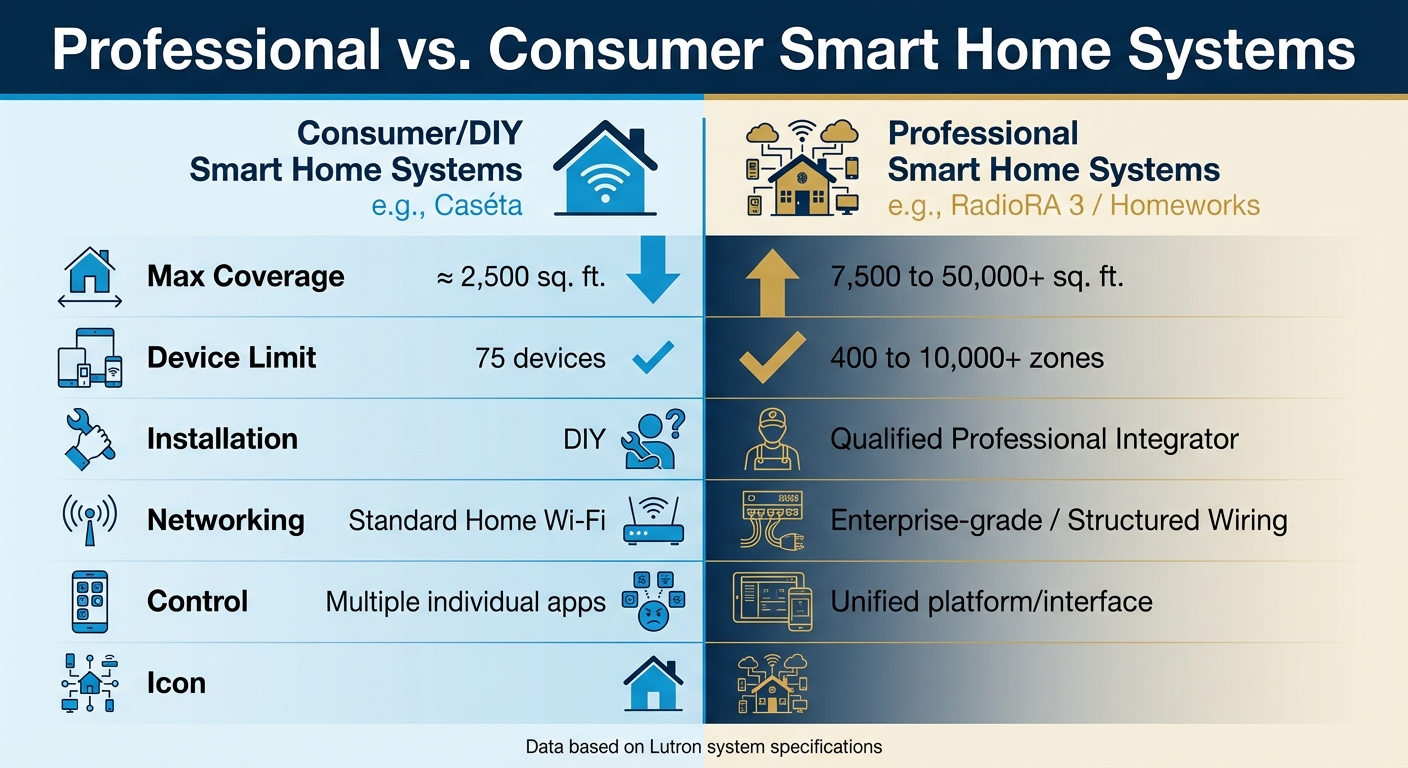
When it comes to scalability and reliability, professional systems significantly outshine consumer-grade options. Take Lutron as an example: their consumer-focused Caséta system covers up to 2,500 square feet and supports 75 devices, which works well for smaller homes. On the other hand, their professional RadioRA 3 system handles up to 7,500 square feet and 400 devices, while the high-end Homeworks QSX system scales to an impressive 50,000 square feet and 10,000 zones [16].
| Feature | Consumer/DIY (e.g., Caséta) | Professional (e.g., RadioRA 3 / Homeworks) |
|---|---|---|
| Max Coverage | ~2,500 sq. ft. | 7,500 to 50,000+ sq. ft. |
| Device Limit | 75 devices | 400 to 10,000+ zones |
| Installation | DIY | Qualified Professional Integrator |
| Networking | Standard Home Wi‑Fi | Enterprise-grade / Structured Wiring |
| Control | Multiple individual apps | Unified platform/interface |
Professional systems also offer unmatched reliability and security. They utilize dedicated communication protocols and process data locally, avoiding the pitfalls of consumer gadgets that depend on crowded home Wi‑Fi networks and cloud servers. This reduces potential points of failure. Additionally, professional setups provide encrypted remote access and backup systems, ensuring that essential functions like security and climate control continue to operate even during outages [12][14].
Another major advantage? Professional integrators deliver personalized, ongoing support. They can program intricate automation scenes – like a "Morning" routine that opens your shades, plays your favorite music, and sets the thermostat to your preferred temperature – all while handling firmware updates, monitoring system performance, and troubleshooting issues. This ensures your smart home runs smoothly for years to come [11][15].
Planning Your Smart Home System
Identifying Your Family’s Needs
When planning a smart home, the goal is to tailor it to your family’s everyday routines and preferences. Start by evaluating your daily habits and pinpointing areas where automation could make life easier. For example, do you often find yourself double-checking locked doors or turned-off lights before leaving in the morning? Would you enjoy a single button that dims the lights and lowers the shades for a relaxed evening? Features like an "Away" mode can streamline these tasks by locking doors, adjusting thermostats, and turning off lights with one simple command [20][7].
It’s also important to ensure the system is intuitive for everyone in the household. Whether it’s a tech-savvy teenager or a grandparent who prefers simplicity, the technology should feel natural to use. As Daisy North Jersey aptly puts it:
"Your home should fit your life, not the other way around" [1].
Avoid solutions that demand juggling multiple apps or deciphering complicated interfaces. Professional integrators can design user-friendly systems that work seamlessly across wall keypads, touchscreens, or smartphones [5].
Additionally, decide between cloud-based or local-control systems. This choice can impact both security and ongoing costs, as many cloud-based systems require annual fees ranging from $240 to $600 for storage and premium features [5]. Consider room-specific needs as well: kitchens may benefit from moisture sensors, media rooms thrive with high-quality audio, and outdoor areas need weatherproof entertainment options [7].
These considerations will help you identify the systems that align with your lifestyle and guide your decision-making process.
Which Systems to Include
To get the most value from your smart home, start with the essentials. A reliable enterprise-grade network and a central control hub are the foundation for everything else [1][21].
From there, prioritize systems based on their immediate benefits. For instance, water leak detection systems with automatic shutoff valves are highly recommended since water damage is the most common homeowner insurance claim, with an average cost of over $11,000 per incident [5]. Security systems provide peace of mind through remote monitoring and keyless entry, while climate control and automated shades enhance comfort and energy efficiency. Entertainment systems, like whole-home audio or outdoor setups, turn your home into a space where family and friends want to gather [17].
| System Category | Priority Level | Key Benefit |
|---|---|---|
| Networking | Critical | Foundation for all devices |
| Security/Access | High | Peace of mind; remote monitoring and keyless entry |
| Water Protection | High | Prevents costly damage (average $11,000+) |
| Climate/Shades | Medium | Energy savings and daily comfort |
| Entertainment | Lifestyle | Creates inviting spaces for family and friends |
Opt for systems built on open standards like Matter or Zigbee. These ensure compatibility with future devices and prevent you from being locked into one manufacturer’s ecosystem [20][5].
With your priorities set, focus on planning the infrastructure and budget to support seamless integration.
Infrastructure and Budget Planning
Incorporating smart home technology is best done during the design phase of your home. Planning early allows you to install structured wiring while walls are open, allocate space for centralized equipment, and ensure sufficient power capacity. This approach not only saves money compared to retrofitting later but also preserves the aesthetics of your home [22][25].
Budgeting for your smart home depends on the level of integration. In Northern New Jersey, basic setups that cover lighting, climate control, and security typically range from $3,000 to $5,000. For whole-home systems, costs can climb to $25,000–$100,000 or more, depending on the size of your home and the complexity of the automation [17]. Don’t forget to account for essentials like permits, which usually cost $200–$500 depending on your location, and professional installation fees [18]. One Sound Choice, a company with over 30 years of experience and 2,500+ installations in Northern New Jersey, offers custom pricing based on your home’s layout and specific needs.
If your budget requires phasing, prioritize the infrastructure first – this includes wiring, network equipment, and central hubs. You can add peripheral devices, like specialized lighting or outdoor entertainment, in later phases [24]. Serenity Smart Homes sums it up well:
"Professional installation isn’t an expense. It’s infrastructure investment that protects your property, eliminates recurring costs, and delivers reliable automation for years to come" [5].
To future-proof your home, consider installing conduits and wire chases during construction. These make it easy to upgrade your system without the need for costly and invasive wall modifications [22][23].
Networking and Control Systems
When it comes to creating a smart home, a strong and reliable network is the glue that holds everything together. Without a dependable connection, even the most advanced devices can falter, leaving you frustrated at the worst possible moments. That’s why building a solid network foundation is absolutely critical.
Professional integrators rely on top-tier hardware like Araknis, Ubiquiti, and Eero to deliver fast, low-latency Wi‑Fi and high-speed wired connections. In larger homes, especially in areas like Northern New Jersey where stone walls and multi-level layouts are common, professional coverage mapping ensures there are no dead zones. This complements the structured wiring and centralized control systems already in place, ensuring your smart home operates seamlessly.
Building a Dependable Network
For devices with heavy data demands – like smart TVs, gaming consoles, and security cameras – wired Cat6/6A connections are the way to go. They reduce network congestion and provide rock-solid stability. For everything else, strategically placed wireless access points ensure you have uninterrupted Wi‑Fi coverage as you move around your home.
To enhance security and performance, segment your network with VLANs. Separating Audio/Video (AV) and Internet of Things (IoT) devices from personal data adds an extra layer of protection. This way, if one device is compromised, your sensitive information stays safe.
Advanced tools like WattBox allow for remote power cycling and monitoring, so issues can often be resolved without an in-person visit. Upgrading to Wi‑Fi 6 can also make a noticeable difference, boosting network performance by up to 40% compared to older systems [26]. Plus, setting up Quality of Service (QoS) ensures critical devices like security cameras and smart locks get priority over less essential traffic.
With a reliable network in place, the next step is creating a unified control system to make managing your smart home effortless.
Easy-to-Use Control Interfaces
A centralized control system – think Control4, Crestron, or Savant – brings all your devices together under one simple, intuitive interface. Whether you prefer using a touchscreen, keypad, or smartphone, these systems make it easy to manage your entire home.
Scene-based automation takes convenience to the next level. For example, an "Away" scene can lock doors, lower shades, dim lights, and arm the security system with a single tap. A "Goodnight" scene might turn off lights, adjust the thermostat, and secure the home for the night. Professional integrators ensure these scenes work consistently, so your home responds instantly every time.
Unlike piecemeal setups, these systems allow devices to communicate and adapt to your habits, helping to improve energy efficiency and overall comfort.
Designing for All Users
A smart home should work for everyone in the household, whether it’s tech-savvy teenagers or grandparents who prefer simplicity. Clearly labeled scenes like "Morning", "Movie Time", or "Entertain" make it easy for anyone to understand and use. Wall-mounted keypads and touchscreens offer a straightforward alternative for those who might not want to rely on smartphones.
Multiple user access levels add another layer of convenience. Parents can retain full control while giving kids limited permissions, and guest modes let visitors adjust the lights or temperature without accessing sensitive security settings.
In Northern New Jersey, companies like One Sound Choice specialize in designing systems that blend seamlessly into your home’s architecture. With over 30 years of experience and more than 2,500 installations, they know how to hide the complexity behind sleek, elegant interfaces. From invisible speakers to intuitive controls, these systems are designed to ensure that every family member feels confident using the technology from day one. This thoughtful approach helps create a truly seamless smart home experience for families in the area.
sbb-itb-c5b321b
Connecting Your Home Systems
Imagine a home where security, lighting, entertainment, and outdoor systems all work together seamlessly. By integrating these elements into a single, automated experience, you create a network of devices that respond intelligently to your routines. The real magic lies in how these systems communicate with one another, transforming your home into a responsive ecosystem.
Professional integrators rely on industry-standard protocols to ensure compatibility across devices from different manufacturers [29]. This means your security cameras can trigger outdoor lights, shades can lower when you start a movie, and outdoor speakers can activate based on the time of day – all effortlessly connected.
Security and Access Control
An integrated security system does more than monitor your home – it actively works with other devices to enhance safety. For example, if a motion sensor or camera detects unusual activity, the system can automatically turn on exterior floodlights or flash indoor lights to alert everyone inside [1][10]. Smart locks can also be programmed to secure doors at a set time each night, adding another layer of protection.
"Smart home automation controls entertainment, comfort, and security with a single tap. Whether you’re streaming your favorite show, adjusting the light, or checking your phone to see who’s at the front door, a home automation system… brings it all together." – Chad Jasinski, Branch Owner, Daisy North Jersey [1]
For families in Northern New Jersey, this level of integration offers peace of mind, particularly when managing multiple properties or traveling. Professional-grade systems ensure reliable communication between components, minimizing the risk of gaps in coverage or false alarms.
Lighting and Shade Automation
Smart lighting and shade control can completely change how you interact with your home. Lutron, a leader in lighting automation, provides features like precise dimming, customizable schedules, and scene creation [30]. Not only does this enhance convenience, but it can also cut energy consumption by 7% to 27%, with motion-activated systems reducing usage by an additional 30% to 50% compared to traditional switches [27].
Motorized shades add another layer of efficiency by adjusting automatically to optimize light and temperature. For instance, a single "Movie Night" setting can dim the lights, lower the shades, and activate your home theater system – all with one command [1][2].
Older homes, particularly those built in the 1980s, may require some upgrades to accommodate smart lighting. In one project by Echelon Electric, switch boxes were rewired to include neutral wires for smart dimmer compatibility. Additionally, the home’s mesh network was expanded to ensure reliable communication with devices on the second floor, and the electrical panel was updated to meet 2023 NEC standards [27].
These systems don’t just stop indoors. Professional-grade automation extends to outdoor spaces, ensuring smooth operation across your entire property.
Entertainment and Outdoor Living
Imagine streaming your favorite music or movies in any room – or multiple rooms – without interruption. Whole-home audio and video systems from brands like Savant, Control4, and Crestron make this possible, delivering flawless playback even when streaming 4K content to several devices simultaneously [30].
For families who love to entertain, these systems go beyond indoor spaces. Outdoor setups can include weatherproof speakers, automated lighting, and even displays designed to withstand the elements. In Northern New Jersey, where outdoor gatherings are a summer tradition, local experts specialize in creating durable, user-friendly systems for everything from backyard movie nights to poolside playlists. With over 30 years of experience and more than 2,500 installations, these professionals ensure your outdoor systems are built to last and easy to use.
Working with a Professional Integrator
When it comes to creating a smart home that works seamlessly for your family, it takes more than just buying the latest gadgets and connecting them to Wi-Fi. Professional integrators bring the expertise needed to turn individual devices into a fully functioning system tailored to your lifestyle. They ensure your smart home not only connects but operates smoothly and reliably.
What Professional Integrators Do
Professional integrators handle every aspect of your smart home setup – design, installation, programming, and ongoing support. They start by understanding your family’s daily routines and preferences, crafting a system that blends effortlessly with your home’s layout. This could mean discreetly hiding speakers behind custom cabinetry, installing motorized shades in hard-to-reach spaces, or ensuring all components communicate without a hitch [9].
Licensed electricians ensure all wiring meets local codes and safety standards [10]. Network specialists design robust systems using tools like Araknis routers to eliminate dead zones and enable remote troubleshooting [9]. Programmers then create custom "scenes" – like an "Away" mode that locks doors, adjusts the thermostat, and activates security cameras with a single command [9].
Unlike many consumer-grade products that rely entirely on cloud connections, professional systems are built to operate locally. This ensures critical functions like lighting and security continue to work even when the internet goes down during storms [8].
Choosing the right integrator is crucial to achieving a smart home that meets your needs.
Why Choose a Local Northern NJ Expert
The importance of hiring a local expert becomes clear when you consider the unique challenges of specific regions. Northern New Jersey, for instance, has a mix of older homes in Bergen County and newer builds, each requiring specialized approaches. Retrofitting older properties often demands intricate solutions to integrate smart technology without major renovations [10]. Coastal properties, on the other hand, need weatherproof outdoor systems and strong network setups to withstand the elements.
One Sound Choice, led by Ryan Herd – a former Pequannock mayor with over 30 years of experience – has completed over 2,500 installations across Northern New Jersey [9]. Their familiarity with the area translates to faster service, smoother coordination with local contractors, and tailored solutions for the region’s unique needs.
"Our team knows the unique needs of homes in northern New Jersey, from historic builds to new construction." – Daisy North Jersey [1]
For families with multiple properties or high-value homes, local integrators can also conduct specialized security audits to address risks such as Wi-Fi jamming or compromised automation systems [9].
How to Evaluate an Integrator
Finding the right integrator starts with checking their credentials. Look for certifications from organizations like CEDIA, HTA, HAA, or ISF [6][31]. These indicate the integrator stays current with industry standards and best practices.
Make sure they hold the necessary state electrical licenses and have proper bonding and insurance [10][2]. Ask whether they conduct background checks on employees who will be working in your home [31]. Also, request written service policies that outline response times – top-tier integrators often promise on-site service within 1–2 days for non-emergency issues [31].
| Evaluation Criteria | What to Look For | Why It Matters |
|---|---|---|
| Certifications | CEDIA, HTA, HAA, or ISF credentials [6][31] | Shows expertise in professional-grade systems |
| Licensing | State electrical license, bonding, insurance [10][2] | Ensures compliance with safety standards |
| Experience | Long-standing business with local projects | Demonstrates reliability and regional knowledge |
| Support | Written service policies and quick response times [31] | Protects your investment over time |
| Security | Employee background checks [31] | Ensures safety during installation |
Companies with decades of experience, like Professional Audio Consultants and Grounded Electric, have demonstrated their ability to adapt through multiple generations of technology. Professional Audio Consultants, for example, earned "Sub-Contractor of the Year" from the Metropolitan Builders & Contractors Association of New Jersey, while Grounded Electric boasts a 4.9/5 rating from over 300 reviews [6][10].
"The value of a well done installation is noticed when the project is new and even more so years later." – Professional Audio Consultants [6]
Lastly, visit the integrator’s showroom to test out control interfaces and experience the quality of their audio-visual setups firsthand [31]. The best integrators offer scalable systems that can grow with your needs, whether you’re upgrading one room at a time or investing in a comprehensive whole-home solution. Basic smart home packages typically start between $1,500 and $3,000, while more advanced systems can range from $5,000 to over $15,000 depending on complexity [10].
Securing and Maintaining Your Smart Home
Even the most advanced smart home setup is at risk without strong security measures and regular maintenance. Did you know that over 80% of confirmed security breaches stem from stolen, weak, or unused passwords? [32]. To protect your system, replace default usernames and passwords with unique, complex ones immediately, and enable multi-factor authentication (MFA) or two-factor authentication (2FA) on all accounts.
Cybersecurity Best Practices
Professional integrators do more than just design your smart home – they also establish robust security protocols and maintenance plans.
One of the most effective ways to secure your home network is through network segmentation. By using Virtual Local Area Networks (VLANs), you can isolate smart devices from your primary network, which is used for sensitive activities like online banking. As Daniel Fulmer, Founder of FulTech Solutions, explains:
"VLAN is what saved my office from getting hacked" [32].
Consider setting up separate VLANs for different device categories: one for control systems, another for media devices, and a third for general internet access.
Take additional steps to secure your router: use WPA3 encryption, disable WPS and UPnP, and change the default SSID to something less identifiable. Position your router centrally for better coverage, and set up a dedicated guest network. Disabling features like remote access, voice-activated purchasing, and unused built-in cameras or microphones can also minimize potential vulnerabilities.
| Security Layer | Best Practice Recommendation | Benefit |
|---|---|---|
| Authentication | Enable MFA/2FA | Protects against unauthorized access even if passwords are compromised |
| Network | Use VLAN segmentation | Prevents malware from spreading across devices |
| Hardware | Disable WPS and UPnP | Reduces common attack points |
| Maintenance | Turn on automatic updates | Ensures vulnerabilities are fixed quickly |
| Privacy | Disable unused cameras/microphones | Blocks potential eavesdropping |
If any of your smart devices stop receiving firmware updates, it’s time to replace them, as they could become security liabilities. Professional integrators can also follow established cybersecurity guidelines to ensure your system is properly secured during installation.
While digital security is critical, don’t overlook the importance of physical upkeep to maintain system performance.
Regular Maintenance and Support
Securing your smart home is just the first step – regular maintenance is key to keeping everything running smoothly. Software updates not only fix bugs but also enhance performance and address security vulnerabilities. On the physical side, neglecting maintenance can lead to issues like dust buildup on sensors, camera lenses, and speaker grilles, which can cause overheating or reduced functionality.
Keep an eye on battery levels in devices like smart locks and sensors to avoid unexpected disconnections. For safety, test smoke and carbon monoxide detectors monthly. These devices are lifesaving – smoke detectors alone can cut the risk of dying in a house fire by half. Yet, over 60% of fire-related fatalities occur in homes without working alarms [34].
Other maintenance tips include cleaning or replacing HVAC filters monthly and scheduling professional tune-ups for heating and cooling systems in spring and fall. These services typically cost between $75 and $200 but are worth the investment to ensure efficiency.
Enable automatic updates to stay on top of security patches. Professional integrators can also provide remote diagnostics and send alerts for preventative maintenance, helping you address potential issues before they escalate. Smart sensors for leak detection and temperature monitoring can further protect your home by providing early warnings of plumbing or environmental problems. As Smart Homes Pro states:
"Regular upkeep not only enhances performance but also extends the lifespan of these technologies" [33].
Preparing for Future Technology
To ensure your smart home remains relevant, choose devices and systems that can integrate with both current and future technologies [19]. Research shows that 70% of homebuyers actively look for smart homes, and 78% are willing to pay extra for homes equipped with smart devices [19]. In fact, smart home features can increase a property’s value by 3% to 5% [36].
Opt for unified platforms like Lutron or Crestron, which can manage anywhere from 50 to 10,000 devices [35]. These systems offer advanced features like biometric access, layered encryption, and edge computing, which processes data locally to reduce the risk of cloud-based breaches. As Origin Wireless AI advises:
"Make sure that all smart home technology used is unhackable, with layered security measures, encryption, and edge-computing" [28].
Plan your infrastructure with future needs in mind. Ensure your home is equipped with 5G-ready networks and strong IoT connectivity to support remote work and entertainment [36]. Consider wiring for wellness systems like air and water quality monitoring, as well as eco-friendly upgrades like solar power integration and smart battery storage. Adding conduits for future EV chargers, additional network drops, and extra power outlets can also make future upgrades easier.
Regular updates and periodic professional checkups are essential for keeping your system ready for new advancements. Professional monitoring and maintenance can safeguard your system’s reliability, ensuring your smart home remains efficient and secure for years to come.
Conclusion
Creating a smart home that fits seamlessly into your family’s life requires thoughtful planning, professional-grade infrastructure, and ongoing support. As outlined in this guide, the backbone of any reliable smart home is a strong network tailored to your home’s layout, paired with systems that communicate effortlessly and security measures that protect your family’s privacy. These key elements come together to create a truly connected and functional home.
Local integrators bring a deep understanding of the area’s unique architectural challenges, whether it’s a historic home in Bergen County or a sleek, modern build in Morris County. With years of experience, they ensure every system is installed to meet local building codes and safety standards. As one satisfied customer, Joseph S., shared: Here’s how we look after our customers.
"Whether sales, design or installation, each employee understands every product, how it works in the system, and how to integrate/install to maximize value/performance."
This level of expertise ensures that your smart home not only works flawlessly but also integrates seamlessly into your daily routine.
Professional integration doesn’t just provide immediate benefits – it ensures your system is built to grow with you. Expertly designed systems can start with essential features like lighting or security and expand over time as your needs and budget evolve [3][4]. This adaptability protects your investment and ensures your smart home remains functional and relevant for years to come.
With over 30 years of experience and more than 2,500 installations across Northern New Jersey, One Sound Choice has been transforming homes with advanced smart solutions. Led by Ryan Herd, the team focuses on creating technology systems that enhance family life without adding unnecessary complexity. Whether you’re upgrading your network, integrating lighting and security, or designing a full-scale smart home, starting with a professional consultation is the first step toward a secure, scalable, and customized solution.
What One Sound Choice clients say
I’d (tell others) that Ryan’s very professional and very easy to work with, in terms of budgeting and listening to what you want to have done. He never pushed us toward anything we couldn’t afford or didn’t want and he got the job done on time.
– Mr. & Mrs. DeSantis (1 Sound Choice client testimonials)
Ryan listened to us – he understood what we wanted to accomplish. (The 1 Sound Choice team’s) commitment to post-installation support and service has been unbelievable. They are professionals in every aspect and have gained our trust throughout the completion of our project.
– Mr. & Mrs. Maytin (1 Sound Choice client testimonials)
I have hired 1 Sound Choice on several occasions over the past 10 years for several projects (from minor implementations to a whole house system). Ryan and the team at 1 Sound Choice are consummate professionals – extremely knowledgeable and up to date with technology, focused on delivering the best solution to fit your need, and highly customer service oriented. This combination plus the quality of finished product (every time) have made me a loyal customer… I highly recommend 1 Sound Choice.
– Terry Maytin (Houzz review)
FAQs
Why should I choose professional smart home integration instead of a DIY solution?
Opting for professional smart home integration ensures that all your devices are perfectly in sync, working together as a unified system. Experts design solutions specifically for your needs, offering more dependable performance compared to DIY setups.
Another advantage is the focus on security and future growth. With a professional installation, it’s easier to expand your system as new technologies emerge. Plus, you’ll have access to ongoing support and expert troubleshooting, sparing you the hassle of resolving issues on your own and giving you added peace of mind.
How do professional integrators design smart home systems to match my family’s needs?
Professional integrators specialize in crafting smart home systems that align perfectly with your family’s lifestyle and preferences. They fine-tune every detail – whether it’s lighting, security, climate control, or entertainment – so your home operates in harmony with your daily routines.
Through personalized automations and scenes, they make your smart home work for you. Imagine your lights dimming and your sound system kicking in for movie night, or your security system activating automatically when you leave the house. They can even tailor temperature settings to keep your home comfortable at all times. These systems are designed to grow with your family, ensuring a smooth and dependable experience as your needs change.
How should I budget for a smart home integration project?
When planning your budget for a smart home setup, it’s important to think about several factors. These include the size of your home, how many devices you want to connect, the type of technology you prefer (such as Wi-Fi, Z-Wave, or hybrid systems), and how complex the installation will be. Generally, larger homes or more advanced systems will come with a higher price tag.
For professional installations, you can expect costs to fall between $2,000 and $6,000, though more sophisticated systems can push that number higher. Be sure to also factor in ongoing maintenance and potential upgrades to keep your system running smoothly and up-to-date. Partnering with an experienced integrator can make the process seamless and ensure your smart home is customized to fit your lifestyle.
Related Blog Posts
- How to Choose Smart Lighting for Every Room in Your Home
- AI-Powered Smart Security System
- Smart Home Security Systems vs Traditional Alarms: What’s Best?
- How to Set Up Whole Home WiFi: 7 Steps for Better Coverage
Want help with the plan? See our smart home page.
One Sound Choice, 8 Tilley Ave, Pompton Plains, NJ 07444. Call or text (973) 945-5275. We work in homes across Morris, Passaic, Bergen, Essex, Somerset, and Hunterdon counties. Written by Ryan Herd, founder of One Sound Choice.