
When it comes to window treatments, safety is key – especially for families with young children or pets. Dangling cords from older blinds can pose serious strangulation and entanglement risks. Fortunately, cordless and motorized shades offer safer alternatives by eliminating these hazards entirely.
Here’s what you need to know:
- Cordless Shades: Operated manually via a bottom rail, these shades remove all visible cords. They’re simple to use and safe for most homes but can be inconvenient for hard-to-reach windows.
- Motorized Shades: Controlled by remotes, apps, or voice commands, these shades eliminate cords entirely and offer hands-free operation. They’re ideal for tall or obstructed windows but come with a higher price tag.
Quick Comparison
| Feature | Cordless Shades | Motorized Shades |
|---|---|---|
| Cord Presence | No external cords | No cords at all |
| Operation | Manual (push/pull bottom rail) | Remote, app, or voice-controlled |
| Best Use Case | Easy-to-reach windows | Hard-to-reach or tall windows |
| Safety for Kids | High (no cords) | Very high (no interaction needed) |
| Pet Safety | High | Very high |
| Cost | Moderate | Higher |
Bottom Line: Both options comply with updated safety standards, but motorized shades offer added convenience and are better for hard-to-reach spaces. Choose based on your home’s layout and family needs.
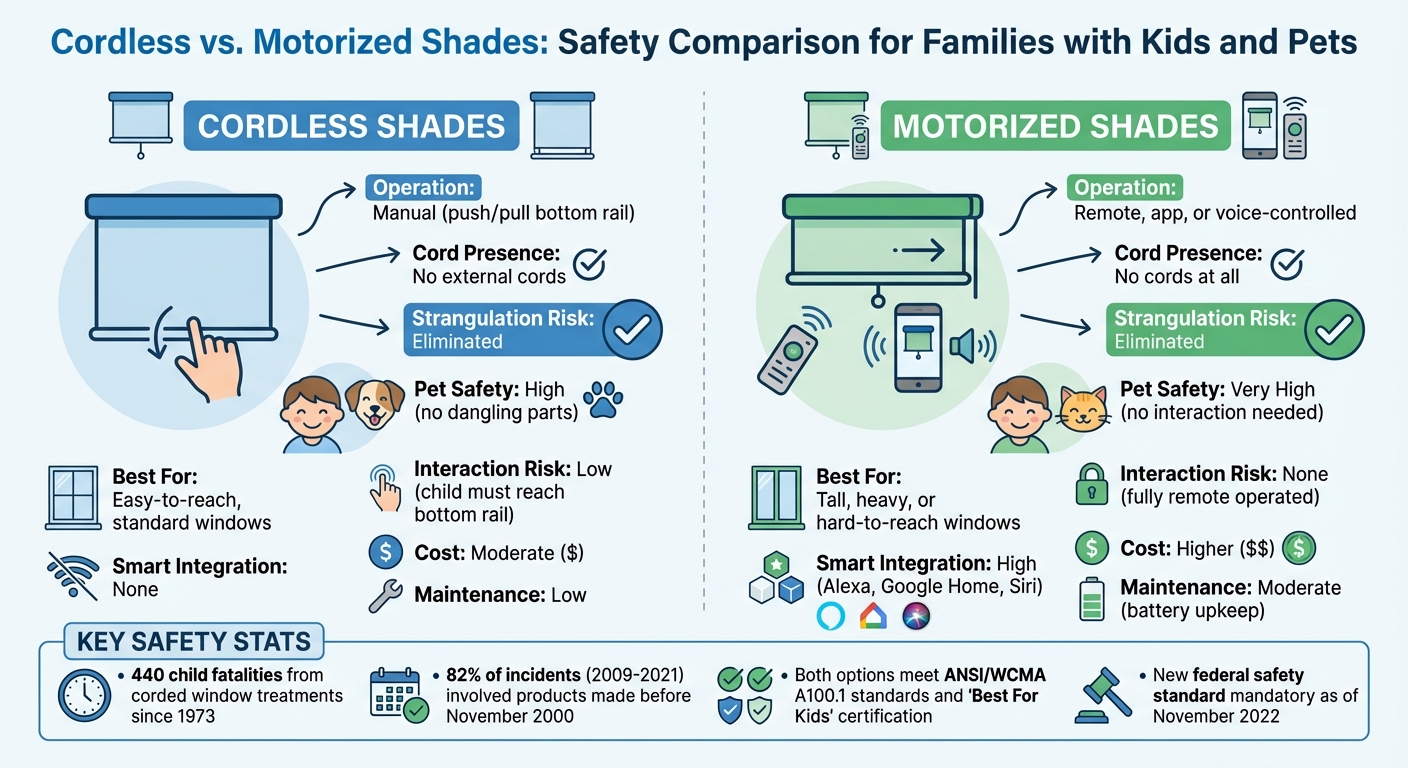
Cordless vs Motorized Shades Safety Comparison Chart
How Window Treatment Design Impacts Child and Pet Safety
Dangers of Traditional Corded Window Treatments
Traditional corded window treatments can pose serious risks to children and pets. Pull cords, continuous loop cords, and inner lift cords can form loops that entangle a child’s neck in mere seconds, creating life-threatening situations [1][2].
Statistics show that older window treatments are especially dangerous. Between January 2009 and December 2021, 82% of reported incidents involved products made before November 2000 [4]. Among these, 60% were tied to cord systems commonly found in horizontal blinds, while 40% involved continuous loop systems typically used with vertical blinds [4]. The inner cords of older blinds can be pulled out to form hazardous loops, which not only endanger children but also attract pets looking for something to chew or play with [1][3].
The situation becomes even riskier when furniture like cribs, beds, or toys is placed near windows, making these cords easily accessible [1][5]. While some older blinds include built-in safety devices like tension or hold-down mechanisms, these often fail due to improper installation, removal by homeowners, or natural wear over time [4]. Non-fatal injuries from cord entanglements can lead to permanent brain damage, quadriplegia, or scarring around the neck [2][5].
Thankfully, modern safety standards have introduced solutions that address these dangers. Homeowners can schedule a consultation to evaluate their current window treatments.
Cordless and Motorized Shades: Current Safety Standards
To tackle these risks, regulators have implemented strict safety requirements for window treatments. In November 2022, the U.S. Consumer Product Safety Commission (CPSC) enforced a mandatory federal safety standard aimed at preventing strangulation by setting performance benchmarks for custom window coverings [5]. These new regulations have made cordless and motorized shades the go-to options for safety-conscious households.
The CPSC now classifies stock window coverings with hazardous operating cords as a "substantial product hazard" if they fail to meet ANSI/WCMA standards [5]. Both cordless and motorized shades comply with these updated safety rules by eliminating pull cords, continuous loops, and inner cords – the primary causes of strangulation and entanglement [2][3].
Products that meet these stringent criteria earn the "Best For Kids" certification, verified by independent third-party labs. This ensures that the products are either entirely cordless or have cords that are completely inaccessible. For motorized shades, experts recommend choosing battery-powered or hardwired options to avoid additional risks like tripping or electrocution from exposed power cables [3].
Safety Features Comparison
| Feature | Traditional Corded Shades | Cordless Shades | Motorized Shades |
|---|---|---|---|
| Cord Presence | Exposed pull cords, inner cords, and loops | No external operating cords | No operating cords; controlled via remote or app |
| Strangulation Risk | High; loops form easily | Minimal to none | None (if battery-powered or hardwired) |
| Pet Safety | Low; cords tempt chewing and play | High; no dangling parts | High; eliminates accessible hazards |
| Safety Compliance | Often fails modern CPSC/WCMA standards | Meets ANSI/WCMA A100.1 and "Best For Kids" criteria | Meets ANSI/WCMA A100.1 standards |
| Primary Hazard | Entanglement in loops | Mechanical failure (rare) | Trip or electrocution risk (with plug-in) |
sbb-itb-c5b321b
Cordless Shades: Safety Benefits and Practical Use
How Cordless Shades Operate
Cordless shades use a straightforward push-and-pull mechanism integrated into the bottom rail. To raise the shade, you simply push the rail upward, and to lower it, you pull it down gently. This system relies on internal springs or counterbalances, eliminating the need for external cords, loops, or strings. Since the entire mechanism is enclosed within the shade itself, there are no visible cords that could attract the attention of curious children or playful pets. Most adults can operate these shades effortlessly with just one hand, making them both practical and safe.
Safety Benefits of Cordless Shades
The design of cordless shades offers clear safety advantages. The biggest benefit is the removal of dangling cords, which are a well-documented hazard in traditional window treatments. Historical data highlights the risks posed by corded designs, particularly for young children.
Experts emphasize that getting rid of dangling cords significantly reduces the chances of accidents involving children. For pet owners, the absence of cords also means less temptation for pets to chew on or play with parts of the window treatment, further increasing safety.
Drawbacks of Cordless Shades
While cordless shades address the risk of strangulation, they come with some practical limitations. Since they require manual operation from the bottom rail, users need to be able to physically reach the shade to adjust it. This can be inconvenient for windows that are high, obstructed, or located in tricky spots like stairwells. In such cases, children might try climbing nearby furniture to reach the shade, which could lead to potential falls or injuries.
"They’re very curious and they love playing with anything besides toys, so they get tangled up in them and they don’t developmentally have the awareness of how to untangle themselves."
- Christine Vitale, Manager of Injury Prevention, UPMC Children’s Hospital of Pittsburgh [7]
Additionally, pets might still interact with the bottom rail or the shade fabric if they can reach it, potentially causing damage. Frequent manual use of the rail, especially in high-traffic areas, can also result in wear and tear over time. Despite these challenges, cordless shades remain a reliable option for minimizing cord-related risks.
Cordless Shades Safety: Pros and Cons
The table below outlines the key safety benefits and practical limitations of cordless shades.
| Feature | Advantages | Disadvantages |
|---|---|---|
| Strangulation Risk | Eliminates dangling cords and accessible inner cords, removing a major hazard. | Does not address fall risks if children climb furniture to reach the shade. |
| Pet Safety | Removes dangling cords that pets might chew or tug on. | Pets may still interact with the bottom rail or fabric if they can access it. |
| Physical Reach | Operated via the bottom rail, keeping cords out of reach. | May encourage children to climb furniture to adjust hard-to-reach shades. |
| Ease of Use | Simple push-and-pull mechanism for most users. | Challenging to operate on high or obstructed windows. |
| Durability | Fewer exposed parts reduce risks of tangling or breakage. | Frequent manual handling can cause wear over time. |
Motorized Shades: Automated Safety Features
How Motorized Shades Operate
Motorized shades rely on built-in motors, powered either by batteries or hardwired connections, to adjust without the need for manual effort. These shades can be controlled using remote controls, wall-mounted keypads, smartphone apps, or even voice commands through platforms like Alexa, Google Home, or Siri. The motor is cleverly hidden within the headrail, ensuring that all components remain out of sight. This design eliminates visible cords, loops, or wands, which are common hazards for children and pets. Not only does this create a safer environment, but it also integrates seamlessly with smart home systems, adding a layer of convenience and safety for families.
Safety Benefits of Motorized Shades
The removal of manual pull cords, loops, and inner cords addresses a serious safety concern that has tragically contributed to at least 440 child fatalities since 1973 [7]. Renee Gurganus notes that motorized window coverings eliminate these visible adjustment features and their associated risks, significantly improving home safety [3].
In addition to eliminating cords, motorized shades reduce the chances of children climbing furniture to reach high windows. They can be operated remotely, whether you’re in the same room or elsewhere in the house, using a smartphone or other control methods. Wall keypads can be installed at heights accessible only to adults, and smartphone apps often include lockable controls to prevent tampering. Many of these products also carry the "Best For Kids" certification, indicating they’ve been independently tested and verified as safe for homes with young children [6].
Experts suggest opting for battery-powered or hardwired systems to avoid the risks associated with plug-in power adapters. Plug-in cables can pose electrocution or entanglement hazards [3]. Battery-powered systems, particularly those using rechargeable lithium-ion batteries, offer a safer, completely cord-free solution and typically last 6 to 12 months on a single charge [8].
Family Safety Features
Motorized shades come with advanced features that cater to family needs. Automated scheduling allows you to program the shades to adjust during nap times, at sunrise or sunset, or in response to sunlight intensity. This helps protect furniture from UV damage, keeps pets comfortable, and aligns with your daily routine [8][9][10].
For families with smart security systems, motorized shades can enhance home protection by simulating occupancy. By opening and closing at scheduled times, they create the impression that someone is home even when you’re away [10].
Voice command integration is another game-changer for busy parents or pet owners. Whether you’re holding a baby or managing a pet, you can control the shades hands-free using platforms like Alexa, Google Home, or Siri Shortcuts. This feature ensures convenience without compromising safety [8][3].
Motorized Shades Control Methods and Safety
| Control Method | Safety Impact for Kids & Pets | Best Use Case |
|---|---|---|
| Remote Control | Removes cords; secure storage (e.g., wall-mounted) prevents tampering. | Ideal for general living spaces. |
| Wall Keypad | Mounted high on walls, keeping controls out of children’s reach. | Perfect for entryways or bedrooms. |
| Smartphone App | Offers remote operation with lockable controls to prevent tampering. | Great for scheduling and remote adjustments. |
| Voice Command | Hands-free operation eliminates physical interaction with shades. | Excellent for multitasking parents. |
Professional installation ensures these control systems work seamlessly with your home’s smart technology. Companies like One Sound Choice in Northern New Jersey specialize in designing and installing lighting and shade automation systems tailored to integrate with your smart home setup, providing reliable and long-lasting solutions backed by expert support.
Cordless vs. Motorized Shades: Which Is Safer?
Safety Comparison
Both cordless and motorized shades eliminate the risk of dangling cords, but they differ in how they operate. Cordless shades require manual adjustment, leaving the bottom rail accessible, which could still be within reach of children. On the other hand, motorized shades completely remove any physical interface. They are controlled using remotes, smartphone apps, or even voice commands, keeping them entirely out of reach [3]. These differences can play a crucial role in deciding which option best suits a household’s unique safety needs.
Window Types and Family Needs
The choice between cordless and motorized shades often depends on the type of windows and specific family requirements. Cordless shades are a great fit for windows that are easy to reach. In contrast, motorized shades are perfect for tall, heavy, or hard-to-access windows. They shine in spaces like staircases, rooms with cathedral ceilings, or areas where furniture blocks access. Plus, motorized shades are a game-changer for nurseries, allowing parents to adjust them without waking a sleeping baby [8].
Cost and Long-Term Value
Price is another factor to consider beyond safety. Cordless shades come at a slightly higher cost than traditional corded blinds [2]. Motorized shades, however, require a larger upfront investment due to their motors, control systems, and smart home compatibility [11]. This higher price reflects the added convenience and advanced safety features they provide. For families upgrading selectively, it’s wise to prioritize safer options – whether cordless or motorized – in areas like nurseries, bedrooms, and playrooms [8].
Safety Comparison
| Feature | Cordless Shades | Motorized Shades |
|---|---|---|
| Strangulation Risk | Eliminated (no dangling cords) | Eliminated (no manual cords or wands) |
| Interaction Risk | Low (child must reach bottom rail) | None (remote/app/voice operated) |
| Best Use Case | Standard, easily reachable windows | Tall, heavy, or hard-to-reach windows |
| Power Source | Manual (spring/tension) | Battery, plug-in, or hardwired |
| Smart Integration | None | High (works with smart home systems) |
| Maintenance | Low (no batteries or motors) | Moderate (requires battery upkeep) |
| Relative Cost | Moderate | Higher |
For homeowners in Northern New Jersey looking for professional smart home solutions, One Sound Choice offers tailored shade automation systems. Their team ensures reliable and durable installations, along with comprehensive post-installation support. Transitioning to safer, automated window treatments has never been easier or more stress-free.
Motorized Blinds & Shades | What to Know BEFORE You Buy
Conclusion: Selecting the Right Shades for Your Family
Choosing the right window treatments for your home involves balancing safety, convenience, and practicality. Both cordless and motorized shades address the critical safety concern of strangulation hazards, but each serves different needs. Cordless shades are a solid choice for standard windows that are easy to reach and operate manually. On the other hand, motorized shades shine in homes with high or hard-to-reach windows, heavier treatments, or for families who appreciate the ease of controlling shades with a smartphone or voice commands.
When deciding, think about your children’s ages and your pets’ habits. For families with kids under 8 years old, both cordless and motorized shades comply with the safety standards that became mandatory on June 1, 2024. Motorized shades, however, offer an added layer of protection by completely removing manual operation. If you have pets that love to bat at or play with dangling cords, motorized options eliminate that risk altogether.
Your home’s layout also plays a role in the decision. If you’re upgrading room by room, start with high-priority spaces like nurseries, children’s bedrooms, or playrooms. Motorized shades are especially helpful in these areas, allowing parents to adjust lighting without entering and potentially waking a sleeping child. For extra safety, ensure furniture is positioned away from windows to limit access.
For families in Northern New Jersey, professional installations can provide peace of mind. Companies like One Sound Choice specialize in custom solutions tailored to your home’s layout and safety needs. With over 30 years of experience and more than 2,500 installations, their team focuses on battery-powered or cord-free hardwired units to avoid introducing new risks from plug-in cables. They also offer ongoing support to ensure your system works seamlessly.
Ultimately, the best window treatment is the one that fits your lifestyle and keeps your family safe. Whether you opt for cordless simplicity or motorized convenience, you’re making an important choice to protect your children and pets from preventable accidents.
What One Sound Choice clients say
We were surprised with what (Ryan) took away from the conversation – even reading between the lines to put everything we wanted and needed right into his designs for us. At first, we really didn’t know who to go with; we hadn’t had any renovations to our home before. We set up a consultation and liked (Ryan) because he was personable, a good listener and knowledgeable. He asked about our wish list and gave us some ideas…which were great.
– Mr. & Mrs. Caywood (1 Sound Choice client testimonials)
The 1 Sound Choice staff was very easy to work with. Ryan, you understood our wants right from the beginning. Simplicity of installation and operation were just some of the reasons we chose 1 Sound Choice. You exceeded my expectations!
– Mr. & Mrs. Matia (1 Sound Choice client testimonials)
I have hired 1 Sound Choice on several occasions over the past 10 years for several projects (from minor implementations to a whole house system). Ryan and the team at 1 Sound Choice are consummate professionals – extremely knowledgeable and up to date with technology, focused on delivering the best solution to fit your need, and highly customer service oriented. This combination plus the quality of finished product (every time) have made me a loyal customer… I highly recommend 1 Sound Choice.
– Terry Maytin (Houzz review)
FAQs
Why are motorized shades safer than cordless shades for kids and pets?
Motorized shades take home safety to the next level by eliminating cords and pull-strings entirely. Instead, they operate via a remote, smartphone app, or voice-activated smart-home system. This design removes the risk of kids or pets getting tangled in dangling cords, preventing potential accidents like strangulation or damage. Plus, these systems offer automated scheduling and lockable controls, ensuring your windows stay covered and secure, even when you’re away.
While cordless shades are a safer alternative to traditional ones, they still require manual operation. This can tempt curious children or pets to interact with them. Motorized shades completely remove that possibility, making them the safest and most convenient option for families.
For those living in Northern New Jersey, One Sound Choice provides professional installation of motorized shade systems. These systems combine top-notch safety features with smart-home integration, creating a home that’s both secure and incredibly easy to manage.
How do cordless and motorized shades compare in terms of cost?
Motorized shades usually come with a higher price tag compared to cordless options, often costing a few hundred dollars more per window. Cordless shades are a more affordable choice, but motorized shades bring added convenience and advanced features that many families find worth the extra expense.
For those who value long-term ease of use and compatibility with smart home systems, the upfront cost of motorized shades can be a worthwhile investment.
Can motorized shades connect to smart home systems for easier control?
Motorized shades work effortlessly with top smart home platforms like Alexa, Google Home, Apple HomeKit, and Samsung SmartThings. This means you can control them with voice commands, manage them through a smartphone app, or set schedules for automatic operation – making your daily routine much simpler.
For families, this convenience goes beyond ease of use. It creates a safer and more organized home, especially when combined with other smart home devices.
Related Blog Posts
- How to Choose Smart Lighting for Every Room in Your Home
- Motorized Shades vs Manual Blinds: Cost and Convenience
- Smart Lighting with Control4 Systems
- Touchscreen Panels vs. Mobile Apps for Smart Homes
Sun glare on the TV? See our motorized shades page.
More questions
Do motorized shades have any cords?
No loose cords. You move them with a remote, an app, a wall button, or a schedule.
One Sound Choice, 8 Tilley Ave, Pompton Plains, NJ 07444. Call or text (973) 945-5275. We work in homes across Morris, Passaic, Bergen, Essex, Somerset, and Hunterdon counties. Written by Ryan Herd, founder of One Sound Choice.