
When setting up a premium outdoor audio system, choosing the right music streaming service is key. Factors like sound quality, smart home integration, and offline functionality can significantly impact your listening experience. Here’s a quick breakdown of the top contenders:
- Apple Music: Offers lossless and hi-res audio (up to 24-bit/192kHz), Dolby Atmos, and seamless integration with the Apple ecosystem. Ideal for audiophiles and Apple users. Costs $10.99/month.
- Tidal: Provides hi-res FLAC streaming, Dolby Atmos, and excellent multi-room compatibility through Tidal Connect. Great for high-end setups. Starts at $10.99/month.
- Spotify: Known for its vast playlist variety and Spotify Connect, but audio quality is capped at 320kbps. Best for casual listening and families. Priced at $11.99/month.
- YouTube Music: Extensive library with unique video content but limited to 256kbps audio. Works well with Google devices. Costs $10.99/month.
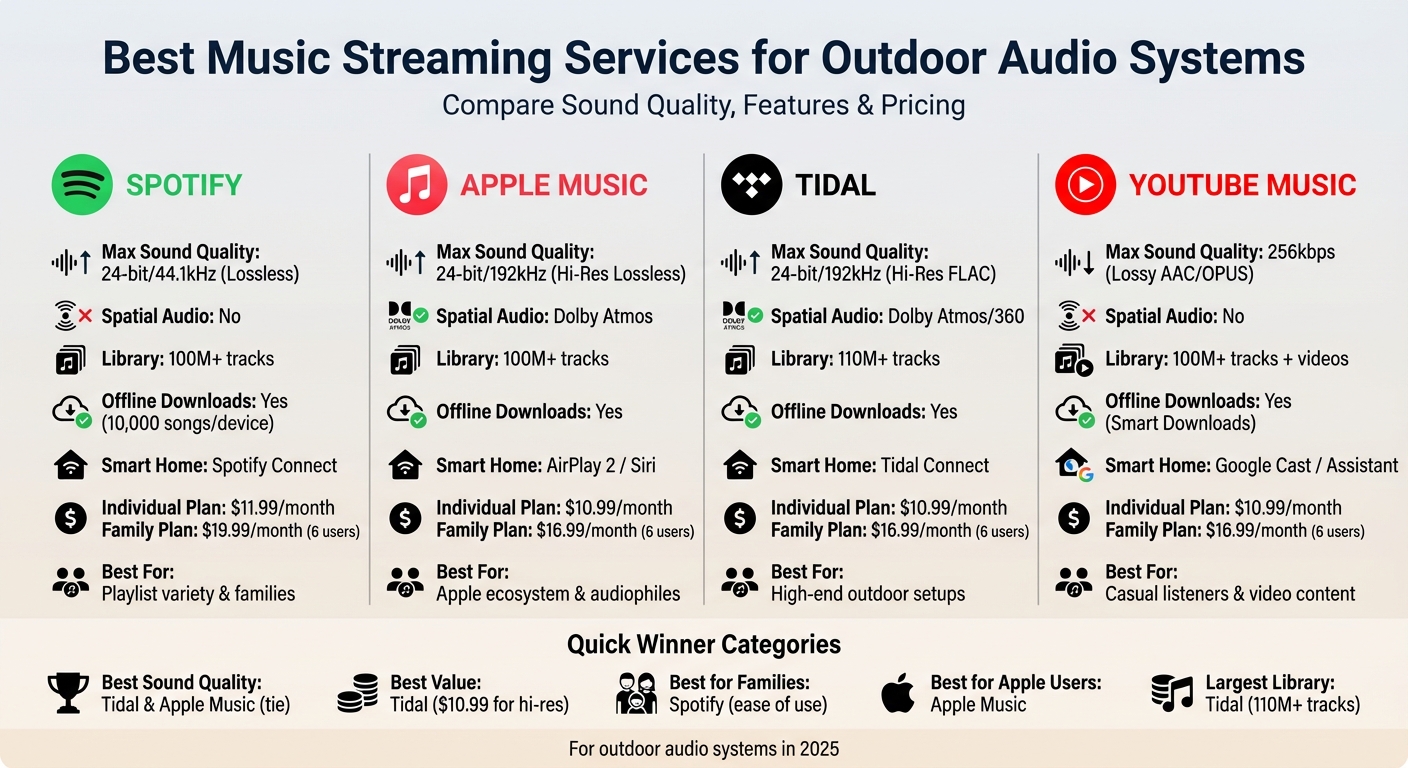
Quick Comparison
| Feature | Apple Music | Tidal | Spotify | YouTube Music |
|---|---|---|---|---|
| Max Sound Quality | 24-bit/192kHz | 24-bit/192kHz | 320kbps | 256kbps |
| Spatial Audio | Dolby Atmos | Dolby Atmos | No | No |
| Library Size | 100M+ tracks | 110M+ tracks | 100M+ tracks | 100M+ tracks |
| Offline Downloads | Yes | Yes | Yes (10k/device) | Yes |
| Smart Home Support | AirPlay 2/Siri | Tidal Connect | Spotify Connect | Google Cast |
| Individual Plan | $10.99/month | $10.99/month | $11.99/month | $10.99/month |
| Family Plan (6 users) | $16.99/month | $16.99/month | $19.99/month | $16.99/month |
For outdoor setups, Tidal stands out for its high-resolution audio and smart home compatibility, while Apple Music is perfect for households using Apple devices. Spotify remains a versatile option for its user-friendly features, though it lacks hi-res audio. YouTube Music is better suited for casual listeners seeking video content but falls short in sound quality.
Your choice depends on your priorities: sound quality, platform compatibility, or playlist variety.
Music Streaming Services Comparison for Outdoor Audio Systems
1. Spotify
Sound Quality
Spotify streams audio at 320 kbps using lossy compression, which falls short of the fidelity required for high-end outdoor sound systems [4][2]. These systems are designed to highlight nuances that compressed formats often miss. Simon Cohen, Former Contributing Editor at Digital Trends, emphasizes this point:
"It’s absolutely worth listening to CD-quality music on these systems (instead of the lossy compressed sound you’ll get from Spotify…)" [1]
Even Rolling Stone has noted the disparity, stating, "Switching between Apple Music and Spotify, the difference in audio quality is palpable, even for those with not-so-keen ears" [4]. This limitation in audio quality is a critical consideration when assessing Spotify’s suitability for premium outdoor setups.
Playlist Variety
Spotify boasts a library of 100 million tracks, paired with features like Discover Weekly, Daily Mix, and activity-based playlists tailored for events [2][5]. As of September 2025, Spotify Premium supports integration with DJ software such as Serato and Djay Pro, enabling users to create custom mixes for outdoor gatherings [6]. Additionally, Spotify’s curated playlists and offline playback options ensure music continuity, even in areas with limited connectivity.
Offline Functionality
Premium subscribers can download up to 10,000 songs for offline use, which is ideal for outdoor events where network reliability may be a concern [2][6][3]. However, DJ software integration still requires an active internet connection. To avoid interruptions, it’s recommended to pre-download playlists through the Spotify app – especially in areas with weak signals. This feature is vital for maintaining a consistent listening experience outdoors.
Smart Home Integration
Spotify integrates smoothly with advanced systems like Control4 and URC, providing seamless music playback across multiple outdoor zones [8][9]. With Spotify Connect, users can stream directly to Wi-Fi-enabled outdoor speakers, offering better reliability than Bluetooth connections [10]. For voice control, a Spotify Premium subscription ($11.99/month) is required when using Google Assistant [7]. This level of integration simplifies the outdoor audio experience. One Control4 user shared:
"The system is so easy to use that even my five-year-old can select in which rooms she would like to hear music." [8]
These features collectively enhance Spotify’s role in creating a reliable and user-friendly outdoor audio environment.
sbb-itb-c5b321b
2. Apple Music
Sound Quality
Apple Music offers an extensive catalog of over 100 million tracks in lossless audio, thanks to its use of ALAC (Apple Lossless) [11]. It provides two quality levels: Lossless, which delivers CD-quality sound at 16-bit/44.1 kHz, and Hi-Res Lossless, which goes up to 24-bit/192 kHz [11]. Unlike Spotify’s compressed audio, Apple Music’s lossless format is ideal for high-end outdoor audio systems. As James Barber from TechHive highlights:
"Apple Music offers the best streaming quality at the most reasonable price." [11]
For those using outdoor systems, a DAC (Digital-to-Analog Converter) is necessary to enjoy true Hi-Res Lossless playback [11]. Additionally, Apple Music includes Spatial Audio with Dolby Atmos, though its performance depends on the specific configuration of the outdoor speakers [11].
Playlist Variety
With a library exceeding 100 million tracks, Apple Music provides curated playlists and live radio channels to suit a wide range of tastes [12]. Users can also upload up to 100,000 personal audio files to the cloud using iTunes Match [11]. According to Audio Advice:
"Apple Music is the clear winner for sound quality, exclusive releases, and immersive listening experiences." [12]
This combination of a massive library and expertly curated playlists makes it versatile for outdoor events, whether it’s a laid-back family barbecue or an elegant evening gathering.
Offline Functionality
Apple Music allows users to download songs, albums, and playlists for offline playback [12]. This feature is particularly useful in outdoor spaces where connectivity might be limited, ensuring uninterrupted music during events. However, keep in mind that lossless files require more storage space [5]. Pre-downloading playlists over a stable Wi-Fi connection can help avoid disruptions caused by spotty outdoor internet [12].
Smart Home Integration
Apple Music seamlessly integrates with professional audio systems using AirPlay 2, enabling streaming to compatible outdoor receivers [13]. AirPlay 2 generally provides better audio quality than standard Bluetooth connections [13]. For advanced outdoor setups, platforms like Bluesound Professional’s BluOS allow Apple Music streaming via Power-over-Ethernet, combining power and high-quality audio in one cable [14]. This level of integration is well-suited for professional-grade outdoor audio installations, such as those commonly found in Northern New Jersey. At $10.99 per month, Apple Music delivers lossless audio at a competitive price [15].
Next, we’ll explore how Tidal compares in terms of sound quality and integration for outdoor audio systems.
3. Tidal
Sound Quality
Tidal offers streaming in FLAC format, reaching up to 24-bit/192kHz, which is far superior to Spotify’s 320kbps streams [16]. This makes it an excellent choice for professional outdoor audio systems, where capturing every detail is crucial. Additionally, Tidal supports Dolby Atmos, delivering an immersive 3D sound experience that envelops the listener – a feature that sets it apart from competitors like Qobuz [16].
To fully enjoy Tidal’s high-quality audio, ensure your setup includes a compatible DAC, amplifier, and high-end speakers. Without these, the audio may be downsampled. It’s worth noting that if you’re using Sonos outdoor speakers, Tidal defaults to CD quality (16-bit/44.1kHz) and does not support Dolby Atmos [1].
Playlist Variety
Tidal’s library includes over 110 million tracks in lossless and hi-res formats [16]. The service also provides a wide range of editorial playlists tailored to specific genres, alongside personalized features like "My Daily Discovery" and "My Mix", which adapt to your listening habits. For families, the Family plan, priced at $16.99 per month, offers clean playlists and parental controls, ensuring a safe listening environment for younger users [17].
Tidal has a strong focus on rap, hip-hop, and emerging artists through its "Tidal Rising" program. It also includes over 650,000 videos, ranging from live concert performances to music videos, which can be a great addition to outdoor setups featuring visual displays [18].
Offline Functionality
In areas with limited internet connectivity, Tidal allows users to download tracks in their chosen quality, including hi-res FLAC [17]. However, due to the large file sizes of hi-res audio, it’s best to download these playlists using a reliable Wi-Fi connection [18].
Smart Home Integration
Tidal integrates seamlessly with professional home automation systems such as Control4, URC, Amazon Alexa, and Google Assistant. Using Tidal Connect, users can stream high-resolution audio to multi-room platforms like Sonos, Denon HEOS, BlueSound (BluOS), and Yamaha MusicCast [19]. Derek Malcolm from Digital Trends highlights the feature’s appeal:
"Tidal Connect is a popular way of casting Tidal audio to compatible wireless speakers… sending it the highest‑quality stream possible, whether it’s lossless FLAC or even Dolby Atmos." [19]
For professional outdoor setups, Tidal works with advanced controllers and amplifiers, including the Control4 Triad SA1 and URC HDA series, which can distribute synchronized audio across multiple outdoor zones [8]. At $11 per month for the Individual plan, Tidal provides hi-res audio at a competitive price.
Next, we’ll take a closer look at YouTube Music to evaluate its suitability for outdoor setups.
4. YouTube Music
Sound Quality
YouTube Music Premium stands out as the only major streaming service that does not offer lossless or high-resolution audio [20][21]. Its maximum streaming quality is capped at 256kbps, utilizing AAC or OPUS formats. This falls short compared to Spotify’s 320kbps and is far below the 24-bit/192kHz high-resolution audio provided by Apple Music and Tidal [12][21]. Additionally, YouTube Music does not support spatial audio or Dolby Atmos, which have become popular for creating immersive listening experiences, especially with outdoor speaker setups [21].
For outdoor environments with significant background noise, such as busy patios or poolside gatherings, the difference in bitrate may not be as apparent. However, if you’re using premium outdoor audio systems like Sonos architectural speakers or high-fidelity wired setups, Apple Music or Tidal might be better suited to fully utilize lossless audio and spatial sound features [12]. These limitations highlight a trade-off: while YouTube Music offers a visually enriched library, its audio quality may not satisfy audiophiles.
Playlist Variety
YouTube Music offers an extensive library featuring over 100 million audio tracks and thousands of playlists. These can be tailored for outdoor events, with personalized mixes that adjust to your listening preferences, ensuring family-friendly options are readily available [21][22].
What sets YouTube Music apart is its integration with YouTube’s vast video library, making it a treasure trove for enthusiasts seeking rare or unconventional music. As James Barber from TechHive explains:
"Subscribers can listen to and make playlists from any song that’s streaming on the YouTube video site… a goldmine for obscure, easy‑listening classics, independent hip hop from the 1980s, or poorly distributed punk rock." [20]
This feature makes YouTube Music particularly appealing for those who enjoy rare live performances or niche tracks that aren’t typically found on other streaming platforms [20]. For families, the Family Plan at $14.99/month offers personalized accounts for multiple users, making it a practical choice for shared listening [21].
Offline Functionality
YouTube Music Premium supports background playback and offline downloads, which are essential for outdoor activities in areas with unreliable internet access [21]. By downloading playlists ahead of time, you can enjoy uninterrupted music during outdoor gatherings, no matter the connectivity challenges [21][22].
Smart Home Integration
The service integrates seamlessly with the Google/Nest smart home ecosystem and supports Google Cast, allowing you to stream music to various whole-home audio and video systems and smart speakers [12][21]. For more advanced outdoor setups, YouTube Music is compatible with Sonos systems, including their outdoor architectural speakers [23]. With Sonos, you can control playback directly through the dedicated app, ensuring a more stable and user-friendly experience [23].
Priced at $10.99/month for the Individual plan [21], YouTube Music offers competitive pricing. However, its lack of lossless audio may deter those with high-end audio systems looking for premium sound quality.
Next, we’ll break down the key features of all four streaming services to help you make an informed choice.
What’s the Best Music Streaming Service? – Sound Quality Compared
Comparison of Features
This section breaks down the key features of popular music streaming services to help you decide which one works best for your outdoor audio setup. Each service has its strengths, so understanding the trade-offs can make your choice easier.
| Feature | Spotify | Apple Music | Tidal | YouTube Music |
|---|---|---|---|---|
| Max Sound Quality | 24-bit/44.1kHz (Lossless) [24] | 24-bit/192kHz (Hi-Res) [24] | 24-bit/192kHz (Max) [24] | 256 Kbps (Lossy) [24] |
| Spatial Audio | No [4] | Yes (Dolby Atmos) [4] | Yes (Dolby Atmos/360) [24] | No [24] |
| Library Size | 100+ million tracks [26] | 100+ million songs [26] | 110+ million tracks [25] | 100+ million tracks [25] |
| Offline Downloads | Yes (10,000 songs/device) [2][28] | Yes [4] | Yes [4] | Yes (Smart Downloads) [25] |
| Smart Home Control | Spotify Connect [27][28] | AirPlay 2 / Siri [28] | Tidal Connect [1][28] | Google Cast / Assistant [2] |
| Individual Plan | $11.99/month [4] | $10.99/month [4] | $10.99/month [4] | $10.99/month [24] |
| Family Plan (6 users) | $19.99/month [4] | $16.99/month [4] | $16.99/month [4] | $16.99/month [24] |
For outdoor audio setups in Northern NJ, it’s essential to balance sound quality with smart home compatibility. The table above highlights the differences between these services, helping you weigh high-quality audio against ease of integration.
Audio Quality Considerations
Apple Music and Tidal stand out for their high-resolution audio and spatial sound features. Spotify offers lossless audio at CD quality, while YouTube Music is limited to 256 Kbps, which is noticeably lower in fidelity [24][4]. However, as Simon Cohen from Digital Trends points out regarding Sonos systems:
"As great as Sonos’ speakers are, they’re hardly of the spare-no-expense-in-the-pursuit-of-audio-purity variety… you just might not get much of an appreciable bump by going hi-res [over CD quality]" [1].
For outdoor environments, where background noise from wind, water, or traffic is inevitable, CD-quality lossless audio (16-bit/44.1kHz) is often sufficient [3][1].
Smart Home Integration
Smart home compatibility is another key factor. Spotify Connect offers seamless control on supported devices [27][28], while Tidal Connect provides similar functionality. Apple Music requires the Sonos app for the best audio quality since AirPlay 2 compresses the sound [1][28]. Meanwhile, YouTube Music integrates smoothly with Google Assistant and Google Home devices [2].
Pricing and Offline Downloads
Family plans range between $16.99 and $19.99 per month. Spotify is the most expensive at $19.99 for six users, while Apple Music, Tidal, and YouTube Music offer the same for $16.99/month [4][24]. Offline downloads are available on all platforms, which is crucial for areas with unreliable Wi-Fi. However, Spotify limits downloads to 10,000 songs per device [2][28].
This comparison highlights the trade-offs between audio quality, smart home features, and pricing, helping you choose the best service for your outdoor audio needs.
Conclusion
Tidal strikes an impressive balance of sound quality, smart home compatibility, and long-term value for professional outdoor audio setups in Northern New Jersey. Its high-resolution audio and extensive catalog make it a top choice for systems that prioritize clarity and detail in outdoor environments. As tech journalists Don Melanson and Michael Garrett Steele observe:
"Tidal is the best streaming music service for most people right now. It offers an enormous catalog of songs, high-definition audio, and is easy to use" [3].
That said, other services may cater to specific needs. Apple Music is an excellent option for households deeply integrated into the Apple ecosystem. With 90 million lossless tracks [3] and seamless Siri voice control, it provides a hands-free, user-friendly experience for outdoor settings.
For families, Spotify shines as a practical choice. Its Spotify Connect feature allows guests and children to easily manage music across devices. However, its lack of lossless audio might limit its ability to fully utilize high-performance outdoor speakers.
For those working with professional integrators, pairing Tidal with SoundMachine offers centralized control of music, lighting, and security through automation systems like Control4, Crestron, or Savant [29]. Ultimately, the best choice depends on your priorities – whether it’s superior audio quality, integration convenience, or family-friendly features – all aimed at creating an exceptional outdoor experience.
What One Sound Choice clients say
(We received) friendly, highly competent, quick and clean installation by 1 Sound Choice. The team followed up a few weeks after completion to ask if we were satisfied with our Media Room and Home Audio System. 1 Sound Choice is truly “top shelf” – they surpassed our expectations every step of the way.
– Mr. & Mrs. Blake (1 Sound Choice client testimonials)
Ryan listened to us – he understood what we wanted to accomplish. (The 1 Sound Choice team’s) commitment to post-installation support and service has been unbelievable. They are professionals in every aspect and have gained our trust throughout the completion of our project.
– Mr. & Mrs. Maytin (1 Sound Choice client testimonials)
I hired 1 Sound Choice to do a surround sound system in my living room and multi-room audio in 5 other rooms in my house,I asked Ryan to make it simple for my wife and I to use and we didnt want to see any wires or equiptment.Ryan ( the owner of 1 Sound Choice) presented me with a awesome solution for what I asked for at a price point that was right in range of my budget.The project was done faster then estimated and the workmanship of Ryan and his crew was above and beyond what I expected, They worked clean and were very personable, I would HIGHLY reccomend everyone to use 1 Sound Choice for all A/V installations. I will definately be using them again!
– kgrecco75 (Houzz review)
FAQs
Do I need a DAC to hear hi-res audio outdoors?
A DAC (digital-to-analog converter) isn’t always required for enjoying hi-res audio outdoors, especially if your streaming device or amplifier already supports high-resolution formats. Many modern outdoor audio systems are designed with built-in digital-to-analog conversion, delivering high-quality sound without the need for additional gear.
Is lossless audio noticeable outside with wind and noise?
Lossless audio distinctions often go unnoticed outdoors because of environmental factors such as wind and background noise. These elements can obscure the finer details in sound, making it difficult to fully experience the clarity and richness that lossless audio is designed to deliver.
Which service works best with multi-zone outdoor speakers?
Wi-Fi streaming outdoor speakers from brands such as Klipsch, Bowers & Wilkins, Monitor Audio, and Sonos are perfect for creating multi-zone audio setups. These speakers offer reliable high-bandwidth connections and smooth wireless integration, enabling you to control different outdoor areas independently or in sync. This makes them a dependable option for high-quality, professional outdoor sound systems.
Related Blog Posts
- High-Res Audio Streaming: What Families Need to Know
- Outdoor Entertainment Setup: 8 Ideas for Your Backyard
- Multi-Zone Audio: Wired vs. Wireless
- How to create a outdoor oasis with audio and video.
Music cutting out in the yard? See our why Sonos cuts out outside page.
More questions
Can I play music outside without Wi-Fi?
Yes, if your app can save songs to play offline. Download playlists first so the music keeps going when the signal drops.
One Sound Choice, 8 Tilley Ave, Pompton Plains, NJ 07444. Call or text (973) 945-5275. We work in homes across Morris, Passaic, Bergen, Essex, Somerset, and Hunterdon counties. Written by Ryan Herd, founder of One Sound Choice.