
High-resolution audio streaming offers a deeper listening experience compared to standard formats by delivering lossless sound quality. This means you can hear every detail in music, movies, and games – like the subtle breath of a singer or the faint scrape of a guitar string. With bitrates reaching up to 9,216 Kbps (compared to CDs at 1,411 Kbps), hi-res audio provides unmatched clarity and dynamic range.
Key Takeaways:
- Hi-res audio uses lossless formats like FLAC and ALAC, ensuring no sound details are removed.
- Services like TIDAL, Apple Music, and Amazon Music Unlimited now offer family plans supporting 24-bit/192 kHz audio.
- To enjoy hi-res audio, you’ll need compatible equipment like WiFi-enabled speakers, DACs, and a strong home network.
- Family plans range from $16.99 to $20/month, offering access to millions of tracks in studio-quality sound.
Hi-res audio transforms how families experience entertainment, from immersive movie nights to competitive gaming. But achieving this requires the right setup and devices to handle the larger audio files and higher data demands.
What Is High-Resolution Audio?
Technical Standards and Audio Quality
High-resolution audio captures sound with greater precision than standard formats, thanks to two critical factors: bit depth and sample rate.
Bit depth determines the number of amplitude levels a recording can represent. For example, a standard CD with 16-bit depth offers about 65,000 values, while 24-bit recordings deliver over 16 million[3]. This increase allows for a much wider dynamic range, so you can hear everything from the faintest whispers to thunderous crashes without added noise.
Sample rate, measured in kilohertz (kHz), refers to how many sound snapshots are taken per second. CDs typically use a 44.1 kHz sample rate, but high-resolution audio begins at 48 kHz and can go up to 192 kHz[1][3]. Higher sample rates capture more sound detail, reproducing frequencies with greater accuracy for a smoother, more natural listening experience.
"Bit depth describes how many tiny pieces of information (i.e. ‘bits’) make up a single snapshot of a soundwave. The higher the bit depth, the more dynamic range the sound has." – Sonos[1]
Unlike standard MP3s or AAC files that rely on "lossy" compression to permanently remove audio details, high-resolution audio uses lossless compression formats such as FLAC (Free Lossless Audio Codec) or ALAC (Apple Lossless Audio Codec)[5]. For instance, a 24-bit high-res file delivers around 4,608 Kbps of data, which is nearly 14 times the amount provided by a high-quality MP3 at 320 Kbps[3].
These technical improvements don’t just enhance sound quality – they redefine how we experience everyday audio.
How Families Benefit from Better Audio Quality
High-resolution audio brings a new dimension to family entertainment, enriching everything from movie nights to music and gaming sessions. With this level of detail, music feels more alive, as though the performers are right there in the room. You’ll notice subtle nuances, like the faint scrape of a guitar string, a singer taking a breath before a note, or the soft brush of drumsticks on a cymbal[2].
For movie nights, high-res audio makes dialogue easier to follow, eliminating the need to constantly adjust the volume. Every word comes through with clarity, and sound effects become more immersive. In gaming, high-resolution audio allows you to pick up on details like approaching footsteps or environmental sounds, giving you an edge in the action[7].
Even in quieter moments, the difference is striking. Standard audio often introduces background hiss or compression artifacts that can mask delicate sound details. High-resolution audio, with its expanded dynamic range, eliminates these distractions, letting you hear soft passages exactly as they were recorded – free from distortion or noise[3][7].
sbb-itb-c5b321b
HI-RES LOSSLESS AUDIO EXPLAINED! | eCoustically Speaking
Comparing High-Res Audio Streaming Services
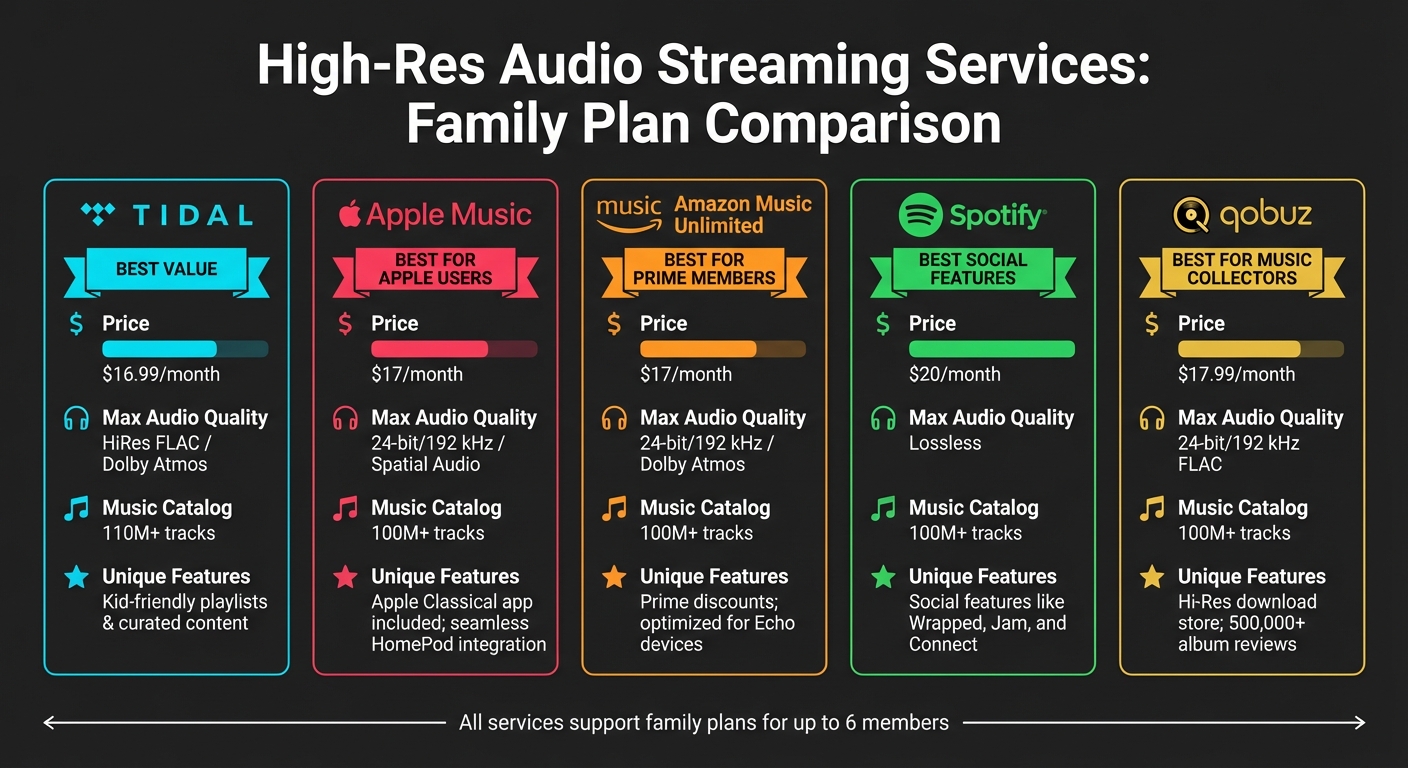
High-Resolution Audio Streaming Services Family Plan Comparison
High-resolution audio can truly transform your listening experience, and finding the right streaming service is essential for families looking to enjoy top-quality sound together.
Service Comparison Table
In recent years, the world of high-resolution audio streaming has evolved significantly. Popular platforms like Spotify, Apple Music, and Amazon Music now include lossless audio in their standard premium plans, meaning you no longer need to pay extra for high-quality sound[11].
Here’s a breakdown of the major players:
| Service | Family Plan Price | Max Audio Quality | Music Catalog | Unique Features |
|---|---|---|---|---|
| TIDAL | $16.99/month | HiRes FLAC / Dolby Atmos | 110M+ tracks | Kid-friendly playlists & curated content[9] |
| Apple Music | $17/month | 24-bit/192 kHz / Spatial Audio | 100M+ tracks | Apple Classical app included; seamless HomePod integration[11] |
| Amazon Music Unlimited | $17/month | 24-bit/192 kHz / Dolby Atmos | 100M+ tracks | Prime discounts; optimized for Echo devices[11] |
| Spotify | $20/month | Lossless | 100M+ tracks | Social features like Wrapped, Jam, and Connect[11] |
| Qobuz | $17.99/month | 24-bit/192 kHz FLAC | 100M+ tracks | Hi-Res download store; 500,000+ album reviews[10] |
All these services now offer family plans for up to six members, making it easier for households to enjoy high-quality audio together. With prices ranging from $16.99 to $20 per month, your choice will likely come down to specific features rather than cost.
Best Options for Family Plans
TIDAL stands out as the most budget-friendly option at $16.99 per month. It offers a vast library of over 110 million tracks and supports Dolby Atmos for an immersive listening experience. Families will also appreciate its curated playlists designed for kids[9].
For families deeply integrated into the Apple ecosystem, Apple Music is a natural fit. At $17 per month, it delivers spatial audio with Dolby Atmos and includes the Apple Music Classical app at no extra cost. It’s also optimized for HomePod speakers and Apple TV 4K, making it an excellent choice for Apple households[11].
If your family already subscribes to Amazon Prime, Amazon Music Unlimited is a great deal. The $17 monthly plan works seamlessly with Echo and Sonos devices, offering streaming quality up to 3,730 Kbps. Plus, Prime members often enjoy exclusive discounts, adding extra value to this option[11].
"Spotify delivers a robust mix of features, including lossless music, audiobooks, Spotify Connect streaming and great community offerings." – Ty Pendlebury, Editor, CNET[11]
Spotify, priced at $20 per month, is perfect for families who enjoy sharing music and engaging with its social features. Whether it’s creating collaborative playlists with "Jam", exploring the annual "Spotify Wrapped", or using Spotify Connect for multi-device streaming, the platform’s community-driven tools set it apart[11].
Lastly, Qobuz is ideal for families who want to own their music in addition to streaming it. The $17.99 Studio Family plan offers access to a Hi-Res download store and discounts of up to 60% on music purchases through the Sublime plan ($180 annually). With over 500,000 album reviews and artist bios, Qobuz is a great pick for music lovers who enjoy diving deeper into the stories behind their favorite tracks[10].
Next up, we’ll look at the equipment and network setup you’ll need to get the most out of your hi-res audio experience.
Equipment and Setup Requirements
To fully enjoy high-resolution audio, you need the right gear and a network capable of handling the extra data demands. Fortunately, you don’t need to overhaul your entire setup – just make sure your equipment supports high-res streaming.
Compatible Speakers and Devices
High-res audio demands devices that can capture every detail of the recording. WiFi-enabled speakers like the Sonos Era 300, Sonos Five, and Sony High-Resolution Wireless Speakers are specifically designed for this purpose, offering a much richer sound experience compared to standard Bluetooth speakers [1][12]. For home theater enthusiasts, premium soundbars such as the Sonos Arc Ultra not only support high-res audio but also immersive formats like Dolby Atmos [1].
Already have a quality stereo system? You can upgrade it for high-res streaming by adding a network streamer like the Bluesound Vault 2i. This allows you to enjoy high-quality audio without replacing your existing speakers [2]. For headphone users, many Bluetooth models compress audio, but certain options, like the Sonos Ace, can deliver lossless quality, whether connected via Bluetooth or a wired connection [1][4]. Additionally, Sony’s Hi-Res Audio headphones are another excellent choice for an elevated listening experience [12].
"A true hi-res audio experience requires not just a particular streaming service or file type, but also equipment that’s capable of accurately reproducing the depth and detail of original recordings." – Sonos [1]
External DACs (Digital-to-Analog Converters) are crucial for unlocking sample rates above 48 kHz on many devices. These devices bypass internal hardware to process high-quality digital files directly [2][8]. High-performance DACs can handle files up to 32-bit/384 kHz and even DSD files up to 22.58 MHz [2].
Once your audio gear is ready, the next step is ensuring your network setup can support these data-heavy files.
Internet Speed and Network Setup
High-resolution audio files are significantly larger than compressed formats. For example, a 24-bit/96 kHz file is roughly three times the size of a CD-quality file [2]. Your network must be robust enough to handle these larger files, especially if multiple rooms are streaming simultaneously. A wired Ethernet connection for your primary streaming device is ideal for stability and speed [3].
WiFi is essential for multi-room setups, as standard Bluetooth compresses audio and limits data transfer rates [1][3][4]. To create a reliable system, use Ethernet connections for central hubs or primary devices while relying on WiFi for additional rooms [3].
"Some wireless systems don’t have the bandwidth to stream such large files and may down-convert them to a lower resolution for streaming." – Ralph Graves, Crutchfield [2]
Keep in mind that streaming high-res audio uses much more data than standard streaming. If your internet plan includes a data cap, monitor your usage closely [8]. For homes with multiple users or rooms streaming simultaneously, a well-designed network ensures everyone enjoys seamless, high-quality sound. For those in Northern New Jersey, One Sound Choice offers enterprise-level networking solutions to optimize your whole-home audio system for flawless performance.
Adding High-Res Audio to Your Smart Home
Integrating high-resolution audio into your smart home setup is easier than ever, especially when you opt for WiFi-enabled speakers instead of traditional Bluetooth devices. Why? WiFi provides the bandwidth needed for lossless audio transmission, whereas most Bluetooth codecs compress audio, stripping away the finer details that make high-res streaming shine [1][4]. To get started with a high-res audio setup, you’ll need three key components: a streaming service, a capable DAC (digital-to-analog converter), and high-quality speakers [1][3]. The DAC plays a crucial role here – it bypasses your device’s internal processing and can handle audio files up to 32-bit/384kHz [2][3]. With this setup, you’ll be ready to enjoy flawless sound quality across your smart home.
Multi-Room Audio Solutions
With systems like Sonos and Bluesound, you can create a multi-room audio experience that lets you play high-res tracks in multiple spaces simultaneously – or customize what plays in each room [1][2]. These systems rely on WiFi for the high data rates needed to stream lossless audio, supporting resolutions up to 24-bit/192kHz [3]. To ensure smooth playback without interruptions, your home network must support multiple high-bandwidth streams at once.
Why Consider Professional Installation
If you’re aiming for a fully integrated smart home experience, professional installation can take your setup to the next level. Experts don’t just optimize audio performance – they also align it with your home’s other automation systems. For example, they can create custom "scenes", like dimming the lights automatically when your favorite playlist starts [13][14]. Professional installers also establish dedicated, interference-free networks to ensure flawless audio streaming and handle the precise calibration of speaker placement and sound levels for your room’s unique acoustics [14].
For homeowners in Northern New Jersey, One Sound Choice offers expert services with over 30 years of experience and 2,500+ successful installations. They specialize in tailoring systems to your specific needs while ensuring they’re scalable for future expansions.
"Our expert installers coordinate carefully to preserve your interiors, conceal wiring, and complete projects efficiently with respect to your schedule." – Definitive Electronics [13]
Another benefit of professional installation is ongoing support. Whether you want to expand your system into new rooms or add outdoor zones, experts ensure your setup grows seamlessly with your home [13][15].
Cost Breakdown for High-Res Audio
Monthly Subscription Pricing
High-resolution streaming services have settled on similar pricing structures, making it easier for families to weigh their options. For individual plans, the cost is typically around $10.99 per month, while family plans – covering up to six accounts – range from $16.99 to $17.99 monthly [9][17]. Family plans are a more economical choice compared to purchasing multiple individual subscriptions.
For example, Tidal’s family plan is priced at $16.99/month and includes curated content for kids. Qobuz Studio charges $17.99/month, but if you opt for annual billing, the cost drops to roughly $10.83/month. Amazon Music Unlimited offers a discount for Prime members, bringing the price to $9.99/month. Many of these services also provide a 30-day free trial, giving users a chance to explore before committing [9][10][16][17].
While subscription costs are a key factor, don’t overlook the need for proper equipment to fully enjoy high-resolution streaming.
Equipment Investment and Long-Term Benefits
To truly experience high-resolution audio, you’ll need to invest in some essential gear. The basics include a Digital-to-Analog Converter (DAC), quality headphones or speakers, and possibly upgrades to your home network. Entry-level USB DACs are available in the $100 to $200 range [6][2]. If you’re looking at wired audiophile headphones, expect to pay between $150 and $550, while high-res compatible wireless speakers typically cost $200 to $700 [3][5][18].
"High-res does not necessarily mean high sound quality. In fact, in our testing we have yet to find a high-res-audio headphone or wireless speaker that matches the sound quality of the best non-hi-res products."
– Maurice Wynn, Audio Expert, Consumer Reports [5]
Investing in quality equipment has its perks. Wired headphones and external DACs avoid common issues like battery degradation that often affect Bluetooth devices. Plus, gear that supports 24-bit/192kHz audio will remain compatible as streaming platforms improve their offerings [5][3][1]. Keep in mind that high-res audio files are significantly larger – up to 10 times the size of standard MP3s – so a strong home network is crucial, especially if multiple users are streaming simultaneously [5][2].
Conclusion
High-resolution audio streaming brings a deeper, more immersive listening experience, capturing every subtle detail in music – from the soft sizzle of cymbals to the faint breath of a vocalist [2]. While there are affordable subscription plans and hardware options, achieving genuine high-res sound takes more than just signing up for a service. It requires the right equipment, a strong home network, and a properly configured system [3].
The real challenge lies in getting all the technical pieces to work together seamlessly. As Tim Gideon from PCMag points out, "Listening to lossless music isn’t quite as simple as just paying a few extra dollars a month, and if you don’t take care, you might be wasting your money on that premium subscription" [3]. For families in Northern New Jersey aiming to incorporate high-resolution audio into their smart homes, professional help can make all the difference. With over 30 years of experience and more than 2,500 successful installations, One Sound Choice ensures your system is set up to deliver the quality you’re paying for – whether it’s optimizing your network, selecting compatible gear, or creating seamless multi-room setups.
High-res audio shines when every part of your system works in harmony. Whether you’re designing a dedicated listening space or upgrading your home entertainment setup, the right expertise ensures your investment pays off. With careful planning and skilled installation, high-resolution audio can elevate your family’s entertainment to a whole new level.
What One Sound Choice clients say
(We received) friendly, highly competent, quick and clean installation by 1 Sound Choice. The team followed up a few weeks after completion to ask if we were satisfied with our Media Room and Home Audio System. 1 Sound Choice is truly “top shelf” – they surpassed our expectations every step of the way.
– Mr. & Mrs. Blake (1 Sound Choice client testimonials)
Ryan listened to us – he understood what we wanted to accomplish. (The 1 Sound Choice team’s) commitment to post-installation support and service has been unbelievable. They are professionals in every aspect and have gained our trust throughout the completion of our project.
– Mr. & Mrs. Maytin (1 Sound Choice client testimonials)
I hired 1 Sound Choice to do a surround sound system in my living room and multi-room audio in 5 other rooms in my house,I asked Ryan to make it simple for my wife and I to use and we didnt want to see any wires or equiptment.Ryan ( the owner of 1 Sound Choice) presented me with a awesome solution for what I asked for at a price point that was right in range of my budget.The project was done faster then estimated and the workmanship of Ryan and his crew was above and beyond what I expected, They worked clean and were very personable, I would HIGHLY reccomend everyone to use 1 Sound Choice for all A/V installations. I will definately be using them again!
– kgrecco75 (Houzz review)
FAQs
What do I need to stream high-resolution audio at home?
To stream high-resolution audio at home, you’ll need a few important pieces of equipment. First, make sure you have a broadband-connected device capable of handling lossless or high-resolution audio files. Then, invest in a 24-bit-compatible DAC (digital-to-analog converter) or receiver to process the higher-quality sound. Lastly, complete your setup with top-tier headphones or high-quality speakers to truly enjoy the crisp, detailed audio.
With these components, you’ll be able to experience the full depth and richness of high-resolution sound, whether you’re sharing it with family or diving into a private listening session.
How does high-resolution audio enhance family entertainment?
High-resolution audio brings out the finer details of the original recording, delivering clearer sound, richer tones, and better separation between instruments. The result? A more immersive and realistic listening experience, whether you’re enjoying a movie, streaming your favorite playlist, or diving into a video game.
For families, this means entertainment becomes more captivating and authentic, turning your living room into a space where shared moments are enhanced by exceptional sound quality.
How do high-resolution audio streaming services compare for families?
High-resolution audio streaming services vary in sound quality, compatibility with devices, and ease of use, all of which influence how well they suit a family’s preferences.
- Tidal offers Master Quality Authenticated (MQA) tracks, delivering outstanding audio fidelity. However, its focus on desktop use makes it less practical for families who need mobile-friendly options.
- Apple Music provides lossless audio with up to 24-bit depth and 48 kHz sample rates (and even higher for some tracks). It integrates smoothly across Apple devices like iPhones, iPads, Macs, and Apple TVs, making it a strong choice for households already invested in Apple’s ecosystem.
- Spotify and YouTube prioritize convenience with their streaming services but rely on compressed formats that don’t achieve the clarity and detail of true high-resolution audio.
Tidal stands out for its audio quality, though it’s less portable. Apple Music strikes a balance between quality and device compatibility, while Spotify and YouTube cater to those prioritizing simplicity over sound precision.
Related Blog Posts
- How to Set Up Whole Home WiFi: 7 Steps for Better Coverage
- Fixing Slow WiFi at Home: 6 Solutions That Actually Work
- Smart Home Questions Answered: 15 Common Concerns for Families
- How to Identify Wi-Fi Interference at Home
Want rich sound at home? See our McIntosh home audio page.
More questions
Do I need new speakers for high-res audio?
You need gear that can play it. That means a service with hi-res files and speakers and amps good enough to let you hear the detail.
One Sound Choice, 8 Tilley Ave, Pompton Plains, NJ 07444. Call or text (973) 945-5275. We work in homes across Morris, Passaic, Bergen, Essex, Somerset, and Hunterdon counties. Written by Ryan Herd, founder of One Sound Choice.