
When setting up a multi-zone audio system, the choice between wired and wireless setups depends on your priorities. Wired systems deliver superior sound quality and reliability but involve higher upfront costs and professional installation. Wireless systems are easier to set up and more flexible but rely on a strong Wi-Fi network and can face connectivity issues. Here’s a quick breakdown:
- Wired Systems: Offer uncompressed, high-quality sound with stable performance. Ideal for new builds, renovations, or dedicated home theaters and media rooms but require cables, professional installation, and higher initial investment.
- Wireless Systems: Easy to install with app-based controls and portable speakers. Perfect for existing homes or renters but depend on Wi-Fi and may face network-related delays or dropouts.
- Hybrid Systems: Combine wired reliability with wireless control for a balanced approach, useful in large or mixed-use spaces.
Quick Comparison
| Factor | Wired Systems | Wireless Systems |
|---|---|---|
| Installation | Requires professional setup, in-wall wiring | Plug-and-play, DIY-friendly |
| Sound Quality | High-fidelity, uncompressed audio | Good quality but may involve compression |
| Reliability | Stable, unaffected by interference | Dependent on Wi-Fi, may face dropouts |
| Flexibility | Fixed placement | Portable and easy to expand |
| Cost | Higher upfront cost | Lower initial investment |
For the best results, consider your home’s layout, renovation plans, and audio needs. Wired is great for permanent setups, wireless suits dynamic spaces, and hybrids provide a middle ground. Each option has trade-offs, so choose based on your priorities.
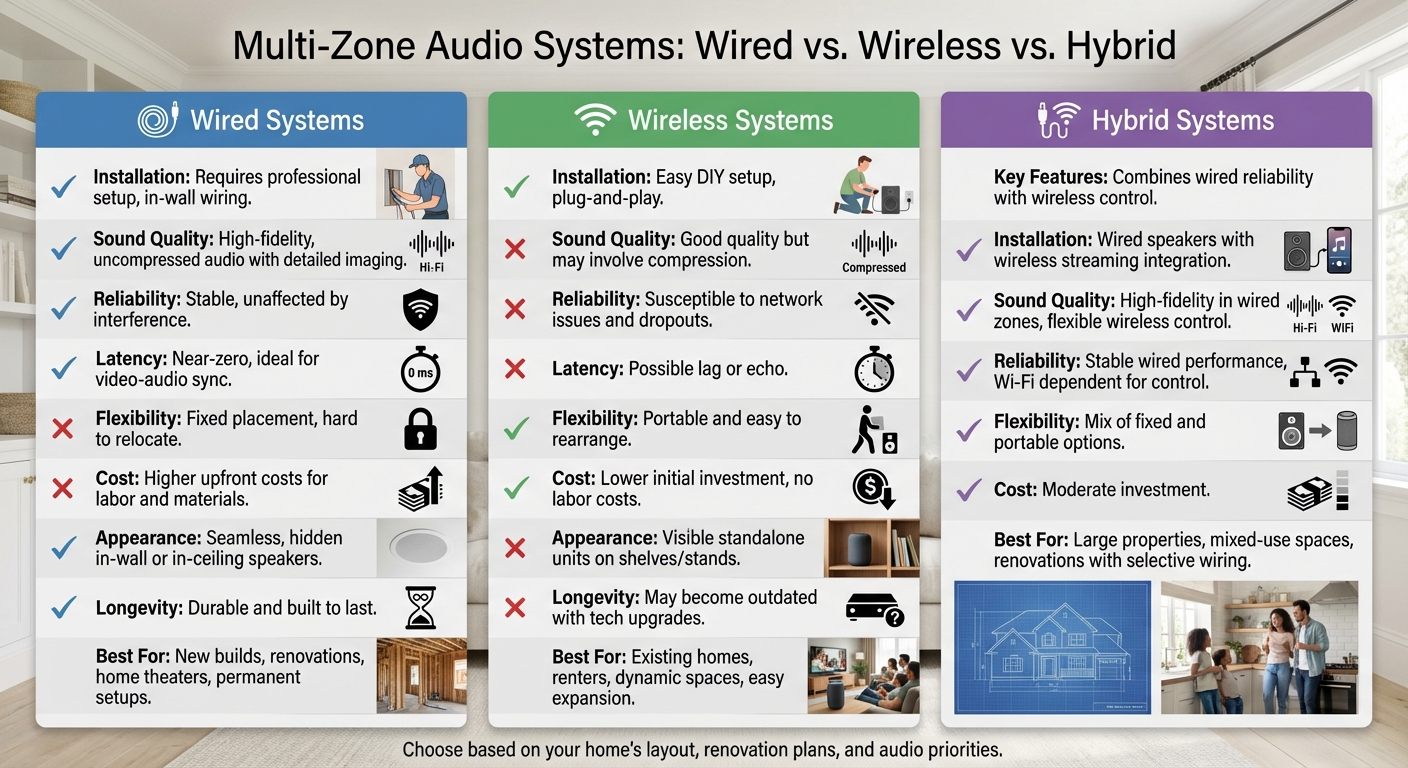
Wired vs Wireless Multi-Zone Audio Systems Comparison Chart
Is Whole Home Audio Possible Without Pre-Wiring? | Expert Tips Inside
sbb-itb-c5b321b
Wired Multi-Zone Audio Systems
A wired multi-zone audio system relies on physical cables to transmit audio signals to a central hub, often located in a basement or utility closet. This hub houses essential components like multi-channel amplifiers, matrix switches to route audio to specific zones, and media streamers or other source devices. From there, dedicated speaker wires connect to in-wall or in-ceiling speakers, creating a streamlined setup [1].
How Wired Systems Work
At the heart of the system is a centralized controller or matrix switch, which decides which audio source plays in each zone. For example, a 12-channel amplifier can power a six-room setup, delivering stereo sound to each zone [3]. Users control the system through wall-mounted keypads, touchscreens, or smartphone apps that communicate with the hub via Cat 5e or Cat 6 cables, ensuring a direct and reliable connection. Speaker wires, such as 14/4 gauge CL2 or CL3 rated cables, not only meet fire safety standards but also guarantee clean signal transmission [3].
"Wired systems achieve this [synchronized play] because each source is routed through a centralized controller or matrix that can ‘feed’ that signal into the desired zone(s)." – Brian Wines, HTD [5]
Benefits of Wired Systems
Wired systems are known for delivering high-quality, uncompressed audio, free from delays or dropouts. Unlike wireless systems, they don’t depend on Wi-Fi, making them immune to network interference caused by household appliances, dead zones, or congestion. This results in a richer and more immersive sound experience. Additionally, the system maintains a clean, seamless appearance, with all wiring hidden behind walls. Another advantage is flexibility with components – homeowners can upgrade individual devices, like adding a new media streamer, without overhauling the entire setup.
"Wired speakers feature a deeper, richer sound as the audio is not compressed during the transmission of data." – Pam Silvia, Expert, Van Dyke Appliance [6]
Drawbacks of Wired Systems
Despite their performance advantages, wired systems require invasive installation. Retrofitting an existing home involves extra labor, as cables need to be routed through finished spaces. The ideal time for installation is during new construction or major renovations, before walls are closed up. Once installed, the system is challenging to modify – relocating a speaker to another room usually means reopening walls to run new cables. Additionally, the upfront costs are higher due to the need for specialized wiring, external amplifiers, and professional integration.
Wireless Multi-Zone Audio Systems
Wireless audio systems offer a modern solution by using your home’s Wi‑Fi or a dedicated mesh network to stream digital sound to speakers. This eliminates the need for complex wiring and makes high-quality audio accessible without professional installation. The simplicity of this setup has made these systems increasingly popular for homeowners seeking flexibility and ease of use.
How Wireless Systems Work
The backbone of a wireless audio system is its connection to a network. Most rely on Wi‑Fi to transmit audio signals, but some brands, like Sonos with its proprietary SonosNet, use an encrypted peer-to-peer mesh network to ease the load on your main router. Each speaker is equipped with a built-in amplifier and connects to a standard power outlet. Synchronization technology ensures audio plays in perfect harmony across multiple rooms. You can control everything through a smartphone or tablet app, which allows you to group zones, adjust volume for individual rooms, and select streaming services like Spotify or Tidal. Systems such as Sonos and Denon’s HEOS can handle up to 32 audio zones, while DTS Play‑Fi supports up to 16 speakers throughout your home [1].
Benefits of Wireless Systems
One of the biggest advantages of wireless systems is their straightforward installation. There’s no need for drilling, running wires through walls, or hiring professionals to ensure compliance with safety regulations. This ease of setup also makes these systems highly adaptable – you can start small with a single speaker and expand over time without additional wiring. The portability of these speakers is another plus, especially for renters or homeowners who frequently update their living spaces. With app-based control, you can manage everything from anywhere in your home.
"Wireless systems provide flexibility, letting you start small and expand anytime, which is perfect for existing homes." – Stafford Home Service Inc.
Drawbacks of Wireless Systems
While wireless systems are convenient, they do have limitations. Their performance is closely tied to the reliability of your Wi‑Fi network. Weak signals or network congestion can cause interruptions or delays, particularly in areas far from the router. These systems also demand considerable bandwidth, especially during heavy use. Another downside is that most wireless systems are "closed", meaning they only work with components from the same manufacturer – for example, a Sonos speaker won’t sync with a Yamaha MusicCast device. Additionally, speaker placement is restricted by the need for nearby power outlets. In larger homes, even with proprietary mesh networks, delays or signal issues can occasionally occur.
"A reliable and robust WiFi network is imperative for the smooth operation of any WHA system and is even more important should you choose a wireless or hybrid wireless solution, both of which are taxing on bandwidth." – Brian Wines, HTD
Wired vs. Wireless: Side-by-Side Comparison
Choosing between wired and wireless audio systems depends on your priorities – whether it’s sound quality, reliability, or ease of setup. This comparison highlights the practical differences to help you make an informed decision for your home.
Sound Quality
Wired systems excel in delivering high-fidelity audio because signals travel directly through cables without compression. This ensures detailed stereo imaging and consistent performance. On the other hand, Wi-Fi speakers can support high-resolution formats, such as 24-bit/96kHz audio [7]. However, their performance can be limited by network bandwidth and the smaller amplifiers typically used in wireless setups.
"Wired speakers win most sound quality comparison tests. They get audio signals directly through cables with no compression or loss." – Kellie Harrison, Home Entertainment Specialist [7]
While sound quality is a key factor, reliability often plays an equally important role, especially in home theaters.
Reliability
Wired systems are inherently stable, unaffected by Wi-Fi interference or network congestion. They also offer near-zero latency, making them ideal for home theaters where precise synchronization between audio and video is critical [7]. Wireless systems, while convenient, can experience dropouts or delays due to network performance issues.
Installation and Cost
Wireless systems are designed for convenience, offering a simple plug-and-play setup that requires only a power source and a stable Wi-Fi connection. Wired systems, however, demand more effort. Installing cables often involves running them through walls or ceilings, which is easier to manage during construction or major renovations. For complex projects, it is best to book a smart home consultation to ensure proper infrastructure. Despite the complexity, wired setups often result in a polished look, with speakers discreetly hidden within walls or ceilings. Wireless speakers, by contrast, are usually visible and placed on shelves or stands.
The table below provides a concise summary of these factors.
Comparison Table
| Factor | Wired Systems | Wireless Systems |
|---|---|---|
| Installation | Requires professional installation with in-wall wiring | Easy DIY setup; plug-and-play |
| Sound Quality | High-fidelity, uncompressed audio with detailed imaging | Good quality but may involve compression |
| Reliability | Stable and unaffected by interference | Susceptible to network issues |
| Latency | Near-zero, ideal for video-audio sync | Possible lag or echo |
| Appearance | Seamless, with hidden in-wall or in-ceiling speakers | Visible standalone units |
| Flexibility | Fixed placement; hard to relocate | Portable and easy to rearrange |
| Cost | Higher upfront costs for labor and materials | Lower initial investment, no labor costs |
| Longevity | Durable and built to last | May become outdated with tech upgrades |
This comparison underscores the trade-offs between the two options. Wired systems prioritize performance and durability, while wireless systems focus on convenience and adaptability. Your choice will depend on what matters most to you.
Hybrid Multi-Zone Audio Systems
Hybrid systems bridge the gap between wired and wireless audio setups, combining the strengths of both approaches to deliver a versatile and reliable solution.
What Hybrid Systems Are
Hybrid audio systems blend the dependability of wired connections with the convenience of wireless control. These setups typically involve traditional wired speakers connected to amplifiers that are integrated into a wireless streaming network. Devices like the Sonos Amp or HEOS Link act as bridges, enabling app-based control without compromising the quality of wired audio.
"You don’t have to choose between wired or wireless – you can have the best of both worlds! By integrating a wireless component like the Sonos amp, you can still wirelessly select songs and adjust the volume from your phone even if your speakers are in a wired system." – Connect E3 [2]
This combination offers a practical and adaptable smart home solution for various home audio needs.
When Hybrid Systems Make Sense
Hybrid systems are particularly useful in scenarios where installing cables is either impractical or too costly. For example, during home renovations, primary zones can be wired for optimal performance, while secondary areas like bedrooms or home offices can use wireless speakers for added flexibility.
These setups are also well-suited for larger properties. They allow seamless integration of indoor and outdoor audio systems and can modernize older wired systems with wireless adapters.
"A hybrid system is an excellent choice if you want to mix wireless speakers with wired floor-standing speakers, in-ceiling speakers, or outdoor speakers that require a lot of power." – Connect E3 [2]
However, since hybrid systems rely on Wi‑Fi to synchronize zones, having a strong and stable network is crucial to prevent interruptions [5].
Choosing the Right System for Your Home
Deciding on the right audio system for your home comes down to understanding your layout, preferences, and budget. Each system type – wired, wireless, or hybrid – offers distinct advantages depending on your needs.
Wired systems are known for delivering uncompressed audio and minimal latency, making them ideal for home theaters or dedicated listening areas. These systems excel in providing high-quality sound but require careful planning and professional installation, as cables need to be concealed within walls or ceilings [7]. On the other hand, wireless systems prioritize convenience and portability. They’re perfect for renters or homes where running cables isn’t feasible, offering an easy plug-and-play setup [4].
If you’re building a new home or undergoing major renovations, installing a wired system can save costs since walls are already accessible. However, in existing homes or rental properties, wireless systems eliminate the hassle and expense of wall modifications. For larger homes, where Wi-Fi dead zones can disrupt audio streaming, wired setups or dedicated mesh networks provide a more reliable solution [1][5].
Hybrid systems offer the best of both worlds. For instance, you can install wired architectural speakers in key areas like the living room for superior sound, while using wireless speakers in secondary spaces such as bedrooms or outdoor patios for added flexibility. Tools like the Sonos Amp allow you to control high-quality wired speakers through an app, simplifying system integration [2].
"Wired systems require an amplifier and should be professionally installed as these systems have a lot of wires that need to be hidden in your walls or ceiling, and programming to ensure the system operates the way you want it and is intuitive." – Pam Silvia, Expert, Van Dyke Appliance [6]
For multi-zone setups, professional assistance is highly recommended. Experts ensure components are matched correctly, optimize networks, and handle compliance with building codes. In Northern New Jersey, One Sound Choice brings over 30 years of experience to the table, offering tailored solutions for complex audio installations. Whether you’re designing a multi-zone system or need expert advice, consulting professionals like One Sound Choice ensures your setup meets both your technical and aesthetic expectations.
What One Sound Choice clients say
1 Sound Choice installed a flat screen TV for us along with surround sound. We could not be happier with the professionalism we received. They were within budget and time — no surprises. We would highly recommend 1 Sound Choice.
– The Baron Family (1 Sound Choice client testimonials)
Ryan listened to us – he understood what we wanted to accomplish. (The 1 Sound Choice team’s) commitment to post-installation support and service has been unbelievable. They are professionals in every aspect and have gained our trust throughout the completion of our project.
– Mr. & Mrs. Maytin (1 Sound Choice client testimonials)
I hired 1 Sound Choice to do a surround sound system in my living room and multi-room audio in 5 other rooms in my house,I asked Ryan to make it simple for my wife and I to use and we didnt want to see any wires or equiptment.Ryan ( the owner of 1 Sound Choice) presented me with a awesome solution for what I asked for at a price point that was right in range of my budget.The project was done faster then estimated and the workmanship of Ryan and his crew was above and beyond what I expected, They worked clean and were very personable, I would HIGHLY reccomend everyone to use 1 Sound Choice for all A/V installations. I will definately be using them again!
– kgrecco75 (Houzz review)
FAQs
Do I need new wiring for a wired multi-zone system?
If your current wiring aligns with the system’s requirements, you might not need to replace it. However, during construction or renovation – when walls are already exposed – installing new wiring can improve performance and provide more flexibility. This is an ideal opportunity to prepare your setup for future needs and ensure the best possible results.
How strong should my Wi‑Fi be for wireless multi-zone audio?
For dependable wireless multi-zone audio, your Wi-Fi signal strength should ideally measure -50 dBm or better. This level of strength helps maintain a stable connection, ensuring smooth performance without interruptions.
When does a hybrid multi-zone system make the most sense?
A hybrid multi-zone audio system works perfectly for homes where certain spaces, like the living room or home theater, demand high-quality performance and dependable wired connections. At the same time, secondary areas, such as bedrooms or outdoor patios, can benefit from the ease and adaptability of wireless technology. This setup combines the unmatched sound quality of wired systems with the convenience and expandability of wireless options, making it especially practical for larger or more intricate home layouts.
Related Blog Posts
- How to Set Up Whole Home WiFi: 7 Steps for Better Coverage
- Smart Home Integration Guide: Connect All Your Devices
- Outdoor Entertainment Setup: 8 Ideas for Your Backyard
- Why Wired Networks Matter for Smart Homes
Does your music drop out in some rooms or outside? See our why Sonos cuts out outside page.
More questions
Can I mix wired and wireless speakers?
Yes. That is called a hybrid setup. Use wired speakers in main rooms and wireless where running wire is hard.
One Sound Choice, 8 Tilley Ave, Pompton Plains, NJ 07444. Call or text (973) 945-5275. We work in homes across Morris, Passaic, Bergen, Essex, Somerset, and Hunterdon counties. Written by Ryan Herd, founder of One Sound Choice.