
Wired networks are the backbone of smart homes, offering unmatched reliability, security, and performance compared to wireless systems. While Wi-Fi is convenient, it often struggles with interference, limited bandwidth, and security risks. Wired connections, like Ethernet with Cat 6A cables, deliver consistent speeds up to 10 Gbps, ensuring smooth streaming, gaming, and real-time monitoring. They also confine data to physical cables, making hacking attempts significantly harder.
Key Benefits of Wired Networks in Smart Homes:
- Reliability: Stable connections unaffected by walls, interference, or distance.
- Security: Data stays within cables, reducing risks of interception or signal jamming.
- Performance: High speeds, low latency, and dedicated bandwidth for demanding tasks.
- Future-Ready: Supports technologies like Power over Ethernet (PoE) and 10 Gbps speeds.
Professionally installed wired networks ensure long-term stability, support for emerging technologies, and reduced Wi-Fi congestion by offloading high-bandwidth devices. For homes prioritizing security and performance, wired networks are the clear choice.
The Foundation of a Reliable Smart Home (Network Essentials)
How Wired Networks Deliver Better Reliability
For systems like security cameras, HVAC, and lighting, uninterrupted communication is non-negotiable. Wired connections excel at providing this stability, avoiding the common disruptions that wireless signals often face.
Avoiding Interference and Connection Problems
Wireless signals have to contend with walls, floors, furniture, and other obstacles, which weaken their strength. Add to that the challenge of distance, and you often end up with dead zones or inconsistent performance. In contrast, Ethernet cables maintain reliable performance over distances up to 100 feet [4].
By hard-wiring critical devices like security cameras and lighting controls, you reduce congestion on wireless networks. This setup eliminates the risk of signal drops, buffering, or "hiccups" caused by overcrowded wireless frequencies [1][6].
Additionally, Cat 6 cables come with extra insulation to block electromagnetic interference. This shielding ensures that data transfers remain stable, even in environments packed with devices emitting radio noise [2].
Guaranteed Uptime for Critical Systems
Wired networks don’t just avoid interference; they also offer near-constant uptime for essential systems. Unlike wireless routers, which can reboot or crash unexpectedly, wired systems are built for consistent operation. As Vikas Dayal from Cables.com explains:
"Almost nothing short of losing power or damage to the wires themselves will cause the [wired] network to stop doing its job" [2].
This level of reliability is crucial for systems that need to function without fail – whether it’s security cameras keeping watch, HVAC systems ensuring comfort, or automation controls responding instantly. Power over Ethernet (PoE) further enhances this dependability by delivering both power and data through a single cable, keeping critical devices running without needing separate outlets [6].
Security Benefits of Wired Networks
Wired networks come with a strong security advantage. Unlike wireless systems that broadcast data through the air, wired networks confine transmissions to physical cables. This setup minimizes vulnerabilities and limits opportunities for hackers to intercept private communications. It’s a practical complement to the reliability benefits we’ve touched on earlier.
Protection Against Eavesdropping and Signal Jamming
Wireless signals don’t stop at your walls – they travel beyond your home, making them susceptible to interception:
"Wired connections are more secure because they are harder for outsiders to access. Anyone who is in range of a wireless network can interact with it, whereas interacting with a wired network requires a physical connection" [2].
This physical limitation is key, especially when you consider that nearly 66% of homeowners worry their smart devices might be "listening" to private conversations [1]. Wired networks also stand up better against signal jamming, which can disrupt wireless security systems. For example, Cat 6 cables come with insulation designed to block interference, ensuring devices like security cameras and alarms maintain stable communication.
Physical Control Over Network Access
Another important advantage of wired networks is the physical control they provide. Since a wired setup requires a direct connection, unauthorized access demands physical intrusion:
"Without physical access to your network, a bad actor won’t be able to even try to gain access to your data" [4].
On the other hand, wireless systems can be targeted from outside your home. For devices that handle sensitive tasks – like managing banking information, health records, or security footage – a wired connection adds an extra layer of defense by eliminating the most common entry point for hackers.
Performance Advantages: Speed, Bandwidth, and Latency
Wired networks deliver performance benefits that wireless systems often struggle to match, especially when handling multiple high-demand tasks at once – like streaming 4K video, online gaming, or real-time security monitoring.
When it comes to speed consistency, wired connections stand out. For instance, Cat 6A cables reliably provide 10 Gbps speeds. On the other hand, while Wi-Fi 6E boasts a theoretical maximum of 9.6 Gbps, real-world performance often falls short due to obstacles like walls or interference [4]. This reliability makes wired networks a solid backbone for modern smart home setups.
Better Performance for Streaming, Gaming, and Surveillance
The consistent speeds of wired networks directly enhance the user experience across various activities. High-bandwidth tasks like online gaming demand both speed and low latency. Even a slight delay in gaming can affect performance, and wired connections offer the ultra-low latency needed for quick input response. Similarly, streaming high-resolution 4K or 8K video benefits from the stable, high-capacity data flow of a wired connection, avoiding the buffering or quality drops that can plague wireless networks [1][4]. Real-time video surveillance also thrives on the steady bandwidth that wired setups provide, ensuring smooth, uninterrupted monitoring.
Less Congestion and Smoother Data Flow
As more devices connect to home networks, wireless bandwidth can quickly become overwhelmed. Eric Bodley, President of Future Ready Solutions, highlights this challenge:
"Wireless networking was developed as a communications platform for devices we walk around with… as the number of wireless devices in a home continues to grow, the bandwidth of a wireless network becomes increasingly congested" [1].
With projections estimating 41.6 billion connected IoT devices generating nearly 80 zettabytes of data globally by 2025, this congestion will only worsen [1]. Shifting high-bandwidth devices – like smart TVs, gaming consoles, and security cameras – to wired connections helps alleviate this strain. By doing so, households free up Wi-Fi bandwidth for mobile devices such as tablets and smartphones, reducing network bottlenecks and ensuring that every device gets the bandwidth it requires [1][6].
sbb-itb-c5b321b
Scalability, Energy Efficiency, and Future-Proofing
Wired networks provide a solid foundation for smart home systems, offering benefits that last well into the future. Acting as the digital backbone, they support evolving technologies like Power over Ethernet (PoE) and make network expansion straightforward – without requiring costly overhauls.
Power Over Ethernet (PoE) for Lower Energy Costs
Power over Ethernet (PoE) technology streamlines both installation and energy management by combining data and power delivery through a single Cat 6 cable. This eliminates the need for separate power sources at each device, simplifying setup and centralizing power distribution through PoE-enabled switches [9].
This approach is particularly beneficial for devices like security cameras, wireless access points, and LED lighting systems. With fewer cables to manage, homeowners can monitor and control power usage from a central hub [8]. Not only does this reduce energy costs, but it also makes scaling up your smart home system easier.
Easy Expansion for More Devices
Wired networks make adding new devices a breeze – just plug in an Ethernet cable. This avoids the compatibility headaches often associated with wireless systems [2].
Ethernet’s reliability over long distances ensures consistent performance, whether you’re connecting a basement, a detached garage, or a home office [4]. With Cat 6A cables capable of handling up to 10 Gbps, there’s plenty of room to accommodate future needs, from 8K video streaming to virtual reality [4][6]. Unlike wireless systems, which may require full equipment upgrades every few years, wired setups installed today can support multiple generations of hardware updates, making them a smart long-term investment.
Wired vs. Wireless: Performance Comparison
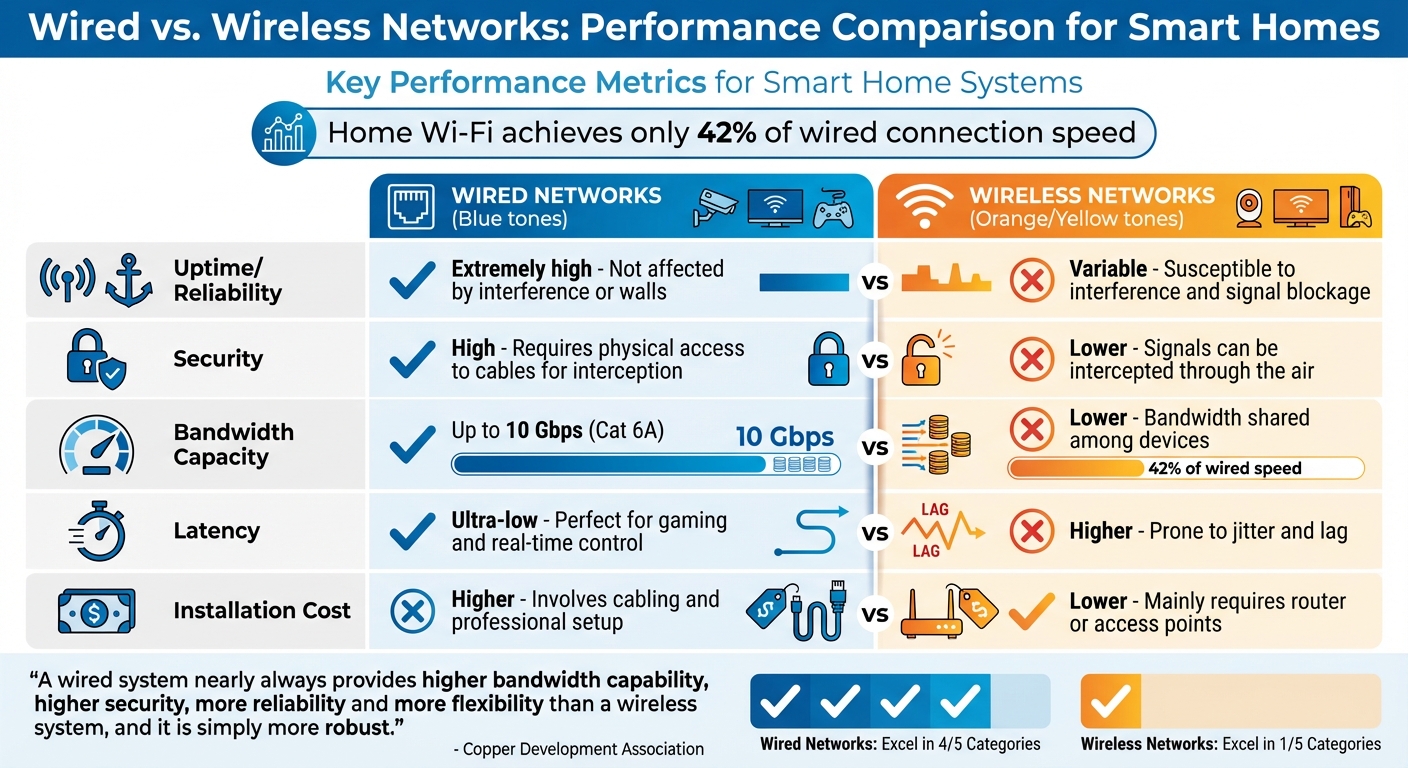
Wired vs Wireless Networks: Performance Comparison for Smart Homes
Setting up a smart home begins with selecting the right network. While wireless networks are convenient for mobile devices, wired connections excel in performance, especially for demanding smart home applications.
The difference in performance is striking. A typical home Wi-Fi network achieves only about 42% of the speed of a wired connection [4]. This performance gap can affect streaming quality and gaming responsiveness. For instance, Cat 6A Ethernet cables deliver a steady 10 Gbps connection, while even the latest wireless standards often fall short in practical use due to interference and distance limitations [4][6].
"A wired system nearly always provides higher bandwidth capability, higher security, more reliability and more flexibility than a wireless system, and it is simply more robust." – Copper Development Association [3]
Beyond speed, wired networks also enhance security by making data interception much harder. This added layer of protection is crucial for key smart home functions where reliability and security are non-negotiable.
Comparison Table
Here’s a quick breakdown of how wired and wireless systems stack up:
| Metric | Wired (Ethernet/Fiber) | Wireless (Wi-Fi) |
|---|---|---|
| Uptime/Reliability | Extremely high; not affected by interference or walls | Variable; susceptible to interference and signal blockage |
| Security | High; requires physical access to cables for interception | Lower; signals can be intercepted as they travel through the air |
| Bandwidth Capacity | Up to 10 Gbps (Cat 6A) [6] | Lower; bandwidth is shared among devices |
| Latency | Ultra-low; perfect for gaming and real-time control | Higher; prone to "jitter" and lag |
| Installation Cost | Higher; involves cabling and professional setup | Lower; mainly requires a router or access points |
While wired systems come with higher initial costs due to installation requirements, their unmatched performance and durability make them a solid long-term choice for stationary devices in a smart home setup.
Professional Installation for Reliable Wired Networks
Setting up a wired network isn’t as simple as plugging in a few cables. The distinction between a basic setup and a professionally installed system can make or break the reliability of your smart home. A well-executed installation ensures years of dependable performance, sparing you the frustration of constant troubleshooting.
Professional integrators rely on SMB (Small and Medium Business) or enterprise-grade hardware to handle heavy data traffic efficiently [5]. This equipment comes with advanced security features, such as network segmentation, which enhances privacy by isolating IoT devices on separate virtual networks [7]. If one device is compromised, the rest of the network remains protected. These high standards are backed by certifications from leading industry organizations.
One such certification, the HTA Certified standard, was established by the Home Technology Association to recognize top-tier integrators. As Josh Christian, CEO of the association, explains:
"Only the top 10% of integrators achieve the HTA Certified standard" [5].
Custom Solutions for Northern New Jersey Families
Taking this professional approach further, One Sound Choice specializes in creating wired networks tailored to the unique needs of Northern New Jersey families. With over three decades of experience and more than 2,500 successful installations, they carefully select the right combination of Cat 6A copper and fiber optic cabling to match your home’s layout and bandwidth requirements [1][5].
By getting involved early in the process, they help homeowners avoid costly changes later on. For homes larger than 1,800 square feet, professionals ensure that wireless access points are hardwired to the main network backbone, rather than relying on bandwidth-sharing mesh systems [5].
Expert Installation and Ongoing Support
Beyond installation, One Sound Choice ensures your wired network remains secure and future-ready. They integrate advanced features like PoE (Power over Ethernet) and design systems capable of supporting emerging 10 Gigabit speeds [1][6]. Their services include remote monitoring of network performance and regular updates for software and firmware, keeping your system protected from new cyber threats [5]. Led by Ryan "The Smart Guy" Herd, One Sound Choice offers expert guidance and a proven track record of reliability.
Eric Bodley, President of Future Ready Solutions, highlights the importance of preparing for the future:
"It’s safe to assume that it won’t be long before 10 Gigabit speeds will become the standard of Internet service providers" [1].
With a professionally installed wired network, your home is equipped to handle these advancements without the need for expensive upgrades down the line.
Conclusion
Wired networks are the backbone of today’s smart homes, offering reliability, security, and performance that Wi‑Fi simply can’t match. By hardwiring key devices like security cameras, gaming consoles, and 4K TVs, you can eliminate buffering, reduce latency, and free up your wireless bandwidth for mobile devices.
Beyond performance, wired connections keep your data confined to physical cables, making it much harder for anyone to eavesdrop on your network[1].
With Cat 6A cabling delivering speeds up to 10 Gbps – far surpassing the 42% speed performance of typical home Wi‑Fi – it’s easy to see why a strong wired network is a must-have[4].
Professional integrators take things a step further by using enterprise-grade hardware, following standards like ANSI/TIA 570‑D, and preparing networks for 10-Gigabit internet and AI-driven automation[5]. They also provide ongoing monitoring and updates to ensure your system stays secure and up-to-date.
For families in Northern New Jersey, a professionally installed wired network is the foundation of a secure, high-performance smart home. Companies like One Sound Choice, with over 30 years of experience and more than 2,500 installations, offer custom solutions designed to meet your family’s needs and stand the test of time.
What One Sound Choice clients say
The 1 Sound Choice staff was very easy to work with. Ryan, you understood our wants right from the beginning. Simplicity of installation and operation were just some of the reasons we chose 1 Sound Choice. You exceeded my expectations!
– Mr. & Mrs. Matia (1 Sound Choice client testimonials)
(We received) friendly, highly competent, quick and clean installation by 1 Sound Choice. The team followed up a few weeks after completion to ask if we were satisfied with our Media Room and Home Audio System. 1 Sound Choice is truly “top shelf” – they surpassed our expectations every step of the way.
– Mr. & Mrs. Blake (1 Sound Choice client testimonials)
I have hired 1 Sound Choice on several occasions over the past 10 years for several projects (from minor implementations to a whole house system). Ryan and the team at 1 Sound Choice are consummate professionals – extremely knowledgeable and up to date with technology, focused on delivering the best solution to fit your need, and highly customer service oriented. This combination plus the quality of finished product (every time) have made me a loyal customer… I highly recommend 1 Sound Choice.
– Terry Maytin (Houzz review)
FAQs
Why are wired networks better than wireless for smart homes?
Wired networks deliver greater reliability, security, and performance for smart homes compared to their wireless counterparts. With higher bandwidth, they ensure smooth functionality for devices like smart TVs, gaming systems, and home theater setups. Plus, since they’re not as vulnerable to interference, wired connections are perfect for essential systems like security cameras and smart locks.
On top of that, wired networks provide an extra layer of privacy by minimizing the risks of wireless hacking. For households aiming for a seamless and dependable smart home setup, a solid wired network serves as the foundation of a professional-grade system.
Why are wired networks important for smart home security?
Wired networks are key to boosting the security of smart homes. Compared to wireless connections, they are much harder to tamper with or intercept, significantly reducing the chances of hackers exploiting weaknesses. Plus, they offer a stable and dependable connection, ensuring your smart devices work smoothly without hiccups.
By avoiding the risks tied to wireless signals – like interception or disruption – wired networks provide a safer setup for your home’s technology. This extra level of protection is especially critical for safeguarding sensitive systems, such as smart security cameras, alarm systems, and the personal data housed within your smart home network.
What should you consider when setting up a wired network for your smart home?
A well-thought-out wired network is the backbone of a reliable, secure, and high-performing smart home. To start, focus on building a digital infrastructure capable of handling heavy data demands like streaming, gaming, and managing numerous smart devices. Using high-quality cables, such as Cat6, is a smart choice – they offer faster data transfer speeds and prepare your setup for future advancements.
Keep your cables organized in accessible pathways to make troubleshooting and upgrades easier down the road. Pay close attention to where you place outlets and network hardware. Positioning these strategically in high-usage areas can significantly improve performance. Wired networks also work hand-in-hand with wireless systems, delivering the stability and bandwidth necessary for smooth smart home operation.
Investing in a well-designed wired network ensures a strong, dependable foundation that keeps up with your smart home’s growing demands while maintaining top-notch reliability and security.
Related Blog Posts
- Fixing Slow WiFi at Home: 6 Solutions That Actually Work
- Future-Proofing Smart Homes with Low-Voltage Wiring
- Enterprise-Grade Networking for Remote Home Control
- Enterprise-Grade Networking for Smart Homes
Rooms that drop Wi-Fi? See our new home Wi-Fi page.
More questions
Do I still need Wi-Fi if I have wires?
Yes. Wires feed the TVs, access points, and gear that stays put. Wi-Fi still runs phones and tablets.
One Sound Choice, 8 Tilley Ave, Pompton Plains, NJ 07444. Call or text (973) 945-5275. We work in homes across Morris, Passaic, Bergen, Essex, Somerset, and Hunterdon counties. Written by Ryan Herd, founder of One Sound Choice.