
Your home’s network is no longer just about internet browsing or streaming – it’s the backbone of your smart devices, work-from-home setups, and security systems. With the average U.S. home juggling 22+ connected devices, traditional routers often fall short, leading to poor performance, dead zones, and security risks. Enterprise-grade networking offers a solution by bringing professional-grade reliability, speed, and security into your home.
Why Upgrade to Enterprise-Grade Networking?
- Handles More Devices: Supports 75+ devices without slowing down, compared to consumer routers struggling after 20.
- Better Coverage: Eliminates Wi-Fi dead zones with wired access points and structured cabling.
- Improved Security: Segments smart devices (like cameras) from personal data with VLANs.
- Longer Lifespan: Built to last 10–30 years, unlike consumer routers that need replacing every 2–5 years.
- Remote Management: Issues can often be fixed remotely, reducing downtime.
Key Features
- Access Points with Wired Backhaul: Ensures strong, consistent signals throughout the home.
- Managed Switches and VLANs: Optimizes traffic and isolates devices for better performance and security.
- Advanced Firewalls: Protects against cyber threats, crucial as ransomware attacks rise.
Why Professional Installation Matters
A professional integrator ensures proper design, placement, and setup of your network, tailored to your home’s size and layout. They also provide ongoing support to keep your system running smoothly.
Bottom Line: If your home relies on smart devices, remote work, or heavy internet use, enterprise-grade networking delivers the stability and performance you need. It’s not just an upgrade – it’s a long-term solution for modern living.
Enterprise Home Network & Wi-Fi Design | Smart Home Infrastructure Explained
sbb-itb-c5b321b
Main Components of an Enterprise-Grade Home Network
Creating a professional-grade home network involves carefully selecting and integrating components to build a reliable and high-performing digital foundation. Here’s how the key elements work together to deliver seamless connectivity.
Access Points and Wired Backhaul
Enterprise-level setups rely on multiple wireless access points (WAPs) strategically placed throughout the home. These access points connect to a central switch using high-quality cabling such as Cat6 or Cat6A. This wired connection, known as a backhaul, sets these systems apart from consumer-grade mesh networks, which often depend on wireless links between nodes.
The benefits of this approach are clear: it delivers consistent, high-speed performance. Professional installers typically recommend one access point for every 1,350 square feet of space, ensuring devices are within 25 feet of an access point for optimal connectivity [6]. When paired with Cat6 or Cat6A cabling, these access points provide reliable Wi-Fi 6 or Wi-Fi 6E speeds across the entire home. Eric Bodley, President of Future Ready Solutions, emphasizes the importance of this infrastructure:
"Think of a home’s wiring infrastructure as the ‘foundation’ or ‘digital backbone’ that supports all of the various technologies in your home" [4].
Wired connections also play a crucial role in freeing up wireless bandwidth. By connecting stationary devices like TVs and gaming consoles directly to the network, you leave more room for mobile devices like phones, tablets, and laptops to enjoy uninterrupted wireless performance. Wired connections can achieve speeds of up to 10 gigabits, far outpacing the capabilities of wireless mesh systems [6].
Network Switches and Routers
At the center of an enterprise-grade network lies a managed network switch, which acts as the hub for all wired devices and access points. Unlike basic consumer switches, managed switches allow you to prioritize network traffic, segment devices, and power other components like cameras and access points through Power over Ethernet (PoE) – eliminating the need for separate power adapters [1][2].
Meanwhile, the router serves as the network’s "brain", directing traffic, managing firewall protection, and handling complex configurations that go beyond the capabilities of standard consumer routers [1][5]. Enterprise-grade routers also support remote monitoring and management, enabling your integrator to troubleshoot and resolve issues remotely – often before you even realize there’s a problem [1]. Together, the switch and router form the backbone of a secure and efficient network, with advanced features like VLANs adding another layer of control.
VLANs and Device Segmentation
VLANs (Virtual Local Area Networks) provide a way to segment your network into distinct sections, keeping different device types isolated from one another. For instance, you could set up separate VLANs for IoT devices like smart thermostats and lights, work computers, security cameras, and guest access [5][6].
This segmentation not only enhances security by containing potential breaches but also improves network performance. TSP Smart Spaces explains the importance of VLANs:
"An enterprise-grade network will consist of multiple VLANs (virtual local area networks) to segment your network, separating your IoT devices from your work devices, and mitigating the damage if a breach occurs" [5].
Benefits of Enterprise-Grade Networking for Smart Homes
A strong network foundation is essential for smart homes, and enterprise-grade systems offer several advantages that go beyond what consumer-grade equipment can provide.
Complete Coverage Across Large Homes
Standard consumer routers often struggle to provide reliable Wi-Fi coverage beyond 150 feet, especially when walls and floors come into play [5]. In contrast, enterprise-grade networks use multiple wired access points to eliminate dead zones. According to the Home Technology Association (HTA), homes larger than 2,000 square feet benefit significantly from multiple access points [5][1]. This setup ensures seamless roaming, meaning your devices automatically connect to the closest access point as you move around. With each access point linked to a central switch via Cat6 or Cat6A cabling, you’ll experience consistent, high-speed internet across the entire home – from a basement theater to third-floor bedrooms. This broad coverage is particularly important for supporting the stable performance needed by modern automation systems.
Reliable Performance for Automation Platforms
Stable, low-latency networks are a must for automation platforms. Network congestion can lead to failed automations, frozen security camera feeds, or delayed voice commands. Enterprise-grade networks address this by using intelligent bandwidth allocation, which ensures that critical systems like security cameras, thermostats, and work-from-home applications get priority. This keeps your smart home running smoothly, even when multiple devices are in use.
Support for 75+ Connected Devices
By 2025, the average household is expected to have around 15 connected devices per person [4]. For a family, this easily adds up, not even counting smart bulbs, sensors, cameras, or entertainment systems. Consumer routers often struggle with more than 20 devices, frequently requiring reboots. In contrast, enterprise-grade access points are built to handle hundreds of simultaneous connections without breaking a sweat. These systems use managed switches and VLAN segmentation to keep network traffic flowing efficiently, avoiding the bottlenecks that plague consumer setups.
Advanced Security Features
Security is another area where enterprise networks shine, especially in homes with numerous connected devices. VLAN segmentation isolates potentially vulnerable IoT devices – like smart bulbs – from personal computers and work equipment, reducing the risk of a breach. Nathan Holmes, Director of Operations at WhyReboot, highlights this advantage:
"Enterprise-grade equipment installed by a professional integrator offers a much higher level of security to protect a home’s network and the personal information stored on it than any ‘off-the-shelf,’ residential-grade components can" [1].
Additionally, enterprise networks often include Wireless Intrusion Detection Systems (WIDS) and Wireless Intrusion Prevention Systems (WIPS). These tools actively monitor for rogue devices and unauthorized access points, disconnecting threats before they can cause harm. Considering that ransomware attacks now occur every 11 seconds [7], these features are vital for safeguarding your family’s data and privacy.
Scalability for Future Expansion
Unlike consumer-grade equipment, which typically lasts only 2 to 5 years, enterprise-grade hardware is built to last 10 to 30 years [1][2]. This longevity ensures your network can handle future technologies without requiring a complete overhaul. Whether you’re adding outdoor cameras, upgrading your home theater, or integrating new smart appliances, enterprise systems adapt effortlessly. Many professional installations also include remote monitoring and management (RMM), allowing technicians to address issues proactively – often before you even notice them. For families in Northern New Jersey, experts like One Sound Choice provide tailored solutions that keep smart home networks reliable and ready for the future.
Enterprise-Grade vs. Consumer-Grade Networks: A Comparison
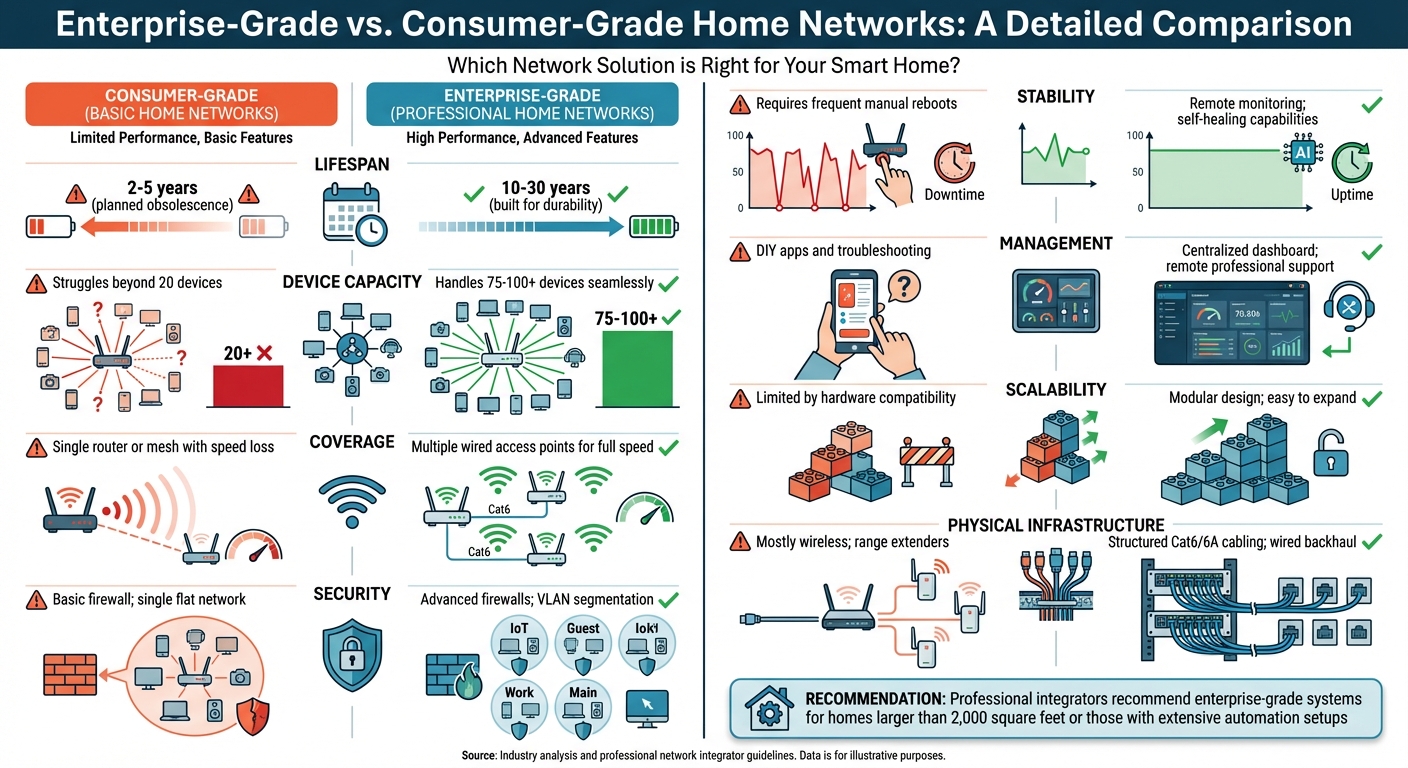
Enterprise-Grade vs Consumer-Grade Home Networks Comparison
When deciding between consumer-grade and enterprise-grade networking, there’s more to consider than just the price tag. These two options differ significantly in terms of durability, reliability, and their ability to meet the demands of a modern smart home. Let’s break it down to see how these differences play out in real-world scenarios.
Consumer-grade routers and mesh systems are designed for basic internet use and limited device connectivity. They’re typically sold with the expectation that they’ll be replaced every few years. On the other hand, enterprise-grade systems are built for environments where downtime isn’t an option, and where dozens – or even hundreds – of devices need to run smoothly without slowing down.
For example, enterprise-grade hardware is built to last 10 to 30 years, using components designed for continuous operation [1][2]. This is especially important for households managing 75 or more connected devices – think security cameras, thermostats, tablets, and gaming consoles. Consumer-grade routers often struggle to handle more than 20 devices and frequently require reboots to function properly [1][8]. In contrast, enterprise-grade systems handle the load with ease, thanks to features like managed switches, VLAN segmentation, and professional-grade access points that keep performance steady, even under heavy use. This is why enterprise-grade solutions are the go-to choice for demanding environments.
Comparison Table: Enterprise-Grade vs. Consumer-Grade Networks
| Feature | Consumer-Grade Networks | Enterprise-Grade Networks |
|---|---|---|
| Lifespan | 2–5 years (planned obsolescence) | 10–30 years (built for durability) [1][2] |
| Device Capacity | Struggles beyond 20 devices | Handles 75–100+ devices seamlessly [1][8] |
| Coverage | Single router or mesh with speed loss | Multiple wired access points for full speed [1][5] |
| Security | Basic firewall; single flat network | Advanced firewalls; VLAN segmentation [5][8] |
| Stability | Requires frequent manual reboots | Remote monitoring; self-healing capabilities [1][8] |
| Management | DIY apps and troubleshooting | Centralized dashboard; remote professional support [8] |
| Scalability | Limited by hardware compatibility | Modular design; easy to expand [2] |
| Physical Infrastructure | Mostly wireless; range extenders | Structured Cat6/6A cabling; wired backhaul [4][8] |
This side-by-side comparison highlights why professional integrators often recommend enterprise-grade systems for homes larger than 2,000 square feet or those with extensive automation setups [1][5]. While the initial investment might be higher, the long-term benefits – like reliable performance, advanced security, and scalability – make it worthwhile. Plus, these systems are designed to grow alongside your family’s evolving technology needs.
Take, for instance, professional integrators like One Sound Choice. They specialize in designing, installing, and supporting enterprise-grade smart home systems in Northern New Jersey. By leveraging the advantages of enterprise-grade networking, they ensure homes remain secure, scalable, and ready for future technological advancements. It’s this level of performance and reliability that sets enterprise-grade solutions apart.
Professional Installation for Long-Term Performance
Getting a professional installation ensures your home network delivers the kind of high-level performance needed to keep up with your family’s growing tech demands. Unlike DIY setups, enterprise-grade systems require expert installation, fine-tuning, and ongoing maintenance to maintain their reliability and efficiency over time.
Custom Design and Site Survey
Before any equipment is installed, professional integrators conduct a detailed assessment of your property. This process involves mapping out Wi-Fi coverage to pinpoint dead zones, analyzing bandwidth needs based on your household’s usage, and evaluating how construction materials – like stone, glass, or millwork – might interfere with wireless signals. The goal? To position access points in the best possible locations for maximum coverage and performance.
Take, for instance, a project by One Sound Choice in Bergen County. For a finished basement designed for high-bandwidth gaming and 4K streaming, they carefully analyzed the layout to ensure the network could handle these demands while keeping equipment discreetly out of sight [3]. This kind of planning doesn’t just optimize performance – it also ensures the network infrastructure blends seamlessly into your home’s design.
Hardware Selection and Placement
Professional installers use durable, enterprise-grade hardware and house it in specialized network racks. These racks include features like integrated power management, uninterruptible power supplies (UPS), and proper ventilation to prevent overheating, ensuring your system runs smoothly for the long haul.
One essential step is installing Cat6 or Cat6A cabling to create a wired backbone for your home’s digital infrastructure. This structured cabling supports high-bandwidth devices like smart TVs and security cameras, freeing up Wi-Fi for mobile devices. With wired connections capable of speeds up to 10 gigabits, this setup far outpaces what most wireless mesh systems can deliver [6]. Wireless access points are then strategically placed using heat maps, taking into account your property’s layout and materials to provide consistent, reliable coverage.
Configuration and Monitoring
Once the hardware is installed, professional engineers configure the network to ensure both top-tier performance and security. This includes setting up Virtual Local Area Networks (VLANs) to separate IoT devices from personal and work devices, reducing potential security risks [5]. They also use remote monitoring and management (RMM) tools to identify and fix issues before they can disrupt your network.
"In the networking world, power cycling doesn’t actually isolate or fix the issue. It just postpones the problem until that event occurs again."
- Nathan Holmes, Director of Operations, WhyReboot [1]
This proactive monitoring eliminates the need for manual reboots or DIY troubleshooting. Companies like One Sound Choice provide this level of support to ensure your network remains dependable and adaptable, meeting your family’s needs both now and in the future.
Conclusion: Enterprise-Grade Networking for Modern Families
Today’s families rely on dependable networks for everything from remote work and online learning to home security and entertainment. An enterprise-grade network can support 75+ devices with ease, thanks to durable hardware designed to last 10 to 30 years and advanced security measures to keep your data safe[1][5]. However, even the best hardware needs expert setup to truly shine.
A professionally designed and installed network eliminates the headaches of dropped connections and slow speeds. Partnering with a skilled integrator ensures your system is built with structured cabling, optimally placed access points, and proactive monitoring that tackles problems before they disrupt your day.
"The enterprise-grade network in your home should be virtually invisible. That is, you should be able to turn on any device, at any time, and simply have it work."
- Nathan Holmes, Director of Operations, WhyReboot[1]
This quote perfectly captures the goal: a network that works so seamlessly, you barely notice it’s there.
In Northern New Jersey, families turn to One Sound Choice for their networking needs. With over 30 years of experience and more than 2,500 installations, Ryan Herd and his team specialize in creating systems that blend into your home while delivering top-tier performance. Whether it’s secure data management, uninterrupted streaming, or preparing for future tech like 8K video, their design-first approach ensures your network evolves with your family’s needs. From initial assessments to ongoing remote support, they cover every detail – whether you’re adding a home theater, extending coverage to a guest house, or upgrading for tomorrow’s technology.
An enterprise-grade network isn’t just about faster Wi-Fi; it’s about building a resilient digital backbone that adapts effortlessly to your family’s ever-changing demands.
What One Sound Choice clients say
(We received) friendly, highly competent, quick and clean installation by 1 Sound Choice. The team followed up a few weeks after completion to ask if we were satisfied with our Media Room and Home Audio System. 1 Sound Choice is truly “top shelf” – they surpassed our expectations every step of the way.
– Mr. & Mrs. Blake (1 Sound Choice client testimonials)
The 1 Sound Choice staff was very easy to work with. Ryan, you understood our wants right from the beginning. Simplicity of installation and operation were just some of the reasons we chose 1 Sound Choice. You exceeded my expectations!
– Mr. & Mrs. Matia (1 Sound Choice client testimonials)
I have hired 1 Sound Choice on several occasions over the past 10 years for several projects (from minor implementations to a whole house system). Ryan and the team at 1 Sound Choice are consummate professionals – extremely knowledgeable and up to date with technology, focused on delivering the best solution to fit your need, and highly customer service oriented. This combination plus the quality of finished product (every time) have made me a loyal customer… I highly recommend 1 Sound Choice.
– Terry Maytin (Houzz review)
FAQs
What are the benefits of enterprise-grade networking in a smart home?
Enterprise-grade networking brings blazing-fast speeds, dependable reliability, and top-notch security to today’s smart homes. It ensures smooth, uninterrupted connectivity throughout your home, effortlessly supporting multiple devices – whether it’s 4K streaming, smart home gadgets, or a fully equipped home office.
With its low-latency performance and strong Wi-Fi coverage, this level of networking is built to meet the demands of a highly connected lifestyle. Plus, it’s ready to grow with you, providing a solid base for integrating future technologies and devices as they become available.
Why is professional installation important for a high-performance enterprise-grade home network?
When you opt for professional installation, your home network is set up to meet the high demands of today’s smart homes. Experts choose top-tier, enterprise-grade equipment and create a solid, pre-wired system that eliminates dead zones, minimizes network congestion, and delivers fast, dependable connectivity across your entire home.
With this level of care and expertise, your network provides steady performance for everything – whether it’s streaming your favorite shows, intense gaming sessions, or managing smart security and automation systems. The result? A seamless, hassle-free experience for your entire household, day in and day out.
Can enterprise-grade networking in smart homes handle future technology upgrades?
Enterprise-grade networking offers a powerful and flexible backbone tailored to keep up with advancing technology. Whether you’re integrating additional smart devices, upgrading to faster internet, or handling increased bandwidth requirements, these systems are built to ensure your smart home stays ahead of the curve.
Choosing professional-grade networking means families can count on consistent, secure, and adaptable connectivity that keeps pace with new technologies, making daily life smoother and more connected without disruptions.
Related Blog Posts
- How to Set Up Whole Home WiFi: 7 Steps for Better Coverage
- Fixing Slow WiFi at Home: 6 Solutions That Actually Work
- Future-Proofing Smart Homes with Low-Voltage Wiring
- Enterprise-Grade Networking for Remote Home Control
Rooms that drop Wi-Fi? See our new home Wi-Fi page.
One Sound Choice, 8 Tilley Ave, Pompton Plains, NJ 07444. Call or text (973) 945-5275. We work in homes across Morris, Passaic, Bergen, Essex, Somerset, and Hunterdon counties. Written by Ryan Herd, founder of One Sound Choice.