
Encryption is the key to securing your family’s privacy in smart homes. It safeguards sensitive data – like video feeds, voice commands, and daily routines – by making it unreadable to anyone without proper access. This ensures your personal information stays safe from hackers, data breaches, and even prying third parties.
Here’s what you need to know:
- What is Encryption? It’s a method that scrambles data into an unreadable format, only accessible with a specific key.
- Why It Matters: Without encryption, devices like cameras and baby monitors can expose private data or routines, creating risks.
- Common Risks: Weak passwords, outdated firmware, and older Wi-Fi protocols like WEP can leave smart home systems vulnerable.
- How It Works:
- Symmetric Encryption: Secures real-time communication between devices.
- Public-Private Key Pairs: Authenticate devices during setup.
- Advanced Algorithms: Protocols like AES-128 and ChaCha20-Poly1305 ensure strong protection.
- Future-Proofing: Emerging technologies like homomorphic encryption and quantum-resistant methods aim to address future threats.
For the best results, consider professional smart home setups to ensure proper encryption, regular updates, and secure configurations. This way, your family’s privacy is protected both now and in the future.
How Do You Ensure Data Privacy For Smart Home Devices? – The Friendly Statistician
How Encryption Protects Family Data
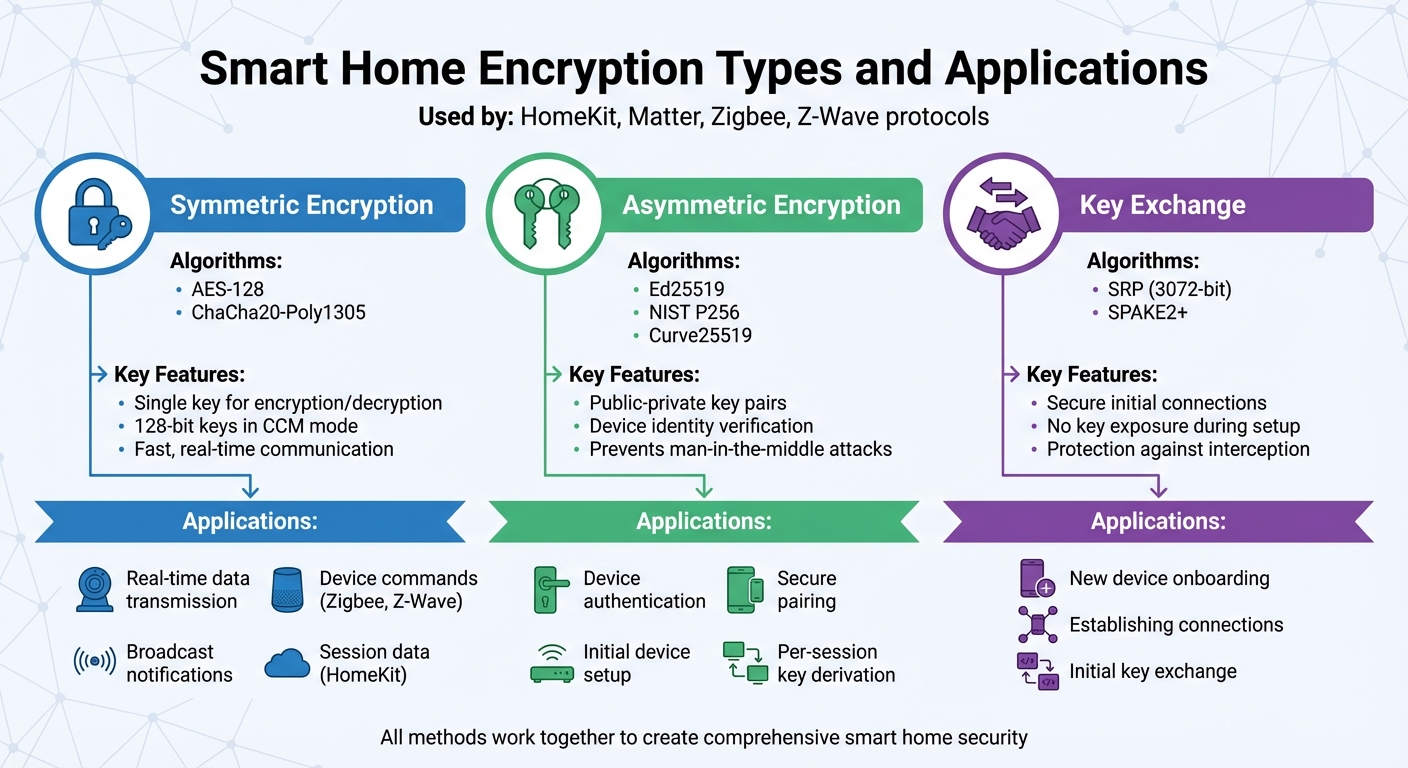
Smart Home Encryption Types and Applications Comparison
Symmetric Encryption for Real-Time Security
Symmetric encryption relies on a single key for both encrypting and decrypting data, making it ideal for fast, real-time communication between smart home devices [1]. Protocols like Zigbee and Z-Wave utilize 128-bit keys in CCM mode to secure device commands [5]. This ensures minimal delay when executing commands across devices.
Apple’s HomeKit takes a step further by using ChaCha20-Poly1305 AEAD to encrypt session data and broadcast notifications [3]. This algorithm is designed to deliver high-speed performance while maintaining robust security, ensuring your interactions with smart devices – like sending commands from your phone – stay safe from prying eyes.
While symmetric encryption handles the speed required for ongoing communication, asymmetric encryption steps in to secure the onboarding process for new devices.
Asymmetric Encryption for Device Authentication
Before a new device can join your smart home network, asymmetric encryption ensures its identity is verified [3]. This method uses public-private key pairs, with HomeKit leveraging Ed25519 and Matter relying on NIST P256, to create a secure connection right from the setup phase [3].
During the initial setup, protocols like Secure Remote Password (SRP) with 3072-bit keys allow devices to exchange encryption keys without exposing them to potential attackers, even if someone intercepts the connection [3]. Once a device is authenticated, it uses per-session keys derived from algorithms like Curve25519 to encrypt ongoing communication. This prevents "man-in-the-middle" attacks, where hackers might try to impersonate your devices [3].
These encryption methods are fine-tuned for smart home environments, working together to provide a secure experience.
Encryption Algorithms for Smart Homes
| Encryption Type | Algorithm | Application |
|---|---|---|
| Symmetric | AES-128, ChaCha20 | Real-time data transmission, broadcast notifications [5][3] |
| Asymmetric | Ed25519, NIST P256 | Device identity, authentication, and secure pairing [3] |
| Key Exchange | SRP (3072-bit), SPAKE2+ | Establishing initial connections between new devices [3] |
Lightweight protocols like MQTT act as a streamlined "universal language" for IoT devices [5]. These can integrate with encryption tools, such as zigbee2mqtt, to maintain security without draining a device’s battery. The trick lies in balancing encryption strength with the device’s capabilities, all while ensuring the overall safety of your home network.
Advanced Encryption Technologies for Long-Term Security
Homomorphic Encryption for Data Privacy
Homomorphic encryption is a game-changer for protecting your personal data. It allows smart home data to be processed and analyzed without ever being decrypted. This means that even when a cloud service or app needs to work with sensitive information, the data remains encrypted throughout the entire process.
Why does this matter? A study by researchers at Northeastern University and Imperial College London revealed that 72 out of 81 IoT devices they tested were sending data to third parties [5]. With homomorphic encryption, even if your devices need to interact with external services, those companies won’t gain access to your raw data. They can perform the necessary computations while your information stays encrypted, shielding you from potential breaches and unauthorized data mining.
This technology isn’t just about addressing current privacy concerns – it’s also paving the way to deal with future challenges, like those posed by quantum computing.
What is quantum-resistant encryption?
Protecting family data today also means preparing for the threats of tomorrow. Current encryption methods, such as RSA and ECC, could be vulnerable to quantum computing in the future. Quantum computers have the potential to break these widely-used encryption standards, which is why security experts are working on quantum-resistant algorithms designed to withstand both traditional and quantum-based attacks.
For now, platforms like Apple HomeKit and the Matter standard rely on protocols like Ed25519 and NIST P256 for device authentication [3]. However, manufacturers are already exploring quantum-resistant upgrades to stay ahead of these emerging threats. The best way to protect your smart home is to enable automatic updates on all devices and routers. This ensures you receive the latest security patches as soon as they’re released.
Another step you can take is upgrading your home router to WPA3 Personal encryption. Doing so strengthens your network and sets you up for better long-term security [6][4].
sbb-itb-c5b321b
Professional Implementation of Encryption in Smart Homes
The Importance of Expert Integration
Setting up encryption in a smart home isn’t as simple as flipping a switch – it requires a skilled approach. Professional technicians address common vulnerabilities that often plague DIY setups, like leaving default credentials in place or misconfiguring security protocols. Craig Young, Principal Security Researcher at Tripwire, underscores this when he advises, "Select WPA2 in Wi-Fi settings (and avoid WPS at all costs)" [8]. Professionals ensure these critical details are handled correctly from the start.
But it’s not just about the initial setup. Professional integration establishes a cohesive security framework, ensuring all devices communicate seamlessly on a unified platform. This approach eliminates potential gaps between systems that hackers could exploit [9]. Experts also implement end-to-end encryption and configure network segmentation, isolating smart devices from sensitive personal data [8].
Another key benefit is ongoing maintenance. Firmware updates, which are crucial for addressing security vulnerabilities, are handled automatically across all devices. Homeowners don’t have to keep track of updates for dozens of gadgets [9][10]. Additionally, professional monitoring centers verify encrypted alerts before dispatching emergency services – an essential step when nearly 98% of alarms turn out to be false [7].
This comprehensive strategy ensures your smart home system is secure, adaptable, and ready to meet your needs.
Why Choose Secure Smart Home Solutions?
For families looking for a security system tailored to their specific needs, professional integrators offer a level of reliability that retail products can’t match. One Sound Choice, with over 30 years of experience and 2,500+ installations, has become a trusted name for families in Northern New Jersey. Led by Ryan "The Smart Guy" Herd, they specialize in implementing advanced encryption technologies, from WPA3 networks to AES-128 communication, customized to fit each home’s unique design.
What makes professional integrators stand out is their ability to adapt security measures to your home and lifestyle. One Sound Choice evaluates your home’s layout to eliminate blind spots, integrates backup solutions like cellular connectivity to maintain secure connections during outages, and provides ongoing support to address new threats as they arise. This hands-on approach ensures your smart home system is secure, dependable, and hassle-free – without the risks and frustrations of DIY solutions.
Conclusion: Encryption as the Foundation of Family Privacy
Encryption plays a central role in keeping family privacy intact within today’s connected homes. It serves as the backbone for safeguarding personal information in smart home systems, ensuring sensitive data remains protected.
By securing data both when it’s stored and when it’s being transmitted, encryption creates a multi-layered defense against unauthorized access [1]. This approach is essential for shielding private information, including behavioral patterns and daily routines, from falling into the wrong hands [2].
Without proper encryption measures, personal data could easily be exposed. Professional services ensure that robust protocols like WPA3 and HomeKit security are properly implemented and regularly updated, maintaining the effectiveness of these protections over time.
For families in Northern New Jersey, working with experts like One Sound Choice can turn advanced encryption into a practical solution for long-term privacy and security.
What One Sound Choice clients say
We one a vacation home and were concerned with security when we are not there. 1 Sound Choice provided camera that allowed us to record all activity for a month and we could dial into the system from the internet. The system also will automatically flash lights inside the home to discourage intruders from entering.
– The Lavelle Family (1 Sound Choice client testimonials)
(We received) friendly, highly competent, quick and clean installation by 1 Sound Choice. The team followed up a few weeks after completion to ask if we were satisfied with our Media Room and Home Audio System. 1 Sound Choice is truly “top shelf” – they surpassed our expectations every step of the way.
– Mr. & Mrs. Blake (1 Sound Choice client testimonials)
Truly One Sound Choice, you won’t find better. I called a couple of AV companies for quotes but on speaking with Ryan I had confidence that One Sound Choice would do the job right. Most companises had assured me that they would not have to cut holes in my walls to achieve my project goals. Ryan was up front, honest and realistic outlining all the possible challenges my install might face whilst reassuring me that One Sound Choice had the capabilitiy and expertise to meet my goals. Consulation was painless and Ryan and Kenny captured my requirements perfectly and offered advice based on their experience regarding optional additons to the project, which were practical and delivered exceptional enhancements. Ryan provided me with a view of what could be achieved given my requirements and then worked with me complete the project with consideration to my budget, but without compromising the final solution. Even completed the project without requiring any patch work which was a bonus. Ryan and Kenny were a pleasure to work with, respectful and courteous and I had confidence having them in our home. Highly recommend for any AV work you are considering. You will not be disappointed with the results.
– Leighton (Houzz review)
FAQs
How does encryption keep your smart home safe from hackers?
Encryption transforms the data exchanged between your smart home devices and network into a secure, unreadable format. This means that even if someone intercepts the information, they won’t be able to decipher or tamper with it. By preventing unauthorized access, encryption acts as a shield, protecting your devices and family from potential hacking threats.
For families looking for secure and dependable smart home systems, professional-grade options like those from One Sound Choice offer robust encryption and other advanced security measures. With over 30 years of expertise, their customized systems are designed to safeguard your home while adding convenience and comfort to your daily life.
How does professional encryption protect your family’s smart home data?
When it comes to smart home devices, professional encryption adds a crucial layer of security. It ensures that all communications between your devices are encrypted, keeping your family’s personal and behavioral data safe from prying eyes. This helps block hackers from intercepting sensitive information, giving you a stronger sense of privacy and protection.
Opting for a professionally implemented encryption setup means your smart home system is equipped with advanced security features designed to protect both your privacy and the integrity of your data. It’s a dependable way to address the unique challenges of staying secure in today’s connected world.
How can families keep their smart home systems secure for the future?
To keep your smart home safe, start with enterprise-level encryption to secure your data. Make it a habit to update the firmware and operating systems of all your devices to fix any potential vulnerabilities. Use strong, unique passwords for each device, and turn on two-factor authentication for extra protection.
For your home network, make sure your Wi-Fi is secured with a strong protocol like WPA3. You might also want to set up a separate guest network for visitors to keep your main network more secure. Don’t forget to back up important data regularly and encrypt it to ensure it stays protected. These precautions can go a long way in safeguarding your privacy and shielding against potential threats.
Related Blog Posts
- AI-Powered Smart Security System
- Smart Home Questions Answered: 15 Common Concerns for Families
- Smart Home Privacy: Cloud Storage Best Practices
- Enterprise-Grade Networking for Remote Home Control
Same password on every device? See our one password page.
One Sound Choice, 8 Tilley Ave, Pompton Plains, NJ 07444. Call or text (973) 945-5275. We work in homes across Morris, Passaic, Bergen, Essex, Somerset, and Hunterdon counties. Written by Ryan Herd, founder of One Sound Choice.