
Adding audio to your pool area can transform it into an entertainment hub, but outdoor systems face unique challenges like humidity, UV exposure, and temperature extremes. Investing in weather-resistant equipment and professional installation ensures durability and optimal sound quality. Key considerations include:
- Weatherproof Components: Use IP66-rated speakers, corrosion-resistant materials, and direct-burial wiring to handle outdoor conditions.
- Speaker Placement: Space smaller speakers evenly around the pool for consistent sound coverage, avoiding dead zones or overpowering hotspots.
- Amplifiers: Choose outdoor-ready models with sufficient wattage (40W+) to overcome ambient noise and ensure clear, distortion-free sound.
- Professional Installation: Avoid DIY pitfalls like incorrect wiring or poor placement. Pros ensure proper setup, safety, and long-term performance.
- Maintenance: Regular cleaning and inspections extend the lifespan of your system.
For larger areas, multi-zone systems with independent volume control provide flexibility, while integrating with whole-home audio systems offers seamless control. A reliable Wi-Fi network is essential for wireless setups. By combining durable components, thoughtful design, and expert installation, you can create a reliable, high-quality poolside audio experience.
All Weather Outdoor Speaker Install for Patio or Pool Speakers
sbb-itb-c5b321b
Why Professional Installation Matters for Pool Audio
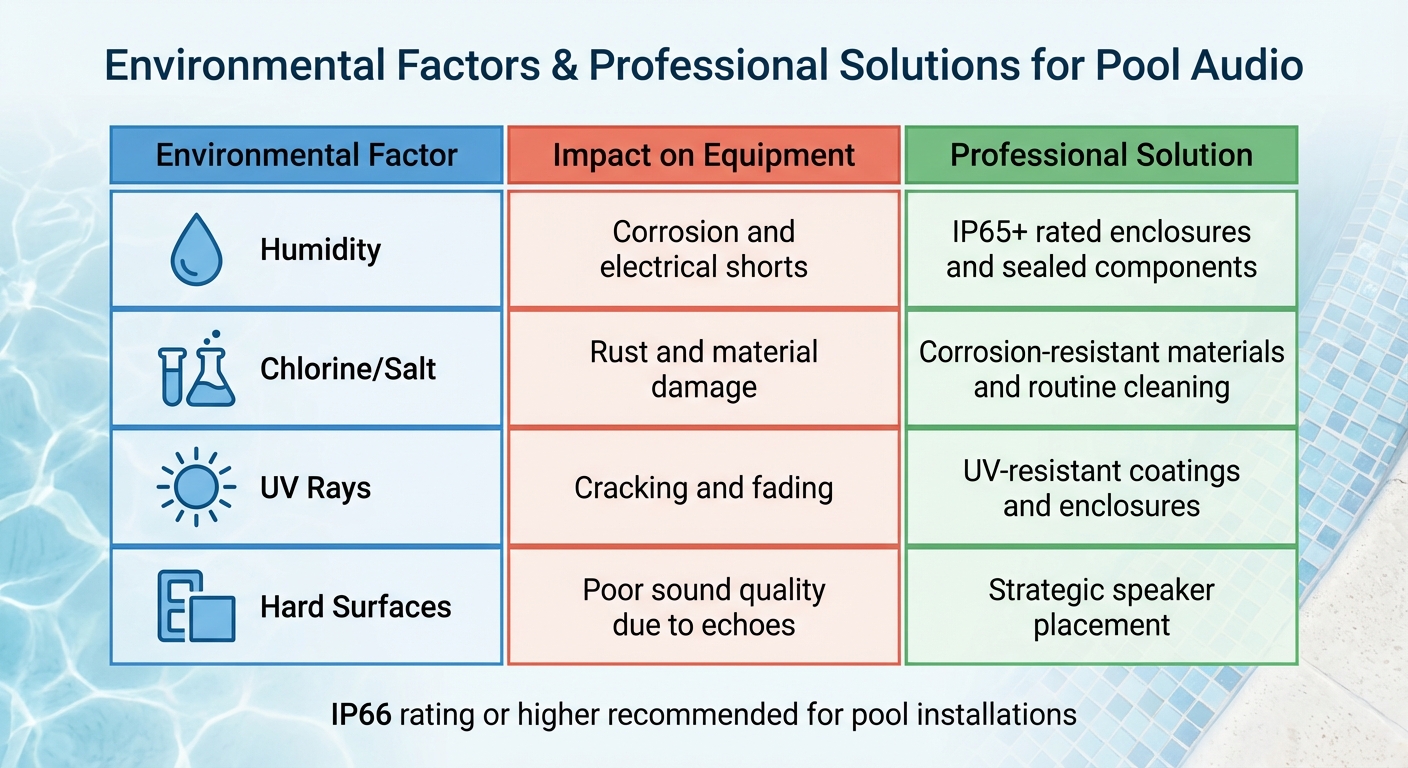
Outdoor Pool Audio Environmental Challenges and Professional Solutions
Poolside environments are tough on audio equipment. Constant exposure to humidity, direct sunlight, extreme temperature changes, and corrosive chemicals like chlorine can quickly wear down components designed for indoor use. These harsh conditions highlight the importance of using equipment built specifically to endure outdoor challenges.
Improperly sealed wiring can allow moisture to seep in, leading to electrical shorts – sometimes even inside your home’s walls. Corroded connections can pose fire risks, while UV rays can weaken and degrade plastic and speaker materials. Chlorine residue further accelerates rust on metal parts. Professional installation ensures these risks are addressed from the start by using the right materials and techniques for the job.
Weather-Resistant Components Are a Must
To withstand the elements, poolside audio equipment must meet strict durability standards. The IP (Ingress Protection) rating system measures how well devices resist dust and water. The first digit rates dust protection (6 means completely dust-tight), while the second digit rates water resistance. For pool installations, an IP66 rating or higher is crucial. This ensures the equipment can handle heavy rain and strong water jets without internal damage.
"For a true ‘set it and forget it’ system, look for speakers with an IP66 rating or higher. This ensures your investment is protected year-round." – Kennedy Design + Build [1]
Professional-grade systems also require direct-burial rated speaker wire, usually 14- or 16-gauge, with waterproof jackets. Unlike standard indoor wire, which allows moisture to creep in between copper strands and cause corrosion, these wires are designed to withstand outdoor conditions without signal degradation [1].
| Environmental Factor | Impact on Equipment | Professional Solution |
|---|---|---|
| Humidity | Corrosion and electrical shorts | IP65+ rated enclosures and sealed components |
| Chlorine/Salt | Rust and material damage | Corrosion-resistant materials and routine cleaning |
| UV Rays | Cracking and fading | UV-resistant coatings and enclosures |
| Hard Surfaces | Poor sound quality due to echoes | Strategic speaker placement |
Why DIY Installations Often Fail
While DIY installation may seem tempting, it comes with significant risks. A common issue is incorrect polarity, where positive and negative connections are mixed up. This results in phase cancellation, which weakens bass and makes the sound feel hollow [1]. Professionals know how to avoid these errors, ensuring optimal sound quality and system safety.
Another frequent DIY mistake is using indoor-rated speakers or equipment with low IP ratings. These are not built to handle the demands of pool environments, leading to quick wear and failure. DIY setups also often lack the even sound distribution of professionally designed systems, which use multiple speakers for balanced coverage.
Wireless DIY systems can face connectivity issues in large outdoor spaces, with signals dropping frequently. Wired systems, on the other hand, offer stable, high-quality audio and are not reliant on Wi-Fi strength. Professional installers often recommend 70-volt systems for larger pool areas. These systems allow for longer wire runs and multiple speakers without losing signal quality – something that’s hard to achieve without specialized expertise [5].
Evaluating Your Pool Area and Audio Requirements
When designing an outdoor audio system for your pool area, it’s crucial to assess the space carefully. Pool areas present unique challenges due to their open nature and the higher levels of ambient noise caused by splashing, water features, and wind. These factors demand weather-resistant components and a system powerful enough to deliver clear, distortion-free sound [7].
Pool Size and Shape Considerations
The size and shape of your pool area significantly impact speaker placement. Generally, a single pair of speakers can cover 200–400 square feet, but irregular layouts, such as L-shaped pools or yards with alcoves, require more strategic spacing [8].
"Around the perimeter of the pool place one small speaker every 25 or 30 feet. That will provide much better experience than two large speakers at opposite ends."
- John Vitiello, President, Alpine Home Media Inc. [7]
This approach avoids dead zones where sound diminishes and hot spots where it becomes overwhelming. Outdoor environments also pose acoustic challenges due to hard surfaces like concrete and water, which reflect sound differently than indoor spaces. As Tony Satariano from Rockustics explains:
"The acoustic realities of an outdoor environment are drastically different. The floor, the walls, the ceiling – all contribute to the fidelity of the speaker. Outside, you don’t get that" [8].
Natural and structural elements, such as trees, sidewalks, and landscaping, can obstruct sound paths. To address this, additional speakers may be necessary to fill in these gaps. Placing speakers along the property line and angling them inward minimizes sound spillover into neighboring areas while maximizing coverage within your space [7][8].
For most outdoor setups, speakers with at least 40 watts per channel are recommended to overcome ambient noise and natural obstacles without distortion [8]. Larger pool areas may benefit from 70-volt systems, which support longer wire runs and multiple speakers on a single amplifier line, simplifying installation and avoiding impedance issues [5]. If your setup includes high-energy water features or covers a particularly large area, buried or weatherproof subwoofers can enhance bass performance, providing depth that standard speakers can’t achieve in open-air environments [6].
How You’ll Use the System
The way you plan to use your pool area influences your audio setup. For a space designed for quiet relaxation, fewer speakers at moderate volumes may suffice. On the other hand, if your pool area is a hub for entertaining, you’ll need broader coverage and higher power to create an immersive experience. In such cases, subwoofers become vital for delivering a full range of sound outdoors [6].
Dividing your backyard into distinct audio zones – such as Pool, Hot Tub, and BBQ/Dining – offers flexibility. Each zone can have independent volume control, allowing you to play lively music by the pool while keeping softer background music in dining areas [7]. For primary listening spots, like a covered patio or poolside lounge, aim to position speakers in an equilateral triangle relative to the main seating area. This setup ensures proper stereo imaging with clear left and right channels [1].
Selecting Speakers and Amplifiers
With your pool area and audio requirements outlined, the next step is choosing speakers and amplifiers that can handle outdoor conditions while delivering high-quality sound. Outdoor audio systems face tougher challenges than indoor setups, so investing in durable, reliable equipment is essential to avoid poor sound performance or early equipment failure.
Outdoor Speaker Options
Outdoor speakers come in several designs, each suited to different needs and aesthetics. Surface-mount speakers are a popular choice for patios and decks, as they can be attached to walls, eaves, or pool houses. Typically installed 8–10 feet high and angled downward, they provide focused sound for specific areas [8].
For larger yards, in-ground or landscape satellite speakers are a great option. These small, stake-mounted units can be placed discreetly in flower beds, shrubs, or along the lawn’s edge, offering even sound coverage without drawing attention [9]. Rock-style speakers, designed to mimic natural stones, blend seamlessly into rock gardens or poolside landscapes [8]. Bollard speakers, which provide 360-degree sound, double as stylish architectural features, making them a good fit for modern pool designs [10].
When choosing outdoor speakers, weatherproofing is critical. Look for models with at least an IPX5 rating to ensure resistance to water jets, though an IP65 rating or higher is preferable for added protection against dust and water [8][6]. Materials like UV-resistant plastic, rust-proof aluminum, or polypropylene are ideal for cabinets, as they resist freezing, rusting, and corrosion [9]. Additionally, high-quality outdoor speakers often feature rust-proof internal components, weather-resistant drivers, and built-in drainage to prevent moisture buildup [9].
Scott Trusty, a Residential Audio/Video Consultant, highlights advancements in outdoor speaker technology:
"Outdoor speaker companies have really tweaked and perfected the technology and the products. The quality’s gotten a lot better, and the components last forever." [8]
Choosing the Right Amplifiers
Outdoor amplifiers need to deliver more power than indoor models to ensure clear, distortion-free sound. At a minimum, speakers require 40 watts per channel to maintain clarity [8]. Underpowering your system can cause distortion or even damage the speakers, as Tony Satariano from Rockustics points out:
"The most common mistake people make with outdoor systems is underpowering them… which can lead to distorted sound from overworking the amp – or, worse, blown speakers." [8]
For smaller setups with just a few speakers, an 8-ohm amplifier with professional ratings will suffice. However, larger installations with multiple speakers benefit from 70-volt commercial-grade amplifiers, such as the Crown CDi series. These amplifiers support long cable runs and allow multiple speakers to be connected to a single output line, simplifying installation and avoiding impedance issues [5].
Multi-zone amplifiers are particularly useful for pool areas, as they let you control the volume and music source independently for different zones – like the pool deck, hot tub, or dining area [6]. Many modern amplifiers also include DSP (digital signal processing) with pre-configured EQ settings, which help optimize sound quality and protect the hardware [5]. For systems with subwoofers, using a dedicated amplifier for bass management ensures better control and allows for independent equalization [5].
Speaker Placement Best Practices
Getting the most out of your outdoor speaker system requires careful attention to placement and protection. For pool areas, this means addressing unique challenges like open spaces, reflective surfaces, and background noise from water and equipment. Proper installation ensures sound clarity and durability, even in these demanding environments.
Where to Mount Speakers
Height matters. Mounting speakers 8–10 feet above ground – on walls, eaves, or poles – not only shields them from moisture but also directs sound downward for better coverage. Ground-level placement, on the other hand, risks obstruction from outdoor elements and creates uneven sound distribution [1].
To focus sound and minimize overspill, angle speakers 15–20° downward toward seating areas. As Kennedy Design + Build explains:
"We almost always mount speakers about 10 feet high and angle them downwards toward the listening area. This directs the sound exactly where you want it and helps keep it from traveling over fences to adjacent properties" [1].
Spacing affects sound quality. For immersive listening, space speakers 12–15 feet apart, or 20–25 feet for more subtle background music [1]. Overlapping speaker coverage by 20–30% ensures smooth transitions between speakers, preventing audio gaps [1].
Derek Flickinger from Electronics Concierge highlights the importance of balanced distribution:
"The appropriate approach is to distribute the sound through a larger number of smaller speakers spread evenly over a larger area. Making it louder is not just turning up the volume" [5].
Using several smaller speakers at moderate volumes creates a consistent "blanket" of sound, avoiding the unevenness caused by relying on just a few larger speakers [5].
Account for reflective surfaces. Materials like concrete, brick, and glass can bounce sound waves, creating echoes or "hot spots." To reduce these effects, angle speakers away from reflective surfaces and maintain 12–18 inches of clearance from walls or windows when mounting [1].
For stereo setups, position two speakers to form an equilateral triangle with the seating area. In larger pool spaces, combining ground-level landscape speakers with elevated ones on fence posts or eaves can create a more immersive sound experience [5].
Once your speakers are mounted for optimal sound, the next step is protecting them from water damage.
Keeping Speakers Away from Water
Even the best-placed speakers need protection from water to ensure they last. Direct exposure to pool jets, splashing, or constant moisture can drastically reduce their lifespan. While speakers with an IP65 (or higher) rating can handle rain and humidity, prolonged direct contact with water accelerates wear on internal components.
Choose sheltered locations. Whenever possible, install primary speakers under eaves, pergolas, or other covered areas. These spots provide natural protection from rain and keep speakers away from the high-humidity zones around the pool. For speakers closer to the water – like landscape or rock-style models – ensure they are at least 3–4 feet from the pool edge to avoid frequent splashing.
Mind drainage and airflow. Avoid placing speakers in low-lying spots where water can collect or in enclosed spaces with poor ventilation. Even weatherproof speakers can be compromised over time by trapped moisture or pooled water.
Connecting to Your Whole-Home Audio System
Integrating your pool audio with your whole-home system offers both enhanced performance and added convenience. Once your outdoor speakers are correctly placed and protected, connecting them to your whole-home audio and video system allows you to manage sound across both indoor and outdoor spaces from a single control point.
Multi-Room Audio Controllers
Automation platforms like Control4, Savant, and Crestron make it possible to control multiple audio zones from one interface. With these systems, you can set different moods for different areas – for instance, playing energetic tunes by the pool while maintaining a relaxed ambiance on the patio, with each zone operating independently [3]. For smaller setups, wireless systems such as Sonos offer a simpler solution. Their weatherproof models can connect to your home’s WiFi network, extending sound outdoors without the need for complex wiring [4].
Professional installers often combine outdoor amplifiers, like the Crown CDi series, with whole-home audio streamers such as the Sonos Port. This pairing bridges powerful outdoor hardware with user-friendly interfaces, making it easy to control your sound system [5].
Chip Tollefson, Owner of Entertainment Pros, highlights the importance of simplicity in these setups:
"A outdoor sound system’s ease of control comes down to having a simple and intuitive interface that integrates your outdoor control systems and your indoor home sound system." [2]
Some advanced systems even go a step further, linking audio with other outdoor features. For example, a single "Pool Party" command can activate the speakers, turn on landscape lighting, and adjust water features all at once [11].
To make the most of these integrated systems, a strong WiFi network is crucial.
WiFi Network Requirements
A reliable WiFi connection is key to streaming high-quality audio and ensuring responsive control throughout your property. Standard home routers typically cover a range of 100–200 feet, but outdoor obstacles like concrete walls or glass windows can weaken the signal [12]. If your pool is located far from the house, installing outdoor access points or a mesh WiFi system can provide better coverage and reduce issues like lag or dropped connections [13].
For optimal performance, use the 5 GHz band, which is less prone to congestion [12]. Keep amplifiers and controllers indoors to protect them from the elements, and rely on weather-rated wiring to maintain connectivity across your property [14][15]. A strong network ensures your entire system runs smoothly, no matter where you are in your outdoor space.
Professional Wiring and Maintenance
Even with top-notch speakers and amplifiers, poor wiring can undermine performance. Poolside audio systems face unique challenges like moisture, temperature fluctuations, and physical wear, all of which can compromise reliability. Professional installation and routine maintenance are essential to protect your investment and ensure consistent performance over time.
Protected Cable Installation
For outdoor setups, direct-burial rated wire is a must. This type of cable has a waterproof jacket that shields the copper inside from moisture, soil acidity, and temperature extremes [1][2]. Regular indoor wiring simply isn’t built to withstand these conditions.
Professionals typically bury cables 4–6 inches deep along garden beds or pathways and use conduit to protect any exposed sections from physical damage and UV rays [1]. When routing wires through walls, installers drill from the inside out at a downward angle, sealing both sides with outdoor-rated silicone caulk to keep out moisture, dirt, and insects [1][19].
For longer runs – between 100 and 200 feet – 12-gauge wire is recommended to prevent signal loss and maintain consistent volume [1]. As Entertainment Pros explains:
"Using inadequate wires can lead to jacket degradation while using wires with a gauge that is too small can create zone sound issues as the sound travels and gets quieter" [2].
Once the wiring is properly installed, regular upkeep is key to preserving system performance.
Regular System Maintenance
With proper care, high-quality outdoor speakers can last up to 20 years [17]. To achieve this, it’s important to schedule annual professional inspections. These checkups typically involve examining weather seals, cleaning debris from speaker grilles, and ensuring waterproof enclosures remain intact [3][17][18]. Monthly cleaning also helps remove dirt and buildup that could affect sound quality [18].
Technicians may also recalibrate the system to adjust for changes in your outdoor environment. Factors like growing plants, new landscaping, or seasonal weather shifts can alter how sound travels [3][6]. GMI Automation highlights the importance of this:
"Outdoor audio equipment needs regular maintenance to perform at its best. Protective covers, waterproof enclosures, and proper seasonal care will help extend the life of your system" [3].
Routine testing can catch potential issues early, allowing technicians to fine-tune volume levels, equalization, and balance before minor problems escalate into major failures [16]. This proactive approach ensures your system delivers clear, high-quality sound whenever you need it [18].
Conclusion
Creating the perfect poolside audio experience requires more than just picking out speakers. It demands professional-grade components, meticulous planning, and expert installation to ensure a system that stands the test of time. Every detail, from the type of wiring to the placement of speakers, plays a crucial role in delivering quality and durability.
Using IP66-rated speakers, direct-burial wiring, and carefully chosen locations ensures a reliable and immersive outdoor audio setup [1]. As Kennedy Design + Build aptly states:
"A thoughtfully installed outdoor audio system does more than play music; it crafts an atmosphere. It’s the invisible element that makes a beautiful space feel truly alive and inviting." [1]
With North American demand for outdoor audio systems expected to reach $1.4 billion by 2029 [1], investing in a professionally designed and installed system not only enhances your lifestyle but also adds long-term value to your property.
If you’re looking for a poolside audio system that can handle Northern New Jersey’s weather extremes, One Sound Choice has over 30 years of experience creating custom, durable installations. Contact us today to schedule your free consultation and bring your outdoor space to life.
What One Sound Choice clients say
1 Sound Choice installed a flat screen TV for us along with surround sound. We could not be happier with the professionalism we received. They were within budget and time — no surprises. We would highly recommend 1 Sound Choice.
– The Baron Family (1 Sound Choice client testimonials)
I’d (tell others) that Ryan’s very professional and very easy to work with, in terms of budgeting and listening to what you want to have done. He never pushed us toward anything we couldn’t afford or didn’t want and he got the job done on time.
– Mr. & Mrs. DeSantis (1 Sound Choice client testimonials)
I hired 1 Sound Choice to do a surround sound system in my living room and multi-room audio in 5 other rooms in my house,I asked Ryan to make it simple for my wife and I to use and we didnt want to see any wires or equiptment.Ryan ( the owner of 1 Sound Choice) presented me with a awesome solution for what I asked for at a price point that was right in range of my budget.The project was done faster then estimated and the workmanship of Ryan and his crew was above and beyond what I expected, They worked clean and were very personable, I would HIGHLY reccomend everyone to use 1 Sound Choice for all A/V installations. I will definately be using them again!
– kgrecco75 (Houzz review)
FAQs
How many speakers do I really need around my pool?
The number of speakers you’ll need largely depends on the size of your pool and how much sound coverage you’re aiming for. Experts emphasize placing speakers strategically to ensure the sound is evenly distributed, avoiding areas where the audio might feel too loud or too soft. For smaller pools, 2 to 4 speakers are usually enough, while larger spaces might call for additional units. To achieve the best results, position the speakers at ear level and direct them toward the primary listening areas. This setup helps create an immersive sound experience, elevating the overall enjoyment of your outdoor space.
What’s the best way to prevent sound from bothering neighbors?
To prevent outdoor noise from bothering your neighbors, pay attention to where you place your speakers. Opt for directional or omnidirectional speakers and aim them inward toward your yard. Position them along your property line to help limit sound from spilling over into neighboring spaces. Using several smaller speakers spaced around the perimeter can create balanced sound coverage. This approach keeps the audio contained within your yard and minimizes the chance of disturbing others.
Should my pool audio system be wired, wireless, or both?
A mix of wired and wireless systems works best for poolside audio. Wired speakers deliver excellent sound quality, are built to last, and offer minimal delay, making them ideal for primary audio coverage. On the other hand, wireless speakers bring convenience and mobility, making them great for portable or secondary use. Together, this setup provides a well-rounded, high-performance solution that balances quality and flexibility for your outdoor area.
Related Blog Posts
- Outdoor Entertainment Setup: 8 Ideas for Your Backyard
- Multi-Zone Audio: Wired vs. Wireless
- How to create a outdoor oasis with audio and video.
- “How Do We Get Music Outside Without It Sounding Cheap or Being Too Loud?”
Does music drop out by the pool? See our why Sonos cuts out outside page.
More questions
Do pool speakers need to be waterproof?
They need to be built for wet, sunny spots. Splashes, damp air, and sun break down regular speakers. Pick speakers rated for outdoor use.
One Sound Choice, 8 Tilley Ave, Pompton Plains, NJ 07444. Call or text (973) 945-5275. We work in homes across Morris, Passaic, Bergen, Essex, Somerset, and Hunterdon counties. Written by Ryan Herd, founder of One Sound Choice.