
To create an outdoor audio setup that delivers great sound without being intrusive or overly loud, focus on even sound distribution and durable equipment. Outdoor spaces have unique challenges: sound dissipates quickly, competes with background noise, and is exposed to weather extremes. Simply turning up the volume leads to distorted, uneven sound and can disturb neighbors. Instead, use multiple weatherproof speakers placed strategically across the area to maintain balanced sound at lower volumes.
Key Takeaways:
- Challenges: Outdoor sound fades quickly, bass is weaker, and weather affects equipment.
- Solution: Use multiple speakers spaced 12–15 feet apart for consistent sound coverage.
- Equipment: Choose weatherproof speakers (IP65+), corrosion-resistant wiring, and durable materials.
- Placement Tips: Mount speakers 8–10 feet high, angle them downward, and avoid hard surfaces to reduce distortion.
- Professional Setup: Tailored designs ensure balanced sound, reliable wiring, and integration with smart home systems.
Investing in professional-grade speakers and installation ensures long-lasting performance and a better listening experience, especially in regions with harsh climates like Northern New Jersey.
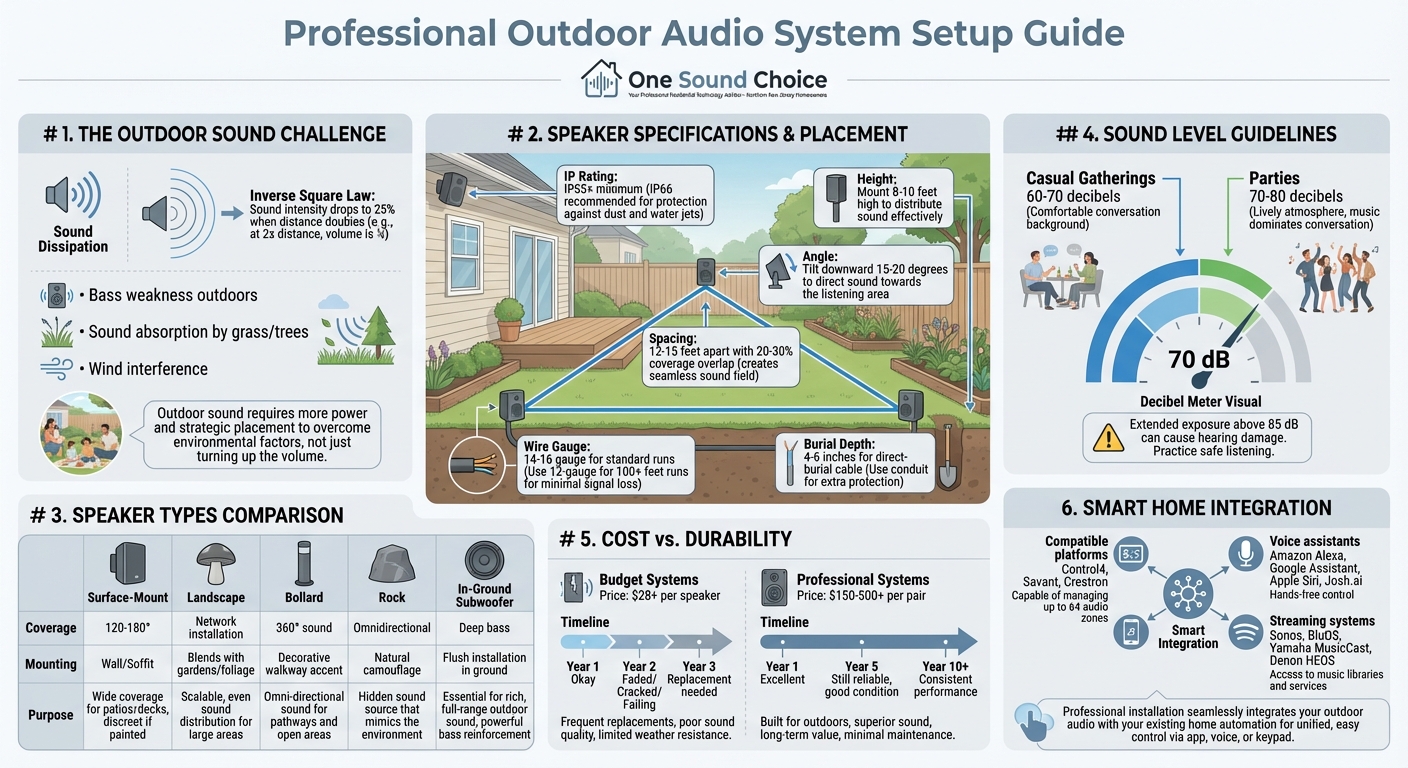
Professional Outdoor Audio System Setup Guide: Key Steps and Specifications
Why Outdoor Audio Needs a Different Approach
How Sound Works in Open Spaces
Sound behaves very differently outdoors compared to indoor spaces. Inside, sound waves bounce off walls, ceilings, and floors, creating what’s known as a "reverberant field", which naturally fills the room. Outdoors, however, there are no such reflective surfaces, leading to an "absorptive field" where sound dissipates into the open air. This fundamental difference has a major impact on how audio systems perform outside.
One key principle at play is the Inverse Square Law: as the distance from a sound source doubles, the sound intensity drops to just 25% of its original level [4]. For example, a speaker that sounds great at 10 feet may be barely audible at 20 feet.
Bass frequencies face additional challenges. Indoors, bass is amplified by walls and corners, but in open spaces, these frequencies often lose their impact, sounding weak or muddy [4][5]. High frequencies don’t fare much better, as grass, mulch, and trees tend to absorb them. Even wind can carry sound waves away from their intended target. Effective outdoor audio systems must address these challenges without simply cranking up the volume. Unfortunately, many budget systems fail to overcome these obstacles, as we’ll discuss next.
Problems with Low-Cost Outdoor Audio Systems
The outdoor environment can be unforgiving, and budget audio systems often fall short. In regions like Northern New Jersey, where weather conditions range from freezing winters to humid summers with temperatures over 90°F, low-cost systems are prone to failure. Many of these systems use enclosures made from materials that degrade under prolonged exposure to UV light, extreme temperatures, and moisture [2][1]. Over time, this leads to cracked housings, corroded connections, and distorted sound.
Wiring is another weak link in budget systems. Standard indoor speaker wire isn’t designed to withstand outdoor conditions, and exposure to soil minerals and moisture causes rapid deterioration. Without using direct-burial rated cables (at least 14- or 16-gauge), systems often suffer from intermittent connections or complete breakdowns [2][6].
Additionally, inexpensive setups typically rely on just one or two speakers placed far apart. This creates uneven sound coverage, with "hot spots" near the speakers and "dead zones" in between. Turning up the volume to compensate only makes the sound harsh and unbalanced.
How Professional Design Solves These Problems
In areas like Northern New Jersey, where weather extremes push equipment to its limits, professional outdoor audio systems offer a tailored solution. Instead of relying on a one-size-fits-all approach, these systems are designed specifically for the space. Rather than using one or two powerful speakers, professionals install multiple speakers spaced 12–15 feet apart, with their coverage areas overlapping by 20–30%. This ensures even sound distribution without creating overly loud spots.
"The problem isn’t the speaker quality. It’s that indoor speakers are designed to work in environments completely different from outdoors." – The Deck Expert [4]
Professional-grade equipment also stands up to the elements. Speakers with IP65 or IP66 ratings are sealed against dust and protected against strong water jets [2]. Their enclosures are made from UV-resistant plastics or rust-proof metals, allowing them to endure years of harsh weather. To protect the wiring, direct-burial cables are often run through conduit where exposed, shielding them from moisture, soil, landscaping tools, and even rodents. These precautions ensure reliable performance, even over long distances of up to 200 feet.
Speaker placement plays a crucial role as well. Mounting speakers 8–10 feet high and angling them downward by 15–20 degrees keeps the sound focused on the listening area rather than letting it dissipate upward. Placing speakers near walls or under eaves can also enhance sound quality by using subtle reflections to boost volume and bass. The result is clear, balanced audio that stays contained within your property, eliminating the need for excessive volume.
sbb-itb-c5b321b
Outdoor Audio Setup – How I Set Up My Pool Area (Multi-Zone, Network Controlled)
Selecting Outdoor Speakers for Your Property
Creating a professional outdoor audio system starts with choosing the right speakers. Achieving durable, balanced sound requires speakers that can handle the elements while delivering excellent performance. For families in Northern New Jersey, where weather can be unpredictable, this balance is especially important.
Types of Outdoor Speakers and Their Features
Outdoor speakers come in several designs, each suited to specific outdoor spaces and needs.
- Surface-mount speakers: These are mounted on walls, soffits, or eaves and provide directional sound within a 120–180-degree range. They’re a great option for patios and decks, offering focused audio near the house. Plus, they can be painted to blend with your home’s exterior.
- Landscape speakers: Designed to blend seamlessly into gardens or greenery, these speakers often look like small satellite lights. When installed as a network, they create even, immersive sound coverage across large areas without standing out visually [9][11].
- Bollard speakers: These deliver 360-degree sound and double as sleek, decorative accents for walkways or modern outdoor designs [9].
- Rock speakers: Mimicking natural stone, these speakers provide omnidirectional sound and are ideal for pool areas or rustic landscapes where you want the audio equipment to disappear into the scenery.
- In-ground subwoofers: These are buried flush with the ground, offering deep bass without visible hardware. They enhance the sound system’s overall depth without disrupting the landscape [9][11].
Factors to Consider When Choosing Outdoor Speakers
The best speaker for your outdoor space depends on how you plan to use the area and its layout. For patios or covered spaces close to the house, surface-mount speakers are a practical choice. Installed 8–10 feet high and angled downward, they keep sound focused. For larger yards or gardens, a mix of landscape or rock speakers distributed throughout ensures even sound coverage without overly loud "hot spots."
Durability is key for outdoor speakers in Northern New Jersey’s climate. Look for models with at least an IP65 rating to withstand rain, snow, and humidity – IP66 or higher is even better [7][2]. Professional-grade speakers often feature UV-resistant ABS or polypropylene enclosures with rust-proof aluminum or stainless steel grilles, ensuring they hold up over time [7][8].
Sound quality also depends on driver size. Larger drivers, such as 8-inch models, produce richer, deeper audio compared to smaller versions, which may require an additional subwoofer for bass support [8]. To ensure even sound distribution, follow the spacing rule: place speakers about 1 foot apart for every inch of the driver size. For example, 6-inch speakers should be spaced around 12 feet apart, covering a 6-foot radius each [8].
Why Professional-Grade Speakers Are Worth the Investment
While budget-friendly options may seem appealing, professional-grade outdoor speakers offer long-term reliability and superior performance. Entry-level weather-resistant speakers, often priced as low as $28, tend to fail after one or two seasons due to issues like corroded connections, sun-damaged components, and weakened enclosures [8][6]. In contrast, mid-range professional speakers typically cost between $150 and $500+ per pair, with full systems running into the thousands [8][2][10]. These systems are built to last, making them a smarter investment over time.
The difference lies in the materials and engineering. Professional speakers use high-quality components like mineral-filled polymer cones and anodized aluminum tweeters, which are designed to cut through outdoor noise. Meanwhile, budget models rely on cheaper materials that are prone to cracking or warping in extreme temperatures [8]. High-end systems also feature amplifiers with Digital Signal Processing (DSP), which optimizes sound for outdoor environments, prevents overdrive, and enhances overall performance [7].
"A thoughtfully installed outdoor audio system does more than play music; it crafts an atmosphere. It’s the invisible element that makes a beautiful space feel truly alive and inviting." – Kennedy Design + Build [2]
For reliability and sound quality, professionally installed wired systems set the standard. Unlike Wi-Fi or Bluetooth connections, which can be inconsistent over large outdoor spaces, wired systems deliver stable, high-fidelity audio. They not only provide years of dependable performance but also maintain your property’s visual appeal and may even boost resale value [2][6].
Planning Speaker Placement for Balanced Coverage
Once you’ve chosen the right speakers, their placement becomes the key to unlocking their full potential. The aim is to achieve consistent sound throughout your outdoor space – avoiding areas that are excessively loud near the speakers or silent "dead zones" where the audio fades away.
Evaluating Your Outdoor Space
Start by measuring each section of your outdoor area and identifying obstacles like trees, pergolas, or outdoor kitchens. Different zones, such as dining patios, pool areas, or garden seating, will require tailored coverage. For primary listening spots, arrange two speakers in an equilateral triangle with the main seating area to create a sense of depth and direction in the sound [2].
Position speakers to face toward your home. This helps contain the sound by using walls as natural barriers and minimizes spillover into neighboring areas [12]. Keep speakers 6–12 inches away from vertical surfaces to avoid distorted or "boomy" sound caused by reflections [5]. For casual gatherings, aim for sound levels around 60–70 decibels, while parties may require 70–80 decibels [5].
Common Speaker Placement Mistakes to Avoid
Relying on just two high-volume speakers for a large space often leads to uneven sound distribution. This setup creates overly loud areas near the speakers while leaving distant sections underpowered [2][5]. Instead, spread multiple speakers across the area to maintain balanced sound without overwhelming any single spot.
Avoid aiming speakers directly at hard surfaces like brick walls or glass windows, as these can cause echoes and distort the sound [2][5]. Similarly, placing stereo pairs too close together reduces the immersive qualities of the music by limiting depth and separation [5]. Use direct-burial rated 14- or 16-gauge wire – or 12-gauge for distances over 100 feet – and run it through PVC conduit to protect against interference and physical damage [2][12].
Next, a professional site survey can refine your placement strategy even further.
How a Professional Site Survey Helps
Bringing in a professional for a site survey ensures no detail is overlooked. Installers can identify ambient noise sources like pool pumps or nearby traffic, assess physical challenges such as hills or retaining walls, and recommend the best speaker locations before installation begins [12][1]. They also calculate the correct wire gauge for the distances involved and plan concealed wiring paths to maintain the visual appeal of your outdoor space [2][13].
A site survey usually includes post-installation tuning, where professionals use amplifier zone controls to balance volume levels across different areas. This ensures a smooth audio transition between spaces like your patio and garden [2][1]. For larger properties, they may suggest 70-volt systems, which accommodate long wire runs and multiple speakers from a single output. However, these systems require careful handling due to their higher voltage [13]. Proper planning during this phase avoids costly errors and guarantees balanced, high-quality sound from the start.
Connecting Outdoor Audio to Your Smart Home
Bringing outdoor audio into your smart home setup allows you to manage music, lighting, and more from a single, streamlined interface.
Smart Control for Different Audio Zones
Professional automation platforms like Control4, Savant, and Crestron enable seamless management of both indoor and outdoor audio zones [15][16]. With these systems, you can set different music or volume levels for specific areas – whether it’s the pool, patio, or garden – all from one interface [15][16]. These platforms support up to 64 distinct zones, giving you precise control over every part of your outdoor space [18].
Additionally, these systems integrate smoothly with popular voice assistants such as Amazon Alexa, Google Assistant, and Apple Siri, as well as privacy-oriented platforms like Josh.ai [15][16]. This flexibility makes it easy to manage your outdoor audio setup in a way that suits your preferences.
However, for everything to work smoothly, reliable connectivity is crucial, which is where Wi‑Fi and streaming solutions come into play.
Wi‑Fi and Streaming Solutions
A strong, stable connection is the backbone of any smart outdoor audio system.
Wi‑Fi is the preferred choice over Bluetooth for permanent outdoor setups [14]. It supports high-resolution audio, avoids common connection dropouts, and allows streaming to multiple zones at once. Systems like Sonos, BluOS (Bluesound Professional), Yamaha MusicCast, and Denon HEOS rely on Wi‑Fi to provide stable, whole-home integration [17]. For larger properties, Power over Ethernet (PoE) speakers offer a practical solution, as a single Cat5e or Cat6 cable can deliver both power and data [18]. To ensure smooth operation, it’s essential to have a robust Wi‑Fi network with strategically placed outdoor access points [14].
This level of connectivity enhances the overall experience, making your outdoor audio system a seamless extension of your smart home.
Coordinating Audio with Other Outdoor Systems
Your outdoor audio system becomes even more effective when integrated with other smart technologies.
For example, you can program "scenes" where music and smart lighting – like Lutron systems – work together to create the perfect ambiance for evening gatherings [15][19]. Outdoor audio can also connect with security systems, using motion sensors or cameras to trigger audio alerts or deterrent sounds when activity is detected. Some advanced systems even use artificial intelligence to adjust sound settings based on environmental factors like background noise or wind, ensuring consistent audio quality as conditions change [14]. Additionally, newer features allow systems to automatically lower volume at specific times, such as midnight, to comply with local noise regulations [14].
Integrating audio with other outdoor systems not only enhances convenience but also adds an extra layer of functionality to your smart home setup.
Building Outdoor Audio Systems That Last
Northern New Jersey’s tough climate puts outdoor audio equipment to the test. From freezing winters to humid summers, your speakers need to be ready to endure it all.
Weatherproof Materials and Construction
Durable materials are key to keeping your outdoor audio system running smoothly year-round. Look for speakers with an IP65 or higher rating – IP66 is even better for a system you can install and forget about [2]. These ratings ensure the speakers are both dust-tight and capable of withstanding powerful water jets from any angle.
"For a true ‘set it and forget it’ system, look for speakers with an IP66 rating or higher. This ensures your investment is protected year-round, delivering flawless performance no matter the season." – Kennedy Design + Build [2]
Top-tier outdoor speakers often feature fiberglass-reinforced ABS or aluminum diecast enclosures, which can handle extreme temperatures and moisture [13]. Rust-proof grills and UV-resistant parts are also essential since prolonged exposure to sunlight can degrade rubber surrounds and cones [6]. If your property is near the shore, choose speakers specifically designed to resist salty air, which can quickly corrode internal components [1].
Protecting Wiring and Connections
Even with the best speakers, poor wiring can compromise your system. Standard indoor speaker wire won’t cut it outdoors – you’ll need direct-burial rated wire (14- or 16-gauge) that’s built to withstand moisture, soil chemicals, and freeze-thaw cycles [2][6].
To safeguard the wiring, run it through PVC piping or outdoor conduit. This protects it from landscapers, rodents, and other potential hazards [6]. When burying direct-burial cable, dig a shallow trench about 4 to 6 inches deep along garden beds or walkways, using conduit for added protection against erosion and landscaping equipment [2][6][13]. If you’re drilling through exterior walls, drill from the inside out at a slight downward angle, and seal both sides with outdoor-grade silicone caulk to prevent water infiltration [2].
For connections, use silicone-filled wire nuts to keep moisture out and prevent corrosion of the copper [13]. With proper wiring in place, routine maintenance becomes essential to keep the system performing well over time.
Maintenance and Warranty Protection
Outdoor audio systems are built to require minimal upkeep, but regular maintenance checks are still important for long-term reliability. Professional inspections can help identify and address any issues caused by weather exposure [20][21].
Choose equipment with strong warranties to protect against weather-related damage [3]. In Northern New Jersey, where winters can be harsh and summers humid, seasonal inspections can catch potential problems early, preventing costly repairs or replacements [3].
While high-quality speakers are designed to withstand year-round use, some homeowners prefer to store them indoors during the harshest winter months. This can help extend their lifespan and maintain sound quality [6][13]. If you do remove your speakers, be sure to cap the exposed wire ends to avoid corrosion.
For peace of mind, consider working with local Northern New Jersey professionals for installation and ongoing support. Their expertise ensures your outdoor audio system remains a dependable part of your home for years to come [1].
Conclusion
Outdoor audio systems come with their own set of challenges, from ensuring consistent sound coverage to weatherproofing against the elements. Achieving a high-quality setup requires expertise, professional-grade equipment, and careful planning. While portable speakers or DIY solutions may seem like a quick fix, they often fail to deliver the balanced sound, durability, and seamless integration that a professionally designed system can provide. When done correctly, outdoor audio blends effortlessly into your environment, enhancing both the atmosphere and the overall appeal of your space.
A well-planned outdoor audio system doesn’t just improve your listening experience – it adds real value to your Northern New Jersey home. It extends your living space, boosts curb appeal, and creates a private oasis where you can enjoy music while reducing ambient noise and keeping sound contained within your property. This thoughtful design ensures you can enjoy your system without disturbing your neighbors. As Parker Landscape Design aptly notes:
"Your backyard should be an extension of your home – where entertainment, relaxation, and high-quality sound come together effortlessly."
By opting for professional installation tailored to Northern New Jersey’s demanding weather conditions, you can count on features like weatherproof materials, hidden wiring, and smart-home compatibility. These elements ensure your system remains reliable year-round while offering the convenience of smartphone control.
Looking to elevate your outdoor space? Reach out to Northern New Jersey experts who can assess your property, recommend durable equipment, and craft a custom solution that fits your lifestyle perfectly.
What One Sound Choice clients say
(We received) friendly, highly competent, quick and clean installation by 1 Sound Choice. The team followed up a few weeks after completion to ask if we were satisfied with our Media Room and Home Audio System. 1 Sound Choice is truly “top shelf” – they surpassed our expectations every step of the way.
– Mr. & Mrs. Blake (1 Sound Choice client testimonials)
Ryan listened to us – he understood what we wanted to accomplish. (The 1 Sound Choice team’s) commitment to post-installation support and service has been unbelievable. They are professionals in every aspect and have gained our trust throughout the completion of our project.
– Mr. & Mrs. Maytin (1 Sound Choice client testimonials)
I hired 1 Sound Choice to do a surround sound system in my living room and multi-room audio in 5 other rooms in my house,I asked Ryan to make it simple for my wife and I to use and we didnt want to see any wires or equiptment.Ryan ( the owner of 1 Sound Choice) presented me with a awesome solution for what I asked for at a price point that was right in range of my budget.The project was done faster then estimated and the workmanship of Ryan and his crew was above and beyond what I expected, They worked clean and were very personable, I would HIGHLY reccomend everyone to use 1 Sound Choice for all A/V installations. I will definately be using them again!
– kgrecco75 (Houzz review)
FAQs
How many outdoor speakers do I actually need for my yard?
The number of outdoor speakers you’ll need depends on the size of your yard and how much sound coverage you’re aiming for. For smaller spaces, like a patio, a single pair of speakers spaced roughly 10 feet apart should do the trick. If you’re working with a larger area, you might need multiple zones with additional speakers to ensure the sound is distributed evenly.
A helpful guideline is to place speakers between 10 and 25 feet apart. This spacing avoids gaps in coverage and prevents overly loud "hot zones." Using more speakers at a lower volume is a smart way to achieve balanced, consistent sound throughout the space.
What’s the simplest way to keep outdoor music from bothering neighbors?
To keep outdoor music enjoyable for you while minimizing disturbance to your neighbors, consider smart speaker placement and ways to contain the sound. Opt for omnidirectional speakers, which spread sound evenly across your yard, and ensure they are directed away from property boundaries. Incorporating sound-absorbing features like hedges, fences, or other landscaping elements can also help reduce noise spillover. These steps allow you to maintain a pleasant outdoor ambiance without causing disruptions.
Do I need a separate subwoofer to get good bass outside?
You don’t always need a separate subwoofer to enjoy decent bass outdoors, but including one can significantly improve the depth and impact of low frequencies. While many outdoor speakers are capable of delivering satisfactory bass, a dedicated subwoofer is perfect for achieving a fuller, more immersive sound – especially in larger areas or for premium audio setups. Designed to endure harsh weather conditions, outdoor subwoofers offer reliable performance and long-lasting durability.
Related Blog Posts
- Outdoor Entertainment Setup: 8 Ideas for Your Backyard
- Multi-Zone Audio: Wired vs. Wireless
- How to create a outdoor oasis with audio and video.
- Why use McIntosh amps instead of Sonos? (Hint sound quality and brute strength)
Does your music cut out in the yard too? See our why Sonos cuts out outside page.
More questions
Why does turning it up make outdoor music sound worse?
Sound fades fast outside. When you crank 1 or 2 speakers, they distort. More speakers at a lower volume sound clear and even.
One Sound Choice, 8 Tilley Ave, Pompton Plains, NJ 07444. Call or text (973) 945-5275. We work in homes across Morris, Passaic, Bergen, Essex, Somerset, and Hunterdon counties. Written by Ryan Herd, founder of One Sound Choice.