
Looking for premium sound in your home audio setup? Choosing between McIntosh amplifiers and Sonos systems boils down to what you value: unmatched power and sound quality or wireless convenience. McIntosh amps, built with precision since 1949, offer high-resolution audio, immense power (up to 2,000 watts per channel), and durability for decades of use. Sonos, on the other hand, provides simplicity and ease of use but lacks the performance needed for audiophile-grade setups or larger spaces.
Key Differences:
- Sound Quality: McIntosh supports 24-bit/192kHz high-resolution audio, while Sonos is limited to CD-quality (16-bit/44.1kHz).
- Power Output: McIntosh amps deliver up to 2,000 watts per channel; Sonos Amp maxes out at 125 watts.
- Longevity: McIntosh amps are built for decades, with replaceable parts and advanced protection. Sonos systems are designed for shorter lifecycles.
For those prioritizing performance, durability, and long-term value, McIntosh amplifiers are the clear choice. If convenience and multi-room streaming are your focus, Sonos may suffice for smaller setups.
Is this the Best Home Theater Combo? Mcintosh Mx123 And Mc257 Review: Ultimate Preamp And Amplifier
McIntosh Amplifiers: Professional-Grade Audio Performance
McIntosh amplifiers bring a refined, professional approach to home audio systems. Since its founding in 1949, the company has dedicated over 75 years to perfecting amplifier technology, catering to serious listeners who value both power and accuracy. These amplifiers are not meant to be tucked away – they are designed to serve as lasting, high-performance components that meet professional standards.
Core Features of McIntosh Amplifiers
McIntosh amplifiers come with a price tag that matches their high-end specifications. Power output across the lineup ranges from 75 watts to an impressive 2,000 watts per channel. The flagship MC2.1KW, for instance, delivers a staggering 2,000 watts through a tri-chassis design [1][12]. However, sheer power is only part of the story. Many models boast Total Harmonic Distortion (THD) levels between 0.05% and 0.005% – low enough to be virtually undetectable – along with a Signal-to-Noise Ratio (SNR) of 113 dB on power amplifier inputs [5][10].
One standout feature is McIntosh’s Output Autoformer™, which ensures consistent power delivery regardless of speaker impedance. This innovation prevents strain or damage to the amplifier and gives users the flexibility to pair it with a wide range of speakers [3][10].
The build quality reinforces McIntosh’s professional-grade reputation. For example, the MA7200 weighs a hefty 75 pounds, with a steel chassis, black glass front panels, and the brand’s signature blue VU meters [10]. Mechanical switches are replaced with electromagnetic ones, which are more durable over time [3]. Additional protective features include Power Guard®, which monitors input and output signals to prevent speaker-damaging clipping, and Sentry Monitor™, a fuse-free short-circuit protection system that resets itself automatically [1][3]. These features make McIntosh amplifiers an excellent fit for high-end smart home systems, ensuring reliability without sacrificing performance.
"Blending together the brand’s modern take on traditional analogue approaches with a healthy dose of digital inputs plus a top flight phono stage, headphone amp and battleship build quality." – Audiograde [10]
Built for Audiophiles and Professionals
McIntosh amplifiers are designed with both audiophiles and professionals in mind, emphasizing reliability and sound integrity. The company backs its products with a 3-year U.S. warranty [5], but many units remain in use for decades. This longevity is supported by the Power Assurance System, a suite of patented circuits that protect against common amplifier issues [1][3]. Durable Cinch™ binding posts ensure high-quality connections that stand the test of time [1][4].
For larger installations, the MI series offers rack-mountable solutions with bussable inputs, ideal for distributed audio systems. The MI128, for example, delivers 120 watts per channel across eight channels, making it perfect for whole-home setups [1]. When paired with the CR106 preamplifier, which can manage up to 30 zones via Dante networking, these systems transform your home audio into a professional-grade infrastructure [2]. These setups typically require expert installation, reinforcing their role as a permanent investment rather than a disposable gadget.
McIntosh amplifiers also support high-resolution audio formats, including DSD512 and 24-bit/192kHz playback, through modules like the DA2 [4][10]. This ensures that every detail of your music library is preserved. Additionally, McIntosh products consistently hold some of the highest resale values in the audio market [11], underscoring their reputation as enduring investments rather than short-lived consumer electronics.
Sonos Systems: Wireless Convenience Over Power

Sonos has carved out a niche by prioritizing wireless simplicity over sheer audio power. Known for making multi-room audio setups straightforward, Sonos systems connect through a dedicated app, eliminating the need for cables running through your home. With features such as Trueplay self-tuning, which adjusts sound to your room’s acoustics, and HDMI ARC integration for direct TV connections, Sonos offers a streamlined experience for users [6][8]. The system’s "always-on" functionality ensures speakers are ready to use instantly with Spotify or other streaming apps, without requiring manual pairing.
Core Features of Sonos Systems
The hallmark of the Sonos ecosystem is its ease of use. The app simplifies tasks such as grouping speakers, adjusting settings, and accessing room correction tools. It also supports major streaming platforms like Spotify Connect and AirPlay 2 [6][8]. The Sonos Amp, a key component of the lineup, delivers 125 watts per channel into 8-ohm speakers [8].
"No one does multi-room audio better than Sonos." – Michael Brown, Executive Editor, TechHive [8]
Sonos speakers are designed to blend seamlessly into home environments. Their minimalist aesthetic ensures they don’t draw attention, making them ideal for those seeking discreet background music. However, while the system excels in convenience and design, it doesn’t cater to audiophiles seeking top-tier sound quality.
Where Sonos Falls Short for High-End Audio
Sonos systems focus on streaming convenience rather than delivering high-fidelity audio. They generally don’t support advanced formats like 24-bit/192kHz playback, a feature that brands like McIntosh offer natively [8][13]. While the Sonos Amp’s 125 watts per channel may suffice for casual listening, it struggles to power demanding speakers or fill larger spaces effectively.
In comparison, McIntosh systems provide significantly more power and support for high-resolution audio. For instance, the RS150 wireless speaker handles 24-bit/192kHz files and Tidal HiFi Lossless at 1,411 Kbps [13], while the RS250 delivers an impressive 650 watts [9]. Sonos simply doesn’t have the power or audio fidelity needed for professional-grade installations or serious audiophile listening.
For complex multi-room setups, the gap becomes even more apparent. Sonos relies on its proprietary app, while McIntosh’s CR106 audio matrix can manage up to 30 independent zones through Dante networking. This $5,500 solution is designed for permanent, high-performance installations rather than consumer-focused convenience [2]. For those prioritizing premium, long-term audio solutions, McIntosh remains the better choice.
sbb-itb-c5b321b
McIntosh vs. Sonos: Direct Comparison
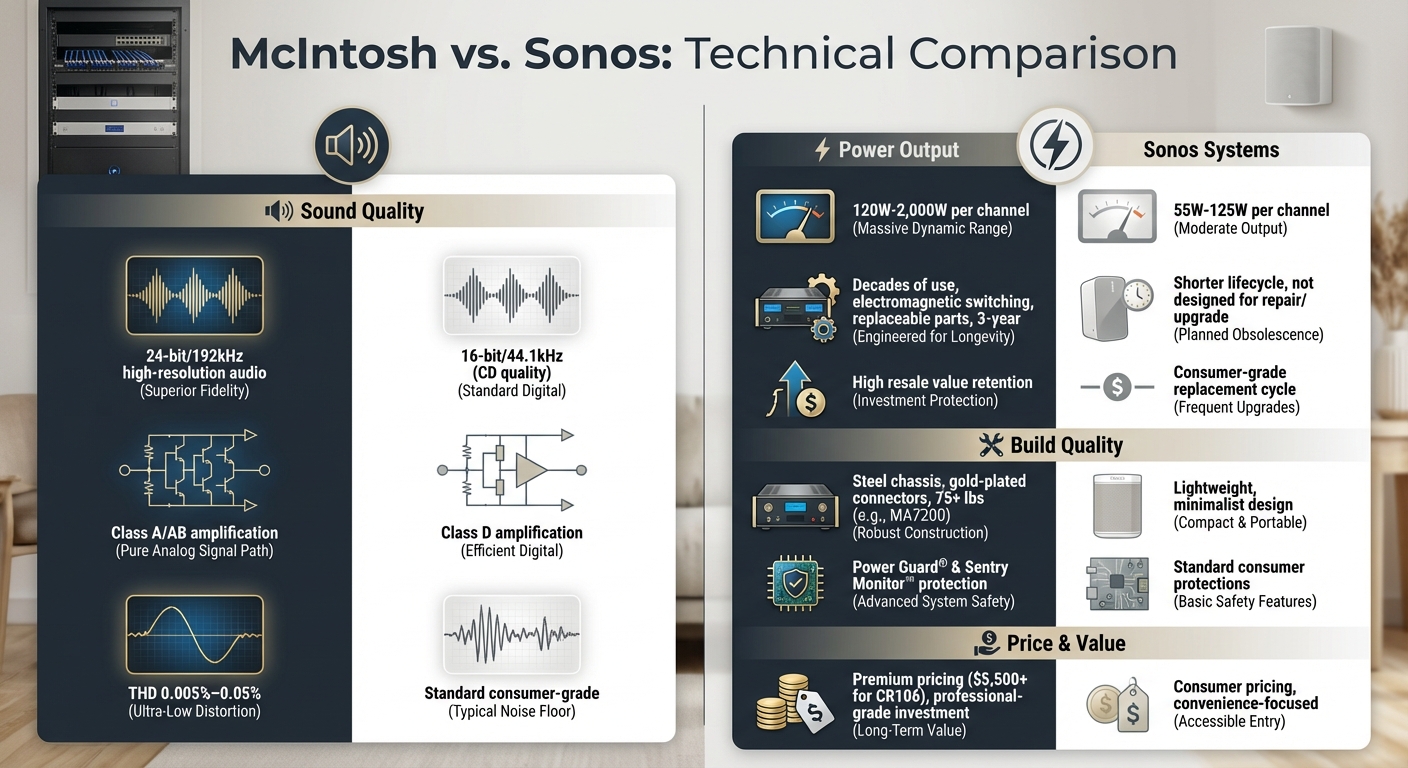
McIntosh vs Sonos Amplifiers: Technical Specifications Comparison
For those planning a long-term investment in high-quality smart home audio, understanding the technical differences between these systems is essential.
Sound Quality: High-Resolution vs. Streaming-Grade
McIntosh amplifiers are designed to support 24-bit/192kHz audio, enabling playback of high-resolution tracks from services like Tidal HiFi and through advanced USB connections [17][3]. This capability preserves the nuances and dynamic range of studio-quality recordings, offering a level of detail that compressed formats simply can’t match. On the other hand, Sonos systems are capped at 16-bit/44.1kHz, which is essentially CD quality. While sufficient for casual listening, this limitation may disappoint those seeking the depth and clarity prized by audiophiles [17].
The performance gap isn’t just theoretical. McIntosh employs Quad Differential circuitry, which minimizes noise and distortion while delivering high power output [3]. Their proprietary Autoformer technology ensures consistent power delivery regardless of speaker impedance – something consumer-grade systems like Sonos lack. While Sonos uses efficient Class D amplification, McIntosh’s Class A/AB designs produce a richer, warmer sound [16][18].
| Feature | McIntosh Amplifiers | Sonos Systems |
|---|---|---|
| Max Audio Resolution | 24-bit/192kHz [17] | 16-bit/44.1kHz [17] |
| Amplifier Class | Class A or AB [16] | Class D [18] |
| Dynamic Range | Wide and detailed [3] | Moderate |
Next, let’s look at power output and speaker compatibility to further understand these differences.
Power Output and Speaker Capability
McIntosh amplifiers deliver at least 120 watts per channel [17]. For instance, the RS150 wireless speaker provides 120 watts divided between its tweeter and woofer [17]. In larger setups, the CR106 controller can manage up to 30 independent zones when paired with additional units [2], making McIntosh a strong option for expansive homes or professional installations requiring consistent, powerful sound.
In contrast, Sonos systems offer lower power output. Older models like the Connect:Amp provide around 55 watts per channel, while the newer Sonos Amp reaches 125 watts with 8-ohm speakers [18][8]. While sufficient for smaller spaces or casual use, these systems may struggle to power demanding speakers or fill larger rooms with sound. Additionally, Sonos’ multi-zone capabilities are more limited compared to McIntosh’s enterprise-grade networking options.
| Feature | McIntosh | Sonos |
|---|---|---|
| Power Output (per channel) | 120W+ [17] | 55W–125W [18][8] |
| Multi-Zone Support | Up to 30 zones [2] | Limited |
These power and compatibility factors naturally lead to a discussion about durability and longevity.
Durability and Lifespan
McIntosh amplifiers are crafted with longevity in mind. The use of electromagnetic switching instead of mechanical parts prevents wear, while features like Power Guard® and Sentry Monitor™ protect components from issues like clipping, distortion, and short circuits [3][7]. Materials such as polished stainless steel, black-painted steel, and gold-plated solid brass connectors further enhance durability by resisting corrosion [7].
"A huge percentage of all the McIntosh stuff ever made is still working and you begin to appreciate why when you spend time with the MSA5500."
– Ed Selley, AVForums Reviewer [14]
In contrast, Sonos systems are built for shorter lifecycles. They are not designed to be repaired or upgraded, often requiring replacement when they fail or become outdated [3][15]. For those viewing audio equipment as a long-term investment, McIntosh’s serviceable construction and reputation for durability make it an obvious choice.
Professional Integration for Smart Home Audio
The Importance of Professional Installation
McIntosh amplifiers are built for sophisticated home audio systems, and their installation demands a professional touch. These devices are designed for advanced setups, requiring precise rack mounting, control programming, and multi-zone audio integration.
Professional installers play a critical role in ensuring McIntosh amplifiers are paired correctly with speakers, tuned for room acoustics, and seamlessly integrated into smart home systems. This process isn’t just about plugging in equipment – it’s about optimizing sound quality and ensuring reliability. Mistakes like improper impedance matching, poor power management, or inefficient signal routing can compromise even the finest audio equipment. By working with experts who specialize in residential technology, homeowners can protect their investment and enjoy consistent, top-tier performance.
"McIntosh dealers are the first line resource to solve technical issues and provide any needed service. Dealers and installers are rigorously trained and supported by McIntosh factory technical support personnel." – McIntosh Laboratory [3]
Professional installation also addresses critical technical needs, such as power protection and control integration. McIntosh systems often require advanced power controllers that deliver AC surge protection, EMI filtering, and programmable voltage safeguards [19]. Many models include RS232 and Power Control ports, enabling smart home processors to send commands – for example, automatically powering on the system when an audio signal is detected [20][1].
This level of integration not only enhances the system’s performance but also ensures that McIntosh equipment serves as a durable and dependable foundation for home audio.
How McIntosh Fits Professional Smart Home Systems
McIntosh’s dedication to premium audio solutions is evident in its product lines tailored for professional smart home integration. Models like the MHT300 and MX200 are certified to "Connect with Control4" and "Works with Crestron Home" [19]. These amplifiers are designed to fit neatly into standard racks, with their 2U or 3U chassis making them ideal for high-end installations [1].
For distributed audio, McIntosh offers the CR106 audio matrix, which functions as a central hub, enabling up to six independent zones from a single unit [2]. For larger homes, installers can link up to five CR106 units using Dante® networking, creating a system capable of managing up to 30 two-channel zones [2]. This scalability sets professional installations apart from consumer-grade wireless systems, offering a unified solution that can serve an entire home with precision and reliability.
The CR106 is priced at $5,500, with availability projected for August 2025 [2]. While this represents a considerable investment compared to consumer options, it reflects the system’s advanced capabilities. Features like custom audio settings for each zone, wired connections for stability, and support for high-resolution sources, such as moving magnet phono stages, make it a compelling choice [2]. For homeowners seeking a long-term, high-performance audio infrastructure, this professional-grade solution delivers both practical benefits and lasting value.
Conclusion: Why McIntosh Is the Better Choice
Main Advantages of McIntosh Amplifiers
McIntosh amplifiers stand out for their exceptional sound quality, impressive power, and long-lasting reliability – qualities that set them apart from systems like Sonos. With support for high-resolution formats up to 24-bit/192kHz and DSD512, McIntosh amplifiers deliver an audio experience far beyond the capabilities of standard streaming systems [6][4]. Their exclusive drive technology creates a sound that is both powerful and warm, maintaining a balanced audio profile [3][4]. Additionally, advanced protection systems shield the equipment from issues like clipping and short circuits, ensuring years of dependable performance [3][20].
Durability is another key strength. McIntosh employs electromagnetic switching, which avoids the wear and tear associated with traditional mechanical switches. The modular design, such as the DA2 Digital Audio Module, allows users to upgrade specific components without replacing the entire system [3][5]. Furthermore, with Total Harmonic Distortion ranging between 0.05% and 0.005%, McIntosh amplifiers deliver crystal-clear sound even at high volumes, free from noticeable distortion [5]. These features make McIntosh amplifiers not just a short-term purchase but a long-term investment in premium home audio.
Treating Home Audio as Long-Term Infrastructure
McIntosh amplifiers are designed with the philosophy of being a lifelong addition to your home audio setup. Their design supports long-term use, with features like Home Theater PassThru enabling seamless integration into multi-channel systems as your needs expand [20][1].
"If you invest in a powerful amplifier, you can enjoy its supplied power and sound output for life." – McIntosh Laboratory [5]
McIntosh also excels in adaptability, offering professional integration options like rack mounting, Dante networking for up to 30 zones, and compatibility with smart home processors. These capabilities make McIntosh amplifiers a flexible foundation that can grow with your home and audio system over time. When selecting your first amplifier, it’s wise to invest in as much power as your budget allows, as this ensures future flexibility for larger speakers or bigger spaces [5]. Combined with McIntosh’s extensive network of trained dealers who provide long-term support, this approach ensures your investment remains valuable for decades to come [3].
What One Sound Choice clients say
1 Sound Choice installed a flat screen TV for us along with surround sound. We could not be happier with the professionalism we received. They were within budget and time — no surprises. We would highly recommend 1 Sound Choice.
– The Baron Family (1 Sound Choice client testimonials)
We were surprised with what (Ryan) took away from the conversation – even reading between the lines to put everything we wanted and needed right into his designs for us. At first, we really didn’t know who to go with; we hadn’t had any renovations to our home before. We set up a consultation and liked (Ryan) because he was personable, a good listener and knowledgeable. He asked about our wish list and gave us some ideas…which were great.
– Mr. & Mrs. Caywood (1 Sound Choice client testimonials)
I hired 1 Sound Choice to do a surround sound system in my living room and multi-room audio in 5 other rooms in my house,I asked Ryan to make it simple for my wife and I to use and we didnt want to see any wires or equiptment.Ryan ( the owner of 1 Sound Choice) presented me with a awesome solution for what I asked for at a price point that was right in range of my budget.The project was done faster then estimated and the workmanship of Ryan and his crew was above and beyond what I expected, They worked clean and were very personable, I would HIGHLY reccomend everyone to use 1 Sound Choice for all A/V installations. I will definately be using them again!
– kgrecco75 (Houzz review)
FAQs
Will I actually hear a difference with high-resolution audio?
High-resolution audio, when paired with premium equipment like McIntosh amplifiers, offers an elevated listening experience. These amplifiers are crafted to reproduce sound with outstanding clarity and detail, allowing the nuances of high-resolution audio to stand out more distinctly compared to what standard systems can deliver.
How much amplifier power do I really need for my home?
When deciding on the right amplifier power, it’s essential to consider your speakers’ specifications and the volume level you aim to achieve. Look for an amplifier with continuous power, also known as RMS, that matches or slightly surpasses the recommended wattage of your speakers. This ensures optimal performance while minimizing the risk of damage. Having a bit more power than your speakers can handle is often beneficial, as it helps reduce distortion and enhances overall sound quality.
Do I need professional installation for a McIntosh system?
Professional installation is strongly advised for a McIntosh system. This ensures the setup is done correctly, allowing the system to perform at its best. A proper installation not only enhances performance but also supports long-term reliability.
Related Blog Posts
- High-Res Audio Streaming: What Families Need to Know
- Multi-Zone Audio: Wired vs. Wireless
- How to create a outdoor oasis with audio and video.
- What is the best streaming service for outdoor music?
Curious how McIntosh would sound in your home? See our McIntosh home audio page.
More questions
Can I use McIntosh and Sonos together?
Many homes do. Sonos is handy for streaming, and a McIntosh amp can power the main speakers for better sound.
One Sound Choice, 8 Tilley Ave, Pompton Plains, NJ 07444. Call or text (973) 945-5275. We work in homes across Morris, Passaic, Bergen, Essex, Somerset, and Hunterdon counties. Written by Ryan Herd, founder of One Sound Choice.