
Smart home technology can help reduce energy bills, but the extent of savings depends on how it’s used and your previous energy habits. While manufacturers often claim savings of 20–30%, studies suggest more realistic reductions of 10–12% for heating and 15% for cooling. For homeowners in Northern New Jersey, where seasonal energy costs are high, technologies like smart thermostats, energy monitoring systems, and automated lighting/shades can make a noticeable difference.
Key insights:
- Smart thermostats: Save $131–$145 annually by automating temperature adjustments and optimizing HVAC efficiency. Professional installation ensures proper setup and maximizes savings.
- Energy monitoring systems: Identify waste, track appliance usage, and provide maintenance alerts, reducing bills by $130–$200 yearly.
- Automated lighting and shades: Cut daily energy use by 5–8% and cooling costs by 17.5% during summer by managing lighting and solar heat gain.
Professional integration is often more reliable than DIY setups, ensuring systems function efficiently and avoid common pitfalls like poor thermostat placement or misconfigured settings. While upfront costs for professional installation can range from $200 to $1,200+, these systems typically pay for themselves within 12–24 months through energy savings and utility rebates. Additionally, professionally installed systems can increase home value by 3–5%, making them a smart long-term investment.
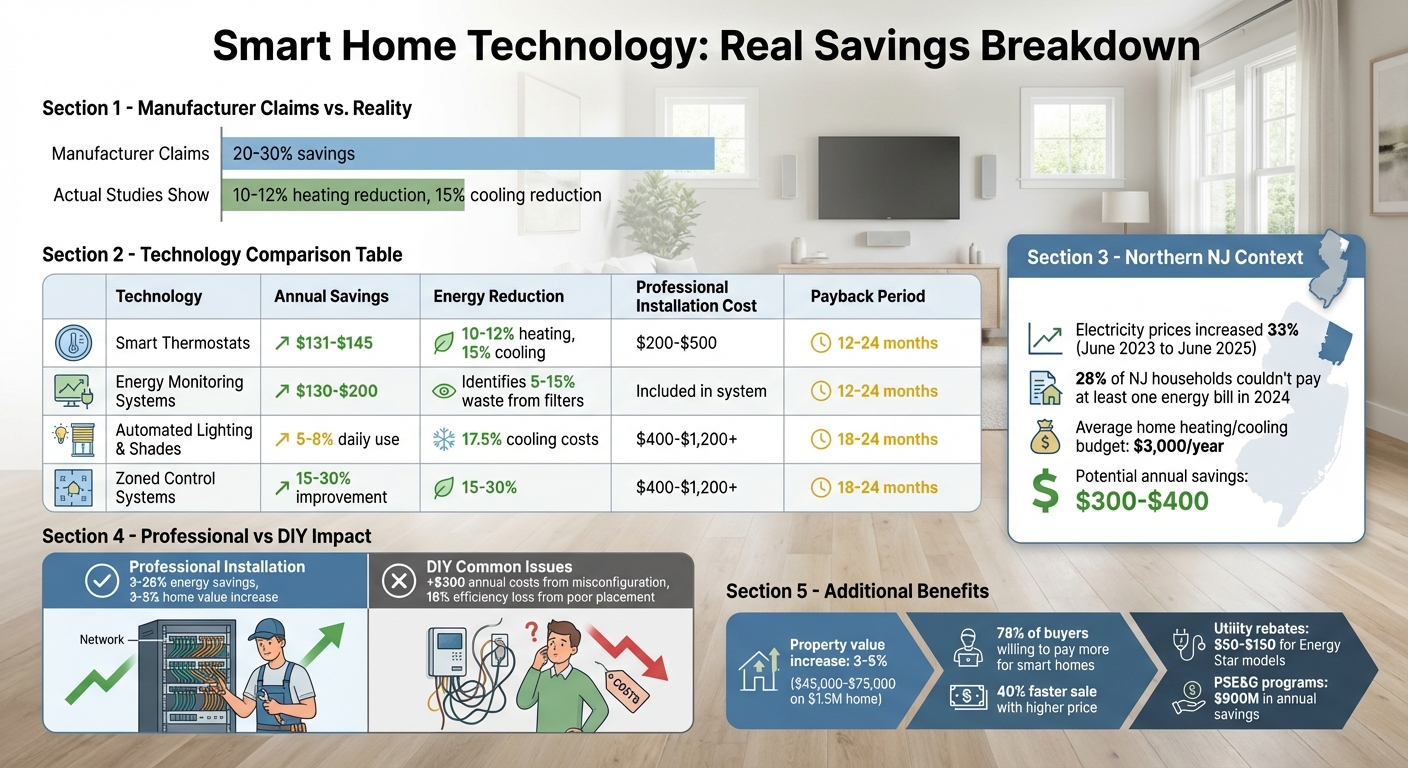
Smart Home Technology Energy Savings and ROI Comparison
Energy Bill Challenges in Northern New Jersey
Seasonal Energy Demands and High Costs
To grasp the importance of smart technologies, it’s essential to first understand the energy challenges faced by homeowners in Northern New Jersey. Seasonal shifts play a major role in driving up utility bills. Winter heating and summer cooling requirements often lead to sharp spikes in energy use, putting significant strain on household budgets. This issue has grown more severe in recent years. Between June 2023 and June 2025, residential electricity prices in New Jersey surged by 33% [5].
"The average residential electricity price in the state climbed by a third from June 2023 to June 2025, driven largely by increased demand and regional delays in building new capacity." – ACEEE [5]
The financial burden is evident. In 2024, 28% of New Jersey households reported being unable to pay at least one energy bill in full over the previous year. This figure surpasses the national average of 23% [5]. Contributing factors include rising demand from data centers and delays in expanding power infrastructure, both of which continue to drive costs higher [5]. These realities emphasize the urgent need for solutions that can minimize energy waste and ease financial strain.
Common Sources of Energy Waste in Homes
High energy costs are compounded by inefficiencies that are often preventable. In many Northern New Jersey homes, HVAC systems run unnecessarily during times when no one is home, wasting energy. Misconfigured heat pumps can activate auxiliary electric strip heat during cold weather, significantly increasing electricity use [2]. Additionally, poor insulation and the lightweight construction of wood-frame homes lead to rapid temperature changes, forcing HVAC systems to cycle more frequently than needed [2]. Thermostats placed in problematic locations, such as on exterior walls or near windows, can cause short-cycling, which wastes energy and disrupts comfort [2].
Another common issue is "vampire power", where unused electronics continue to draw electricity even when turned off, adding to overall consumption [3]. Addressing these inefficiencies is a critical first step in making the most of smart home technologies. By tackling these areas of waste, homeowners can better position themselves to benefit from energy-saving solutions and reduce their utility bills effectively.
sbb-itb-c5b321b
Smart Home Technologies That Actually Lower Electric Bills
Smart Thermostats: Optimizing HVAC Efficiency
Smart thermostats help reduce energy costs by learning your household’s daily habits and adjusting temperature settings accordingly [6][7]. These devices go beyond simple programming. For instance, geofencing technology uses your smartphone’s GPS to detect when everyone has left a specified area (typically 1–2 miles from your home). When this happens, the thermostat automatically switches to an energy-saving mode. As someone approaches home, it begins adjusting the temperature to ensure comfort upon arrival [6][7].
In larger homes, like those in Northern New Jersey, distributed sensors take efficiency a step further by managing temperatures based on actual room occupancy [1][7]. These thermostats also incorporate local weather data to make smarter adjustments – such as pre-cooling before a heatwave or delaying heating when natural sunlight can warm the home [6][7].
The financial impact is notable. Homeowners can save between $131 and $145 annually [1][2], and high-end models can cut cooling costs by as much as 26% in specific scenarios [1][7]. Additionally, these systems reduce wear and tear on HVAC units by minimizing system cycling, potentially extending the unit’s lifespan by 2–3 years [6].
"If you leave for work at 8 a.m., our smart thermostats can proactively lower the temperature while you are away to conserve energy and preheat or precool your home to ensure that your house is at your desired temperature when you return."
– Greg Fyke, President and CEO, Ecobee [1]
Professional installation is often recommended to ensure proper functionality, especially in older homes that may require a stable C-wire connection. Installing such a connection can cost between $120 and $180, particularly if it involves running wires through finished walls [2]. For homes with heat pumps, professional configuration of the "Heat Pump Balance" to "Max Savings" mode can help delay the activation of costly auxiliary heating [2]. Many utilities in New Jersey also offer rebates between $50 and $150 for Energy Star-certified models, making these systems an even smarter investment. Most homeowners see a full return on investment within 12 to 24 months [6][7].
To complement these thermostats, energy monitoring systems provide deeper insights into where energy is being used – and wasted.
Energy Monitoring Systems: Identifying and Reducing Waste
Energy monitoring systems are designed to pinpoint inefficiencies in your home’s energy use. These devices track real-time consumption across major appliances and systems, presenting data in daily, weekly, or monthly reports [7]. The information they provide is actionable, helping homeowners make simple adjustments. For example, raising the cooling temperature by just 1°F could save around $8 per month [7].
Another benefit is the maintenance alerts these systems provide. By tracking runtime hours, they notify you when maintenance is due or when abnormal usage patterns occur. For instance, a dirty HVAC filter can reduce efficiency by 5–15%, but a timely alert ensures it gets replaced before it impacts your energy bill [7]. Additionally, smart recovery technology calculates the best start times for heating or cooling, trimming system runtime by 15–20 minutes per cycle [6].
When paired with other smart systems, energy monitors amplify their impact. For example, coordinating with automated shades to close them during peak sunlight hours can cut cooling loads by 15–20% [7]. In larger homes with multiple zones, professional installation ensures sensors are placed correctly, avoiding inaccurate readings that can occur with DIY setups [2][4]. Studies show households using energy monitoring systems can save between $130 and $200 annually [6].
Automated Lighting and Shades: Reducing Daily Consumption
Smart lighting and shading systems contribute to energy savings by ensuring power is only used when necessary. Occupancy and motion sensors automatically turn off lights in empty rooms, while preset "scenes" like "Goodnight" or "Away" power down unnecessary devices when the house is unoccupied. These features can reduce daily energy use by 5–8% [6].
Automated shades further boost efficiency by managing solar heat gain. In Northern New Jersey’s summer months, closing shades on south- and west-facing windows during peak sunlight hours prevents excess heat from entering the home, reducing the workload on your air conditioner. Research shows this strategy can lower cooling energy use by an average of 17.5% [2]. In particularly hot and dry climates, more aggressive cooling adjustments can yield energy savings of up to 28% [2].
Geofencing technology adds another layer of convenience. When the last person leaves home, the system switches to eco-mode, adjusting temperatures and turning off unnecessary lighting. Combined with weather integration, which adjusts shades and temperatures based on local forecasts, these features can achieve an additional 5–10% savings beyond standard automation [6]. When integrated with HVAC and energy monitoring systems, automated lighting and shades create a comprehensive energy-saving solution.
For larger homes in areas like Franklin Lakes, Short Hills, and Mendham, professional installation ensures these systems work seamlessly across multiple floors and zones. Homes equipped with occupancy detection and geofencing can save an average of 10–12% on heating and 15% on cooling bills [6].
Why Professional Integration Matters for Long-Term Savings
Why Professional-Grade Systems Outperform DIY Solutions
Investing in professional integration for smart home technology can lead to substantial savings and avoid the pitfalls often associated with DIY installations. Proper configuration is essential to ensure systems function efficiently, and this is where many DIY efforts fall short.
Take, for example, a case from 2017. A homeowner installed a thermostat on an exterior wall near a window. Morning sunlight caused the thermostat to record temperatures 8–12°F higher than the actual room temperature, leading to inefficient heating. Once a professional relocated the thermostat to an interior wall with better airflow, the homeowner saw a 16% reduction in heating costs [2].
DIY setups often face issues like misconfigured "Heat Pump Balance" settings or reliance on power-sharing adapters. These mistakes can activate backup heating prematurely or cause intermittent power disruptions, adding over $300 annually in energy costs [2]. High-end HVAC systems, such as Carrier Infinity or Trane ComfortLink, use proprietary protocols for advanced features. Installing a DIY thermostat can force these systems into basic compatibility mode, reducing efficiency from an 18-SEER heat pump to just 14–15 SEER, which directly impacts energy bills [2].
Professional installers address these challenges by running a dedicated common (C) wire to provide stable power. This solution, costing $120–$180 for complex installations, eliminates reliability issues. A 2019 study of 43 identical homes showed that professionally configured systems with features like Auto-Away and optimized scheduling achieved energy savings between 3% and 26%. The highest savings occurred when settings were tailored to the occupants’ specific routines [2].
Sensor placement is another critical factor. Professionals consider the home’s construction materials and thermal mass – whether it’s brick, wood frame, or another type – to determine the best thermostat locations and setback strategies. These details, often overlooked in DIY guides, can significantly impact system efficiency.
In areas like Mendham or Short Hills in Northern New Jersey, larger homes benefit greatly from professionally integrated zoned control systems. These systems can improve energy savings by 15–30% but require careful planning to avoid issues like furnace stress and short-cycling – problems common in non-professional installations [8].
The technical precision of professional integration ensures long-term savings, making it a worthwhile investment compared to the potential inefficiencies of DIY solutions.
Cost vs. ROI: Investing in Long-Term Energy Efficiency
While professional integration comes with higher upfront costs, the long-term financial benefits make it a smart choice. Professionally installed smart thermostats, for instance, deliver average savings of 9.6% on gas heating and 17.5% on electric cooling [2]. For a Northern New Jersey home with an annual heating and cooling budget of $3,000, this translates to savings of $300–$400 each year. Factoring in the cost of professional C-wire installation ($120–$180) and a premium thermostat ($200–$350), the payback period is about 18 months. Utility rebates of $50–$125 for Energy Star–certified models can further shorten this timeframe.
Beyond energy savings, professional integration boosts property value. Smart home systems can increase home values by 3–5% [9]. For a $1.5 million home, that’s an additional $45,000–$75,000. Buyers prefer professionally installed systems, as noted by Full Spectrum Technology Group:
"A professionally installed system commands a higher premium because buyers trust it will actually work. They don’t want to inherit your weekend project." [9]
In fact, 78% of homebuyers are willing to pay more for homes with pre-installed smart devices, and such homes are 40% more likely to sell quickly and at a higher price [9]. Professional integration signals reliability and long-term value, unlike DIY setups that may appear disjointed.
Here’s a comparison of key smart home features for professional and DIY approaches:
| Smart Feature | Property Value Increase | Average Professional Cost | Energy Savings |
|---|---|---|---|
| Smart Thermostats | 3–5% | $200–$500 | 10–15% |
| Smart Security Systems | Up to 5% | $500–$1,000 | High buyer appeal |
| Home Automation Hub | 3–5% | $1,000–$3,000 | Unified control |
| Zoned Control Systems | 3–5% | $400–$1,200+ | 15–30% |
Bundling services can make professional integration more affordable. For instance, combining smart home upgrades with annual HVAC maintenance can reduce truck roll fees from $120–$180 to just $30–$60 for the additional labor [2]. This approach spreads costs across multiple tasks, making professional installation more accessible without cutting corners.
Unlike DIY systems, which may become outdated or require frequent troubleshooting, professionally installed systems are built to accommodate future upgrades. This ensures your investment remains valuable as technology advances, providing peace of mind and long-term functionality.
Conclusion
Key Takeaways for Northern New Jersey Homeowners
Investing in professional-grade smart home technology can significantly lower electric bills, especially when tailored to meet the specific needs of your home. As mentioned earlier, properly installed systems can deliver consistent savings. In Northern New Jersey, PSE&G’s energy efficiency programs have already helped save over $900 million annually, offering homeowners substantial rebates and incentives to make professional integration more attainable [11].
Professional installation addresses common pitfalls of DIY setups, such as thermostat placement issues, missing C-wires, and improperly configured heat pump settings, all of which can lead to higher energy costs [2]. By ensuring proper power connections, optimized sensor placement, and settings customized to your home’s layout and your family’s habits, professional integration provides a more reliable and efficient solution.
The financial benefits are clear: with typical payback periods of about 18 months, utility rebates ranging from $50 to $125 for ENERGY STAR–certified equipment, and bundled service options that lower installation fees, professional integration proves to be a smart investment. Prioritizing HVAC systems – often the largest contributor to utility bills – is an excellent starting point for improving energy efficiency [10]. Additionally, the PSE&G Marketplace offers subsidized equipment, and enrolling in "Connected Savings" programs can provide extra annual credits while helping to stabilize the grid [11][1].
The surprising ways smart home technology helps save energy and money | Terms of Service
What One Sound Choice clients say
We were surprised with what (Ryan) took away from the conversation – even reading between the lines to put everything we wanted and needed right into his designs for us. At first, we really didn’t know who to go with; we hadn’t had any renovations to our home before. We set up a consultation and liked (Ryan) because he was personable, a good listener and knowledgeable. He asked about our wish list and gave us some ideas…which were great.
– Mr. & Mrs. Caywood (1 Sound Choice client testimonials)
I’d (tell others) that Ryan’s very professional and very easy to work with, in terms of budgeting and listening to what you want to have done. He never pushed us toward anything we couldn’t afford or didn’t want and he got the job done on time.
– Mr. & Mrs. DeSantis (1 Sound Choice client testimonials)
One Sound Choice was our second try at finding a contractor to repair our flood-damaged home after Irene blew through in August of 2011. Our Cape Cod house has a slab foundation and the entire first floor – living room, kitchen, dining room, two bedrooms, and a bathroom – got 5 feet of water. Ryan, the owner, was highly professional from start to finish. He worked closely with us to produce a contract that was within our insurance budget, and he came in on time and on budget. In some cases, he went over and above the call of duty; for example, surprising me with some crown molding in the bathroom and dining room that I had really wanted but just didn’t have the money for. We actually had enough left to hire him to do our home theater and bedroom media center! We were so pleased to have discovered the truly good people at One Sound Choice, and hope to work with them again when we are ready to remodel our upstairs rooms.
– bethbarnhill (Houzz review)
FAQs
Which smart upgrades typically reduce energy bills the most in Northern NJ homes?
Smart thermostats, energy monitoring systems, and automated lighting are excellent tools for reducing energy costs in Northern NJ. These technologies not only help cut down on energy consumption but also offer added convenience and improved efficiency for homeowners.
How do I know if my home will actually see savings from smart tech?
Smart technology can lead to energy savings, but success depends on proper installation, mindful usage, and selecting reliable products. For example, research indicates that smart thermostats can reduce gas heating costs by 10% and electric cooling expenses by 17.5%, translating to annual savings of around $131–$145. However, these savings often depend on how the system is configured and the user’s habits. Working with professionals to install and integrate these systems can ensure they are set up correctly, helping you achieve real energy savings while steering clear of exaggerated marketing promises.
What should I ask an installer to avoid setup mistakes that waste energy?
To make sure your energy system is set up efficiently and avoids unnecessary waste, discuss these key points with your installer:
- Smart thermostat programming: Have them create energy-saving schedules tailored to how your household operates.
- Proper placement of sensors and thermostats: Ensure they are installed in locations that prevent inaccurate readings, like avoiding areas with direct sunlight or drafts.
- Accurate calibration: Verify that energy monitoring systems are calibrated correctly for precise tracking of your energy use.
- Automation rules: Set up rules to minimize wasted energy, such as turning off devices that draw power when not in use, like smart plugs or lights.
Taking these steps can help your system run more efficiently while keeping your energy costs in check.
Related Blog Posts
- How to Choose Smart Lighting for Every Room in Your Home
- 5 Benefits of Remote Climate Control
- How to Automate Shades for Maximum Energy Savings
- How Motorized Shades Work with Smart Home Systems
More questions
Which upgrade should I start with?
Start with heat and AC. That is where most of the bill goes, so a smart thermostat that is set up right comes first. Lights and shades come next.
One Sound Choice, 8 Tilley Ave, Pompton Plains, NJ 07444. Call or text (973) 945-5275. We work in homes across Morris, Passaic, Bergen, Essex, Somerset, and Hunterdon counties. Written by Ryan Herd, founder of One Sound Choice.