
Smart thermostats can save money on energy bills, but their effectiveness varies based on household habits and occupancy patterns. For families with active schedules, these devices automate temperature control using features like geofencing, learning algorithms, and energy reports. However, homes with constant occupancy or disciplined manual thermostat use may see minimal savings. Proper installation is crucial to avoid setup issues that can reduce efficiency or increase costs.
Key Takeaways:
- Average savings: 9.6% on heating, 17.5% on cooling, translating to $131–$145 annually.
- Best results occur in homes with irregular schedules or frequent absences.
- Features like remote control and maintenance alerts add convenience but may not drastically cut costs in always-occupied homes.
- Professional installation ensures optimal performance and avoids common setup errors.
Smart thermostats offer convenience and potential savings, but the financial return depends on how they’re used and configured.
Energy Efficiency Challenges in Family Homes
High Energy Costs from Irregular Usage
When it comes to energy savings, human habits often outweigh the efficiency of HVAC systems. Small oversights, like forgetting to adjust the thermostat before heading to work or bed, can lead to significant energy waste. In these cases, your system may continue heating or cooling an unoccupied home for hours [1][2].
One particularly common behavior – setting the thermostat to "Hold" and ignoring its programming features – limits effective use to only about 25% of users [2]. This habit keeps the system running at a constant temperature around the clock, completely negating any potential energy savings.
Physical factors can make the problem worse. Thermostats placed on exterior walls or near windows often give inaccurate readings due to direct sunlight or drafts. For example, sunlight can cause the thermostat to register temperatures 8°F to 12°F higher than the actual room temperature, leading to unnecessary and frequent system cycling. This not only wastes energy but also reduces overall comfort [1]. Additionally, failing to replace air filters every three months forces the HVAC system to work harder, increasing energy consumption and risking costly repairs to components like the blower assembly [2].
Together, these behavioral and environmental factors create significant challenges for family homes, where varied schedules and needs make precision even more critical.
Family-Specific Challenges
For families, achieving energy efficiency comes with its own set of hurdles. Children, for instance, often adjust the thermostat to suit their preferences, disrupting carefully planned settings. With multiple family members needing different comfort levels in various rooms, a single thermostat struggles to balance efficiency and comfort [3].
Another major issue is constant occupancy. Homes with stay-at-home parents, remote workers, or young children rarely benefit from "away" modes, which are designed to reduce energy use when no one is home. This means the baseline energy consumption remains high, regardless of how advanced the thermostat might be [1][3]. Unpredictable schedules add to the difficulty – activities like after-school programs, weekend trips, or irregular work hours often conflict with traditional thermostat programming.
These challenges underscore the complexity of managing energy in family homes, where diverse needs and routines demand more flexible and responsive solutions. The next section will explore how these solutions can address these unique obstacles.
sbb-itb-c5b321b
How Smart Thermostats Work for Families
Smart thermostats simplify managing home temperatures by using learning algorithms, location-based controls, and energy tracking. These features help families reduce energy waste without the need for constant manual adjustments.
Learning Algorithms and Automatic Scheduling
Smart thermostats are designed to adapt to your family’s daily routines. During the first week, they monitor when your household wakes up, leaves for work or school, and goes to bed. They also use motion sensors to detect which rooms are occupied and identify patterns, such as lowering the heat on consecutive Monday mornings, to create automatic schedules [7][9][3].
"The primary goal of smart thermostat algorithms is to optimize energy use while still maintaining comfort levels in your home."
- Ethan Turner, Home Technology Expert [7]
Some advanced models take this further by employing reinforcement learning, which helps them understand your home’s unique heating and cooling characteristics. By analyzing data from temperature sensors, humidity levels, and manual adjustments, these systems determine the most efficient temperature settings. Updates occur only when conditions, like temperature shifts outside your preferred range, trigger a need for change [8].
This automatic scheduling becomes even more effective when combined with location-based features.
Remote Control and Geofencing
Geofencing creates a virtual perimeter around your home, allowing the thermostat to switch to an energy-saving "Away" mode when the last family member leaves. As someone returns, the system begins adjusting the temperature to ensure the home is comfortable upon arrival [7].
Smartphone apps add another layer of convenience, enabling parents to adjust settings remotely. Sharon King, a Duke Energy customer, shared how this feature helped her:
"There are so many times I have left the house without turning the temp down from overnight. And I can fix that remotely instead of having to leave it all day." [6]
In one example from December 2025, a family in Phoenix, Arizona, used geofencing and pre-cooling to manage air conditioning during the scorching summer heat. They allowed their home to reach 82°F while at work and activated pre-cooling 45 minutes before arriving home. This approach reduced their cooling energy use by 28% and saved them $217 on their summer utility bills compared to the previous year [1].
Some systems also come with wireless sensors that can be placed in specific rooms, such as a nursery or home office, to ensure comfort even if the main thermostat is located elsewhere. Additionally, many models offer locking features, allowing parents to set a PIN or limit adjustments to prevent accidental changes that could waste energy. New parents can read how we set up smart tech in a nursery.
Energy Reports and Usage Insights
Smart thermostats go beyond automation by providing detailed energy usage reports. These reports show how many hours your HVAC system runs daily, weekly, or monthly [3]. They help identify peak usage times and reveal how seasonal changes affect energy consumption [10].
Many apps also provide tips for more efficient temperature settings and send maintenance alerts, such as reminders to replace air filters every three months, to keep your system running smoothly [3].
"Some of my favorite features that I notice improve savings are the automatic adjustments with Smart Schedule, Auto-Eco energy-saving shifts and Seasonal Savings."
- A leading smart thermostat product expert [4]
Energy data can also uncover potential problems. For instance, in 2017, an HVAC technician discovered that a thermostat placed on an exterior wall near a window was giving inaccurate readings due to morning sunlight. After moving the thermostat to an interior wall, the homeowner saw a 16% reduction in heating costs over three months [1].
Actual Savings: What the Data Shows
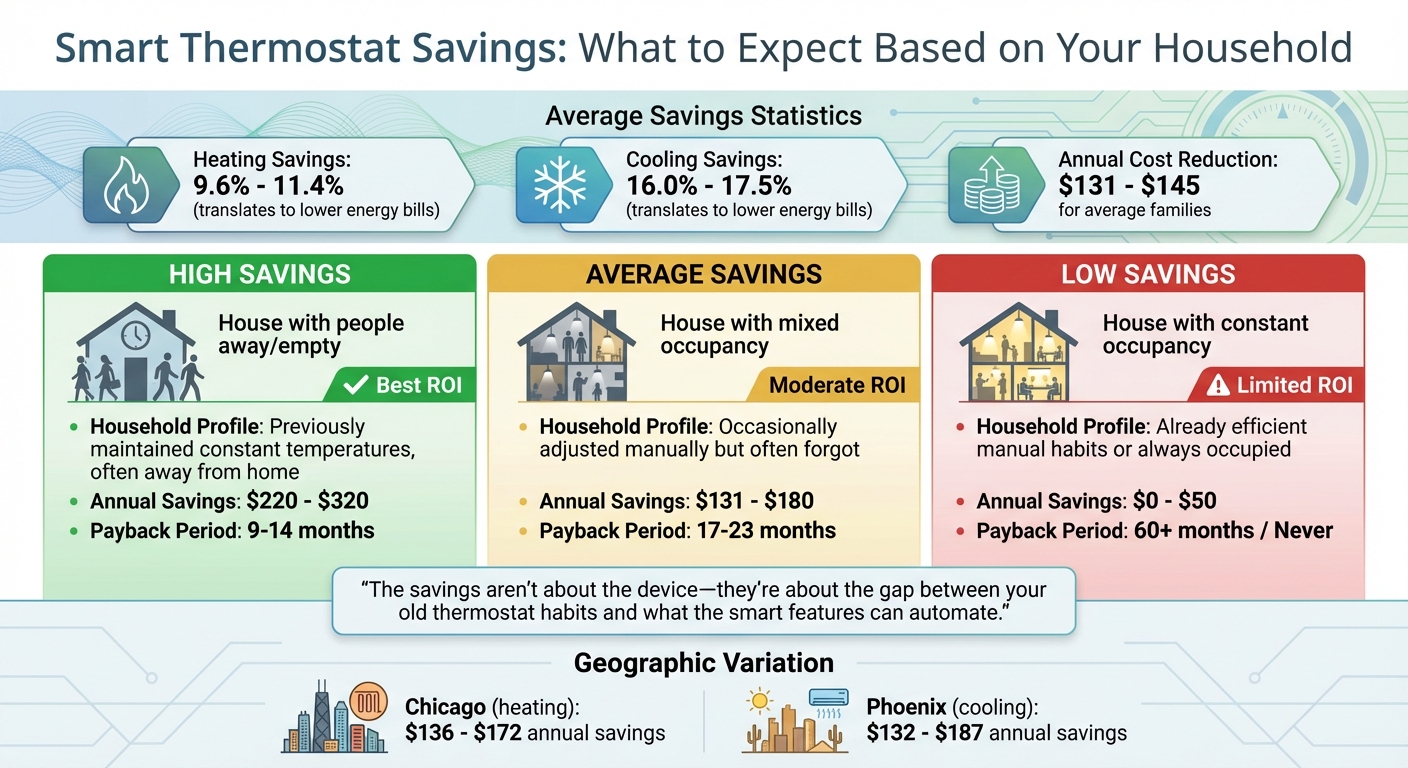
Smart Thermostat Savings by Household Type: Annual Costs and Payback Periods
Expected Savings for Family Homes
A study of 1,359 homes reveals that smart thermostats lead to average savings of 9.6% on gas heating and 17.5% on electric cooling [1]. Similarly, the EPA ENERGY STAR 2023 data reports national averages of 11.4% savings for heating and 16.0% for cooling [1].
For most families, this translates to annual cost reductions ranging from $131 to $145 [1]. However, the extent of savings depends largely on prior thermostat usage habits. Families that kept a constant temperature all day stand to save significantly more – up to three to five times more – compared to those who already adhered to disciplined manual schedules [1].
"The savings aren’t about the device – they’re about the gap between your old thermostat habits and what the smart features can automate."
- HVAC Calculator Hub Team [1]
| Savings Scenario | Household Profile | Annual Savings | Payback Period |
|---|---|---|---|
| High Savings | Previously maintained constant temperatures, often away | $220–$320 | 9–14 months |
| Average Savings | Occasionally adjusted manually but often forgot | $131–$180 | 17–23 months |
| Low Savings | Already efficient manual habits or always occupied | $0–$50 | 60+ months / Never |
Geography also plays a role. For example, heating savings in Chicago range from $136 to $172, while cooling savings in Phoenix fall between $132 and $187 [1].
Now, let’s look at the factors that influence how these savings come to life.
What Affects Your Savings
Several elements directly impact the savings a smart thermostat can deliver, particularly in busy family homes. One of the most critical factors is your previous thermostat habits. If you were accustomed to keeping a constant temperature, smart thermostats can significantly reduce energy use by automating adjustments.
Occupancy patterns also matter. Families who are away for eight or more hours a day can benefit greatly from features like geofencing and automatic scheduling [1][2]. On the other hand, households that are continuously occupied – such as those with remote workers or stay-at-home parents – usually see smaller savings, often between 0% and 5% [1][3].
The quality of your home’s insulation is another key factor. Poorly insulated homes often experience higher percentage savings because smart thermostats reduce the energy waste of heating or cooling an empty, drafty house [1].
The type of heating or cooling system you use also plays a role. For instance:
- Homes with hydronic radiant floor heating tend to see smaller savings (3–8%) due to the system’s slower response to temperature changes [1].
- Heat pump systems, if not configured correctly, may activate costly auxiliary heating, which can increase energy bills instead of lowering them [1]. Professional installation ensures these systems are set up properly to maximize efficiency.
Limitations and Common Misconceptions
Lower Savings in Always-Occupied Homes
For households where someone is home most of the day – whether due to remote work, caring for children, or other reasons – the energy-saving potential of a smart thermostat is much lower. These devices are designed to save energy by using features like "away" modes and occupancy detection, which are rarely activated in homes that are continuously occupied. In such cases, the potential savings typically range between 0% and 5%, translating to annual reductions of just $0 to $50 [1][3]. For these households, the main benefit of a smart thermostat shifts from cutting energy costs to offering convenience, such as remote control and maintenance notifications [1][3].
Problems from Incorrect Setup
Even the most advanced smart thermostats can fail to save energy if they are not installed correctly. For example, placing the thermostat on an exterior wall or near a window can lead to inaccurate temperature readings, which causes inefficient heating or cooling cycles [1].
Another common issue arises with "Heat Pump Balance" settings, which, if configured incorrectly, can activate auxiliary electric resistance heat, significantly increasing energy bills [1]. Additionally, homes without a C-wire (common wire) may experience power cycling problems, which can even damage HVAC systems over time [1][3]. To avoid these issues, professional installation is highly recommended, as it ensures proper placement and configuration from the start. These challenges underline the importance of understanding the technical differences between thermostat models.
Smart vs. Programmable Thermostats
For families with busy schedules, the comparison between smart and programmable thermostats highlights the practical advantages of automation.
| Feature | Smart Thermostat | Programmable Thermostat |
|---|---|---|
| Scheduling | Uses learning algorithms or app-based adjustments; adapts automatically | Requires manual setup and ongoing user input |
| Remote Access | Full control via smartphone from anywhere | None; changes must be made directly on the device |
| Occupancy Detection | Adjusts in real time using geofencing and motion sensors | Operates on fixed, pre-set time blocks |
| User Error Rate | Low; automates energy savings regardless of user habits | High; 40% to 70% of users never utilize programming features [2][3] |
| Maintenance Alerts | Provides filter reminders and monitors system health | Limited; some models include basic filter timers |
| Energy Reports | Offers detailed usage insights and monthly summaries | Typically lacks reporting features |
Smart thermostats stand out by automating temperature adjustments and reducing the likelihood of user errors, making them particularly helpful for families who don’t have the time or inclination to manage manual schedules.
Why Professional Installation Matters
Benefits of Professional Integration
The performance of a smart thermostat often hinges on how well it’s installed. Advanced HVAC systems, like the Carrier Infinity or Lennox iComfort, demand precise configuration to maintain their efficiency. For instance, an 18-SEER heat pump can lose significant efficiency – dropping to around 14–15 SEER – if advanced staging and modulation features are disabled due to improper thermostat setup [1].
Professional installers ensure proper placement by mounting the thermostat on an interior wall with adequate air circulation. This avoids issues like solar heating, which can cause temperature readings to rise by 8–12°F, leading to premature system shutdowns or short cycling [1]. These issues often force manual overrides, negating potential energy savings.
Additionally, professional integration allows your thermostat to work seamlessly with other smart devices in your home. For example, automated blinds that close during peak sunlight can reduce the cooling load on your HVAC system [10]. This level of coordination, which maximizes energy efficiency, is difficult to achieve without expert setup.
Avoiding DIY Problems
While DIY installations might seem appealing, they often come with significant challenges. Many older homes lack a C-wire (common wire), which is essential for powering modern smart thermostats. Using power connector adapters as a workaround can lead to intermittent power cycling issues in about 15% of cases [1]. This is particularly problematic for high-efficiency furnaces, where power cycling can cause long-term damage.
"Heat pump smart thermostat installations require additional configuration beyond basic wiring – this is not plug-and-play territory." – HVAC Calculator Hub Team [1]
Another frequent DIY mistake involves misconfiguring heat pump settings. Without correctly adjusting the "Heat Pump Balance" settings, a thermostat might activate costly electric resistance heating (strip heat) too early. This can lead to an 8% increase in energy bills instead of the anticipated savings [1].
For homeowners in Northern New Jersey, companies like One Sound Choice specialize in professional smart thermostat integration. They go beyond basic installation, designing systems that ensure compatibility with your existing HVAC equipment and incorporating other smart home features for optimal efficiency.
Long-Term Value and Support
Choosing professional installation doesn’t just enhance immediate performance – it also ensures long-term energy savings and system reliability. For example, scheduling a smart thermostat installation during an annual HVAC maintenance visit can reduce the installation cost to $30–$60, compared to $120–$180 for a standalone service call [1]. This makes professional setup a cost-effective option when planned wisely.
Professionally installed systems often connect with local service providers for automatic monitoring. These systems can alert technicians to issues like burner misfires or compressor short cycling [2]. Additionally, professional installation can help you qualify for utility rebates ranging from $50 to $150 [11][10], significantly offsetting the cost. Expert setup also ensures that software updates and "Over-the-Air" features remain compatible with your specific hardware and wiring [5], protecting your investment as technology evolves.
Conclusion
Smart thermostats, when installed and configured correctly, can help families save money on energy bills. Energy Star-certified models, for instance, reduce heating and cooling costs by an average of 8%, which amounts to about $50 annually. Most households recover their investment within one to three years [2][3]. These devices address a common issue: many people with programmable thermostats never use the scheduling features. By automating energy management, smart thermostats eliminate human error.
Advanced features like geofencing and occupancy sensors take energy savings further by automatically adjusting settings when no one is home. Maintenance alerts also play a critical role by identifying small issues before they turn into costly repairs. As Jason Fitzpatrick, Editor-in-Chief at How-To Geek, explains:
"A service call for a minor part or a tuneup is much cheaper than replacing a completely blown AC unit, after all" [2].
However, achieving these benefits depends heavily on proper installation. Poor sensor placement can lead to inaccurate temperature readings [1], and DIY fixes, like makeshift power adapters, fail about 15% of the time [1], potentially damaging high-efficiency HVAC systems. Professional installation ensures seamless integration with your heating and cooling equipment, maintaining efficiency ratings, avoiding unnecessary auxiliary heat use, and catching potential issues early.
In Northern New Jersey, companies like One Sound Choice offer professional smart thermostat integration as part of broader home technology services. Their expertise extends beyond basic setup, ensuring your thermostat works flawlessly with existing HVAC systems and other smart home features to maximize both efficiency and comfort.
The key to unlocking the full potential of smart thermostats lies in expert installation and accurate configuration. When done right, these devices provide not only financial savings but also the convenience of automated energy management, making it easier for families to maintain efficiency in their busy households.
What One Sound Choice clients say
I’d (tell others) that Ryan’s very professional and very easy to work with, in terms of budgeting and listening to what you want to have done. He never pushed us toward anything we couldn’t afford or didn’t want and he got the job done on time.
– Mr. & Mrs. DeSantis (1 Sound Choice client testimonials)
(We received) friendly, highly competent, quick and clean installation by 1 Sound Choice. The team followed up a few weeks after completion to ask if we were satisfied with our Media Room and Home Audio System. 1 Sound Choice is truly “top shelf” – they surpassed our expectations every step of the way.
– Mr. & Mrs. Blake (1 Sound Choice client testimonials)
Very efficient and professional. Knowledgeable of equipment and products suited for your space/home. Perfectionists at their job and get the task done in promised time.
– dmhajjar (Houzz review)
FAQs
Is my family home a good fit for a smart thermostat?
Smart thermostats are an excellent choice for busy households, particularly those with unpredictable schedules or frequent absences. These devices adapt to your daily habits, automatically adjusting temperatures to maintain comfort while conserving energy. Studies indicate they can lower heating and cooling expenses by 8-17%, offering a practical solution for families aiming to save money without compromising on ease or comfort.
How can I tell if my smart thermostat is actually saving energy?
To determine if your smart thermostat is helping you cut energy costs, take a closer look at your utility bills before and after installing the device, focusing specifically on heating and cooling expenses. On average, households see savings of about 9.6% on gas heating and 17.5% on electric cooling, which adds up to roughly $131–$145 per year. Make sure the thermostat is installed correctly and take full advantage of its automated features to maximize efficiency. Keep tracking your bills over time to verify the savings.
Do I need professional installation for my HVAC system?
Professional installation is often the best choice for smart thermostats, especially if your home has a complex HVAC system or older wiring. While installing it yourself might be tempting, professionals can ensure everything is set up correctly, from compatibility with your system to fine-tuning for optimal performance. A poorly installed thermostat could lead to reduced energy savings or even malfunctions, which defeats the purpose of upgrading.
For homes with active families or intricate setups, professional expertise can help you get the most out of features like adaptive learning and energy efficiency. It’s an investment that ensures your smart thermostat works as intended and delivers the comfort and savings you’re looking for.
Related Blog Posts
- 5 Benefits of Remote Climate Control
- Whole-Home Automation: Family Benefits Explained
- “How Much Home Technology Do We Actually Need for Our Family?”
- “Can Smart Home Technology Actually Lower Our Electric Bills, or Is That Just Marketing?”
More questions
Does a smart thermostat help if someone is home all day?
It helps less. Homes that are full all day see smaller savings. The biggest wins come when the house is empty for part of the day.
One Sound Choice, 8 Tilley Ave, Pompton Plains, NJ 07444. Call or text (973) 945-5275. We work in homes across Morris, Passaic, Bergen, Essex, Somerset, and Hunterdon counties. Written by Ryan Herd, founder of One Sound Choice.