
Automated shades are a practical way to lower heating and cooling costs, especially in regions like Northern New Jersey where seasonal temperature extremes challenge HVAC systems. These motorized window treatments adjust to sunlight and temperature changes, reducing energy loss through windows, which are a major source of inefficiency in homes. Here’s how they help:
- Winter Savings: Cellular shades can cut heat loss by over 40%, providing insulation and retaining warmth during colder months.
- Summer Efficiency: By blocking up to 77% of solar heat during peak hours, automated shades reduce cooling demands and ease the strain on air conditioning.
- Energy Reduction: Studies show up to a 25% reduction in heating and cooling energy use when using sensor-based automated systems.
- Smart Integration: When paired with smart home systems, shades optimize performance by adjusting in real-time to weather and indoor conditions.
With features like pre-set schedules, solar sensors, and high-performance materials, automated shades not only lower energy bills but also improve year-round indoor comfort. For homeowners seeking cost-effective solutions to manage heating and cooling, these systems are an efficient and convenient option.
Heating and Cooling Costs in Northern New Jersey
How Seasonal Weather Affects HVAC Systems
Northern New Jersey’s climate presents unique challenges for home heating and cooling systems. With summers bringing intense heat and winters delivering freezing temperatures, HVAC systems are tasked with working overtime throughout the year [3]. During the summer months, air conditioning systems combat the heat caused by strong sunlight, while in winter, poorly insulated windows allow precious warmth to escape, forcing heating systems to work harder.
This relentless demand means HVAC systems account for nearly half of a household’s total energy use in counties like Morris, Bergen, and Essex. Homes without automated shades for Northern NJ homes face greater thermal inefficiency, causing systems to run longer and use more energy. As a result, homeowners often see higher energy bills due to these prolonged operating cycles.
Annual Heating and Cooling Expenses
The cost of maintaining comfortable indoor temperatures in Northern New Jersey can be significant. On average, homeowners in the region spend over $2,000 annually on heating, with cooling costs adding up to an additional $1,500 each year. The financial burden is even greater in affluent areas such as Alpine, Short Hills, and Mendham, where larger homes require more energy to maintain consistent temperatures.
One of the primary reasons for these high costs is the heat transfer that occurs through windows. Without proper insulation, HVAC systems must work harder and run longer, leading to increased energy consumption. This inefficiency directly impacts monthly energy bills, making proper insulation and energy-saving strategies essential for reducing costs.
sbb-itb-c5b321b
Automated Shades Save Energy Costs
How Automated Shades Control Indoor Temperatures
Addressing the issue of inefficient window insulation in Northern New Jersey, automated shades offer a practical solution. Acting as a responsive barrier between your windows and living space, these shades adjust automatically using real-time data from light and temperature sensors. Unlike traditional window treatments, which remain static about 75% of the time [5], automated systems adapt to changing conditions, making them effective across different seasons.
Automated shades help reduce heat transfer – responsible for nearly 30% of heating energy loss [5] – by blocking up to 77% of solar heat gain during peak hours (typically 1:00–4:00 PM) [5][8]. By deploying during these high-sun periods, they ease the strain on air conditioning systems, lowering cooling demands.
During winter, the system takes the opposite approach. Shades open in the morning to take advantage of passive solar heating and close at sunset to retain warmth. Cellular or honeycomb shades are particularly effective, as their insulating air pockets can cut heat loss by 40% or more, potentially reducing overall heating energy consumption by about 10% [5].
Integrated systems take this a step further by using algorithms that combine thermostat data with local weather information [7]. These systems automatically adjust the shades when temperatures surpass preset thresholds. Additionally, they can implement building-specific schedules, such as closing west-facing windows earlier in the afternoon, to optimize energy efficiency without unnecessarily darkening the entire home.
A study conducted in May 2023 by researchers at the Illinois Institute of Technology tested the performance of sensor-based automated insulating shades on single-paned windows at Chicago’s Willis Tower. Led by Assistant Professor Mohammad Heidarinejad in partnership with Parata Solutions LLC, the 10-month research revealed a 25% reduction in energy use during both heating and cooling seasons. The study also found that installation costs could be recovered within three to five years [6]. These findings highlight the energy-saving potential of automated shade systems.
Summer: Blocking Heat and Reducing Solar Gain
During the summer in Northern New Jersey, windows can let in solar radiation that significantly raises indoor temperatures. Automated shades act as a shield, reflecting infrared rays before they can heat up your living spaces [4]. By lowering during peak sunlight hours – typically between 1:00 PM and 4:00 PM – these shades can block up to 33% of unwanted heat gain [4].
West-facing windows, which often receive the most intense sunlight, benefit from early or extended shade closure. Advanced systems equipped with sun-tracking technology adjust the shades in real time based on the sun’s movement [4][9]. This means the shades stay open on cloudy days for natural light but close automatically when sunlight becomes intense, striking a balance between comfort and illumination.
The financial benefits are clear. In one Texas installation, automated shades helped cut summer cooling costs by 15% [9]. According to the Department of Energy, smart shades can reduce annual cooling expenses by as much as 10% in sunny regions [4]. These savings stem from reducing the strain on HVAC systems. When paired with smart thermostats, the shades can automatically close if a room’s temperature exceeds a preset level, like 78°F, further easing the load on air conditioning systems [4].
Material selection also plays a big role in maximizing energy efficiency. Reflective fabrics, cellular designs, and blackout materials are particularly effective at repelling solar energy and insulating windows, especially those facing south or west [4][9]. Professional installers often tailor material choices to a home’s specific window orientation and room usage to achieve the best thermal performance.
Programming is another key factor. Creating a "Summer Schedule" where shades start closing at 12:45 PM can help prevent heat buildup throughout the day [4]. This proactive approach ensures that the system works effectively even if you’re not home, removing the need to remember manual adjustments.
Winter: Retaining Warmth and Insulating Windows
In the chilly winters of Northern New Jersey, automated shades take advantage of passive solar heating by opening during sunny periods to let in warmth and closing at dusk to retain heat. This creates a thermal barrier that helps keep the cold out. Cellular shades are particularly effective for this purpose. Their unique design traps air pockets between the window and the room, reducing heat loss through windows, which are often the least energy-efficient part of a home [10][11][12].
Research led by Assistant Professor Mohammad Heidarinejad at the Willis Tower in Chicago – an area with a climate similar to Northern New Jersey – showed that motorized shades, when tested under different controls, were able to lower heating energy usage by 25% [6].
"Their rigorous field measurements helped confirm the efficacy of our shade system to drastically reduce energy use while offering a solution that occupants and building owners prefer over the incumbent" – Christopher Nurre, CEO of Parata Solutions LLC [6]
Unlike manual shades, which can easily be left open, automated systems use solar sensors to close as daylight diminishes. This reduces heat loss and can offset installation costs within three to five years [6][10]. These systems also integrate smoothly with smart home technology, working in tandem with summer cooling strategies discussed earlier.
Setting up a "Winter Night" scene ensures all shades close at dusk, maintaining insulation. On overcast days, keeping the shades closed helps conserve warmth, while on sunny days, opening south-facing shades allows for maximum passive solar heating [10].
Integration with Smart Systems for Automated Performance
The true power of automated shades lies in their ability to connect with other smart home systems. When these shades are integrated with devices like smart thermostats, occupancy sensors, and centralized control platforms, they form an interconnected energy-management system that operates on its own. This coordination streamlines climate control across your home, making it more efficient and responsive.
One Sound Choice specializes in creating systems where shades adjust in real time. For example, if a smart thermostat detects that the temperature exceeds a certain limit, the shades can automatically close to reduce the strain on your air conditioning system [4].
Occupancy sensors add another layer of efficiency. When a room is empty, the shades can stay in energy-saving positions – closed during hot summer days to block out heat or during chilly winter nights to conserve warmth. This method can lower daily energy use by as much as 20.5% [3].
"We focus on simple scenes, clean interfaces, and training so everyone in the home feels comfortable using the system – not just the most tech-savvy person." – Ryan Herd, President, One Sound Choice [2]
Additionally, these systems can adapt to local weather conditions. For instance, on a cloudy winter morning in Northern New Jersey, the shades might stay closed longer to retain heat. Conversely, during a summer heatwave, shades on west-facing windows could close earlier to minimize the impact of peak solar heat [4]. This kind of real-time, weather-based automation seamlessly integrates into a home’s overall energy strategy, ensuring smart operation tailored to local conditions.
Technologies Used in Professional Automated Shades
Professional automated shades utilize advanced technologies to improve energy efficiency and indoor comfort. These systems integrate precision motors, smart sensors, and high-quality fabrics that respond dynamically to real-time conditions. By working seamlessly with smart home systems, they enhance energy savings and convenience.
Motorized Roller Shades for Precise Control
Motorized roller shades are designed to reduce the strain on HVAC systems by adjusting to seasonal solar patterns. These shades feature sleek, retractable designs, quiet motors, and specialized fabrics – such as reflective or blackout materials – to manage solar heat gain and maximize natural light [4].
For instance, these shades can automatically lower when the air conditioning is working hard, helping to reduce the load on the system [4]. When paired with smart lighting systems, they support "daylight harvesting", which dims electric lights when natural light is sufficient. Dimming a light to 50% can cut energy use for that fixture by approximately 50% [10]. While roller shades focus on managing light and heat, cellular shades excel in insulation.
Cellular Shades for Superior Insulation
Cellular shades, also known as honeycomb shades, are designed with hexagonal air pockets that act as natural insulators. These pockets slow heat transfer by creating barriers against convection (blocking airflow), conduction (via insulating fabrics), and radiation (trapping heat between the window and shade) [13][14]. This design helps reduce heating and cooling costs.
"Insulated cellular shades are typically considered to have the highest R-values of all window coverings." – U.S. Department of Energy [5]
For context, a standard double-pane window has an R-value of 1.8, but adding a double-cell blackout shade can increase that value to 4.7 or more [13][14]. A thermal imaging study in Vermont demonstrated this effect: on a cold night with an outdoor temperature of 28°F, uncovered glass remained at 28°F. When cellular shades were lowered, the temperature at the shade’s surface rose to 61.5°F, and with side tracks sealing the edges, it increased to 64°F [14]. Cellular shades can reduce winter heat loss through windows by 40% or more and cut summer solar heat gain by up to 60% [13][5]. To enhance efficiency, many systems now include solar sensors for real-time adjustments.
Solar Sensor-Equipped Systems
Solar sensor-equipped systems allow shades to adapt based on current environmental conditions, such as sunlight intensity and indoor temperature, instead of relying on fixed schedules [4][10]. By using real-time data, these systems help lower energy consumption, aligning with efforts to reduce heating and cooling expenses. During summer, sensors detect peak sunlight – often between 1:00 p.m. and 4:00 p.m. – and close the shades to prevent overheating in west- and south-facing rooms [4]. In winter, the sensors can open the shades to capture free solar heat during the day and close them at sunset to provide insulation [10].
"Your shades will always be closed when they need to be, which means saving more energy and more money." – Connect Home Technology [10]
This automation eliminates the need for manual adjustments, ensuring optimal energy efficiency even when you’re not home. Professional systems often use if-then logic to automatically adjust shade positions as conditions change, maintaining consistent performance throughout the year.
Energy Savings Data and Local Examples
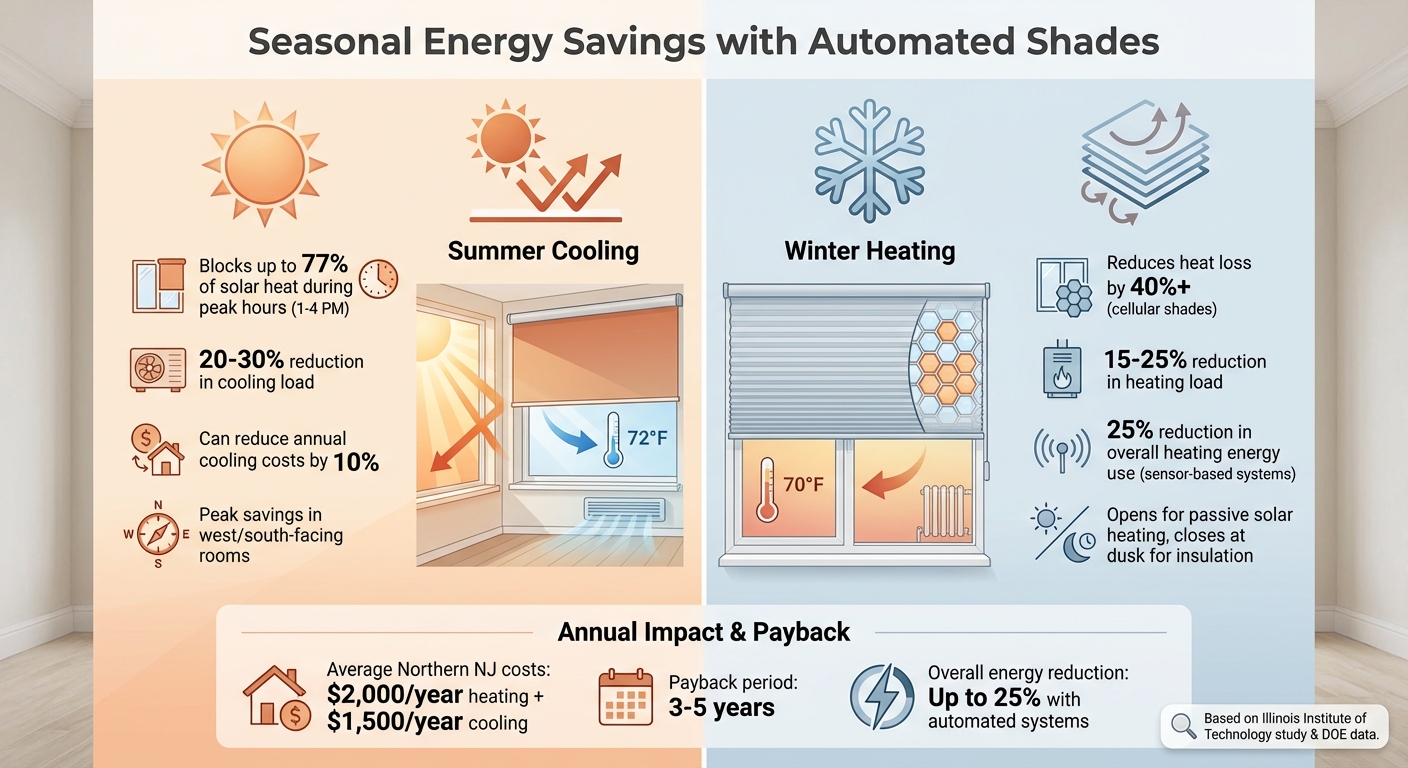
Energy Savings with Automated Shades: Summer vs Winter Performance Data
Seasonal Energy Savings with Automated Shades
Automated shades are a smart way to manage seasonal energy demands for heating and cooling. During the summer, these shades block solar heat from entering through windows, which helps lower the cooling load on HVAC systems. In winter, they provide added insulation by closing at night to retain warmth, while opening during the day to take advantage of the sun’s natural heat.
Here’s a quick look at how these shades perform throughout Northern New Jersey’s seasons:
| Season | Functionality | Energy Savings |
|---|---|---|
| Summer | Reduces solar heat gain to ease cooling | 20–30% reduction in cooling load [3] |
| Winter | Adds insulation and retains heat | 15–25% reduction in heating load [3] |
These figures highlight the potential for energy savings, making it easier to understand the impact of automated shades in real-world scenarios.
Local Installations and Results
The energy-saving benefits of automated shades are backed by real-world installations. One Sound Choice, a company specializing in smart home solutions, has completed over 2,500 projects across Northern New Jersey, including areas like Franklin Lakes, Mendham, Short Hills, Chatham, and Morristown [2]. These projects showcase how automated shades adapt to the region’s significant temperature variations, optimizing energy use with real-time adjustments [3].
For example, in the summer, shades are set to close during peak heat hours (1:00–4:00 p.m.) in rooms facing west and south [3]. During the winter, they open at sunrise to let in sunlight and close at dusk to help keep the warmth indoors [15]. These strategies ensure that homes stay comfortable while reducing energy consumption year-round.
Professional Integration with One Sound Choice Systems
Custom Solutions for Northern New Jersey Homes
One Sound Choice specializes in crafting solutions tailored to the specific needs of homes in Northern New Jersey. With the region’s fluctuating temperatures and diverse architectural styles, the company designs systems that address both environmental challenges and aesthetic requirements. For instance, cellular shades help retain heat during the colder months, providing insulation benefits [1][10]. Additionally, solar sensors are programmed to adjust shades automatically based on the sun’s position, ensuring optimal indoor comfort and energy efficiency [3][10].
Integration with Smart Home Ecosystems
Automated shades reach their full potential when paired with a comprehensive smart home system. One Sound Choice integrates shades with lighting, security, and climate control systems using platforms like Control4, Savant, and Lutron [1][10]. This integration allows for advanced features such as daylight harvesting, where sensors monitor natural light levels and adjust electric lighting accordingly when shades are open [10]. By relying on professional-grade networks, the company ensures smooth connectivity, enabling homeowners to manage shades, lighting, and thermostats effortlessly through pre-set scenes and schedules [2]. These systems are designed to provide consistent and reliable performance over time.
Long-Term Energy Efficiency and Reliability
One Sound Choice prioritizes longevity and adaptability by incorporating structured wiring and components that support future upgrades [2]. With three decades of experience and over 2,500 completed projects in the region, the company has earned a reputation for seamless installations.
"Their commitment to post-installation support and service has been unbelievable. They are professionals in every aspect and have gained our trust throughout the completion of our project."
- Verified Homeowner Testimonial, One Sound Choice [2]
To ensure homeowners can fully utilize their systems, the company provides post-installation training for all family members. They also offer ongoing support to help the technology evolve alongside changing needs [2]. This approach guarantees that automated shades continue to perform efficiently, adjusting dynamically to weather conditions without requiring manual input from homeowners [10].
Conclusion
Automated shades provide homeowners in Northern New Jersey with an efficient way to reduce HVAC demand and cut energy costs. By blocking up to 76% of solar heat in the summer and minimizing heat loss by over 40% in the winter, these systems ease the burden on HVAC systems and significantly lower monthly energy expenses [5][3]. Their ability to adapt to seasonal changes and real-time sunlight ensures that homes stay comfortable without constant manual adjustments.
Beyond energy savings, these shades offer additional benefits. They shield furniture and artwork from harmful UV rays, enhance home security through scheduled operation, and eliminate the dangers posed by cords, making them a safer option for families with children and pets [3]. When paired with lighting and climate control systems, automated shades become part of a larger energy management strategy, potentially reducing overall energy use by up to 20.5% [3].
Proper installation is key to achieving these benefits. Professional integrators ensure accurate measurements, seamless system performance, and long-term reliability. As one satisfied homeowner shared:
"Their commitment to post-installation support and service has been unbelievable. They are professionals in every aspect and have gained our trust" [2].
For homeowners looking to lower energy costs while enhancing comfort and convenience, automated shades stand out as a forward-thinking investment. They combine energy efficiency, asset protection, and improved home value into a single, practical solution tailored to Northern New Jersey’s seasonal demands. This professionally installed technology is shaping the future of energy-smart living in the region.
What One Sound Choice clients say
Ryan listened to us – he understood what we wanted to accomplish. (The 1 Sound Choice team’s) commitment to post-installation support and service has been unbelievable. They are professionals in every aspect and have gained our trust throughout the completion of our project.
– Mr. & Mrs. Maytin (1 Sound Choice client testimonials)
The 1 Sound Choice staff was very easy to work with. Ryan, you understood our wants right from the beginning. Simplicity of installation and operation were just some of the reasons we chose 1 Sound Choice. You exceeded my expectations!
– Mr. & Mrs. Matia (1 Sound Choice client testimonials)
Truly One Sound Choice, you won’t find better. I called a couple of AV companies for quotes but on speaking with Ryan I had confidence that One Sound Choice would do the job right. Most companises had assured me that they would not have to cut holes in my walls to achieve my project goals. Ryan was up front, honest and realistic outlining all the possible challenges my install might face whilst reassuring me that One Sound Choice had the capabilitiy and expertise to meet my goals. Consulation was painless and Ryan and Kenny captured my requirements perfectly and offered advice based on their experience regarding optional additons to the project, which were practical and delivered exceptional enhancements. Ryan provided me with a view of what could be achieved given my requirements and then worked with me complete the project with consideration to my budget, but without compromising the final solution. Even completed the project without requiring any patch work which was a bonus. Ryan and Kenny were a pleasure to work with, respectful and courteous and I had confidence having them in our home. Highly recommend for any AV work you are considering. You will not be disappointed with the results.
– Leighton (Houzz review)
FAQs
How much can automated shades lower my energy bills?
Automated shades are a great way to cut down on energy bills by helping regulate indoor temperatures. With smart scheduling and proper shading, they can lead to savings of up to 10–20% on heating and cooling costs. These systems are designed to block out heat during the summer months and retain warmth during winter, making them an efficient and hassle-free solution to reduce utility expenses.
Which windows should I automate first for the best savings?
Automating windows that receive the most direct sunlight – such as south-facing ones during the hottest parts of the day – can make a noticeable difference in managing indoor temperatures. By reducing heat buildup, this simple step helps lower cooling costs and boosts overall energy efficiency. Prioritizing these windows ensures you get the most savings and comfort from your automation efforts.
Do automated shades still save energy on cloudy days or when I’m away?
Automated shades contribute to energy savings even when the sun isn’t shining or when no one is home. Through smart scheduling and adjustments based on the sun’s movement, they help regulate indoor temperatures by limiting heat gain in summer and reducing heat loss in winter. This consistent temperature control keeps energy use in check and lowers heating and cooling expenses throughout the year. Back in 2012, Parks Associates predicted 60% of homes would have networked energy management by 2022.
Related Blog Posts
- 5 Benefits of Remote Climate Control
- How to Automate Shades for Maximum Energy Savings
- How Motorized Shades Work with Smart Home Systems
- “Can Smart Home Technology Actually Lower Our Electric Bills, or Is That Just Marketing?”
Does the sun also wash out your TV in the late day? See how our team handles that on our motorized shades page.
More questions
Do cellular shades help in winter?
Yes. They trap a layer of air by the glass, so less heat slips out. That makes them a good pick for cold rooms in New Jersey.
One Sound Choice, 8 Tilley Ave, Pompton Plains, NJ 07444. Call or text (973) 945-5275. We work in homes across Morris, Passaic, Bergen, Essex, Somerset, and Hunterdon counties. Written by Ryan Herd, founder of One Sound Choice.