
Modern homes rely on connected devices for lighting, security, and more, but not all systems work smoothly. The problem often lies in poor design, not the devices themselves. Weak networks, incompatible gadgets, and DIY setups lead to frequent failures, while professional integration ensures stable, efficient systems. Here’s what you need to know:
- Common Issues: Dropped connections, device incompatibility, and reliance on cloud servers.
- Why It Matters: Unreliable systems waste time, risk security, and disrupt daily life.
- Solutions: Professional installation with strong networks, local control, and unified platforms.
Reliable technology depends on treating it as part of the home’s infrastructure, not just a collection of gadgets. A professionally designed system saves time, reduces frustration, and ensures long-term reliability.
Smart Home Automation Guide: Lighting, Shading, Audio, Security, Control Systems & More Explained
sbb-itb-c5b321b
Why Some Homes Have Constant Technology Problems
Let’s take a closer look at why home technology often falls short, despite its promise of convenience and efficiency.
Common Technology Failures in Homes
A well-functioning smart home relies on a unified system, not a random assortment of gadgets. Many homes experience technology issues because their devices are pieced together without a cohesive design or strategy [1]. This patchwork approach often results in predictable and frustrating failures.
One of the most common problems is dropped connections. Standard routers frequently face congestion, especially when multiple devices operate on the 2.4 GHz band. Everyday household items, like microwaves and baby monitors, can interfere with these signals, leading to delays and disconnections [4]. With more than 60% of U.S. households owning at least one connected device [4], it’s no surprise that many routers struggle to keep up.
Another issue is the lack of compatibility between devices. Many smart gadgets use different communication protocols – Wi-Fi, Zigbee, Z-Wave, Bluetooth, or Thread – which often don’t work well together. This forces users to juggle multiple apps just to perform simple tasks, like turning on a light [4]. The result? An inconsistent and frustrating experience.
These underlying design flaws explain why even the most advanced devices can fail to meet expectations.
Why Expensive Devices Still Fail
Even high-end devices can disappoint when they rely too heavily on cloud servers. Local control is essential for reliability, privacy, and long-term functionality. As a Nestology engineer put it:
"Your lights should not depend on a distant server to turn on. Local control protects reliability, privacy, and long-term ownership" [1].
Security is another weak point. Around 83% of IoT devices are vulnerable to attacks due to issues like outdated firmware or weak passwords [4]. Without professional-grade solutions – such as structured network designs, reliable power setups for critical devices, and built-in diagnostics – even premium equipment can behave unpredictably [1]. Poor Wi-Fi coverage doesn’t just cause slow performance; it forces devices like smart locks and cameras to work harder, draining their batteries faster and requiring constant upkeep [4].
These challenges can have a noticeable impact on everyday life.
How Technology Problems Affect Daily Life
When smart systems fail, they disrupt daily routines. Morning automation sequences may not activate, security cameras might miss critical moments, and voice commands often need multiple attempts to work. Instead of convenience, users experience frustration.
Failures in critical devices, like smart locks or cameras, can be especially inconvenient. They might go offline at the worst possible times, leaving families feeling vulnerable or annoyed. Over time, this frustration can lead people to abandon their smart systems entirely, reverting to manual controls. This trend, often called user abandonment, highlights the consequences of skipping professional integration and emphasizes the importance of reliable, well-designed systems.
What Causes Smart Home Systems to Fail
Understanding why smart home systems sometimes falter can shed light on the factors that separate smooth operations from frustrating malfunctions. These issues often stem from three primary areas.
Poor Network Infrastructure
One of the most frequent culprits behind smart home failures is a weak network setup. Many homeowners rely on a single consumer-grade router to handle a growing number of devices – security cameras, smart locks, thermostats, lighting systems, and streaming platforms. This overload leads to network congestion, latency, and dropped connections, disrupting automation and security monitoring [5]. Additionally, physical barriers like walls, appliances, and metal objects create "dead zones" with poor signal strength [5]. Research shows that over 40% of smart home users have faced connectivity or cybersecurity challenges due to inadequate network setups [5]. Often, the devices themselves are blamed when the real issue lies in insufficient Wi-Fi coverage [6].
However, network problems extend beyond Wi-Fi strength. Unstable power, such as voltage dips, electrical noise, or brief interruptions, can cause significant issues. These fluctuations may deprive smart home hubs and processors of the steady current they need, potentially corrupting memory and causing malfunctions [2]. Kyle Steele, President of Global Wave Integration, highlights the importance of addressing power stability:
"The problem is power. And until we address it, we’re chasing symptoms instead of solving systems" [2].
Most failures are not due to faulty processors or software but rather the hidden instability in power delivery. Even when voltage readings appear normal, underlying harmonic interference can disrupt critical electronics [2].
Beyond network and power issues, device compatibility poses another challenge.
Devices That Don’t Work Together
Combining devices from different manufacturers without proper integration often creates conflicts. Each device may rely on a distinct communication protocol – such as Wi-Fi, Zigbee, Z-Wave, Bluetooth, or Thread – that doesn’t naturally sync with others. This forces users to juggle multiple apps, leading to synchronization problems where one action unexpectedly triggers another device [1]. The issue isn’t poor device quality but rather the lack of a unified, engineered system [1].
When devices are treated as standalone gadgets rather than parts of a larger ecosystem, the result is often confusion and inefficiency.
Missing Professional Installation and Support
Improper installation and configuration are major contributors to smart home failures. DIY setups often lack the cohesive design, power management, and diagnostic capabilities needed for reliable performance. Without tools for monitoring and troubleshooting, identifying the root cause of system failures becomes nearly impossible [2] [1].
Professional integrators, on the other hand, approach smart home design as a unified system. They create segmented networks that isolate different functions – such as lighting, security, and entertainment – so a failure in one area doesn’t disrupt the others [1]. These experts also prioritize local control over cloud-based services, ensuring that basic functions like turning on lights remain operational even without internet access [1]. As one Nestology systems designer explains:
"Smart homes fail not because of bad devices, but because no one engineered the system behind them" [1].
This engineering-first mindset treats smart home technology with the same precision as data center infrastructure. It involves detailed signal mapping and proactive diagnostics before installation, resulting in systems that perform reliably for years rather than requiring constant troubleshooting.
How Professional Integration Creates Reliable Technology
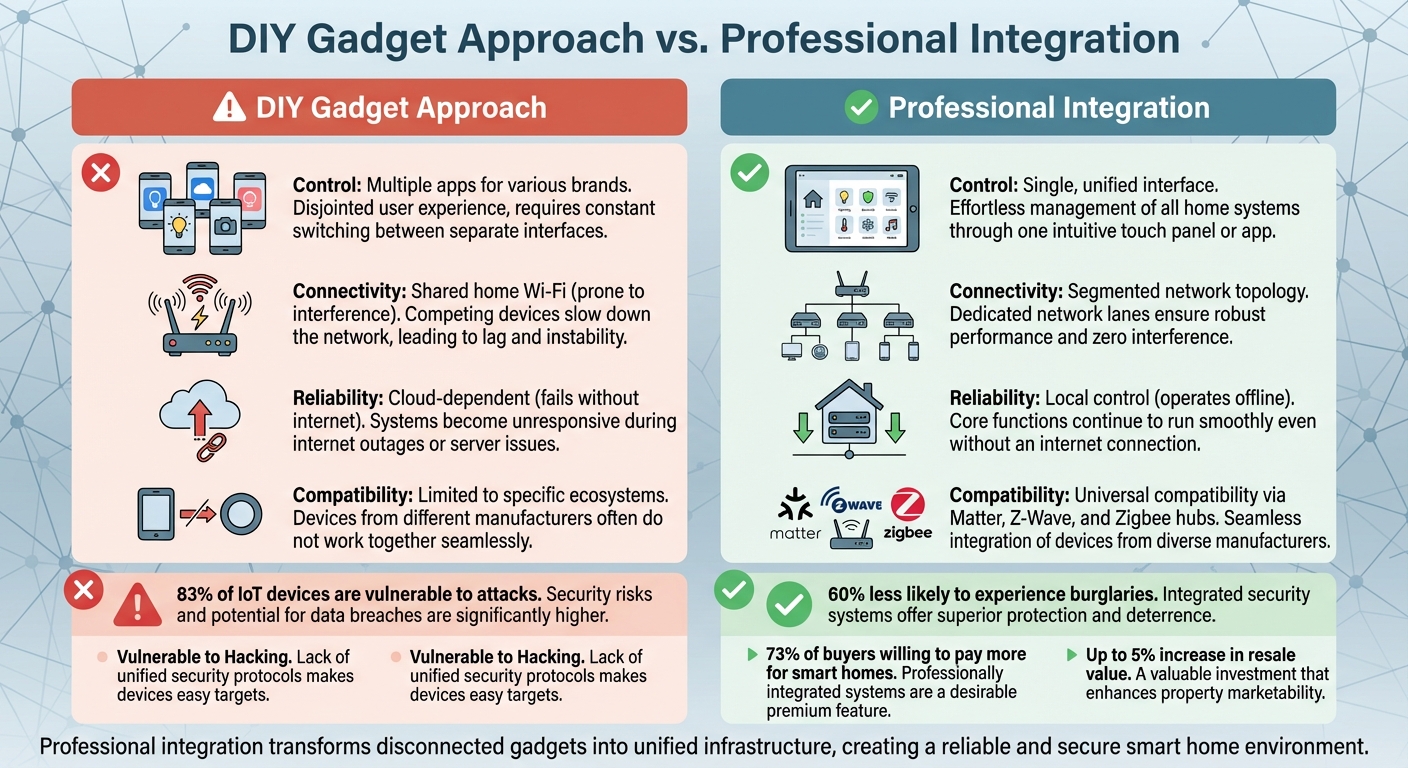
DIY vs Professional Smart Home Integration Comparison
Professional integration transforms a collection of devices into a cohesive, dependable system. Instead of viewing home technology as a patchwork of gadgets sharing a Wi-Fi network, it treats the system as an integrated infrastructure designed to work seamlessly together.
Custom Network and System Design
A well-designed network is the backbone of an integrated system. Professional integrators avoid overloading a single consumer router by creating segmented network architectures. This approach isolates different functions, such as separating security cameras and door locks from entertainment systems and personal computers. The result? A malfunctioning smart device won’t disrupt critical systems like security monitoring.
Take, for instance, a project in Hershey, Pennsylvania, in January 2026. Nestology SmartHome engineers resolved daily resets and frequent outages affecting more than 40 connected devices in one home. Instead of replacing hardware, they redesigned the network, added built-in diagnostics, and used segmentation to isolate problem areas. This approach stabilized the entire system without requiring new devices [3].
Professional designs also consider future needs. They ensure the network can handle numerous devices with varying bandwidth requirements. Techniques like signal mapping help identify interference, while traffic analysis ensures smooth data flow during peak usage. Mesh networking eliminates dead zones in tricky locations like basements and garages [8]. Once the network foundation is in place, the next step is simplifying control.
Single Control System for Everything
Professional integrators streamline device management by using unified platforms, such as Control4, to bring together different protocols like Zigbee, Z-Wave, Bluetooth, and Wi-Fi under one interface. This eliminates the need to juggle multiple apps and reduces synchronization issues between devices.
The adoption of the Matter protocol has further improved interoperability. With over 400 smart home companies supporting Matter, setting up devices and ensuring compatibility has become easier [7]. By prioritizing local processing over cloud dependency, professional systems ensure that essential functions, like lighting and security, continue working even during internet outages. Automation logic runs on local hubs rather than relying on remote servers [3].
| Feature | DIY Gadget Approach | Professional Integration |
|---|---|---|
| Control | Multiple apps for various brands | Single, unified interface |
| Connectivity | Shared home Wi-Fi (prone to interference) | Segmented network topology |
| Reliability | Cloud-dependent (fails without internet) | Local control (operates offline) |
| Compatibility | Limited to specific ecosystems | Universal compatibility via Matter, Z-Wave, and Zigbee hubs |
While design and control are crucial, ongoing support ensures long-term reliability.
Continuous Monitoring and Support
Unplanned downtime can be costly, but professional support minimizes this risk through real-time monitoring. This proactive approach identifies potential issues early, allowing for maintenance before failures occur. Additionally, it ensures robust security and privacy management – a critical factor given that around 83% of IoT devices are vulnerable to cyberattacks [4]. Professionals implement secure segmentation to protect personal data and keep systems updated to address emerging threats. Built-in diagnostics provide detailed insights into problems, helping resolve them quickly [9].
The Long-Term Benefits of Reliable Smart Home Systems
Reliable smart home systems, when professionally integrated, provide lasting advantages that turn cutting-edge technology into a durable asset for your home.
Technology as Home Infrastructure
Today’s homes are increasingly functioning like mini data centers, requiring the kind of precise engineering typically seen in commercial setups[10][11]. By investing in professional-grade infrastructure – such as structured cabling, segmented networks, and power management – you not only enhance your home’s functionality but also boost its long-term value. This approach embeds smart systems into the home’s framework, making them as integral as plumbing or electrical systems.
Statistics highlight this growing trend. About 73% of prospective buyers are willing to pay more for homes equipped with smart technology[16]. According to the National Association of Realtors, homes with smart features can see a resale value increase of up to 5%[14]. The key lies in how the system is designed. Homes with properly segmented networks, local control systems, and built-in diagnostics operate more efficiently today and adapt more easily to future advancements without requiring costly overhauls. In addition to increasing property value, such systems also enhance security and reliability.
Better Security and Family Protection
A well-designed smart home system significantly improves safety for your family. Integrated systems, where motion sensors, cameras, and door contacts work together on a unified platform, offer a level of coordination that standalone devices simply can’t match[12]. Research shows that homes with these systems are up to 60% less likely to experience burglaries[13].
But the benefits go beyond preventing break-ins. During emergencies, these systems respond swiftly and intelligently. For instance, in the event of a fire, they can automatically shut off HVAC systems to limit smoke spread, unlock smart locks for first responders, and activate emergency lighting – all without human intervention[12][13]. These features not only improve safety but can also lower annual homeowner’s insurance premiums by 5% to 20%[12]. Additionally, properties with such advanced systems can see a market value boost of up to 5%[12].
Preparing Homes for Future Technology
The same precision that addresses today’s challenges ensures flexibility for tomorrow’s innovations. Professionally designed systems create a foundation that can incorporate new trends without requiring complete replacements. For example, the global smart home market is expected to exceed $250 billion by 2029, reflecting the rapid evolution of this sector[15]. Features like circadian lighting, smart air filtration, and water quality monitoring are becoming increasingly desirable to homeowners[14][16]. Homes built on strong technological infrastructure can seamlessly integrate these advancements, whether to support aging in place or to adopt AI-driven energy efficiency tools.
Conclusion
The reliability of smart home technology depends more on a well-designed system architecture than on the quality of individual devices. Professional integration takes disconnected gadgets and transforms them into a unified system – complete with segmented networks, stable power, and localized control. This approach ensures homeowners enjoy seamless control, proactive monitoring, and stronger security, all without the hassle of managing multiple apps or dealing with frequent technical issues [1][17].
Kyle Steele, President of Global Wave Integration, highlights a critical point:
"The processor isn’t the problem. The software isn’t the problem. The programming isn’t the problem. The problem is power." [2]
Professional integrators tackle hidden challenges like voltage drops and electrical interference, which can cause unpredictable behavior in sensitive electronics. These are issues that even the most expensive devices can’t overcome without the right infrastructure in place [2].
Homes that function effortlessly share one key characteristic: they treat technology as a permanent part of the infrastructure, not as a collection of temporary gadgets. With the smart home market expected to grow at an annual rate of 12.59% through 2027 [18], professional integration offers more than just convenience. It safeguards your investment, ensures your home is ready for future innovations, and eliminates the need for costly upgrades down the road. By choosing professional integration, you turn technology into a lasting foundation designed to meet the demands of both today and tomorrow.
What One Sound Choice clients say
(We received) friendly, highly competent, quick and clean installation by 1 Sound Choice. The team followed up a few weeks after completion to ask if we were satisfied with our Media Room and Home Audio System. 1 Sound Choice is truly “top shelf” – they surpassed our expectations every step of the way.
– Mr. & Mrs. Blake (1 Sound Choice client testimonials)
We were surprised with what (Ryan) took away from the conversation – even reading between the lines to put everything we wanted and needed right into his designs for us. At first, we really didn’t know who to go with; we hadn’t had any renovations to our home before. We set up a consultation and liked (Ryan) because he was personable, a good listener and knowledgeable. He asked about our wish list and gave us some ideas…which were great.
– Mr. & Mrs. Caywood (1 Sound Choice client testimonials)
Truly One Sound Choice, you won’t find better. I called a couple of AV companies for quotes but on speaking with Ryan I had confidence that One Sound Choice would do the job right. Most companises had assured me that they would not have to cut holes in my walls to achieve my project goals. Ryan was up front, honest and realistic outlining all the possible challenges my install might face whilst reassuring me that One Sound Choice had the capabilitiy and expertise to meet my goals. Consulation was painless and Ryan and Kenny captured my requirements perfectly and offered advice based on their experience regarding optional additons to the project, which were practical and delivered exceptional enhancements. Ryan provided me with a view of what could be achieved given my requirements and then worked with me complete the project with consideration to my budget, but without compromising the final solution. Even completed the project without requiring any patch work which was a bonus. Ryan and Kenny were a pleasure to work with, respectful and courteous and I had confidence having them in our home. Highly recommend for any AV work you are considering. You will not be disappointed with the results.
– Leighton (Houzz review)
FAQs
How can I tell if my issues are Wi-Fi or power related?
To figure out whether your problem is tied to Wi-Fi or power, start by looking for signs of power interruptions. Devices that reboot frequently or experience outages are often dealing with power-related issues. For Wi-Fi troubles, keep an eye on your network for high traffic or unstable signals, as these can lead to disconnections. If your devices lose power without warning, it’s likely a power issue. On the other hand, if they disconnect while maintaining steady power, your Wi-Fi is likely the culprit.
What should I look for in a professional smart home integrator?
When selecting an integrator, prioritize those who emphasize designing a well-integrated and professional system instead of merely installing devices. A skilled integrator will focus on critical aspects like network protocols, power stability, and overall system architecture to ensure dependable performance. Seek out professionals who customize solutions based on the specific requirements of your home, ensuring ease of use, robust security, and lasting reliability. This thoughtful approach helps avoid common pitfalls such as device incompatibility or frequent network disruptions, which often arise in poorly planned setups.
Will my smart home still work if the internet goes out?
Most smart home devices are designed to keep working locally even if the internet goes down. However, any features relying on cloud services – like controlling devices remotely or using voice assistants – might not be accessible during the outage. For more dependable performance, professionally integrated systems are built to ensure essential functions remain operational without internet connectivity.
Related Blog Posts
- Smart Home Personalization: What Families Need
- “Why Does My WiFi Still Not Work Properly Even Though I’ve Already Upgraded?”
- “How Do I Avoid Spending Money on Home Technology I’ll Regret in a Few Years?”
- “Why Does Our Smart Home Feel Complicated Instead of Convenient?”
Want a house where the tech just works? See our smart home page.
More questions
Is it the devices or the setup?
Most of the time it is the setup. Weak Wi-Fi, bad power, and gear that does not work together cause more trouble than the devices do.
One Sound Choice, 8 Tilley Ave, Pompton Plains, NJ 07444. Call or text (973) 945-5275. We work in homes across Morris, Passaic, Bergen, Essex, Somerset, and Hunterdon counties. Written by Ryan Herd, founder of One Sound Choice.