
Outdoor motorized shades are a practical solution for managing heat, light, and privacy in outdoor spaces like patios, porches, and decks. Unlike indoor shades, these are installed outside your home to block solar heat and UV rays before they reach windows. They’re built with durable, weather-resistant materials to withstand rain, wind, and sun, making them ideal for extending the usability of outdoor areas and reducing energy costs.
Key features include:
- Heat and UV Protection: Blocks up to 99% of UV rays and reduces solar heat five times more effectively than indoor shades.
- Weather Resistance: Made with rust-resistant frames and fabrics designed to endure outdoor conditions.
- Wind Stability: Options like zipper tracks or guide wires keep shades secure in winds up to 20 mph.
- Smart Integration: Can connect to smart home systems for automated control based on sun or wind sensors.
These shades are especially useful in regions like Northern New Jersey, where they enhance outdoor comfort during hot summers and protect furniture from UV damage. Professional automated shade installation ensures precise fitting, durability, and seamless integration with home automation systems.
| Feature | Indoor Shades | Outdoor Shades |
|---|---|---|
| Purpose | Light control, privacy, décor | Heat blocking, UV protection |
| Durability | Light-duty, indoor use | Heavy-duty, weather-resistant |
| Heat Blocking | Moderate | High |
| UV Protection | Protects interiors | Protects outdoor and indoor spaces |
| Wind Resistance | Not applicable | Up to 20 mph |
| Maintenance | Low | Moderate (debris cleaning) |
Outdoor motorized shades not only improve outdoor living spaces but also help lower cooling costs and provide privacy. Installation costs typically range from $2,000 to $6,000 per opening, with professional installers ensuring reliable performance and long-term value.
Make Your Outdoor Space Smarter with SmartWave Matter Shades
sbb-itb-c5b321b
What Are Outdoor Motorized Shades?
Outdoor motorized shades are systems installed on the exterior of buildings, designed to adjust durable fabric panels using motorized mechanisms. Unlike indoor shades, these are mounted on outdoor spaces like patios, porches, decks, or even exterior windows. Their operation relies on motorized tracks, guide wires, or zipper systems, which ensure the fabric stays secure and resists flapping in windy conditions.
These shades are built to withstand the elements, incorporating materials like PVC, acrylic, UV-blocking mesh, or waterproof vinyl to endure harsh sunlight, rain, and temperature changes. The frames and tracks are typically made from powder-coated aluminum or other rust-resistant materials. Many systems also feature a protective cassette or valance that shields the motor and fabric roll from debris when retracted.
The main purpose of outdoor motorized shades is to block solar heat and harmful UV rays before they can penetrate windows or outdoor living spaces. This reduces heat buildup and extends the usability of outdoor areas during cooler months. Additionally, they provide privacy and, in some cases, protection from insects and wind. These features highlight their effectiveness and versatility.
Key Features of Outdoor Motorized Shades
One of the standout qualities of outdoor motorized shades is their resilience against weather. The fabrics are often woven with a cross-weave pattern to resist sun, wind, rain, and even sand. The "openness level" of the fabric determines how much light passes through and affects privacy. For instance, a fabric with 1% openness blocks 99% of UV rays, while 3% and 5% openness block 97% and 95%, respectively [1].
Cord-free motorized controls not only improve the aesthetic appeal but also enhance safety, especially in homes with children or pets. Stability in windy conditions is achieved through retention systems. Some models use stainless steel guide wires designed to withstand wind speeds up to 20 mph [3], while others rely on zipper track systems (also called Fabric Retention Tracks), which secure the fabric edges to improve wind resistance and keep insects out.
The color of the fabric also plays a role in its performance. Light-colored fabrics can reflect 40–50% of sunlight, helping to keep spaces cooler, while darker fabrics reflect only 20–25%. However, darker shades are effective in reducing glare and improving outward visibility [1]. Power options for these shades include hardwired motors, battery-operated systems, and solar-powered models, offering flexibility and eco-conscious choices without the need for extensive electrical work. These features make outdoor motorized shades a versatile solution for various settings.
Where Outdoor Shades Are Used
Outdoor motorized shades are a popular choice for enhancing outdoor living areas, turning patios, porches, and decks into comfortable, shaded retreats. They help reduce glare, block direct sunlight, and provide protection from light rain. In regions like Northern New Jersey, where summer humidity can make outdoor spaces uncomfortable, these shades allow for extended outdoor enjoyment, even during warmer days.
Beyond outdoor living areas, these shades are often installed over exterior windows and doors, particularly on south- and west-facing walls that receive intense afternoon sun. By shading these areas, they help reduce indoor heat and lessen the strain on air conditioning systems. Some homeowners also use them to enclose screened porches or create semi-private outdoor dining spaces that remain functional in windy conditions. Thanks to their durability and adaptability, they are also well-suited for integration with smart home systems.
How Outdoor Shades Differ from Indoor Motorized Shades
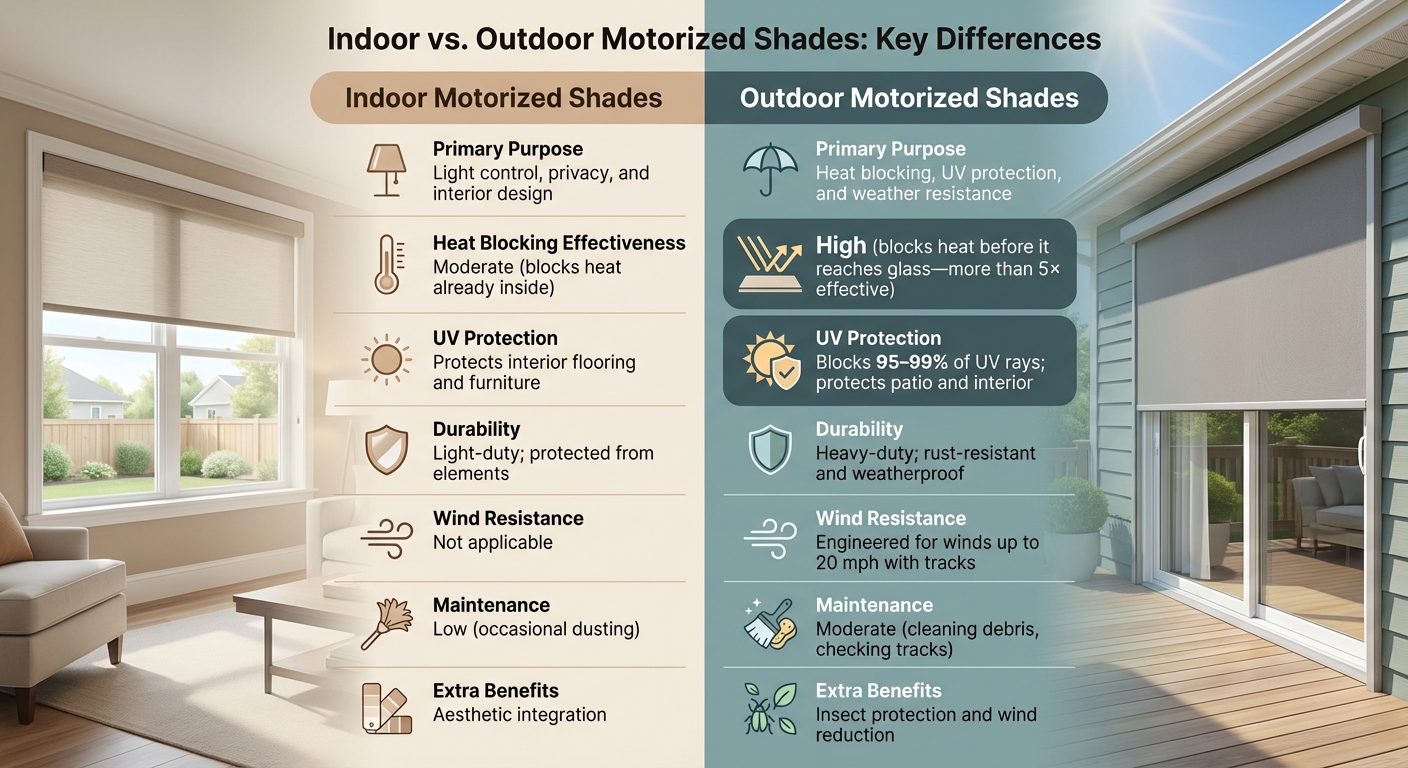
Indoor vs Outdoor Motorized Shades Comparison Chart
Performance Differences
Outdoor shades are designed to block solar heat before it even enters your home, making them far more effective at reducing heat compared to indoor shades. In fact, outdoor shades can block solar heat over five times more efficiently than indoor roller shades [1].
While indoor shades primarily focus on light control, privacy, and enhancing interior décor, outdoor shades take on a more protective role. They shield outdoor furniture from fading, reduce wind on patios, and, when paired with zipper track systems, even keep insects at bay. Many high-end outdoor systems also feature automatic sensors that respond to harsh weather conditions like high winds or heavy rain, retracting the shades to prevent damage [4][2].
This key difference highlights how outdoor shades not only safeguard your home’s interior but also improve comfort in outdoor spaces.
Durability and Maintenance
Outdoor shades are specifically built to withstand challenging weather conditions, such as New Jersey’s humid summers, damp springs, and occasional high winds. They are constructed with powder-coated aluminum frames and weather-resistant fabrics that resist UV rays, mold, and mildew [7][5]. Indoor shades, on the other hand, are made from lighter materials since they are protected from outdoor elements.
Maintaining indoor shades typically involves simple dusting, while outdoor shades require periodic cleaning to remove debris. Even though outdoor shades are designed to handle wind, it’s best to retract them during strong gusts or when you’ll be away for extended periods [3].
These design considerations ensure each type of shade is tailored to its specific environment.
Indoor vs. Outdoor Shades Comparison
Here’s a quick overview of how indoor and outdoor motorized shades differ:
| Feature | Indoor Motorized Shades | Outdoor Motorized Shades |
|---|---|---|
| Primary Purpose | Light control, privacy, and interior design | Heat blocking, UV protection, and weather resistance |
| Heat Blocking | Moderate (blocks heat already inside) | High (blocks heat before it reaches glass – more than 5× effective) [1] |
| UV Protection | Protects interior flooring and furniture | Blocks 95–99% of UV rays; protects patio and interior [1] |
| Durability | Light-duty; protected from elements | Heavy-duty; rust-resistant and weatherproof [7] |
| Wind Resistance | Not applicable | Engineered for winds up to 20 mph with tracks [3] |
| Maintenance | Low (occasional dusting) | Moderate (cleaning debris, checking tracks) [5] |
| Extra Benefits | Aesthetic integration | Insect protection and wind reduction |
Benefits of Outdoor Motorized Shades for Northern New Jersey Homeowners
Better Outdoor Living Spaces
Outdoor motorized shades can turn patios, decks, and pergolas into spaces you can enjoy all year, even during the muggy summers in New Jersey. They offer protection from the sun, light rain, and wind, making outdoor areas more comfortable for relaxing or hosting guests. Plus, they help preserve outdoor furniture by reducing UV damage [1] [2] [8].
The convenience of smart automation is a huge bonus. Shades equipped with sun and wind sensors can adjust automatically – retracting during strong winds or lowering when the sun is blazing [4] [8]. These features not only improve functionality but also contribute to savings and added security, as explained below.
Lower Energy Costs
Beyond enhancing outdoor spaces, motorized shades can also help trim energy bills. By blocking solar heat before it even reaches your windows, these shades are over five times more effective than traditional indoor treatments at reducing heat gain [1]. During summer, direct sunlight can raise indoor temperatures by 10°F or more, putting extra strain on air conditioning systems [10]. Outdoor shades reduce this heat gain, leading to lower cooling costs.
In the winter, the shades can work in reverse – letting in sunlight during the day to naturally warm your home and closing at night to keep the heat inside, minimizing energy loss [10].
More Privacy and Security
Privacy gets a boost with outdoor shades, as they limit visibility into your home. You can even customize the level of privacy by selecting fabrics with different opacities – like 1% for maximum coverage or 5% for a balance between privacy and maintaining your view [1] [3].
Motorized shades also add a layer of security. Automated scheduling can make it look like someone is home, even when you’re not [6] [10]. For instance, a single "Goodnight" command can close all shades and lock doors at once [10]. The cordless design eliminates potential hazards for kids and pets, while also keeping valuables – both indoors and out – out of sight, discouraging potential intruders [2] [6].
When integrated with smart home systems, these shades offer even greater convenience, allowing you to control them effortlessly while enhancing safety and efficiency.
Connecting Outdoor Shades to Smart Home Systems
Control Options for Outdoor Shades
Motorized outdoor shades can be integrated into your home network using a smart hub, Wi-Fi bridge, or wireless protocols like Matter, Zigbee, and Z-Wave [6][11][12]. Once connected, you gain control through various methods, including smartphone apps, handheld remotes, wall-mounted switches, or even voice commands [6][9][11].
Automation takes convenience a step further with sensor-based systems. Sun sensors can detect light intensity and lower the shades during peak sunlight hours, while wind sensors retract them when wind speeds exceed safe limits – typically around 20 mph. This helps protect both the shade’s fabric and its motor [3][11]. These adjustments happen in real time, ensuring optimal performance and durability.
For expansive outdoor areas, zoned control offers flexibility by dividing the space into distinct sections. For example, west-facing shades can lower in the afternoon to block the setting sun, while south-facing ones stay open. This tailored approach adapts to the sun’s movement throughout the day, making your outdoor spaces more comfortable [11].
Smart Home Automation Benefits
Outdoor shades can integrate seamlessly with smart home platforms such as Crestron Home, Control4, Lutron, or Samsung SmartThings. These systems allow your shades to work in harmony with other devices like lighting, climate controls, and security systems [9][10][11]. For instance, you can create a "Movie Night" scene that lowers patio shades, dims outdoor lights, and activates speakers – all with a single command [10]. This level of integration enhances outdoor living by adding convenience, energy efficiency, and security.
Voice control is another standout feature, enabling hands-free operation – perfect for activities like grilling or hosting guests [6][11]. Additionally, you can program schedules, such as an "Away Mode", to raise and lower the shades at specific times. This not only mimics your daily routine but also adds a layer of security while you’re away [10].
Professional Installation for Outdoor Shades
Custom Solutions for Northern NJ Homes
Outdoor shades face a variety of challenges, including wind, rain, fluctuating temperatures, and tricky mounting conditions. In Northern New Jersey, professional installers assess specific factors like wind patterns, sunlight exposure, and the architectural details of your home to create a shade system that performs well throughout the year.
Accurate measurements are crucial, especially for zipper track systems, which require precision within a quarter-inch. Even slight miscalculations can lead to fabric jams or compromised performance [13][14]. Professionals also tackle complex installations, such as oversized openings up to 45 feet wide or hard-to-reach areas [7][14].
To ensure stability, installers customize systems to handle local conditions. For example, cable guides work well in moderate winds, while zipper tracks are ideal for high-wind areas, offering wind resistance up to Level 8, which equates to 39–46 mph [14]. Proper anchoring is critical, with hardware secured to solid structures like wood framing, concrete, or brick, avoiding weaker surfaces that could fail under stress [14]. This attention to detail not only guarantees a perfect fit but also enhances the system’s durability and functionality over time.
Long-Term Reliability and Value
Professional installation ensures your outdoor shades deliver reliable performance year after year. With high-quality materials and precise integration, the system functions as intended. For instance, National Blinds Installation (NBI) Inc. has completed over 263,000 installations for more than 37,000 customers over a 21-year period ending in 2026. Their technicians, averaging 24 years of experience, specialize in the intricacies of motorized outdoor systems [14].
This expertise protects your investment, especially when integrating shades with smart home platforms like Crestron, Control4, or Lutron [6][9]. Installers manage firmware updates, motor limit calibrations, and programming to ensure that multiple shades operate in sync over time. For most homes, motorized outdoor shades with side tracks cost between $2,000 and $6,000 per opening [7]. This price includes not just the hardware but also the engineering, support, and precision installation that extend the system’s lifespan and uphold manufacturer warranties [5][14].
Conclusion
Outdoor motorized shades can turn patios, pergolas, and decks into comfortable spaces you can enjoy all year. By blocking solar heat at its source, they are over five times more effective than indoor treatments [1]. For homeowners in Northern New Jersey, this means lower energy costs, less glare, and better protection from wind and rain.
Adding smart home features takes these shades to another level. With voice controls, automated schedules, and weather sensors, your shades can adapt to changing conditions effortlessly.
With installation costs ranging from $2,000 to $6,000 per opening, professional installation is key. It ensures accurate measurements, secure mounting to withstand local winds, and seamless smart home integration – safeguarding your investment for the long run [7].
Professional-grade outdoor shades are a practical way to extend your outdoor living season while improving energy efficiency. They’re a durable, integrated solution that blends perfectly into your home.
What One Sound Choice clients say
The 1 Sound Choice staff was very easy to work with. Ryan, you understood our wants right from the beginning. Simplicity of installation and operation were just some of the reasons we chose 1 Sound Choice. You exceeded my expectations!
– Mr. & Mrs. Matia (1 Sound Choice client testimonials)
(We received) friendly, highly competent, quick and clean installation by 1 Sound Choice. The team followed up a few weeks after completion to ask if we were satisfied with our Media Room and Home Audio System. 1 Sound Choice is truly “top shelf” – they surpassed our expectations every step of the way.
– Mr. & Mrs. Blake (1 Sound Choice client testimonials)
I have hired 1 Sound Choice on several occasions over the past 10 years for several projects (from minor implementations to a whole house system). Ryan and the team at 1 Sound Choice are consummate professionals – extremely knowledgeable and up to date with technology, focused on delivering the best solution to fit your need, and highly customer service oriented. This combination plus the quality of finished product (every time) have made me a loyal customer… I highly recommend 1 Sound Choice.
– Terry Maytin (Houzz review)
FAQs
Do outdoor shades block your view?
Outdoor shades can limit your view to some extent, depending on their opacity and the openness of the mesh. Despite this, they are crafted to minimize sun exposure while still letting you enjoy the scenery, striking a balance between protection and visibility.
What wind speed can outdoor shades handle?
Outdoor shades are built to endure winds up to 50 mph, while certain systems can handle speeds as high as 95 mph. For even harsher conditions, high-performance models are designed to withstand winds reaching 130 mph. The overall durability varies by system and model, offering dependable performance even in tough weather scenarios.
Do outdoor shades need a hardwired power source?
Outdoor shades come with various power options, including batteries, solar power, or a hardwired electrical connection. The best choice depends on your specific setup and how you plan to install them. Additionally, many systems feature wireless controls and automated functions, making operation more convenient.
Related Blog Posts
- Motorized Shades vs Manual Blinds: Cost and Convenience
- Cordless vs. Motorized Shades: Safety for Kids and Pets
- Outdoor Entertainment Setup: 8 Ideas for Your Backyard
- How to Automate Shades for Maximum Energy Savings
Glare inside, too? See our motorized shades page.
More questions
How are outdoor shades different from indoor shades?
Outdoor shades go on the outside of the house. They stop heat before it reaches the window and are made to handle rain, wind, and sun.
One Sound Choice, 8 Tilley Ave, Pompton Plains, NJ 07444. Call or text (973) 945-5275. We work in homes across Morris, Passaic, Bergen, Essex, Somerset, and Hunterdon counties. Written by Ryan Herd, founder of One Sound Choice.